Does Medicare Insurance Cover Allergy Treatment?
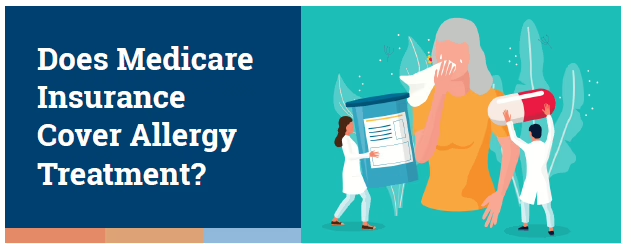
If you think you had an allergic reaction, you should seek a medical opinion to determine the
cause of the reaction. After these medical tests, you’ll likely begin treatment of some kind,
often over-the-counter medications. Should your reaction be severe enough, you may be
prescribed an allergy shot.
If you’re receiving both these services without coverage, they can be quite expensive, which
may push you to avoid having them done. This can leave you with questions and a lingering
risk that you may trigger another severe reaction again. The Medicare program can help cover
these costs, but coverage of allergy treatment and testing isn’t always straightforward.
Medicare Insurance Coverage of Allergy Testing
Luckily, finding out what you’re allergic to is generally covered by both Original Medicare and
Medicare Advantage plans. This is because it’s considered a diagnostic test since it’s diagnosing
your allergy. Under Original Medicare, it’s usually covered by Medicare Part B, though it may
be covered by Part A if you’re receiving it as part of inpatient care. Under Medicare Part B,
you’ll owe 20 percent of the Medicare insurance-approved amount, with the other 80 percent
covered by Original Medicare. If you have a Medicare Advantage plan, services are generally
covered the same as Original Medicare at a minimum, though some offer more coverage. This
varies from plan to plan.
There are specific situations where Medicare insurance may not cover your allergy test.
According to the Centers for Medicare & Medicaid Services (CMS) billing guidelines1, allergy
tests aren’t covered if they’re specific types of outdated tests (sublingual intracutaneous and
subcutaneous provocative and neutralization testing, challenge ingestion food testing, and
cytotoxic food tests). These tests generally have been found to be ineffective or unsafe. Most
commonly used allergen tests, like the common skin prick test, should be covered by your
Medicare insurance plan.
The Medicare Program & the Allergy Shot
Coverage becomes more complicated when it comes to the allergy shots. There is currently no
blanket coverage decision made by CMS about allergy shots, which are a type of immunotherapy.
Without this national coverage determination, local Medicare insurance contractors and doctors
can make their own calls on coverage. The reasoning for this local decision-making is because
allergies, their risks, and allergen immunotherapy are highly localized and personal to each
individual. In some cases, you may have an allergy, but it may not rise to the level where an allergy
shot is necessary. For this reason, a doctor will likely need to say the allergy shot is medically
necessary to receive coverage. It’s also worth noting that the alternative method of receiving
allergen immunotherapy treatment, sublingual immunotherapy (a pill taken under the tongue), is
not covered by Medicare insurance.
If you do receive Medicare insurance coverage, it’ll likely be under Medicare Part B, since the
shot is given in the doctor’s office. This means you’ll owe 20 percent of the Medicare insuranceapproved
amount. Without coverage, the shot may cost up to several thousand dollars each year,
so it’s good to have 80 percent of that handled by your plan. You may also owe a copayment for
the office visit.
Prescription Allergy Medications
Of course, not all treatment options will arise to the level of allergen immunotherapy. In some
cases, a prescription antihistamine may be enough for stronger, though not life-threatening,
cases of allergies. In these cases, Original Medicare, that is Parts A and B, won’t cover these
prescriptions. If you have Original Medicare, you can receive coverage through a Medicare Part
D plan, which can cover prescriptions. You can also use Medicare Part C (also called Medicare
Advantage), which sometimes includes prescription drug coverage as part of the plan. Of
course, this is just for prescription drugs. You may not have coverage for over-the-counter
antihistamines, but these are often affordable without coverage.
Allergies are a pain, literally. Even if you’re not having an allergic reaction, taking the necessary
steps to avoid a reaction can be stressful and interfere with your day-to-day life. It can get even
worse if you don’t have coverage for the diagnosis and treatment of your allergies. Make sure
that you’re getting the help for your allergies with a robust Medicare insurance plan — whether
that’s Original Medicare with a Part D plan, should you have any prescription allergy medications,
or a Medicare Advantage plan that has prescription drug coverage!
Read More: https://downloads.cms.gov/medicare-coverage-database/lcd_attachments/34597_20/
L34597_ALRG001_BCG.pdf
Not affiliated or endorsed by Medicare or any government agency.