Medicare Basics
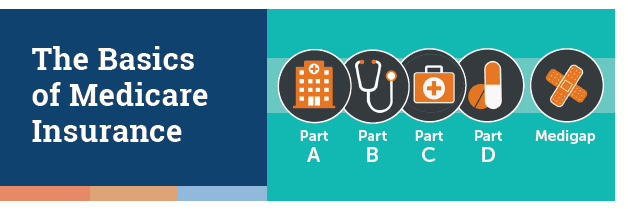
The ins and outs of Medicare insurance aren’t always easy to grasp. To understand what Medicare insurance is, we have a few basics to go over.
The Parts of Medicare Insurance
🧱 Part A
Part A is your hospital coverage that assists in paying for your medical stays, whether they be hospital visits, skilled nursing facility stays, or hospice care.
🩺 Part B
Part B covers your medical services such as doctor’s visits, ambulance rides or lab tests. Prescribed durable medical equipment like wheelchairs and sleep apnea machines is also covered.
📋 Part C
The alternative to Original Medicare is Part C, which is also known as Medicare Advantage. Offered by federally approved private insurers, Medicare Advantage combines Parts A and B into one plan with one card. Some plans may offer additional benefits.
💊 Part D
Medicare Part D is an optional plan that covers your prescription drugs. Much like Medicare Advantage, Part D is offered by federally approved private insurers. Your Part D plan defines covered drugs and the pharmacies where you can pick them up.
🛡 Medicare Supplements
Known commonly as Medigap plans, Medicare Supplements are sold by approved insurers and cover the copays and deductibles that Parts A and B do not. While you can combine a Medicare Supplement with Parts A and B, you cannot pair one with Medicare Advantage.
The Medicare Program Through History
The Medicare program has a long history of helping Americans afford their health care. Because of this, it’s one of the most beloved and trusted federal programs in American history.
Early Beginnings
While the bill that created the Medicare program was signed into law in 1965, the roots of the bill go much deeper. The insurance landscape for seniors before the creation of the Medicare program was a harsh one. Only about half of Americans over 65 had insurance. The others were unable to afford coverage or were considered uninsurable. President Teddy Roosevelt felt this was such a big deal that he added it to his 1912 election platform.
President Harry Truman took the first major steps towards a national medical insurance. In 1945, Truman called on Congress to create a national health insurance fund. The plan was to cover all Americans. While the bill died in Congress, he tried again in 1947 and 1949.
Later, the Eisenhower administration passed the Dependents’ Medical Care Act. This bill covered the family of servicemen and eventually gave the Medicare program its name. President John Kennedy reignited the call for national health insurance in 1961. The task force he organized suggested the creation of a program for Americans over 65.
The Medicare Program’s First Baby Steps
President Lyndon Johnson was the next to take up the call. In 1964, Johnson addressed Congress to create what would become the Medicare program. The Medicare and Medicaid Act, also called the Social Security Amendments of 1965, passed Congress in a landslide, creating the Medicare program and Medicaid. President Truman, who Johnson hailed as the “true daddy of Medicare,” became the first person covered by the Medicare program.
The next major expansion of the Medicare program was in 1972 under President Nixon. The first step in Medicare’s expansion opened Medicare insurance coverage to citizens with long-term disabilities and end-stage renal disease.
A Modern Medicare Program
In 1997, private insurance plans, known as Part C or Medicare Advantage, were introduced. President George W. Bush expanded Medicare insurance further by adding drug coverage through Medicare Part D in 2003.
In 2010, President Barack Obama’s signature Affordable Care Act expanded Medicare insurance coverage for Americans to specific preventative services. These services included mammograms, diabetes screenings, and flu shots.
Since the creation of the Medicare program, millions of Americans have gotten health care that they otherwise could not have. Today, more than 65 million Americans receive Medicare insurance benefits. With its history of helping millions every year, it’s no wonder that it remains the popular program it is.
Read more:
Medicare.gov. Parts of Medicare – https://www.medicare.gov/basics/get-started-with-medicare/medicare-basics/parts-of-medicare
Not affiliated or endorsed by Medicare or any government agency.