What is Original Medicare?
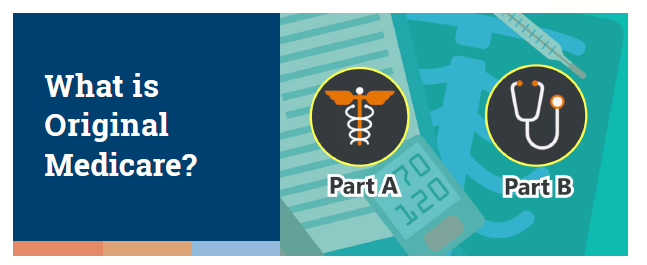
Medicare Parts A and B (Original Medicare) make up the two public health insurance options provided by the government since President Lyndon B. Johnson created the program in 1964. Original Medicare was considered so successful that it remained unchanged for decades.
Today, Parts A and B continue to cover many of the health costs for millions of Medicare program enrollees. How does Original Medicare succeed in this, and what do the parts cover?
Medicare Part A
Medicare Part A can be thought of as your hospital insurance. It helps to pay for your stay at a health care facility, whether that is a hospital, skilled nursing facility, or nursing home, among others.
At these inpatient facilities, Part A helps cover many of the services, including meals, a semi-private room, prescription drugs taken during your treatment, and mental health care. Private nursing or rooms are not covered unless determined to be medically necessary.
In some circumstances, Part A can assist with services like hospice or home health care. Contact your doctor to see if you fall into a qualifying category.
Most people are automatically enrolled in Medicare Part A when they turn 65 as long as they’re receiving Social Security benefits. They can also receive Part A premium-free in most circumstances if they paid Medicare taxes while working.
If you elect not to receive Social Security benefits, you won’t be automatically enrolled at age 65. Depending on when you were born, 65 may not be your full retirement age. Instead, you may need to wait to begin receiving full retirement benefits. If you’re not at your full retirement age, but want Original Medicare, you’ll have to apply for Medicare program benefits separately.
Medicare Part B
Medicare Part B helps cover medically necessary services, including doctor visits, ambulance services, and physical therapy. Part B covers many preventive and screening services, as well.
If you need any durable medical equipment, Part B can help you pay for it. Durable medical equipment includes items that your primary care physician prescribes to you to use at home, like wheelchairs, blood sugar monitors, or hospital beds. It must be:
- Able to withstand repeated use, lasting for at least three years;
- Used for medical reasons;
- Generally, not useful to someone who isn’t ill or injured;
- Used in your home.
Unlike Medicare Part A, all enrollees must pay a monthly premium for Part B. If you receive Social Security or similar benefits, these premiums come out of your benefit payment. In most cases, Medicare program enrollees will pay a standard premium.
Read more:
CMS.gov. Original Medicare (Part A and B) Eligibility and Enrollment. – https://www.cms.gov/medicare/enrollment-renewal/health-plans/original-part-a-b