
Medicare Coverage
Does Medicare Cover Hospital Beds? Who Qualifies in 2026
Does Medicare cover hospital beds at home? Learn Medicare’s four qualifying criteria, which bed types and accessories it pays for, the 13-month rental and your 2026 costs.
- Part B covers a home hospital bed when your condition meets one of four criteria, such as needing positioning an ordinary bed can’t provide.
- Semi-electric beds can be covered; total electric beds aren’t, because Medicare calls the height adjustment a convenience feature.
- Medicare rents the bed for 13 months: 10% of its purchase price monthly for months 1-3, then 7.5%, before ownership transfers to you.
- In 2026, you pay 20% of the approved rental after the $283 Part B deductible, if your supplier accepts assignment.
Table of Contents
Make sure your family is financially protected today!
Does Medicare cover hospital beds? Yes. Part B covers a hospital bed as durable medical equipment when your doctor orders it for use in your home and your condition meets Medicare’s criteria, such as needing positioning that an ordinary bed can’t provide. Medicare rents the bed for 13 months, and then it’s yours. In 2026, you pay 20% of the approved amount after the $283 Part B deductible.
When does Medicare cover hospital beds?
Medicare.gov says Part B “may cover hospital beds, if you’re eligible.” As with other durable medical equipment, Part B covers a medically necessary bed when your doctor or other health care provider orders it for use in your home, and you get it from a supplier enrolled in Medicare. So does Medicare cover hospital beds just because one would be more comfortable? No. Your medical condition has to meet the criteria below.
Where you live matters. A long-term care facility can count as your home for this rule, but a hospital or nursing home that’s giving you Medicare-covered care can’t. If you’re in hospice, Part A’s hospice benefit covers durable medical equipment for pain relief and symptom management, which our Medicare hospice guide explains.

Medicare qualifications for hospital bed coverage
The detailed rules come from the Hospital Beds and Accessories policy that Medicare’s equipment contractors use. A basic fixed-height hospital bed is covered if you meet at least one of these four criteria:
- You have a medical condition that requires positioning your body in ways that aren’t feasible with an ordinary bed.
- You need positioning that isn’t feasible with an ordinary bed to relieve pain.
- You need the head of the bed raised more than 30 degrees most of the time because of congestive heart failure, chronic lung disease or problems with aspiration.
- You need traction equipment that can only be attached to a hospital bed.
Raising your head and upper body less than 30 degrees doesn’t usually require a hospital bed, according to the policy. Those four criteria are the core Medicare qualifications for hospital bed coverage. Every other type of bed starts from them, as this table shows:
| Bed type | Covered when you meet a basic criterion and… |
|---|---|
| Fixed-height bed | Nothing more is needed |
| Variable-height bed | You need a different bed height to move to a chair, wheelchair or standing position |
| Semi-electric bed | You need frequent changes in body position, or an immediate change |
| Heavy duty extra wide bed | You weigh more than 350 pounds but not more than 600 pounds |
| Extra heavy duty bed | You weigh more than 600 pounds |
| Total electric bed | Not covered; Medicare calls the height adjustment a convenience feature |
Source: Hospital Beds and Accessories LCD L33820 (revision effective January 1, 2020), used by Medicare’s DME contractors. Checked November 6, 2026.
Semi-electric or full-electric: which does Medicare pay for?
Medicare can pay for a semi-electric bed if you meet a basic criterion and need frequent changes in body position or have an immediate need for one. Ask your doctor to note in your record why those changes are needed.
A total electric bed, which adds electric height adjustment, isn’t covered. The policy says “the height adjustment feature is a convenience feature,” and “Total electric beds will be denied as not reasonable and necessary.” If you want one anyway, ask the supplier before delivery what you’d owe, and read any Advance Beneficiary Notice it gives you. If you choose to get the bed anyway, you’re agreeing to pay if Medicare doesn’t.

Does Medicare pay for hospital bed rails, trapezes and mattresses?
Often, yes, when your condition calls for them. The policy covers side rails or safety enclosures “when they are required by the beneficiary’s condition” and they’re part of, or an accessory to, a covered hospital bed.
A trapeze bar is covered if you need it to sit up because of a breathing condition, to change body position for other medical reasons, or to get in or out of bed. If your condition requires a replacement innerspring or foam rubber mattress, it’s covered for a hospital bed you own.
Does Medicare cover hospital beds and mattresses for pressure sores?
Yes, through separate support surface rules. A Group 1 surface, such as a pressure-reducing mattress or mattress overlay, is covered under the Group 1 policy if you’re completely immobile. It’s also covered if you have limited mobility or any stage pressure ulcer on your trunk or pelvis, plus at least one of these: impaired nutrition, bowel or bladder incontinence, altered sensory perception or poor circulation.
A Group 2 surface is for more serious wounds. Under the Group 2 policy in effect since May 1, 2021, you need one of these:
- Multiple stage 2 pressure ulcers on your trunk or pelvis that haven’t improved in the past month despite full treatment that included a Group 1 surface.
- Large or multiple stage 3 or 4 pressure ulcers on your trunk or pelvis.
- A flap or skin graft for a pressure ulcer on your trunk or pelvis within the past 60 days, if you used a Group 2 or 3 surface right before leaving a hospital or nursing facility in the past 30 days.
Group 2 coverage generally continues until the ulcer is healed, but after a flap or graft it’s generally limited to 60 days from surgery. Several of these items also need prior authorization. CMS’s Required Prior Authorization List has included powered air flotation beds, powered pressure-reducing air mattresses and certain advanced overlays and mattresses nationwide since 2019. Air-fluidized beds have needed it nationwide since October 28, 2026. Your supplier usually submits the request.
How much does Medicare pay for hospital beds in 2026?
Does Medicare pay for hospital beds in one lump sum? No. Medicare rents a hospital bed for 13 months of continuous use, and then the supplier must transfer ownership to you. Federal payment rules (42 CFR 414.229) set the bed’s monthly rental at 10% of Medicare’s purchase price in months 1 to 3 and 7.5% in each later month. You pay 20% of the approved rental after the Part B deductible, which CMS set at $283 for 2026. Make sure the supplier accepts assignment for all rental months.
Hypothetical example: Maria, 80, rents a semi-electric bed. Her supplier accepts assignment, and she has already met this year’s Part B deductible through doctor visits. Suppose Medicare’s purchase price for the bed is an illustrative $1,500; actual amounts vary by bed and area.
- For the first 3 months, Medicare approves $150 a month (10% of $1,500). Maria’s 20% share is $30 a month, or $90.
- For months 4 through 13, the approved rental drops to $112.50 a month (7.5%). Her share is $22.50 a month, or $225.
- All told, the 13 payments come to $450 + $1,125 = $1,575. Maria pays $90 + $225 = $315, Medicare pays $1,260, and the bed then belongs to her.
Had Maria not paid any of her 2026 deductible when the rental began, month 1’s $150 would go entirely toward it. In month 2, she’d pay the remaining $133 plus 20% of the other $17 ($3.40), or $136.40. The deductible applies again each calendar year. A Medigap plan that pays the full Part B coinsurance would cover her 20% share.
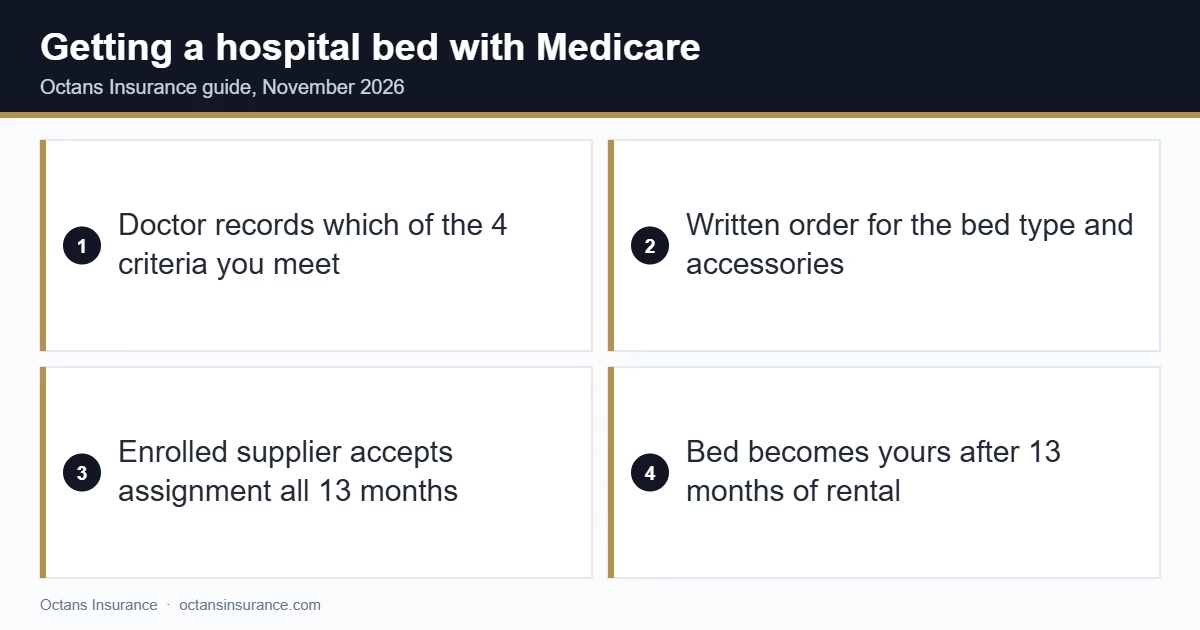
How to get a hospital bed through Medicare
If you think you meet the Medicare qualifications for hospital bed coverage, these steps help the claim go smoothly:
- Tell your doctor how you need to be positioned, how often you change position and whether you have pain, breathing problems or pressure sores.
- Ask the doctor to order the specific bed type and accessories, and to record which criteria you meet.
- Choose a Medicare-enrolled supplier that accepts assignment for all 13 rental months.
- If you need a pressure-reducing surface on CMS’s list, let the supplier get prior authorization before delivery.
- Keep your Medicare Summary Notices and track the rental months until ownership transfers.
Questions to ask the supplier before delivery:
- Is this a fixed-height, variable-height or semi-electric bed, and which criterion does my order meet?
- Are the rails, trapeze or mattress billed separately, and are any of them items Medicare won’t cover?
- Will you accept assignment for every rental month?
- Can you maintain and service the bed after I own it?
Does Medicare cover hospital beds: frequently asked questions
Does Medicare pay for hospital beds in hospice?
Yes. Medicare’s hospice benefit, under Part A, covers durable medical equipment for pain relief and symptom management, which can include a hospital bed. To qualify for hospice, a hospice doctor and your primary care doctor, if you have one, must certify that you’re terminally ill, with a life expectancy of 6 months or less. Original Medicare still pays for covered care for health problems that aren’t part of your terminal illness.
What happens after 13 months of renting a hospital bed?
The supplier must transfer ownership to you. At least two months before that date, federal rules say the supplier must tell you whether it can maintain and service the bed after you own it. Once you own the bed, Medicare pays 80% of the approved amount for repairs, up to the cost of replacing it, and you pay 20%.
Does Medicare pay for a hospital bed I need for only a few months?
It can. As long as you meet the criteria, Medicare pays the rental month to month, so you pay your 20% share only for the months you keep the bed. The supplier picks the bed up when you no longer need it, and repairs during the rental are the supplier’s responsibility.
Does Medicare cover hospital beds in a Medicare Advantage plan?
Yes, if you meet the criteria. Every Medicare Advantage plan must cover the same medically necessary equipment categories as Original Medicare. If you’re already renting a bed and join a new Medicare Advantage plan, Medicare’s DME booklet says to call the new plan as soon as possible to make sure it will keep covering it. Our Medicare Part C guide explains these plans.
What if Medicare denies my hospital bed?
First, ask your doctor whether your records show which of the four criteria you meet, since coverage depends on meeting at least one of them. Then you can appeal by following the instructions on your Medicare Summary Notice (MSN) and filing by the date in the MSN. Our guide to appealing a denied health insurance claim walks through the process.

How a licensed Octans agent can help
A 13-month bed rental means 13 coinsurance payments, plus any deductible, so your coverage choice shows up in real dollars. A licensed Octans agent can compare Original Medicare with a Medigap plan against the Medicare Advantage plans we offer in your area, including their supplier networks and approval rules. Call (617) 935-9220.
For free, personalized counseling from a program that isn’t connected to any insurance company, contact your State Health Insurance Assistance Program (SHIP) at shiphelp.org. You can also call 1-800-MEDICARE (1-800-633-4227; TTY 1-877-486-2048) with questions about a supplier or a claim.
Keep Reading: Related Guides
- What is Original Medicare?
- Medicare Supplement (Medigap) plans explained
- Medicare hospice benefit guide
- Medicare Durable Medical Equipment
- Does Medicare Cover Wheelchairs? Manual, Power and Scooters in 2026
- Does Medicare Cover Oxygen? Tests, Rentals and Costs in 2026
- Medicare and Home Health Care
We do not offer every plan available in your area. Please contact Medicare.gov or 1-800-MEDICARE to get information on all of your options.
This article is for general information and is not tax, legal, or medical advice.
About examples and tools: Hypothetical examples, sample rates, calculators and quizzes on this site are for general educational and illustrative purposes only. They are not quotes, offers of coverage, or guarantees of eligibility, approval, price or benefits, and they are not legal, tax, financial or medical advice. The insurance company decides eligibility and price; Medicare rules are set by CMS and the Social Security Administration. Octans Insurance is not connected with or endorsed by the U.S. government or the federal Medicare program.
Compare how plans handle hospital bed costs
Start with a free, no-obligation quote review with a licensed Octans agent.
(617) 935-9220 | life@octansinsurance.com