
Medicare Coverage
Does Medicare Cover Oral Surgery? When It Pays and What It Costs
Does Medicare cover oral surgery? Learn which extractions and jaw procedures Original Medicare pays for, what’s excluded, how Part A and Part B costs work in 2026 and where Medicare Advantage fits.
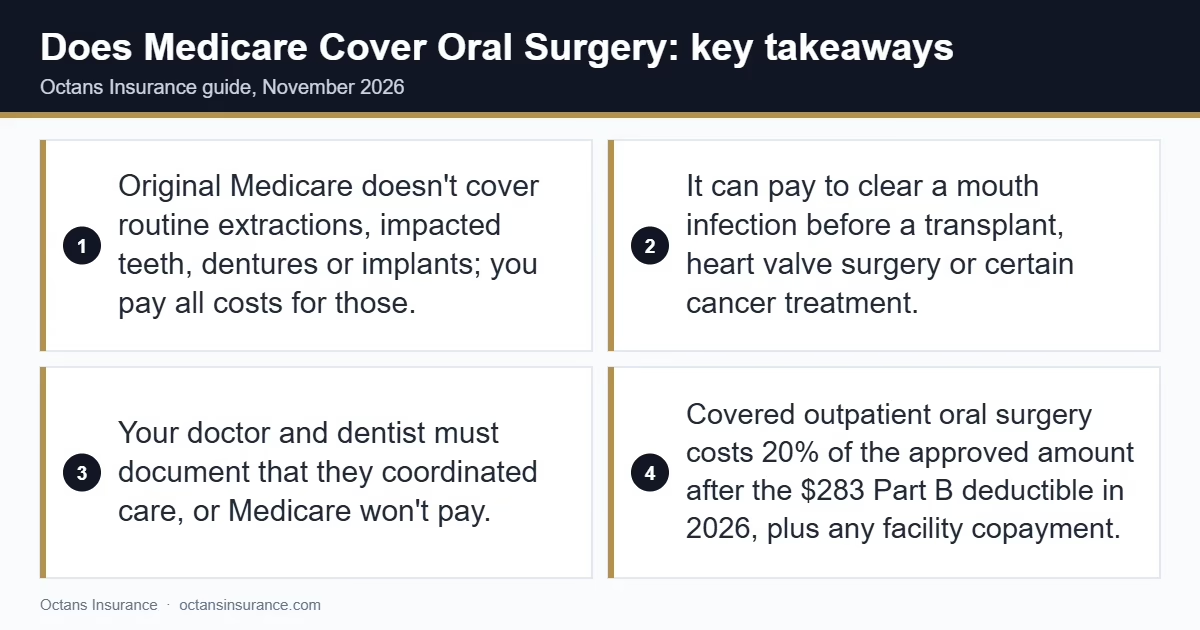
- Original Medicare doesn’t cover routine extractions, impacted teeth, dentures or implants; you pay all costs for those.
- It can pay to clear a mouth infection before a transplant, heart valve surgery or certain cancer treatment.
- Your doctor and dentist must document that they coordinated care, or Medicare won’t pay.
- Covered outpatient oral surgery costs 20% of the approved amount after the $283 Part B deductible in 2026, plus any facility copayment.
Table of Contents
Make sure your family is financially protected today!
Does Medicare cover oral surgery? Usually not. Original Medicare doesn’t pay for routine tooth extractions or surgery to prepare your mouth for dentures. It can pay when the oral surgery is tied to covered medical care, such as clearing an infection before a heart valve replacement, organ transplant or cancer treatment, treating a jaw fracture, or a hospital stay your health makes necessary.
Does Medicare cover oral surgery in most cases?
No. Federal law excludes items and services for the care, treatment, filling, removal or replacement of teeth, or the structures that directly support the teeth. CMS says those supporting structures include the gums, the periodontal membrane, cementum and the alveolar bone, which holds the tooth sockets.
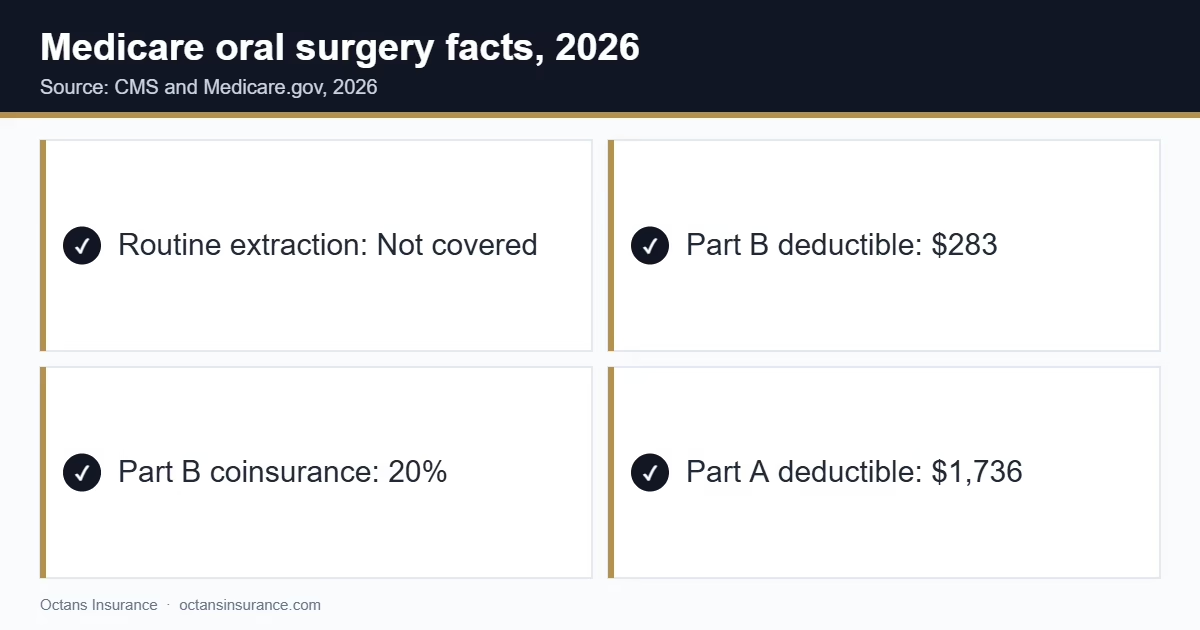
Medicare.gov puts it plainly: in most cases, Medicare doesn’t cover routine cleanings, fillings, tooth extractions, dentures or implants. You pay all costs for services Medicare doesn’t cover.
How hard the surgery is doesn’t change that. The Medicare Benefit Policy Manual, Chapter 16 says that when an excluded service is the main procedure, it isn’t covered regardless of its complexity or difficulty. Its own example is the extraction of an impacted tooth. For routine dental care, see our guide to whether Medicare covers dental.
When does Medicare pay for oral surgery?
Medicare pays for oral surgery when the dental work is “inextricably linked” to the success of another covered medical service. CMS says Part A and Part B can pay in those cases. The Medicare Benefit Policy Manual, Chapter 15 and the CMS dental page list examples, including:
- Before an organ transplant, heart valve replacement or valvuloplasty: a dental or oral exam as part of the workup, plus treatment to eliminate an oral or dental infection. Stem cell and bone marrow transplants count here too.
- Before some cancer treatment: the same exam and infection treatment before chemotherapy, CAR T-cell therapy or high-dose bone-modifying drugs used to treat cancer. See Medicare cancer treatment coverage.
- Head and neck cancer: exams and infection treatment before treatment, plus care for dental or oral complications afterward.
- Radiation: pulling teeth to prepare the jaw for radiation treatment of cancer.
- Tumor surgery: rebuilding a ridge done as a result of, and at the same time as, removing a tumor.
- Jaw fracture: stabilizing or immobilizing teeth when the fracture is set, and dental splints used to treat a covered condition such as a dislocated jaw joint.
- Kidney failure: dental or oral exams and infection treatment before or during covered dialysis for End-Stage Renal Disease (ESRD). Read more about Medicare and ESRD.
Medicare can also pay for related services, such as anesthesia, diagnostic X-rays and the operating room, when the dental service itself is covered.
Does Medicare cover tooth extraction before surgery or cancer care?
Sometimes. Does Medicare cover tooth extraction when you just have a bad tooth? No. But Medicare.gov gives the example of a procedure, like a tooth extraction, to treat a mouth infection before cancer treatment such as chemotherapy.
Coverage generally extends only to what’s needed to clear the infection. CMS’s manual says that if an infected tooth is found before a transplant or heart valve surgery, treatment could mean pulling the tooth. A dental implant or crown afterward may not be considered immediately necessary, so Medicare wouldn’t pay for it.
Your doctor and dentist must also work together. CMS says the medical and dental providers must coordinate care, such as through a referral or an exchange of information. Without documented coordination, Medicare won’t cover the dental services. Ask both offices to confirm they’ve talked before you schedule the extraction. Without that record, Medicare won’t cover tooth extraction even when the medical reason is real.
Does Medicare cover jaw surgery?
It depends on why you need it. Does Medicare cover jaw surgery after an injury? CMS lists services to stabilize or immobilize teeth when a jaw fracture is set as covered. Chapter 16 adds that an X-ray taken in connection with setting a fracture of the jaw or facial bone is covered, but a single X-ray taken for the care of teeth or gums is not.
Dental splints are covered only when they’re part of covered treatment for a covered medical condition, such as a dislocated jaw joint.
Jaw joint pain (TMJ) is harder, and Medicare doesn’t cover jaw surgery just because it’s labeled TMJ. The Benefit Policy Manual says many TMJ treatments fall under Medicare exclusions, and a TMJ diagnosis on a claim isn’t enough; the actual condition or symptom must be identified. Ask your surgeon to explain the diagnosis behind any jaw procedure.
What oral surgery Medicare doesn’t cover
Does Medicare pay for oral surgery to prepare for dentures? No. Both CMS and Chapter 16 list these as excluded when they’re done to prepare the mouth for dentures.
| Procedure | Original Medicare | Why |
|---|---|---|
| Routine tooth extraction | Not covered | Removal of teeth is excluded |
| Impacted tooth extraction (such as wisdom teeth) | Not covered | Excluded no matter how complex |
| Alveoplasty, frenectomy or ridge rebuilding to fit dentures | Not covered | Linked to an excluded service (dentures) |
| Removing a torus palatinus for dentures | Not covered | Linked to an excluded service |
| Extraction to clear infection before a transplant, heart valve surgery or cancer treatment | May be covered | Linked to a covered medical service |
| Extraction to prepare the jaw for radiation for cancer | May be covered | Listed CMS example |
| Ridge rebuilding during tumor removal | May be covered | Listed CMS example |
| Stabilizing teeth when a jaw fracture is set | May be covered | Listed CMS example |
Source: CMS, Medicare Dental Coverage, and Medicare Benefit Policy Manual, Chapters 15 and 16, as of November 2026. “May be covered” means the service must also meet Medicare’s medical necessity and care-coordination rules.
How much you pay if Medicare covers oral surgery in 2026
When Medicare does cover oral surgery, your cost depends on whether the care falls under Part A or Part B. Medicare.gov says Medicare may cover some dental services when you’re admitted as a hospital inpatient because of your medical condition or the severity of the procedure. A hospital stay doesn’t make an excluded procedure covered, though. Chapter 16 says being in the hospital or not has no direct bearing on whether a given dental procedure is covered.
Part A (inpatient): For each benefit period in 2026, Medicare.gov says you pay the $1,736 deductible, then $0 a day for days 1 to 60 and $434 a day for days 61 to 90. Part B generally covers 80% of the approved amount for doctors’ services while you’re in the hospital. Our Medicare Part A guide explains benefit periods.
Part B (outpatient): You pay 20% of the Medicare-approved amount after the 2026 Part B deductible of $283. If the surgery happens in a hospital outpatient department, Medicare.gov says you also usually pay the hospital a copayment for each service, which in most cases can’t be more than the Part A deductible for each service.
Hypothetical example: Luis needs several teeth pulled to prepare his jaw for radiation treatment of cancer, one of the cases CMS’s manuals list as covered. A Medicare-enrolled oral surgeon does the extractions in the office, so Part B pays. Luis has paid $100 toward his 2026 Part B deductible so far. Assume the Medicare-approved amount for the extractions is $650 (an assumed figure for illustration, not a real fee).
Luis owes the rest of his deductible first: $283 − $100 = $183. That leaves $650 − $183 = $467. He pays 20% of $467, which is $93.40. His share is $183 + $93.40 = $276.40, and Medicare pays $373.60. If he had already met his deductible, he’d pay 20% of $650, which is $130. If the work is done in a hospital outpatient department instead, a facility copayment may be added.
How to find out if Medicare will pay for your oral surgery
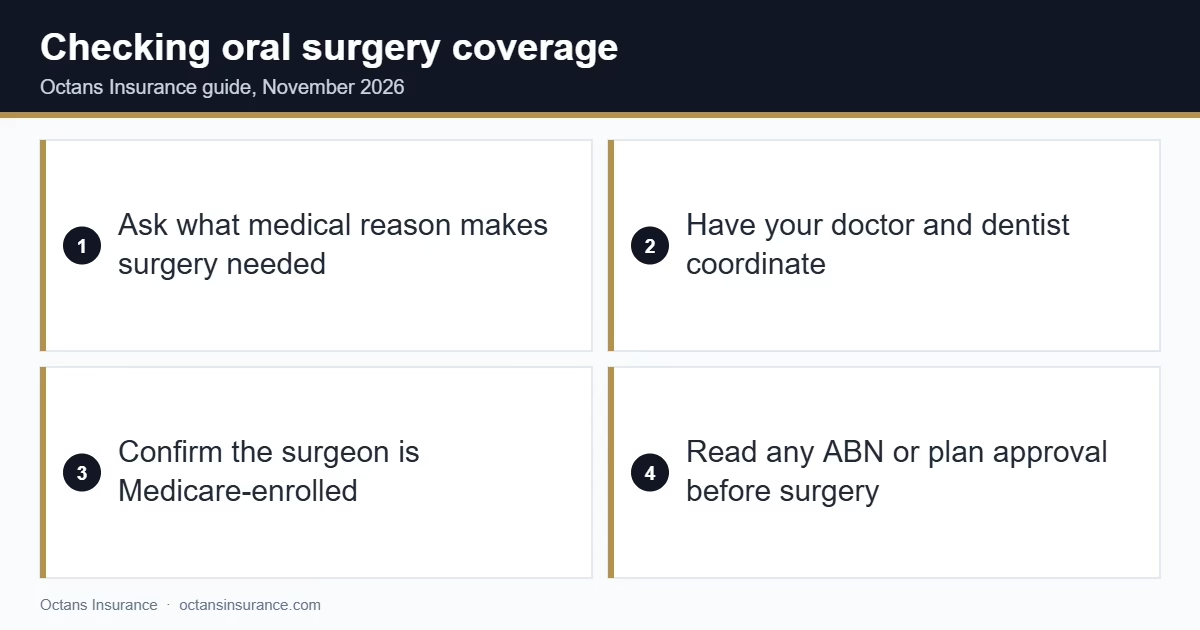
- Ask why the surgery is needed. Find out if it’s linked to a covered treatment, such as a transplant, heart valve surgery, cancer care, dialysis or a jaw fracture.
- Confirm your providers coordinate. Ask your doctor and oral surgeon to share information and note it in your records, as CMS requires.
- Check that the surgeon is Medicare-enrolled. CMS says a provider must be enrolled in Medicare to bill for covered dental services.
- Ask where it will be done. Inpatient, hospital outpatient and office settings have different costs.
- Read any notice before you sign. If your provider thinks Medicare won’t pay, they may give you an Advance Beneficiary Notice (ABN). Signing means you agree to pay if Medicare doesn’t.
- Check other coverage. Ask your Medicare Advantage plan, Medicaid or other insurance what it pays.
Does Medicare Advantage pay for oral surgery?
A Medicare Advantage plan must cover all medically necessary services Original Medicare covers, according to Understanding Medicare Advantage Plans. That includes the medically linked oral surgery above. You may need prior authorization, and if the plan doesn’t approve the request, you may have to pay the full cost.
Some plans offer extra dental benefits, such as checkups or cleanings, and some go further. These extras vary by plan and area, and Medicare & You notes they are generally limited. Check each plan’s dental details before you join. Our page on Medicare dental, vision and hearing explains the main options.
If you have both Medicare and Medicaid, CMS notes that some states may cover routine and other dental services. Contact your state Medicaid agency to find out what’s covered.
Questions to ask before oral surgery:
- What medical condition makes this surgery necessary?
- Have you and my doctor documented that you coordinated my care?
- Will this be billed to Medicare, and under Part A or Part B?
- Will I get an ABN for any part of the work?
- Does my plan need prior authorization, and is this surgeon in network?
- What will the anesthesia, X-rays and facility charge?
Does Medicare cover oral surgery: frequently asked questions
Does Medicare pay for oral surgery for wisdom teeth?
Usually not. CMS lists extraction of an impacted tooth as a non-covered dental service, and Medicare’s manual says an excluded procedure isn’t covered no matter how complex it is. A Medicare Advantage plan with extra dental benefits might pay part of the cost, depending on the plan. Check the plan’s dental details or call the plan before you schedule.
Does Medicare cover tooth extraction before chemotherapy?
It can. Medicare.gov gives the example of a procedure, like a tooth extraction, to treat a mouth infection before cancer treatment such as chemotherapy. Your oncologist and dentist must coordinate and document your care. Medicare generally pays only for what’s needed to clear the infection, so a later crown or implant may not be covered.
Does Medicare cover jaw surgery after an accident?
Medicare can pay for care tied to a broken jaw. CMS lists stabilizing or immobilizing teeth when a jaw fracture is set as a covered example, and an X-ray taken while setting a jaw or facial bone fracture is covered. Ask your surgeon which parts of the planned work involve the teeth and gums, since those may be excluded.
Does Medicare pay for anesthesia during oral surgery?
Only if the oral surgery itself is covered. CMS says Medicare can pay for related services like anesthesia, diagnostic X-rays and use of the operating room when they support a covered dental service. If the main procedure is excluded, such as a routine extraction, the anesthesia generally isn’t covered either.
Will Medicare pay for a hospital stay for dental surgery?
It may. Medicare.gov says Medicare may cover some dental services you get when you’re admitted as a hospital inpatient because of your underlying medical condition or the severity of the procedure. Being admitted doesn’t make an excluded procedure covered, so ask which charges Medicare will pay. In 2026, Part A inpatient costs start with a $1,736 deductible for each benefit period.
Does Medigap pay for oral surgery?
Medigap helps pay your share of Medicare-covered costs, like deductibles and coinsurance. So if Medicare covers your oral surgery, a Medigap plan can help with your share. If Medicare doesn’t cover the surgery, Medigap won’t pay for it either, because it only helps with costs for covered Medicare services. Learn more about Medicare Supplements.

How Octans can help with oral surgery costs
A licensed Octans agent can explain how Original Medicare, Medigap and Medicare Advantage handle medically linked oral surgery, and what you’d likely pay if Medicare covers oral surgery in your case, and how dental extras vary by plan and area. We compare plans from many carriers in the states we serve. We can’t tell you whether a specific procedure is medically necessary; that’s for your doctor and the plan.
For free, unbiased counseling, you can contact your State Health Insurance Assistance Program (SHIP). You can also call 1-800-MEDICARE (1-800-633-4227), TTY 1-877-486-2048.
To talk with an Octans agent, call (617) 935-9220.
Keep Reading: Related Guides
- Does Medicare cover dental?
- Medicare dental, vision and hearing
- Medicare cancer treatment coverage
- Does Medicare Cover Knee Replacement? Costs, Rehab and Rules
- Does Medicare Cover MRI Scans? What You’ll Pay in 2026
We do not offer every plan available in your area. Please contact Medicare.gov or 1-800-MEDICARE to get information on all of your options.
This article is for general information and is not tax, legal, or medical advice.
About examples and tools: Hypothetical examples, sample rates, calculators and quizzes on this site are for general educational and illustrative purposes only. They are not quotes, offers of coverage, or guarantees of eligibility, approval, price or benefits, and they are not legal, tax, financial or medical advice. The insurance company decides eligibility and price; Medicare rules are set by CMS and the Social Security Administration. Octans Insurance is not connected with or endorsed by the U.S. government or the federal Medicare program.
Compare plans with dental benefits
Start with a free, no-obligation quote review with a licensed Octans agent.
(617) 935-9220 | life@octansinsurance.com