
Final Expense Insurance Scams: 9 Red Flags to Spot
Final Expense Insurance Scams: The Short Answer
Most final expense insurance scams sell real-sounding coverage with fake urgency, fake government ties or pressure to drop a policy you own. The NAIC says government agencies won’t contact you to sell insurance. Stop, call your state insurance department, confirm the agent is licensed, never pay by gift card, and use your free-look period.
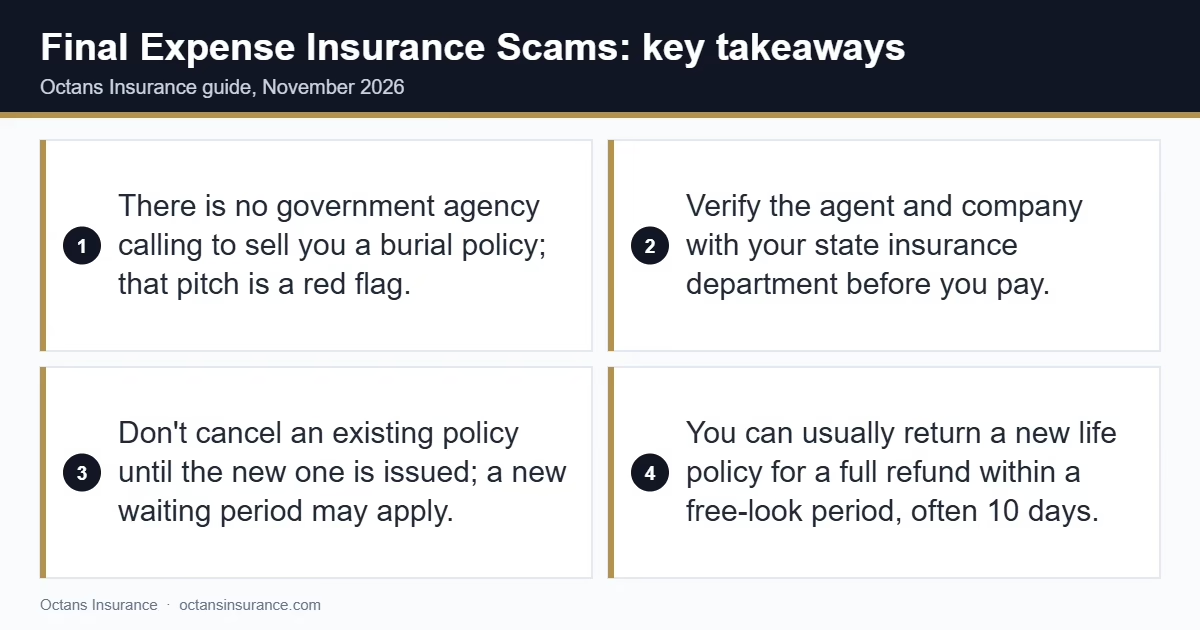
- There is no government agency calling to sell you a burial policy; that pitch is a red flag.
- Verify the agent and company with your state insurance department before you pay.
- Don’t cancel an existing policy until the new one is issued; a new waiting period may apply.
- You can usually return a new life policy for a full refund within a free-look period, often 10 days.
Table of Contents
Make sure your family is financially protected today!
Final expense insurance scams usually don’t involve fake policies. They involve fake urgency, fake government ties and pressure to drop coverage you already have. Real final expense insurance is a small whole life policy from a licensed insurer. Check the agent’s license with your state, never pay by gift card, and use your free-look period.
Is final expense insurance legit?
Yes. Final expense insurance is a type of small whole life policy that people often buy to cover a funeral and final bills. It is sold by licensed insurance companies and agents, and it is regulated by your state insurance department. Our final expense insurance guide explains how the product works and what it typically costs.
The problem is not the product. Final expense insurance scams are about how some people sell it. TV ads, mailers and calls for this coverage often aim at adults over 60. Many of those sellers are legitimate. Some use tactics that consumer regulators warn about. This guide shows you how to tell the difference before you sign or pay.
The “government final expense benefit” myth
The most common of all final expense insurance scams starts with a myth. A typical pitch says you qualify for a “government final expense program” or a “state-approved burial benefit.” These ads are selling private life insurance. The government is not calling you to sell it.
According to the National Association of Insurance Commissioners (NAIC), the federal government and state insurance departments will not contact individual consumers to sell them insurance. So a caller who claims to be from Medicare, Social Security or “the state” and then pitches a burial policy is a warning sign.
Online, the same trick shows up as lookalike ads. The Federal Trade Commission (FTC) warns that some businesses pay for ads styled like official government sites. Its advice: look for a small “Ad” or “Sponsored” label, and remember that when a site’s address ends in .gov, it’s from the U.S. government.
9 red flags of final expense insurance scams
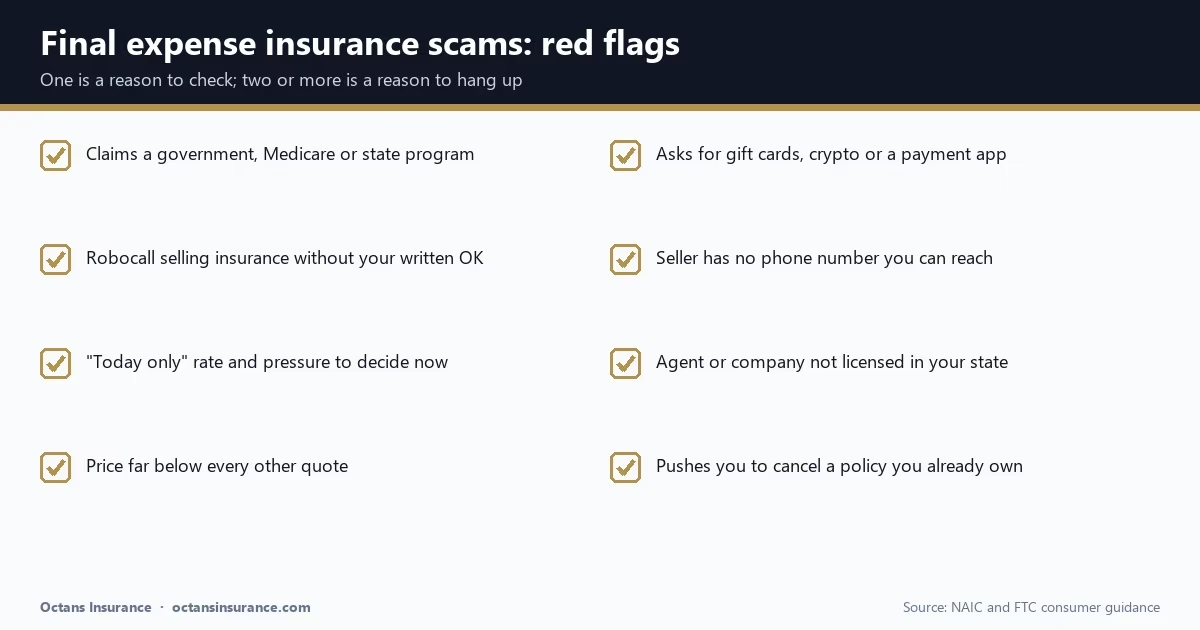
Any one of these is a reason to stop and check. Two or more together is a reason to hang up.
- A government connection. The caller or mailer suggests Medicare, Social Security or the state is offering the policy.
- A sales robocall. The FTC’s robocall guidance says a robocall trying to sell you something is illegal unless the company has your written permission.
- “Today only” pricing. The NAIC warns against anyone who pressures you to buy because a rate is only good for a short time.
- A price far below everyone else. The NAIC says scammers may offer policies at prices significantly lower than competitors’.
- Unusual payment demands. The FTC says scammers insist on payment by gift card, cryptocurrency or a payment app because that money is hard to trace.
- A seller you can’t reach. The NAIC notes that scammers may be hard to reach by phone, if there is a listed number at all.
- No license you can verify. The agent or company doesn’t show up when you check with your state.
- Pressure to cancel what you have. The pitch depends on dropping a policy you already own.
- No policy in the mail. The NAIC says if your policy or ID card doesn’t arrive in a timely manner, check that your premiums were applied.
Also be careful with “free quote” websites. The FTC warned in 2025 that sites offering insurance quotes may collect your information and sell it to telemarketers. Before you enter details, it suggests searching the site’s name with words like “complaint” or “scam.”
How to verify an agent’s license
Checking a license takes a few minutes and is the single best defense against final expense insurance scams. The NAIC’s fraud guidance sums it up in three words: Stop. Call. Confirm.
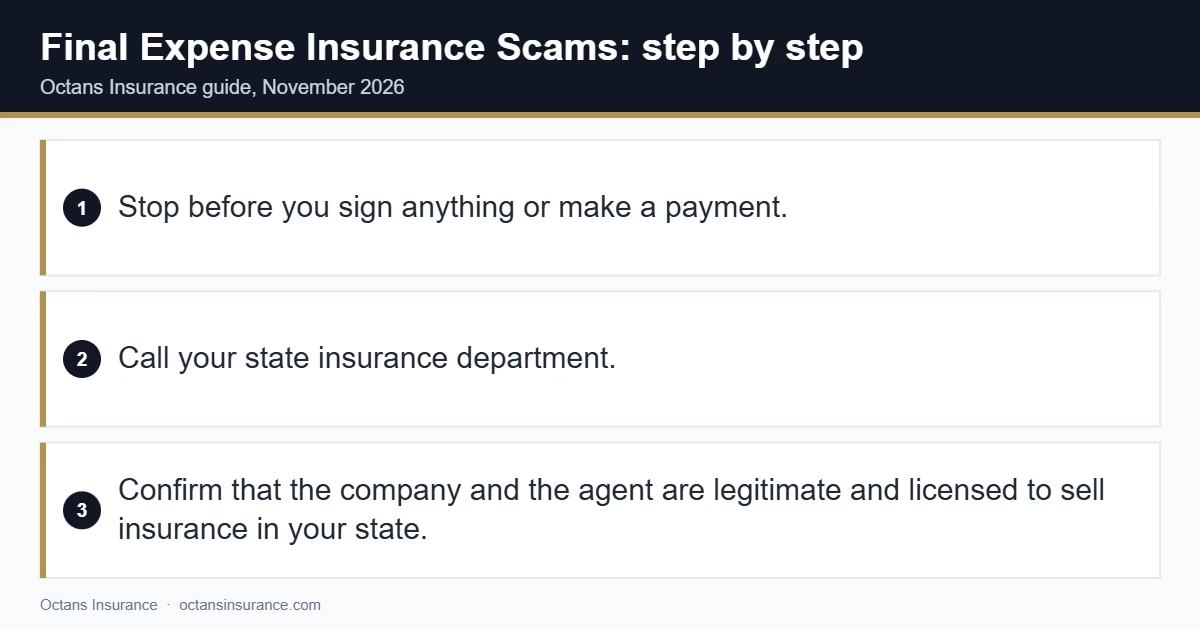
- Stop before you sign anything or make a payment.
- Call your state insurance department.
- Confirm that the company and the agent are legitimate and licensed to sell insurance in your state.
Ask the agent for their full name, their National Producer Number and the insurance company’s exact name. A licensed agent will share these without fuss. Some state insurance departments also have online lookup tools. Octans lists its agents’ National Producer Numbers on our licenses page for this reason.
The NAIC’s life insurance tips also say to check with your state insurance department that the company is authorized to do business in your state.
Replacement pitches: when switching policies costs you
Some final expense insurance scams target people who already own a policy. The pitch: “I can get you the same coverage for less.” Sometimes that is true. Often the trade-off is hidden.
The NAIC’s 2026 Life Insurance Buyer’s Guide says to compare your current policy with any new one, notes that changes in your health may affect your ability to get a new policy or its price, and says not to cancel your current policy until you get the new one. Another NAIC tip says it may be costly to replace insurance in the early years of a policy.
There is also the waiting period. Many guaranteed issue policies pay a limited benefit for natural-cause deaths in the first two years, as our guaranteed issue life insurance guide explains. A new policy can start that clock over.
For example, say (made-up numbers) you have paid $40 a month for 18 months. That is $40 × 18 = $720 already paid in. A caller offers a new policy for $35 a month. You would save $5 × 12 = $60 a year. But if the new policy has a fresh two-year waiting period, your family could get far less than the full benefit if you die of an illness during that time. Ask for both policies in writing before deciding.
Your free-look period and cancellation rights
If you already bought a policy and regret it, or think you fell for one of these final expense insurance scams, you may be able to undo it. According to the NAIC’s Life Insurance Buyer’s Guide, if you’re not satisfied with a new policy, you can return it for a full refund within a certain period, usually 10 days after you receive it. The review period is usually stated on the first page of the policy.
The exact length depends on your state and the policy. Check the first page as soon as the policy arrives. If you want to cancel, contact the insurance company directly in writing, keep a copy, and note the date you mailed it. If an agent pressured you, tell your state insurance department too.
Where to report final expense insurance scams
Reporting final expense insurance scams helps regulators spot patterns, even if you didn’t lose money. Use the place that fits what happened:
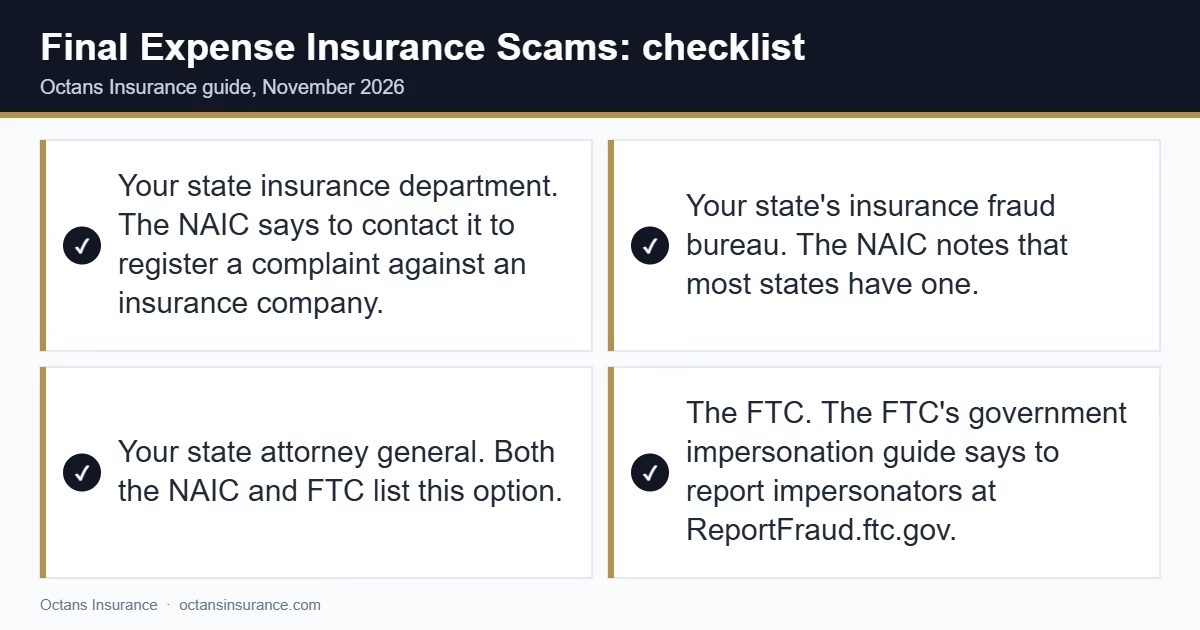
- Your state insurance department. The NAIC says to contact it to register a complaint against an insurance company.
- Your state’s insurance fraud bureau. The NAIC notes that most states have one.
- Your state attorney general. Both the NAIC and FTC list this option.
- The FTC. The FTC’s government impersonation guide says to report impersonators at ReportFraud.ftc.gov. Report illegal sales robocalls at DoNotCall.gov.
If you shared your Social Security or bank details, the FTC also points to IdentityTheft.gov. Spotting final expense insurance scams early protects the money you set aside for your family. When you’re ready to compare real options, our burial insurance vs life insurance guide and funeral cost calculator can help you size a policy.
Keep Reading: Related Guides
- Final expense insurance guide
- Guaranteed issue life insurance
- Burial insurance vs life insurance
- Octans agent licenses
- Funeral Home Price List
- Preneed vs Final Expense Insurance
Final Expense Insurance Scams: Frequently Asked Questions
Is there a government final expense program?
No government agency sells final expense insurance. Ads for a “government final expense program” or “state-approved burial benefit” are marketing private life insurance. According to the NAIC, the federal government and state insurance departments will not contact individual consumers to sell them insurance. Treat any caller who claims otherwise as a warning sign.
Is there a $25,000 burial benefit from the government?
No government agency is offering a $25,000 burial policy by phone, mail or TV ad. Pitches using that phrase are usually selling a private final expense policy, which you pay for with monthly premiums. A few limited government death and burial payments exist for certain people; our final expense insurance guide lists them. Check any offer with your state insurance department before you pay.
Is final expense insurance a scam?
No. Final expense insurance is a legitimate small whole life policy sold by licensed insurers and agents and regulated by your state. Scams come from how some sellers market it: fake government ties, robocalls, “today only” pricing, payment by gift card or pressure to replace a policy. Verify the agent’s license and read the policy before paying.
How can I check if an insurance agent is licensed?
Use the NAIC’s three steps: stop, call, confirm. Stop before you sign or pay, call your state insurance department, and confirm that the company and agent are legitimate and licensed in your state, as the NAIC’s fraud guidance advises. Ask the agent for their full name, producer number and the insurer’s exact name before the call.
What should I do if I bought a policy I don’t want?
Check your free-look period right away. According to the NAIC’s Life Insurance Buyer’s Guide, you can return a new policy for a full refund within a certain period, usually 10 days after you receive it, and the period is usually stated on the first page. Cancel in writing with the insurer and keep a copy.
This article is general information, not legal, tax, or medical advice. Premium examples are published samples, not quotes.
About examples and tools: Hypothetical examples, sample rates, calculators and quizzes on this site are for general educational and illustrative purposes only. They are not quotes, offers of coverage, or guarantees of eligibility, approval, price or benefits, and they are not legal, tax, financial or medical advice. The insurance company decides eligibility and price; Medicare rules are set by CMS and the Social Security Administration.