
Life insurance for parents
Life Insurance on Your Parents: Consent, Costs, and Options
You can buy life insurance on your parents if they agree and sign the application. Adult children often own the policy, pay the premiums, and serve as beneficiary. Here is how consent and insurable interest work, who should pay, and what final expense coverage costs at 65 to 85.
- In most states your parent must consent to the policy, usually by signing the application.
- Close family members generally have an insurable interest based on love and affection, so state law usually doesn’t require you to prove a financial loss.
- You can own the policy and pay premiums; if your parent owns it and you pay, ask a tax professional about gift rules.
- Published example rates show $10,000 of simplified issue coverage at $53 a month for a 70-year-old woman and $70 for a man.
Table of Contents
Make sure your family is financially protected today!
Yes, you can buy life insurance on your parents, as long as your parent knows about it, agrees, and signs the application. Adult children usually do this to cover a funeral, a small debt, or the costs they would carry after a parent dies. You can own the policy, pay the premiums, and be the beneficiary. This guide explains consent, insurable interest, who pays, and the final expense options most families compare.
Can you buy life insurance on your parents?
Yes. Children are allowed to insure a parent, but not secretly. State insurance laws generally set two rules: your parent must consent, and you must have an insurable interest in your parent’s life. Both rules exist so that a life policy is protection, not a bet on someone’s death.
In practice, the parent is the “insured,” and the adult child is often the “owner” and “beneficiary.” The owner controls the policy and receives the bills. The insured answers the health questions, because the price and approval depend on the parent’s age and health, not yours.
Consent and insurable interest
Your parent’s consent and signature
A carrier will not issue a policy on an adult who does not know about it, and state laws require consent. Massachusetts General Laws chapter 175, section 123 says a life policy may be issued only on an application signed or agreed to in writing by the person insured, with narrow exceptions for young children and family policies. New York Insurance Law section 3205(c) likewise requires the insured’s written consent, with exceptions such as spouses and group coverage.
Expect the carrier to confirm your parent’s consent directly, for example through a phone interview or an e-signature. If a parent has dementia and can’t consent, a valid power of attorney may matter; ask the carrier and an elder law attorney before applying.
What insurable interest means for adult children
Insurable interest means the policy owner would suffer a real loss if the insured died. For close family, the law usually presumes it. New York Insurance Law section 3205 defines insurable interest for people “closely related by blood or by law” as a substantial interest based on love and affection.
So a son or daughter normally has insurable interest in a parent without proving money is at stake. Carriers still ask why you want coverage and how much. Expect pushback if the amount you request is far larger than any plausible funeral cost, debt, or support you provide.
Who owns and pays for life insurance on your parents
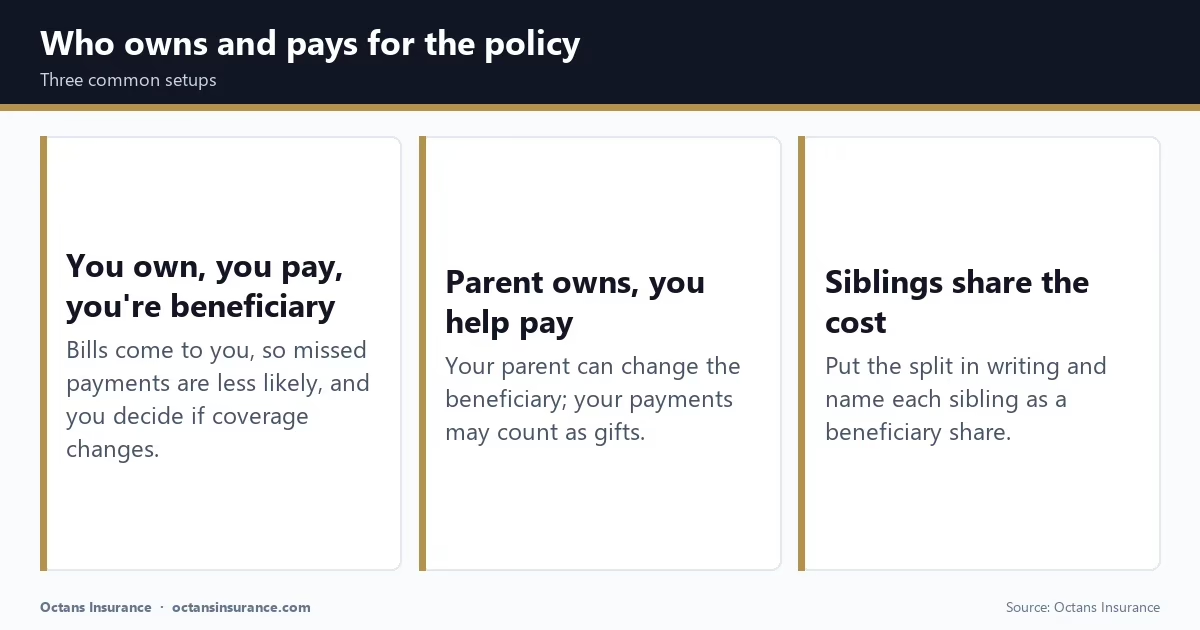
There are two common setups. In the first, you own the policy, pay the premiums, and name yourself (and maybe siblings) as beneficiaries. You control it, so the coverage stays in place as long as you pay. In the second, your parent owns the policy and you simply help with premiums.
| Setup | Who controls the policy | Points to weigh |
|---|---|---|
| You own, you pay, you are beneficiary | You | Bills come to you, so missed payments are less likely. You decide if coverage changes. |
| Parent owns, you help pay | Your parent | Your parent can change the beneficiary. Your payments may count as gifts. |
| Siblings share the cost | The named owner | Put the split in writing and name each sibling as a beneficiary share. |
The IRS says a gift is any transfer to an individual where you receive nothing of full value in return. For 2026, the annual gift tax exclusion is $19,000 per recipient (IRS gift tax FAQ). If your parent owns the policy and you pay, ask a tax professional how to treat it.
Policy types: term, final expense, and guaranteed issue
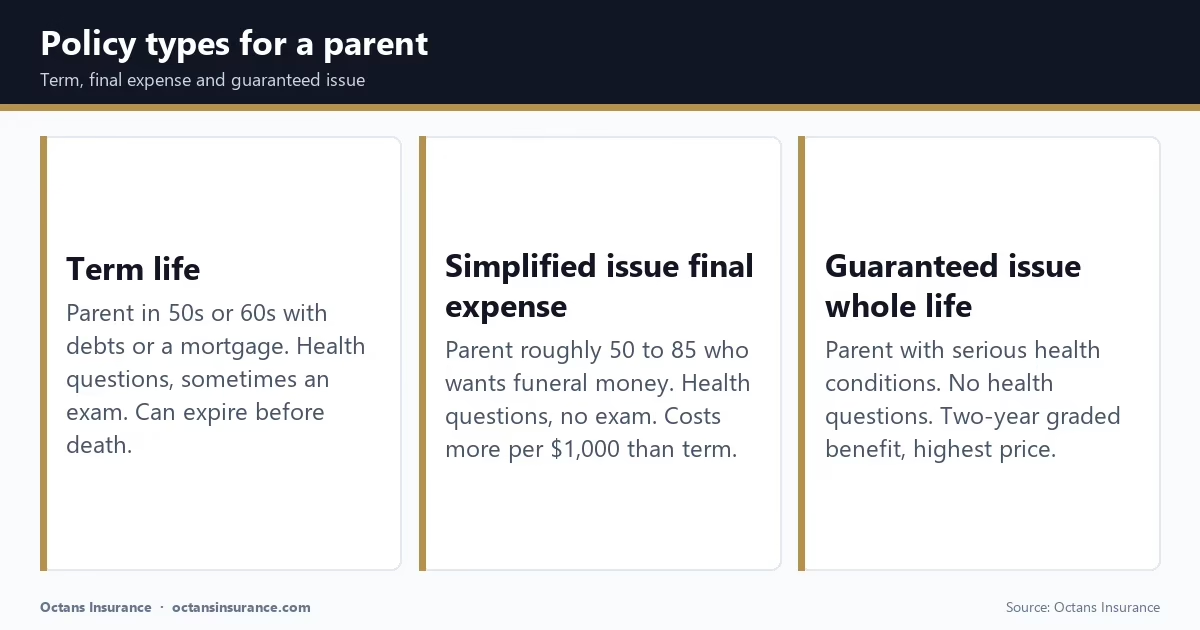
The right type depends mostly on your parent’s age and health. Term life covers a set number of years and is usually cheapest for parents in their 50s and 60s, but it can end before your parent dies. Whole life stays in force for life if premiums are paid.
Final expense insurance for parents is small whole life coverage, often $5,000 to $25,000, with health questions instead of an exam. Guaranteed issue whole life asks no health questions, but it costs more and pays a reduced benefit for natural-cause deaths in the first two years. Learn more on our final expense insurance, guaranteed issue life insurance, and term life insurance pages.
| Type | Typical fit | Health questions | Main trade-off |
|---|---|---|---|
| Term life | Parent in 50s or 60s with debts or a mortgage | Yes, sometimes an exam | Can expire before death |
| Simplified issue final expense (whole life) | Parent roughly 50 to 85 who wants funeral money | Yes, no exam | Higher cost per $1,000 than term |
| Guaranteed issue whole life | Parent with serious health conditions | No | Two-year graded benefit, highest price |
How much life insurance for elderly parents costs
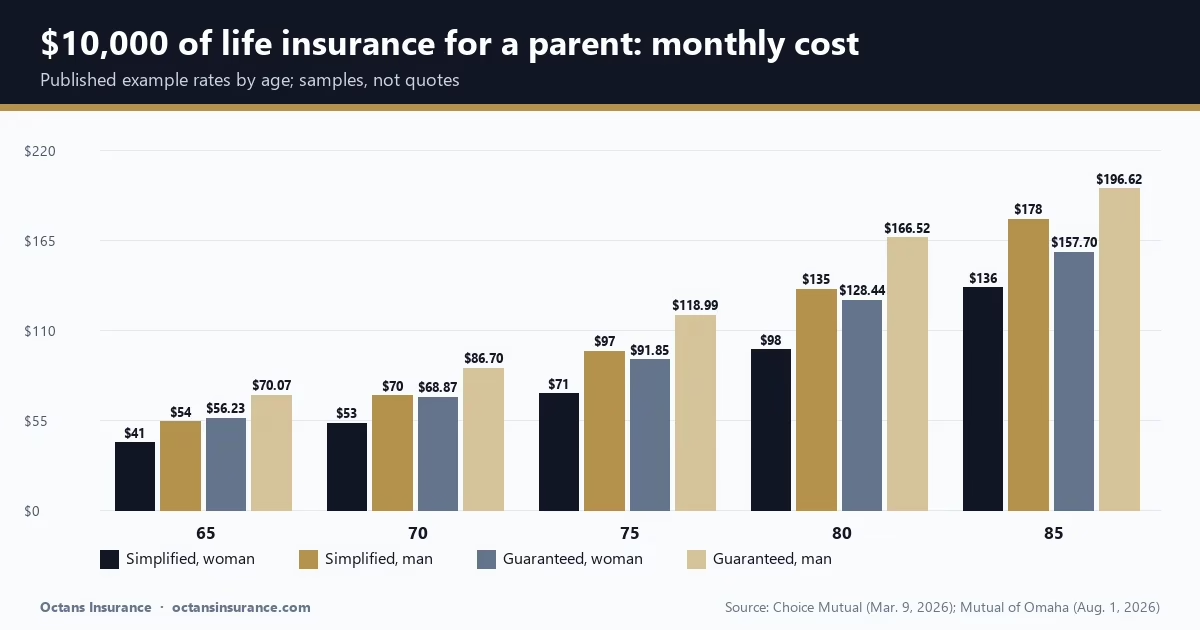
Life insurance for elderly parents is priced mainly by age, sex, tobacco use, and health. The table below shows published example rates, not quotes. Simplified issue figures are Choice Mutual non-tobacco rates valid March 9, 2026. Guaranteed issue figures are from Mutual of Omaha’s Guaranteed Whole Life rate chart effective August 1, 2026, which covers issue ages 45 to 85.
| Parent’s age | $10,000 simplified, woman | $10,000 simplified, man | $10,000 guaranteed issue, woman | $10,000 guaranteed issue, man |
|---|---|---|---|---|
| 65 | $41/mo | $54/mo | $56.23/mo | $70.07/mo |
| 70 | $53/mo | $70/mo | $68.87/mo | $86.70/mo |
| 75 | $71/mo | $97/mo | $91.85/mo | $118.99/mo |
| 80 | $98/mo | $135/mo | $128.44/mo | $166.52/mo |
| 85 | $136/mo | $178/mo | $157.70/mo | $196.62/mo |
Illustrative only. Carriers set final rates after reviewing your parent’s application, and prices vary by state. Waiting raises the price: the same $10,000 for a woman goes from $53 a month at 70 to $71 at 75 in these published rates.
How much coverage to buy
Start with the costs you would actually pay. The National Funeral Directors Association’s 2023 General Price List Study put the national median cost of a funeral with casket and burial at $8,300, and a funeral with cremation at $6,280 (NFDA). Those medians leave out cemetery plots, markers, and cash-advance items.
Then add any debt you would settle, travel for family, and a cushion for local prices. Our funeral cost calculator can help. Many families land between $10,000 and $25,000 of final expense insurance for parents. Life insurance on your parents that runs much higher usually needs a clear financial reason.
Hypothetical example: three siblings and a $10,000 policy
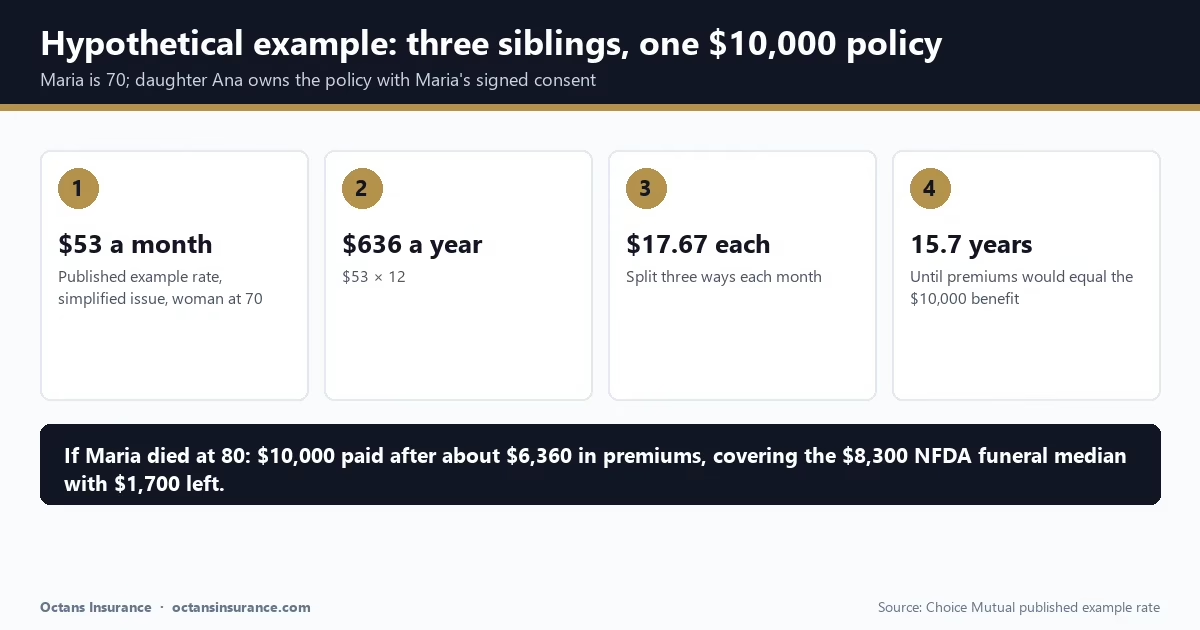
Hypothetical example. Maria is 70, does not use tobacco, and qualifies for simplified issue coverage. Her daughter Ana applies for $10,000 of whole life on her with Maria’s signed consent. Ana is the owner. Ana and her two brothers are equal beneficiaries.
Using the published example rate of $53 a month, the yearly cost is $53 × 12 = $636. Split three ways, each sibling pays about $17.67 a month ($53 ÷ 3). Over 10 years, total premiums are $636 × 10 = $6,360, still below the $10,000 benefit. Premiums would only equal the benefit after about 15.7 years ($10,000 ÷ $636), when Maria would be in her mid-80s.
If Maria died at 80, the policy would pay $10,000 after about $6,360 in premiums. That covers the $8,300 NFDA median for a funeral with burial, with $1,700 left ($10,000 − $8,300). The IRS says death benefits paid to a beneficiary generally aren’t taxable income; see is life insurance taxable.
Should you buy life insurance on your parents?
It suits families where a child would pay the funeral or a shared debt, where a parent has little savings, or where siblings want a fair way to split costs ahead of time. It also helps when you, not your parent, want control so the policy doesn’t lapse.
It may not be worth it if your parent already has savings or coverage that would pay final costs, or if the premiums would strain your own budget. A savings account set aside for the funeral is the main alternative; it costs nothing extra but offers no leverage if your parent dies early. If your parent gets Medicaid or MassHealth, cash value can count as an asset, so check MassHealth life insurance and burial rules or your state’s rules.
Checklist before you apply
- Talk with your parent first and confirm they agree to sign.
- Decide who owns the policy, who pays, and who the beneficiaries are.
- Gather your parent’s date of birth, medications, doctors, and recent diagnoses.
- Pick a coverage amount tied to real costs, such as funeral and debts.
- Compare simplified issue and guaranteed issue prices for the same amount.
- Check the agent’s license with your state insurance department.
- Set up automatic payments from the owner’s account.
- Read the policy during the free-look period and keep a copy where siblings can find it.
Answers on the application must be accurate. Massachusetts law, for example, lets an insurer contest a policy during its first two years in force, and gives a 30-day grace period for late premiums after the first year (M.G.L. c. 175, § 132). Rules vary by state.
Life insurance on your parents: FAQ
Can I buy life insurance on my parents, and how?
Yes, you can buy life insurance on your parents if they agree and sign the application. You need an insurable interest, which close family members normally have through love and affection under laws such as New York Insurance Law § 3205. An agent collects your parent’s health answers, often by phone, and you can be the owner, payer, and beneficiary. Massachusetts law (c. 175, § 123) requires the insured’s written signature or assent.
How does life insurance for parents work?
Your parent is the insured, and the price is based on their age and health. The owner, often you, pays premiums and controls the policy. When your parent dies, the beneficiary files a claim with a death certificate and receives the death benefit. The IRS says death benefits paid to a beneficiary generally aren’t taxable income, though any interest added is taxable. Most families use final expense whole life or term coverage.
How much does life insurance for my parents cost?
It depends on your parent’s age, sex, health, and tobacco use. As published example rates, Choice Mutual’s non-tobacco simplified issue rates (valid March 9, 2026) show $10,000 of coverage at $53 a month for a 70-year-old woman and $70 for a man, rising to $71 and $97 at age 75. Guaranteed issue coverage costs more. These are illustrations, not quotes; carriers set the final price.
Can I pay the premiums on my parents’ life insurance?
Yes. The simplest setup is for you to own the policy and pay the premiums, so the bills come to you and the coverage stays in your control. If your parent owns the policy and you pay, your payments may count as gifts; the IRS annual gift tax exclusion is $19,000 per recipient for 2026. Ask a tax professional about your situation. Your parent must still consent to the policy.
Can I buy life insurance for parents who live in another country?
Usually not through a standard U.S. final expense or term policy. U.S. carriers set their own rules for people who live abroad. Published foreign-national guidelines, such as Zurich’s, require strong U.S. ties and an application and exam completed in the United States. Most families instead look at an insurer licensed in the parent’s own country. A parent who lives in the U.S. can usually apply the normal way, with the parent’s consent and signature.
Should I buy life insurance for my parents?
It can make sense if you would pay your parent’s funeral or debts, your parent has little savings, or siblings want to share the cost ahead of time. It may not be worth it if your parent already has savings or coverage, or if premiums strain your budget. The key trade-off is premiums paid now versus a known payout later. The NFDA put the 2023 median cost of a funeral with casket and burial at $8,300.
How Octans helps you insure a parent
Octans Insurance is an independent agency in Topsfield, Massachusetts. Our licensed agents compare 120+ carriers across 19 states and can quote life insurance on your parents in one call, with your parent on the line to give consent and answer health questions. We will show you simplified issue and guaranteed issue options side by side so you can choose. See our agents’ licenses, read more about life insurance over 70 and burial insurance, or start with life insurance quotes. Call (617) 935-9220.
Rates shown are published example rates for illustration, not offers of coverage. Carriers decide eligibility and price, and availability varies by state. This page is general information, not legal or tax advice.
Important: Octans Insurance agents are licensed in the states in which they operate. Coverage availability and rates may vary by state. Premium examples, when provided, are illustrative samples from published sources, not quotes. Final rates are determined by the insurance carrier based on underwriting and applicable policy criteria. Policy terms, exclusions, limitations, riders, and availability vary by carrier and state.
About examples and tools: Hypothetical examples, sample rates, calculators and quizzes on this site are for general educational and illustrative purposes only. They are not quotes, offers of coverage, or guarantees of eligibility, approval, price or benefits, and they are not legal, tax, financial or medical advice. The insurance company decides eligibility and price; Medicare rules are set by CMS and the Social Security Administration.
Compare Coverage for Your Parents
Start with a free, no-obligation quote review with a licensed Octans agent.
(617) 935-9220 | life@octansinsurance.com