
Life Insurance
Simplified Issue Life Insurance: No Exam, Just Health Questions
Simplified issue life insurance swaps the medical exam for a short health questionnaire and record checks. See what insurers ask, the coverage they publish, and how to apply without risking a denied claim.
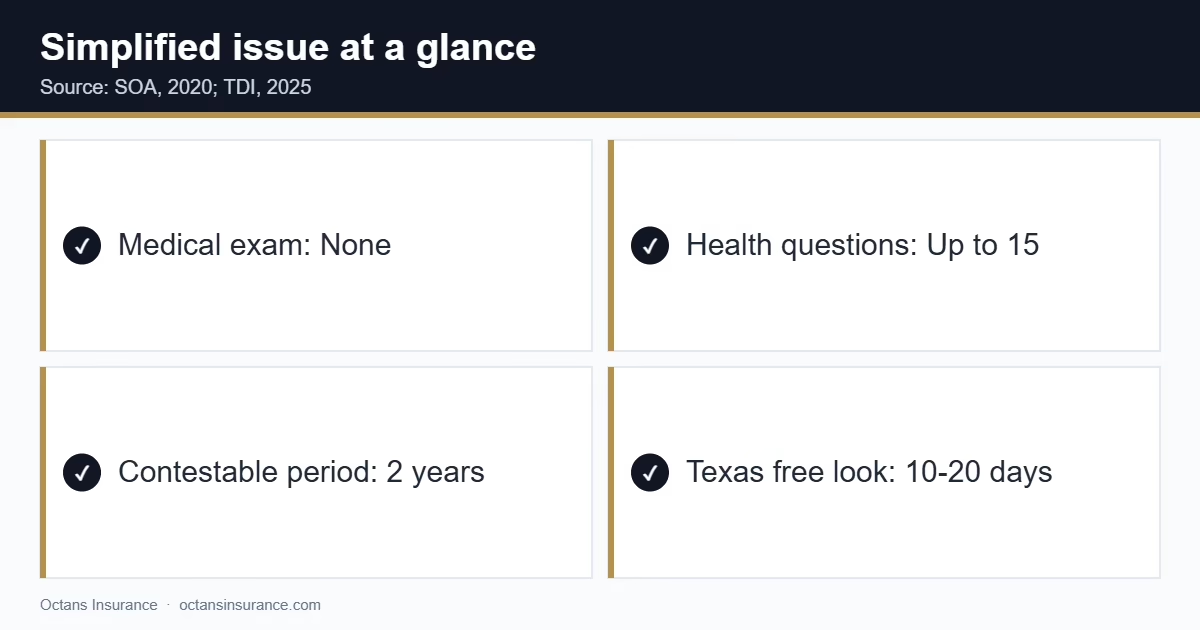
- Simplified issue underwriting needs no physical exam or fluid samples, just a limited set of health questions, perhaps up to 15 (Society of Actuaries, 2020).
- Insurers check MIB, prescription and motor vehicle records, and a filled prescription is reported as taken even if never used (SOA).
- In Texas, life policies have a two-year contestable period; if a claim is denied, premiums go back to the beneficiary (TDI).
- Published November 2026 examples: AARP permanent life from New York Life, up to $100,000, ages 50 to 80; Fidelity Life final expense, $5,000 to $50,000.
Table of Contents
Make sure your family is financially protected today!
Simplified issue life insurance is coverage you apply for by answering health questions instead of taking a medical exam or giving blood and urine samples. The insurer also checks records such as your prescription history, then usually decides quickly. It sits between guaranteed issue, which asks no health questions, and fully underwritten coverage. Approval isn’t guaranteed, and it costs more per dollar of coverage than fully underwritten insurance.
What is simplified issue life insurance?
No single legal definition applies to every insurer. A 2020 Society of Actuaries (SOA) research report says the industry uses the term for either a type of product or an underwriting method with less than full underwriting. In practice, simplified issue life insurance has three parts:
- No exam. The SOA report says simplified issue underwriting doesn’t require a physical exam or fluid samples.
- A short questionnaire. The report describes a limited number of health questions, perhaps up to 15.
- Electronic record checks. Insurers compare your answers with third-party data gathered electronically. That allows a quick decision, with few, if any, rate classes.
Each company writes its own rules. The SOA’s simplified issue definition page says program requirements vary widely between companies, so the same health history can get different answers.
Advertising rules make the same point. Under the NAIC’s model regulation on life insurance advertising, which states may adopt, an ad that says “no medical examination required” for a policy that isn’t guaranteed issue must also tell you that getting the policy may depend on your answers to the health questions.

What do simplified issue health questions ask?
Simplified issue health questions are usually yes-or-no. The SOA report, citing the research group LIMRA, says the most common ones ask about your medical history, recent hospital stays, and your height and weight. Some ask whether you are terminally ill, have been diagnosed with a serious illness, or have HIV or AIDS.
Many work as knockout questions. The SOA says that, depending on the insurer, a yes to some of them can disqualify you, or it may just raise your premium. Taking a medication on an insurer’s knockout list can also make you ineligible.
Then come the record checks. The report says the standard checks match you against motor vehicle records, the Medical Information Bureau (MIB) and prescription histories. One detail catches people off guard: a filled prescription is reported as taken, even if you never took the medicine.
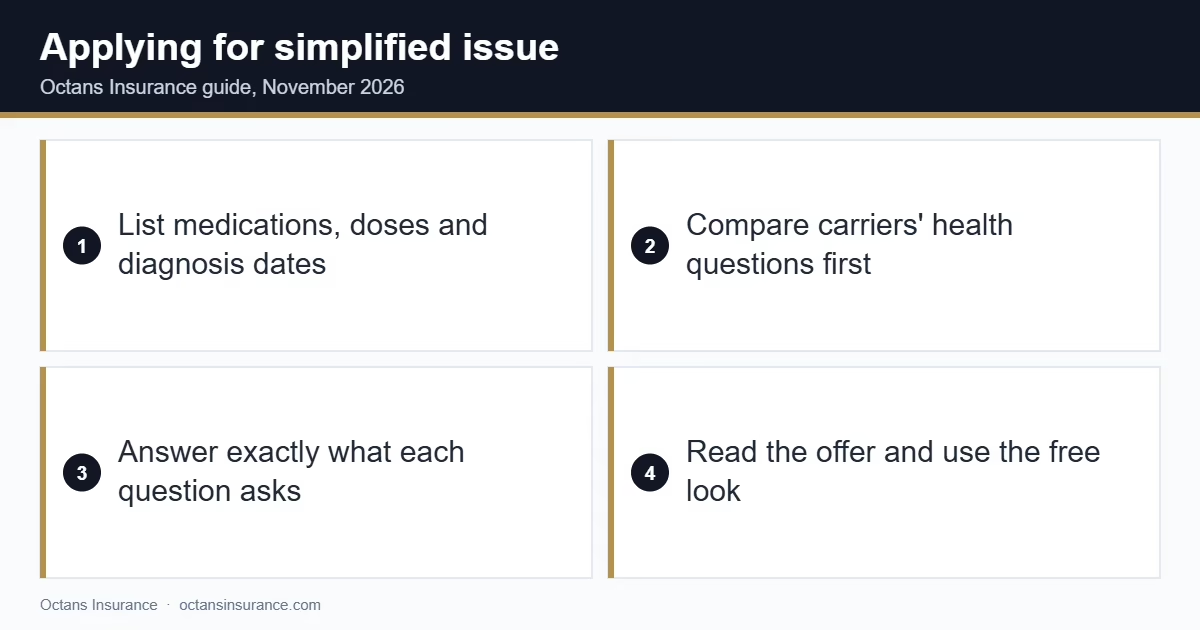
So before you answer simplified issue health questions, gather your medication names and doses, diagnosis dates, hospital stays and doctors’ names. Answer from that list, not from memory.
Simplified issue vs guaranteed issue vs fully underwritten
The three main ways to buy coverage differ in what the insurer asks and in what it pays if you die early.
| Feature | Simplified issue | Guaranteed issue | Fully underwritten |
|---|---|---|---|
| Health questions | Yes, a short list | None | Yes, about your health, job and habits |
| Medical exam or fluid samples | Not required | Not required | Often required |
| Can you be turned down? | Yes | No, if you’re in the eligible age range | Yes |
| Death from illness in the first two years | Full benefit on a level plan; reduced on a modified or graded plan | Limited benefit | Death benefit paid, subject to the contestable period |
Sources: SOA report (February 2020); TDI life insurance guide (updated Dec. 12, 2025); NAIC glossary; AARP program from New York Life; Loyal American plan table. Read November 2026.
If you can answer the questions favorably, a level simplified issue plan avoids the early-benefit limit that comes with guaranteed issue. Loyal American’s level plan, shown on HealthSpring’s whole life page, pays 100% of the benefit amount for a non-accidental death in the first two years. AARP’s guaranteed acceptance plan from New York Life has limited benefits during its first two years. Our guaranteed issue life insurance guide covers that trade-off in depth.
Against fully underwritten coverage, the trade-off is price. The SOA says premiums per unit of coverage are higher for simplified issue than for fully underwritten and accelerated underwriting products, because insurers know less and charge a little more. If you’re healthy and need a large policy, an exam may save money. Our life insurance medical exam guide explains what the exam involves, and our no exam life insurance guide covers accelerated underwriting.
How much simplified issue life insurance can you get?
Each insurer sets its own ages and amounts, and they change. The examples below come from insurers’ own pages, including the AARP Life Insurance Program from New York Life and Fidelity Life. They show the range on offer. They aren’t recommendations, and availability varies by state.
| Plan (insurer) | Type | Issue ages | Coverage |
|---|---|---|---|
| AARP Level Benefit Term Life (New York Life) | Term; rates rise in 5-year age bands; ends at age 80 | Members 50–74; spouses or partners 45–74 | $10,000 to $150,000 |
| AARP Permanent Life (New York Life) | Whole life; rate guaranteed never to increase | Members 50–80; spouses or partners 45–80 | Up to $100,000 |
| RAPIDecision Final Expense (Fidelity Life) | Permanent; full coverage on approval | 50–85 | $5,000 to $50,000 |
| AARP Guaranteed Acceptance Life (New York Life), for comparison | Guaranteed issue; limited benefits for 2 years | Members 50–85; spouses or partners 45–85 | Up to $30,000 |
Sources: AARP Life Insurance Program from New York Life product pages; Fidelity Life RAPIDecision Final Expense page. Read November 2026. AARP membership is required for the AARP program, and its guaranteed acceptance plan tops out at $25,000 in some states.
Two patterns stand out. Simplified issue term life insurance can reach larger amounts, but the AARP plan’s rates rise every five years and its coverage stops at 80. Simplified issue whole life insurance offers less coverage, but whole life can be kept in force for your whole life. Fidelity Life says its final expense premiums and coverage amounts stay the same for the life of the policy.
Simplified issue life insurance pros and cons
Pros:
- No exam, needles or lab visit.
- Speed. Most panelists in the SOA report said a decision usually comes within minutes for most policies, and the report says some applicants are covered the same day.
- Full coverage from day one on a level plan, if you qualify for it.
- Options into your 80s. Two of the plans above accept applicants up to age 80 or 85.
Cons:
- A higher cost per dollar of coverage than fully underwritten insurance.
- Little reward for excellent health, since the SOA notes there are few, if any, rate classes.
- Smaller maximums on whole life plans: $50,000 and $100,000 in the examples above.
- No guarantee of approval. A knockout answer or a record mismatch can mean a decline.
- You may be offered a reduced plan. The SOA notes that applicants who don’t meet the requirements may be offered graded benefit whole life, which pays less if death comes in the first two policy years.
What happens if you answer a health question wrong?
With simplified issue life insurance, the insurer approves and prices the policy based on your answers, so a mistake can cost your family the benefit. The Texas Department of Insurance (TDI) says life policies have a two-year contestable period. If you die during it, the insurer may review the information you gave on your application. TDI adds that if a company denies payment, it must return the premiums to your beneficiary.
After two years, the door mostly closes. Under the Texas Insurance Code, section 1101.006, a policy in force for two years from its issue date during the insured’s lifetime is incontestable, except for nonpayment of premiums. Other states set their own rules. Our life insurance contestability period guide explains how claim reviews work.
Hypothetical example: Ruth, 67, buys a $20,000 simplified issue whole life policy for $95 a month. (The premium is made up for this example; it isn’t a quote.) She answers “no” to a question about a heart condition she was treated for last year. She dies of a heart attack 18 months later, inside the two-year contestable period.
- Premiums paid: 18 × $95 = $1,710.
- If the insurer denies the claim because of the wrong answer, the Texas rule TDI describes sends the premiums back to her beneficiary: $1,710.
- Shortfall compared with the face amount: $20,000 − $1,710 = $18,290.
An accurate answer might have led to a different offer, such as a modified plan, or to a decline. Either outcome is better than a policy your family can’t collect on.
How to apply for simplified issue life insurance
- Set the amount. Add up what the money must cover, such as a funeral, debts or a spouse’s income gap. Pick a premium you can pay for life.
- Build a health list. Write down every medication and dose, each diagnosis and hospital stay with dates, and your doctors’ names. A pharmacy printout helps.
- Compare simplified issue health questions before you apply. Because requirements vary widely by company, a condition that is a knockout at one insurer may be acceptable at another.
- Answer exactly what’s asked. Many applications are taken by phone. Our life insurance phone interview guide shows what to expect.
- Expect record checks. The insurer will compare your answers with MIB, prescription and motor vehicle records.
- Read the decision. You may be approved for a level plan, offered a graded or modified plan, or declined. If you’re declined, see what to do if you’re denied life insurance.
- Use the free look. TDI says Texas policies have a free-look period of at least 10 to 20 days, when you can cancel for any reason and get a full refund. Other states set their own periods.
- Automate payments. TDI says most policies have a 31-day grace period after the due date. If a policy lapses anyway, replacing it means applying again at an older age.
Questions to ask before you buy
- Is this a level benefit plan, or a graded or modified one?
- If it’s graded or modified, what exactly does it pay in years one and two? Are accidental deaths paid in full?
- Which health questions does this application ask, and how far back do they look?
- Will my premium stay level for life, or rise at set ages?
- If it’s simplified issue term life insurance, when does coverage end, and can I exchange it for a permanent policy?
- Does the policy build cash value, and when does that start?
- How long is the free-look period in my state?
- Can my spouse or partner apply too, and at what ages?
Simplified issue life insurance: frequently asked questions
Is simplified issue the same as no exam life insurance?
Not quite. “No exam” is a broad label that covers several paths, including simplified issue, guaranteed issue and accelerated underwriting for healthy applicants. Simplified issue is the middle path. You skip the exam and fluid samples, but you answer a short list of health questions, and the insurer checks records such as MIB and prescription histories. Guaranteed issue skips the questions too but limits early benefits.
Can you be denied simplified issue life insurance?
Yes. Simplified issue life insurance isn’t guaranteed acceptance. The Society of Actuaries says a yes to certain knockout questions, or a medication on an insurer’s knockout list, can make you ineligible. Because each insurer writes its own questions, a decline at one company doesn’t always mean a decline everywhere. Guaranteed issue coverage remains a fallback, though its benefits are limited in the first two years.
Does simplified issue life insurance have a waiting period?
A level benefit plan doesn’t. Loyal American’s level plan, for example, pays 100% of the benefit amount even for a non-accidental death in the first two years. If you’re placed in its modified plan instead, a non-accidental death in that window pays 110% of the premiums paid. Accidental death pays 100% of the benefit amount under both plans. Other insurers use different formulas, so check yours.
How fast is simplified issue approval?
Often fast. Most panelists in the SOA report said a decision is usually made within minutes for most simplified issue life insurance policies, and some applicants can be covered the same day. Fidelity Life says approval on its final expense plan typically comes in days, not months. Expect delays if your answers don’t match records, such as a prescription you filled but never took. Speed is never a promise of approval.
Is simplified issue whole life insurance more expensive?
Per dollar of coverage, usually yes, compared with fully underwritten insurance. The SOA says insurers charge a little more because they have less information about each applicant. With few, if any, rate classes, a very healthy person may pay the same rate as someone with minor issues. If you’re healthy and need a large amount, get a fully underwritten quote to compare.
Can you buy simplified issue life insurance after 80?
Sometimes. Among the plans we reviewed in November 2026, Fidelity Life’s final expense plan accepts applicants up to age 85, with coverage from $5,000 to $50,000. AARP’s permanent plan from New York Life, by contrast, stops taking members after age 80. Ages, amounts and plan availability vary by state, so confirm the rules where you live before you apply.

How a licensed Octans agent can help
Simplified issue life insurance rewards preparation. A licensed Octans Insurance agent can check your medication list and health history against the questions different carriers ask before anything is submitted, and compare options from 120+ carriers.
We’ll explain whether an offer is level, graded or modified, what it pays in the first two years, and how it compares with guaranteed issue or a fully underwritten policy. We can’t promise approval or a price. The insurer makes that decision.
To talk it through, call (617) 935-9220 and ask for a licensed agent. If you’re planning for funeral costs, our final expense insurance guide is a good next read.
Keep Reading: Related Guides
- No exam life insurance
- Guaranteed issue life insurance
- Final expense insurance
- Graded Death Benefit
- Modified Whole Life Insurance
- Life Insurance Death Benefit
- Life Insurance Underwriting
Important: Octans Insurance agents are licensed in the states in which they operate. Coverage availability and rates may vary by state. Premium examples, when provided, are illustrative samples from published sources, not quotes. Final rates are determined by the insurance carrier based on underwriting and applicable policy criteria. Policy terms, exclusions, limitations, riders, and availability vary by carrier and state.
About examples and tools: Hypothetical examples, sample rates, calculators and quizzes on this site are for general educational and illustrative purposes only. They are not quotes, offers of coverage, or guarantees of eligibility, approval, price or benefits, and they are not legal, tax, financial or medical advice. The insurance company decides eligibility and price; Medicare rules are set by CMS and the Social Security Administration.
Compare simplified issue options with a licensed agent
Start with a free, no-obligation quote review with a licensed Octans agent.
(617) 935-9220 | life@octansinsurance.com