
Funeral costs
Who Pays for Funeral Costs? Family, Estate, Taxes and Help
Usually the person who signs the funeral home contract pays first and can be repaid from the estate. Family generally isn’t liable for a relative’s debts. Funeral costs are deductible only on a federal estate tax return, and Social Security, VA and state programs offer limited help.
- The person who signs the funeral contract is usually responsible for the bill, but can generally be repaid from the estate.
- In Massachusetts, reasonable funeral expenses rank second among estate claims, after administration costs (M.G.L. c. 190B, §3-805).
- Funeral costs can’t be deducted on Form 1040 or Form 1041; only on Form 706, which applies to estates over $15 million for 2026 deaths.
- Help is limited: $255 from Social Security; as of October 2026, $1,032 toward burial plus $1,032 for a plot from the VA (non-service-connected deaths on or after Oct. 1, 2026); and some state programs.
Table of Contents
Make sure your family is financially protected today!
Who pays for funeral costs? In most families, the person who signs the funeral home contract pays the bill first, and the deceased person’s estate can usually repay them. Life insurance, a prepaid plan, a payable-on-death account or a government benefit may cover some or all of it. Family members generally aren’t required to pay a relative’s debts from their own money. This guide explains who is responsible, when the bill is due, what’s tax deductible, and where to find help with funeral costs.
Who pays for funeral costs: the short answer
The funeral home looks to the person who arranged the funeral and signed the contract. A New York Department of Health guide puts it plainly: the customer, the family member, legal representative or friend making the arrangements, is legally responsible for the funeral bill. That person can then generally have the bill paid from the estate.
Signing makes you the one the funeral home bills. If you’re unsure the estate can cover it, check the sources below before you sign.
| Possible source | Who receives it | How fast |
|---|---|---|
| Life or burial insurance | Named beneficiary, or the funeral home by assignment | Once the insurer approves the claim |
| Payable-on-death bank account | Named beneficiary, which can be a person or a funeral home | Usually without probate |
| Prepaid (preneed) funeral contract | The funeral home named in the contract | Already arranged |
| Estate assets | Creditors, including whoever paid the funeral | After the court appoints a personal representative |
| Government benefits | Eligible survivors or the person who paid | Varies; applications required |

Who pays for funeral costs when a parent dies
When a parent dies, an adult child often steps in to make arrangements. Doing that doesn’t, by itself, make you responsible for your parent’s other debts. The FTC says family members usually don’t have to pay a deceased relative’s debts from their own money; debts stay with the estate.
The FTC lists exceptions: you cosigned the debt, you’re a surviving spouse in a community property state such as California, you live in a state that makes spouses pay certain debts like some health care bills, or you were responsible for the estate and didn’t follow state probate rules. The funeral contract is different, because signing it is your own agreement.
Can funeral costs be paid from the estate?
Yes. Funeral costs can be paid from the estate, and many states rank them near the top of the list of claims. In Massachusetts, when an estate can’t pay every claim in full, reasonable funeral expenses come second, right after the costs of administering the estate (M.G.L. c. 190B, §3-805). They come ahead of federal debts, last-illness medical bills and ordinary creditors.
Getting funeral costs paid from the estate takes time. A court must first appoint a personal representative, who gathers assets and pays claims in order, so a relative often pays first and keeps receipts. If the estate has little or nothing, the signer may not get it all back.
Some money moves faster because it skips probate. Life insurance paid to a living named beneficiary generally passes outside probate, and a payable-on-death account goes straight to the person or funeral home named at the bank. A policy that names the estate, or no one, can end up stuck in probate.
Are funeral costs tax deductible?
For most families, no. Funeral costs aren’t tax deductible on your own return or on the deceased person’s final Form 1040, according to IRS Publication 529 and Publication 559. The Form 1041 instructions also rule out the deduction on the estate’s income tax return.
Funeral costs are tax deductible only on Form 706, the federal estate tax return, less reimbursements such as Social Security or VA death benefits. For 2026 deaths, Form 706 is generally required only when the gross estate plus certain taxable gifts tops $15,000,000 (IRS Form 706 instructions, July 2026). This is general information, not tax advice; ask a tax professional.
| Tax return | Can funeral costs be deducted? | IRS source |
|---|---|---|
| Your own Form 1040 | No | Publication 529 |
| Deceased person’s final Form 1040 | No | Publication 559 |
| Estate income tax return, Form 1041 | No | Form 1041 instructions |
| Estate tax return, Form 706 | Yes, less reimbursements | Form 706 instructions |

Where to find help with funeral costs
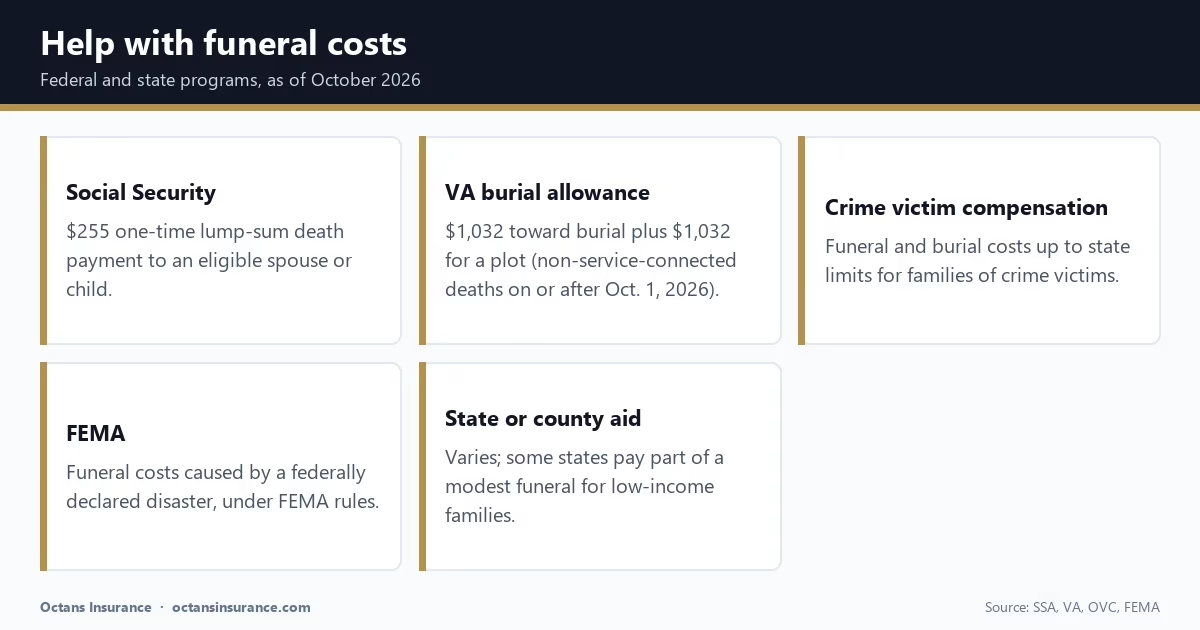
Government help with funeral costs exists, but it rarely covers a full funeral. For scale, the National Funeral Directors Association’s 2023 study put the national median at $8,300 for a funeral with viewing and burial and $6,280 for one with viewing and cremation, before cemetery charges (see our funeral cost calculator).
| Program | What it pays | Who can get it |
|---|---|---|
| Social Security lump-sum death payment | $255, one time | An eligible surviving spouse, or an eligible child if there’s no spouse |
| VA burial allowance | As of October 2026, $1,032 toward burial and $1,032 for a plot (non-service-connected deaths on or after Oct. 1, 2026) | Survivors of eligible veterans, under VA rules |
| State crime victim compensation | Funeral and burial costs, up to state limits | Families of crime victims who meet state rules |
| FEMA Individuals and Households Program | Funeral or reburial expenses caused by the disaster | Disaster survivors who meet FEMA rules after a federally declared disaster |
| State or county burial assistance | Varies; some states pay part of a modest funeral | Low-income families; rules vary by state |
Claim Social Security’s lump sum within two years of the death, by phone at 1-800-772-1213. The VA generally wants claims within two years of burial for deaths that weren’t service-connected; see our guide to life insurance for veterans.
Funeral and burial costs were the second-largest expense that state crime victim compensation programs reimbursed in fiscal years 2021 and 2022, according to the Office for Victims of Crime. FEMA’s COVID-19 Funeral Assistance program is closed to new applications.
State help with funeral costs for low-income families varies widely. In Massachusetts, the Department of Transitional Assistance may pay up to $1,100 toward an unpaid balance, but only when the total funeral, cremation and burial cost is $3,500 or less; see our page on funeral costs in Massachusetts. New York’s Attorney General says eligible families can apply for burial assistance up to 120 days after the death.
How to lower the bill before anyone pays
Whoever pays for funeral costs can shape the total. The FTC Funeral Rule gives you these rights at every funeral home:
- Get prices by phone, without giving your name.
- Receive a General Price List to keep, and see casket prices before you see the caskets.
- Buy only the items you want instead of a package.
- Use a casket or urn bought elsewhere, without a handling fee.
- Choose an alternative container for cremation; no state requires a casket for it.
- Skip routine embalming, which no state law requires for every death.
The FTC suggests comparing prices from at least two funeral homes. It also says skipping embalming when burial or cremation happens soon can save hundreds of dollars, and direct cremation or immediate burial doesn’t require it.
Hypothetical example: who pays for funeral costs in one family
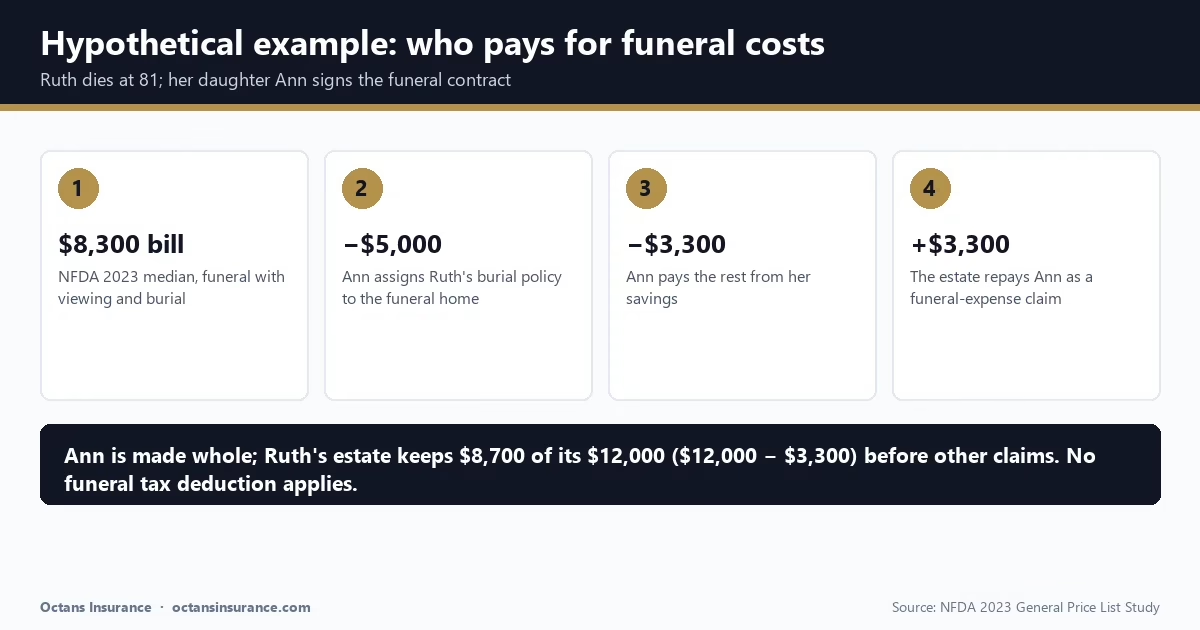
Hypothetical example. Ruth, a widow in Massachusetts, dies at 81. Her daughter, Ann, signs the funeral home contract for a funeral with viewing and burial priced at the NFDA 2023 national median of $8,300, before cemetery charges. Ruth had a $5,000 burial insurance policy naming Ann as beneficiary, and $12,000 in a bank account with no named beneficiary.
| Step | Amount | Running balance owed |
|---|---|---|
| Funeral bill (NFDA 2023 median) | $8,300 | $8,300 |
| Ann assigns the burial policy to the funeral home | −$5,000 | $3,300 |
| Ann pays the rest from her own savings | −$3,300 | $0 |
| Estate later repays Ann as a funeral-expense claim | $3,300 | Ann is made whole |
The check: $8,300 − $5,000 = $3,300. After repaying Ann, Ruth’s estate has $12,000 − $3,300 = $8,700 left before administration costs and other claims. The estate is far below the $15,000,000 Form 706 threshold, so none of the funeral costs are tax deductible for anyone in this family.
Checklist for whoever pays for funeral costs
- Look for a will, prepaid funeral contract, life insurance policy or payable-on-death account before you sign anything.
- Ask the funeral home for its General Price List and compare at least one other home.
- Read the written statement of goods and services before you pay.
- If there’s life insurance, ask whether the funeral home accepts an assignment of benefits. Our guide on how to file a life insurance claim lists the papers you’ll need.
- Keep every receipt so the funeral costs can be paid from the estate later.
- Apply for any help with funeral costs that fits: Social Security, VA, crime victim or state programs.
- Don’t pay the deceased person’s other debts from your own money unless you’re legally responsible for them.
- Ask an estate attorney or tax professional about anything specific.
Who pays for funeral costs: frequently asked questions
Who is responsible for paying funeral costs?
Usually the person who signs the contract with the funeral home is responsible for the bill, though they can generally be repaid from the deceased person’s estate. Family members usually don’t have to pay a relative’s debts from their own money, the FTC says, unless they cosigned or state law makes them liable. Life insurance, a prepaid funeral plan or a payable-on-death account can also cover the bill. If there’s no money, some states and counties help with a basic burial.
Can funeral costs be paid from the estate?
Yes. Funeral costs can be paid from the deceased person’s estate, and many states give them high priority. In Massachusetts, reasonable funeral expenses rank second among claims, right after administration costs (M.G.L. c. 190B, §3-805). Because probate can take months, a family member often pays first and is repaid later. Money that skips probate, such as life insurance paid to a named beneficiary or a payable-on-death account, can be available sooner. An estate attorney can confirm your state’s rules.
Do funeral costs have to be paid upfront?
It depends on the funeral home. Each home sets its own payment terms in its contract, so ask before you sign. Under the FTC Funeral Rule, you must receive a written statement of what you chose and what it costs before you pay. Many homes accept an assignment of life insurance benefits, so the insurer pays them directly from the claim. In California, a home can’t refuse or delay releasing a body to another funeral home over an unpaid bill.
Are funeral costs tax deductible?
Not on an individual return. The IRS says no deduction for funeral expenses can be taken on the deceased person’s final Form 1040, and Publication 529 lists funeral and burial costs, including a cemetery lot, as nondeductible personal expenses. Funeral costs can be deducted only on the federal estate tax return, Form 706, which is required only for large estates (over $15 million for 2026 deaths). Social Security or VA burial payments reduce that deduction. Ask a tax professional.
Can funeral expenses be deducted on Form 1041?
No. The IRS Form 1041 instructions say not to deduct medical or funeral expenses on Form 1041; funeral expenses are deductible only on Form 706, the federal estate tax return. That’s true even when the estate paid the funeral bill. Most estates never file Form 706, because it’s required only for estates over $15 million for deaths in 2026. The deceased person’s medical bills paid by the estate may be deductible on their income tax return instead. Ask a tax professional.
Is there financial help with funeral costs?
Yes, though it rarely covers a whole funeral. Social Security pays a one-time $255 to an eligible surviving spouse or child. As of October 2026, the VA pays $1,032 toward burial and $1,032 for a plot when an eligible veteran’s non-service-connected death is on or after October 1, 2026. Some states and counties help low-income families, every state has a crime victim compensation program that can help with funeral costs, and FEMA may help after a declared disaster.
Can you negotiate funeral costs?
Yes, in effect. The FTC Funeral Rule lets you buy only the items you want instead of a package, get prices by phone, and use a casket or urn bought elsewhere without a fee. Comparing General Price Lists from at least two funeral homes, as the FTC suggests, is your strongest lever, and New York’s Attorney General suggests telling providers you don’t have unlimited funds. Skipping embalming when burial or cremation happens soon can save hundreds of dollars, the FTC says.
How Octans can help your family plan ahead
The simplest way to settle who pays for funeral costs is to decide ahead of time. A small whole life policy, often called burial insurance or final expense insurance, pays cash to the person you name. Premiums can exceed the benefit if you live a long time, so we’ll tell you when savings already do the job.
Octans Insurance is an independent agency in Topsfield, Massachusetts. Our licensed agents, listed on our licenses page, compare 120+ carriers across 19 states. We’re not affiliated with any government agency. Call (617) 935-9220 or use our quote tool to compare options with no obligation.
Important: Octans Insurance agents are licensed in the states in which they operate. Coverage availability and rates may vary by state. Premium examples, when provided, are illustrative samples from published sources, not quotes. Final rates are determined by the insurance carrier based on underwriting and applicable policy criteria. Policy terms, exclusions, limitations, riders, and availability vary by carrier and state.
About examples and tools: Hypothetical examples, sample rates, calculators and quizzes on this site are for general educational and illustrative purposes only. They are not quotes, offers of coverage, or guarantees of eligibility, approval, price or benefits, and they are not legal, tax, financial or medical advice. The insurance company decides eligibility and price; Medicare rules are set by CMS and the Social Security Administration.
Plan Ahead So Your Family Isn’t Left With the Bill
Start with a free, no-obligation quote review with a licensed Octans agent.
(617) 935-9220 | life@octansinsurance.com