
What are Medicare Deductibles?
Medicare Deductibles: The Short Answer
Medicare deductibles are the amounts you pay before Medicare starts paying its share. In 2026, the Part A deductible is $1,736 per benefit period, so you can owe it more than once a year, and the Part B deductible is $283 a year, after which you usually pay 20% of the Medicare-approved amount. Part D plans set their own deductibles, but none can be above $615 in 2026, and Medicare Advantage plans set their own deductibles too.
Table of Contents
Make sure your family is financially protected today!
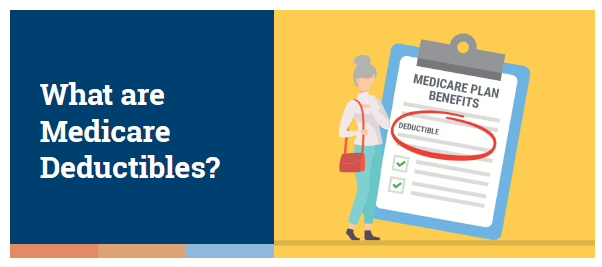
If you’ve ever reviewed or had a health insurance plan, whether that’s a private plan or Medicare, you’ve likely seen or dealt with a deductible. They’re very common in insurance plans. So common, in fact, that you may have never even stopped to think about what they are exactly. How do they influence your coverage? Do you not receive coverage until you’ve reached that deductible or are you always receiving coverage? Do all Medicare insurance plans have a deductible?
These are important questions, and the answers can change your mind about which plans to choose. At the same time, since deductibles are such a common element of health insurance, you may have been embarrassed to ask. So, let’s break down exactly what deductibles are and how you may encounter them with the Medicare program.
What are Deductibles?
Within insurance, deductibles are a set amount you must pay before the insurance plan’s coverage kicks in. You can find deductibles in many kinds of insurance coverage. While they are often a set dollar amount, they are sometimes a percentage of the overall value of the insured item, like that for property or certain types of environmental risks. In order to receive the full extent of coverage that your insurance plan offers, you’ll need to reach this limit with applicable payments from services.
For health care services, does this mean that you’ll be stuck paying for all your costs until you hit the Medicare insurance deductible? Not necessarily. While the majority of health services require the deductible to be met to receive full coverage, some things may be covered prior to meeting your deductible. This will differ depending on the insurance plan, so it’s a good idea to do a little research before signing on to a specific plan. For Medicare insurance beneficiaries, we can go into some more specifics that may help you make decisions about your coverage.
Original Medicare Insurance Deductible
What is the deductible for Medicare insurance? Well, in Original Medicare, there are two deductibles you’ll encounter. In Medicare Part A, there’s an inpatient hospital deductible that you’ll owe each benefit period. Once you’ve paid that much for inpatient health services in a single benefit period, your Medicare insurance coverage will kick in. In Medicare Part B, the other half of Original Medicare, there’s a general deductible.
Once you’ve paid enough applicable services, Medicare Part B will cover 80 percent of the Medicare-approved amount, and you’ll only owe the remaining 20 percent. This doesn’t mean that you’ll have no coverage or benefits from your Medicare insurance plan prior to reaching your deductible. Some services are covered before you reach it, like preventative care. This includes services like your Annual Wellness visit or the flu shot.
Of course, there’s another way you benefit from your Medicare insurance plan before reaching your deductible. If you’re using a doctor or health service that accepts Medicare assignment, they’ve agreed to charge you at an agreed upon price. This price is usually lower than what the health care provider would normally charge for those services.
In this sense, you’re already receiving benefits from your Medicare insurance coverage, even if you haven’t reached your deductible yet.
Finally, a Medicare Supplement (also known as a Medigap plan) is one method of reducing or even eliminating a Part A or Part B deductible. While you can only qualify for a plan that covers the Part B deductible if you were eligible for the Medicare program prior to January 1, 2020, most Medigap plans offer some coverage of the Part A deductible.
All but one standardized Medicare Supplement plans offer at least partial coverage of the Part A deductible. Plans K, L, and M help cover 50 percent, 75 percent, and 50 percent of it, respectively, while the rest cover it in full. Only Plan A does not offer Part A deductible coverage.
Medicare Advantage and Part D Deductibles
Similarly, many Medicare Part C (also called Medicare Advantage) plans have an annual deductible. Since Medicare Advantage plans are offered by private insurance companies as alternatives to Original Medicare, these plans may have differing deductibles. As Original Medicare alternatives, they’re required by the Centers for Medicare & Medicaid Services (CMS) to cover what Original Medicare covers at minimum. You should expect the same pre-deductible services covered as with Original Medicare.
Medicare Part D is a privately offered prescription drug coverage plan that pairs with your Original Medicare coverage. It too may have a deductible. Much like Medicare Advantage plans, these deductibles will vary from plan to plan. Unlike Medicare Advantage, though, CMS regulates the maximum limit that a Part D deductible can be.
When it comes to choosing a plan, whether that’s a Medicare Advantage or Part D plan, the deductible is a worthwhile factor to take into account. Going with the lowest deductible may not be the best call, though. High-deductible plans often balance out that initial cost to the beneficiary by having lower premiums or higher coverages once you reach that deductible.

Whether it’s about the complex ins-and-outs of the Medicare program or the basics of your coverage, you never have to be embarrassed to ask a question. Don’t be ashamed to ask questions and learn more about the Medicare program. It’s the best way to take a firm grasp of your coverage and your health care!
How does the Part A deductible work with benefit periods?
The Part A deductible is not a once-a-year charge. It is tied to something called a benefit period. That is why you can pay it more than once in the same year.
Medicare.gov defines it this way:
- A benefit period begins the day you are admitted as an inpatient in a hospital or skilled nursing facility (SNF).
- It ends when you haven’t had inpatient hospital care, or skilled care in a SNF, for 60 days in a row.
- If you go back in after a benefit period ends, a new one begins, and you pay the inpatient deductible again.
- There is no limit to the number of benefit periods.
Hypothetical example: Ann is admitted to the hospital in February and pays the $1,736 Part A deductible for 2026. She goes home and stays out of the hospital and any SNF for 75 days. In June, she is admitted again. Because more than 60 days passed, a new benefit period starts. She owes the deductible a second time.
If Ann had been readmitted after only 30 days, she would still be in the same benefit period. She would not owe a new deductible.
Meeting the deductible covers your share for the first 60 days of a hospital stay. After that, daily coinsurance starts. Here are the 2026 amounts from Medicare.gov and the CMS 2026 fact sheet:
| Days in a benefit period | Hospital (inpatient) | Skilled nursing facility |
|---|---|---|
| Days 1 to 20 | $0 per day after the deductible | $0 per day |
| Days 21 to 60 | $0 per day | $217 per day |
| Days 61 to 90 | $434 per day | $217 per day |
| Days 91 to 100 | $868 per day (lifetime reserve days) | $217 per day |
| Days 101 to 150 | $868 per day (lifetime reserve days) | All costs |
| After day 150 | All costs | All costs |
You have 60 lifetime reserve days in total. Once you use them, they don’t come back. SNF care also needs a qualifying inpatient stay of at least 3 days in a row in most cases, per Medicare.gov.
Which Part B costs fall outside the deductible?
After you meet the $283 Part B deductible in 2026, you usually pay 20% of the Medicare-approved amount. But some Part B costs work a little differently. Medicare.gov lists these:
- Clinical lab services: $0 for covered lab tests.
- Outpatient hospital care: 20% coinsurance plus a hospital copayment. That copayment usually won’t be more than the Part A deductible amount.
- The premium: You pay the $202.90 monthly Part B premium even if you don’t use any Part B services. It does not count toward the deductible.
Most important, Original Medicare has no yearly cap on what you pay. Medicare.gov says there’s no yearly limit on out-of-pocket costs unless you have other coverage. That 20% has no ceiling, which is why many people add a Medigap policy or choose a Medicare Advantage plan.
How do Part D deductibles and the $2,100 cap work in 2026?
Part D has its own deductible, separate from Parts A and B. Each drug plan sets its own, but no plan can go above the federal maximum. Some plans have no deductible at all.
Per Medicare.gov’s Part D cost page, your drug costs move through three stages in 2026:
- Deductible stage. You pay the full cost of covered drugs until you meet your plan’s deductible. No plan may have a deductible above $615 in 2026.
- Initial coverage stage. You pay 25% coinsurance until your out-of-pocket spending reaches $2,100.
- Catastrophic coverage stage. You pay $0 for covered Part D drugs for the rest of the calendar year.
The $615 deductible and $2,100 cap are confirmed in the CMS 2026 Part D program instructions.
Hypothetical example: Maria’s plan uses the $615 maximum deductible and 25% coinsurance. Her covered drugs cost $1,000 a month in total. In January, she pays the $615 deductible plus 25% of the remaining $385, or $711.25. From February to June, she pays $250 a month. In July, she reaches the $2,100 limit after paying $138.75. She then pays $0 for covered drugs for the rest of 2026. Real plans can differ, so check your plan’s own costs.
Medicare Advantage plans that include drug coverage use the same three stages. If large bills early in the year are a worry, the Medicare Prescription Payment Plan can spread your costs across the year. Medicare.gov is clear that it doesn’t save you money or lower your drug costs. It only changes when you pay.
How much could Medicare deductibles add up to in one year?
Each part of Medicare has its own deductible. If you use all three parts in the same year, they stack. This example uses the 2026 amounts from CMS and Medicare.gov.
Hypothetical example: Joe has Original Medicare and a Part D plan with the maximum $615 deductible. He has no Medigap policy. In 2026, he sees his doctor several times, fills regular prescriptions and has one hospital stay.
| Deductible | 2026 amount | How often |
|---|---|---|
| Part B | $283 | Once a year |
| Part A (one hospital stay) | $1,736 | Once per benefit period |
| Part D (plan maximum) | $615 | Once a year |
| Total deductibles | $2,634 | Before coinsurance and premiums |
That $2,634 is only the deductibles. Joe also pays his monthly premiums, 20% of most Part B services, and 25% of drug costs until he reaches the $2,100 Part D limit. If he had a second hospital stay in a new benefit period, he would owe another $1,736.
This is why it helps to look at total yearly costs, not just one deductible, when you compare coverage.
A note on hospital “observation”: Being in a hospital bed overnight does not always mean you are an inpatient. If the hospital keeps you “under observation,” you are an outpatient, even if you stay the night.
That matters for your Medicare deductibles. As an outpatient, Part B usually applies instead of Part A. You pay 20% coinsurance plus a hospital copayment, per Medicare.gov.
It also affects skilled nursing care. Medicare.gov says time under observation or in the emergency room does not count toward the 3-day inpatient stay that SNF coverage usually requires. If you are in the hospital, it is fair to ask staff whether you have been admitted as an inpatient.
Do higher earners pay higher deductibles? No. The Part A, Part B and Part D deductibles are the same no matter your income. What changes with income is your premium.
In 2026, people with income above $109,000 (single) or $218,000 (joint) pay an extra amount on top of their Part B premium and Part D premium. CMS calls this the income-related monthly adjustment amount, or IRMAA. Here are the first two tiers from the CMS 2026 fact sheet:
| Income (single / joint) | Total Part B premium | Part D extra amount |
|---|---|---|
| Up to $109,000 / $218,000 | $202.90 | $0.00 |
| Above $109,000 up to $137,000 / above $218,000 up to $274,000 | $284.10 | $14.50 |
Higher tiers go up to a $689.90 total Part B premium. The CMS fact sheet lists every tier.
How do Medicare Advantage deductibles compare?
Medicare Advantage plans don’t use the same Medicare deductibles as Original Medicare. Each plan sets its own deductibles, coinsurance and copays, and they can change each year, per Medicare.gov.
The biggest structural difference is the yearly limit. Medicare Advantage plans have a limit on what you pay for covered Medicare services. Once you reach it, the plan pays 100% of covered services for the rest of the year. Original Medicare has no such limit.
When you compare a plan, look at more than the deductible alone:
- Is there a separate deductible for drug coverage?
- What are the copays for doctor visits, specialists and hospital stays?
- What is the plan’s yearly out-of-pocket limit?
- Do you need to use the plan’s network?
You also keep paying your Part B premium while you are in a Medicare Advantage plan. Plan details vary by area, so check the plan’s own documents or Medicare.gov’s comparison.
What is the high-deductible Plan G deductible?
Some Medigap policies come in a high-deductible version. With high-deductible Plan G (and Plans F and J), you pay Medicare-covered costs up to a set amount before the policy starts to pay. CMS sets that amount each year, so it is the same no matter which company sells the policy.
According to CMS deductible announcements, the high-deductible amount is:
- $2,950 in 2026
- $3,050 in 2027
Rising Medicare deductibles affect this choice too, because a higher deductible means more costs you cover first. Massachusetts does not use lettered plans at all. If you live there, see Medicare Supplement plans in Massachusetts. For the standard plans, see Medicare Plan G vs. Plan N.
Do Medicare deductibles change every year?
Yes. CMS sets the Part A and Part B amounts each year. It announced the 2026 amounts in November 2025. Here is how 2026 compares with 2025, per the CMS 2026 fact sheet:
| Item | 2025 | 2026 |
|---|---|---|
| Part A inpatient deductible | $1,676 | $1,736 |
| Part B deductible | $257 | $283 |
| Part B standard premium | $185.00 | $202.90 |
| SNF coinsurance, days 21 to 100 | $209.50 | $217 |
As of October 2026, CMS had not yet announced the 2027 Part A and Part B deductibles. Some 2027 drug plan figures are already out. For example, CMS set the 2027 Part D base beneficiary premium at $41.33, per its July 28, 2026 announcement. Check back after the new figures are released.
Can you get help paying Medicare deductibles?
If your income and savings are limited, your state may help. The Qualified Medicare Beneficiary (QMB) program can pay Part A and Part B premiums and may also pay Medicare deductibles, coinsurance and copays, per Medicare.gov.
In 2026, the QMB limits are generally $1,350 a month in income and $9,950 in resources for one person. For a married couple, they are $1,824 and $14,910. Limits are a bit higher in Alaska and Hawaii, and some states use looser rules.
For drug costs, Extra Help can lower what you pay for Part D. You qualify automatically if you have full Medicaid, a Medicare Savings Program or SSI. Otherwise, you can apply through Social Security, per Medicare.gov.
Even if you don’t think you qualify, Medicare.gov suggests you apply anyway. A licensed agent or your State Health Insurance Assistance Program can help you sort through the options.
Read More: https://www.medicare.gov/basics/costs/medicare-costs
Not affiliated or endorsed by Medicare or any government agency.
Keep Reading: Related Guides
- Medicare glossary of common terms
- Preparing for your Welcome to Medicare visit
- Medicare for spouses and dependents
Medicare Deductibles: Frequently Asked Questions
What are the Medicare deductibles for 2026?
The 2026 Medicare deductibles are $1,736 per benefit period for Part A and $283 per year for Part B. Part D plans may have their own deductible of up to $615 in 2026.
Can a Medigap plan pay Medicare deductibles?
Some Medigap plans pay the Part A deductible, and in Massachusetts Supplement 1A covers it too. Plans sold to people new to Medicare since 2020 cannot cover the Part B deductible, so plan your budget for Medicare deductibles accordingly.
Medicare Deductibles: Next Steps With a Licensed Agent
Questions about medicare deductibles usually depend on your age, health, state, and budget. A licensed Octans agent can review your situation, compare options from more than 120 carriers, and explain the trade-offs before you decide. Call (617) 935-9220 or request a free quote.


Related guides
We do not offer every plan available in your area. Please contact Medicare.gov or 1-800-MEDICARE to get information on all of your options.
Sources: Medicare.gov; Centers for Medicare & Medicaid Services. This article is for general information and is not tax, legal, or medical advice.
About examples and tools: Hypothetical examples, sample rates, calculators and quizzes on this site are for general educational and illustrative purposes only. They are not quotes, offers of coverage, or guarantees of eligibility, approval, price or benefits, and they are not legal, tax, financial or medical advice. The insurance company decides eligibility and price; Medicare rules are set by CMS and the Social Security Administration. Octans Insurance is not connected with or endorsed by the U.S. government or the federal Medicare program.