
Final Expense
Graded Death Benefit: What a Policy Pays in Years 1 to 3
A graded death benefit can shrink what your family receives if you die of an illness early in a policy. See the legal limits, published payout schedules, accident rules and how to qualify for more.
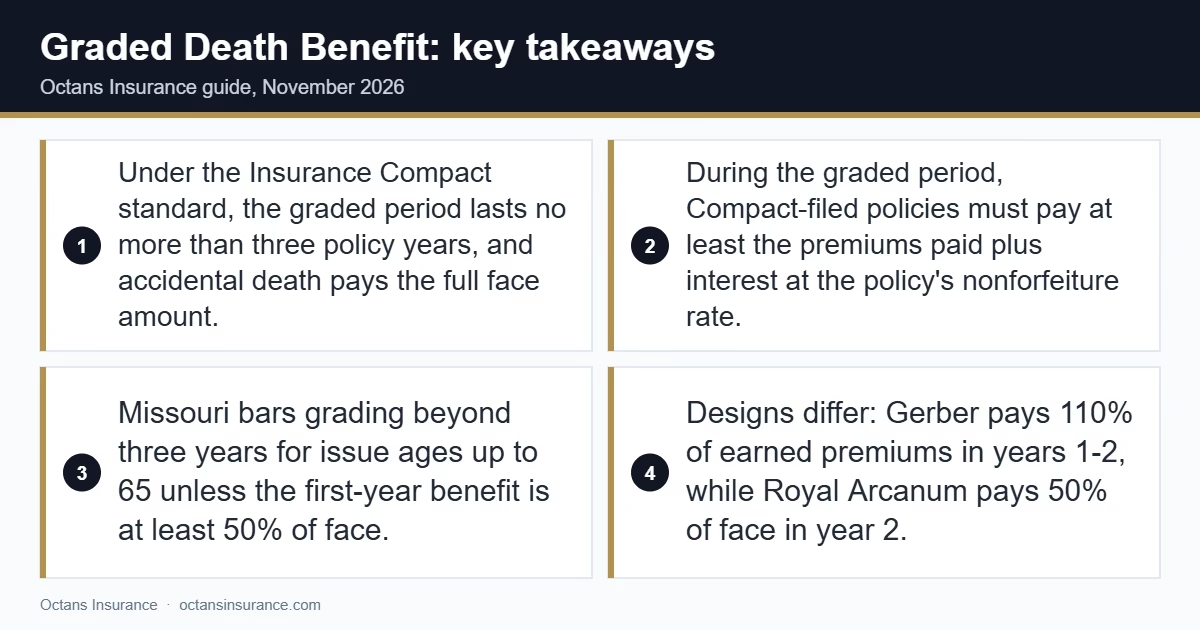
- Under the Insurance Compact standard, the graded period lasts no more than three policy years, and accidental death pays the full face amount.
- During the graded period, Compact-filed policies must pay at least the premiums paid plus interest at the policy’s nonforfeiture rate.
- Missouri bars grading beyond three years for issue ages up to 65 unless the first-year benefit is at least 50% of face.
- Designs differ: Gerber pays 110% of earned premiums in years 1-2, while Royal Arcanum pays 50% of face in year 2.
Table of Contents
Make sure your family is financially protected today!
A graded death benefit limits what a life insurance policy pays if you die from illness during its first two or three years. In that window, your beneficiary gets a reduced amount, such as your premiums back plus a set percentage or interest, or a share of the face amount. Accidental deaths are usually paid in full, and the full benefit applies once the graded period ends.
What is a graded death benefit?
It’s a feature of some whole life policies, especially ones sold without medical underwriting. The Massachusetts Division of Insurance, in Filing Guidance Notice 2019-G, describes these products as having no or a limited death benefit in the first few years of coverage. Insurers sell them under names like Graded Death Benefit, Limited Death Benefit or Modified Death Benefit.
The limit applies to deaths from natural causes, such as illness. Massachusetts expects the cover page to carry language substantially similar to a caption saying whether the policy pays no benefit or a limited benefit for those deaths in the early years, and when the full face amount starts. The cover should also prominently include: “This policy has a limited graded death benefit – PLEASE READ YOUR POLICY CAREFULLY.” The Division expects these disclosures on graded products offered for sale on or after February 1, 2020.
Graded benefit life insurance is the opposite of a level benefit policy, which pays the full amount from the first day. Our guide to life insurance with no waiting period explains how to look for that kind of coverage.
How does a graded death benefit work?
Insurers design their own schedules, but regulators set the outer limits. The Interstate Insurance Product Regulation Commission (the Insurance Compact), a state-based body that sets uniform product standards, adopted a standard for graded whole life policies in 2017. For policies filed under it:
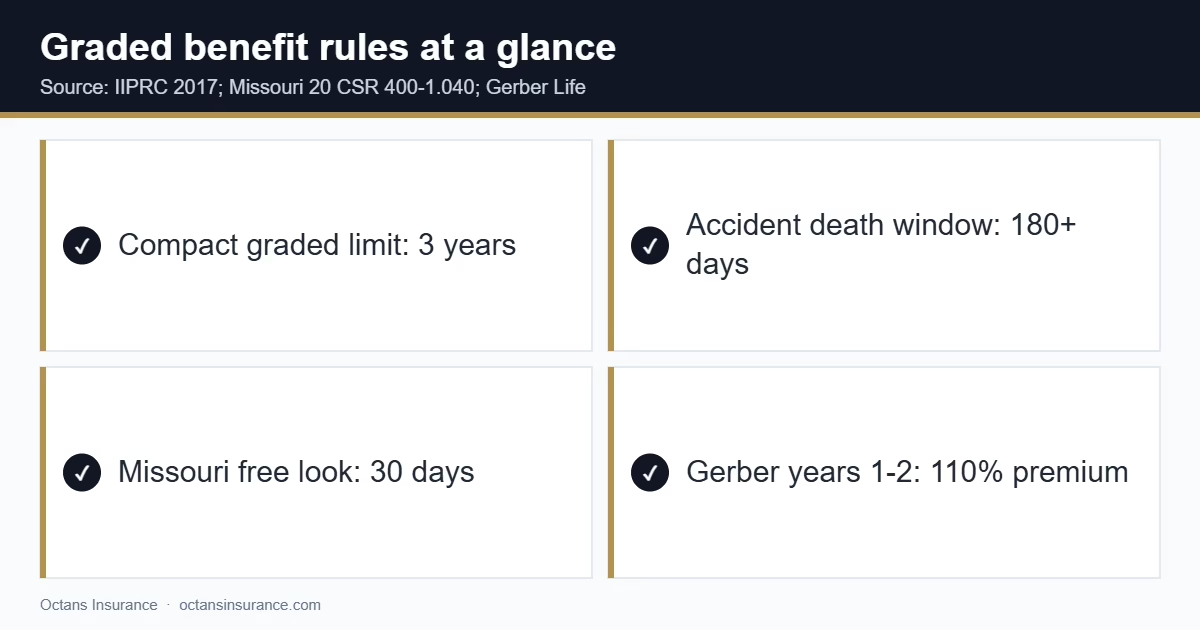
- The reduced benefit for death from natural causes can last no more than the first three policy years.
- During that time, the benefit can’t be less than the premiums paid up to the death, with interest at the rate the policy uses for its nonforfeiture values.
- The full face amount must be paid for death from accidental causes at any time. The policy can require that death occur within 180 days of the accident, but no shorter window.
- The cover page must warn that the policy has a limited graded death benefit.
States add their own rules. Missouri’s regulation, 20 CSR 400-1.040, covers graded policies issued there:
- They must be sold on a guaranteed issue basis or on liberal underwriting standards that justify grading.
- Accidental death benefits during the graded death benefit period must be at least the face amount, unless the policy pays at least 50% of the face amount as a first-year benefit.
- For issue ages up to 65, grading can’t last more than three years unless the first-year benefit is at least 50% of the face amount.
- For issue ages 66 to 75, the limit is two years, or three if the third-year benefit is at least 65% of the face amount, unless the first-year benefit is at least 50%.
- No policy can be issued at age 76 or older unless the first-year benefit is at least 50% of the face amount.
- The face of the policy must prominently say, in substance, that if you aren’t satisfied you can return it within 30 days of receipt for a full premium refund.
What does a graded policy pay if you die early?
The Insurance Compact standard names two main designs: a benefit equal to premiums paid plus interest, and a benefit that’s a percentage of the face amount. Here’s how some published schedules handle a death that isn’t caused by an accident.
| Plan (source) | Year 1 | Year 2 | Year 3 | Full benefit starts |
|---|---|---|---|---|
| Gerber Life Guaranteed Life | 110% of earned premiums | 110% of earned premiums | Full benefit | Year 3 (year 2 in North Dakota) |
| Bankers Life Basic Life Graded | 110% of first-year annual premium | 120% of first two years’ annual premium | 100% of the death benefit | Year 3 |
| Royal Arcanum graded guaranteed issue plan | Premiums returned without interest | 50% of face amount | 75% of face amount | Year 4 |
| Example in a 2020 Society of Actuaries report | 35% of face amount | 70% of face amount | 100% of face amount | Year 3 |
Sources: Gerber Life Guaranteed Life FAQ; Bankers Life whole life page (premium figures exclude the policy fee); Royal Arcanum graded plan page; SOA, Simplified Issue Underwriting (February 2020). Read November 2026. Schedules can vary by state.
The gap between designs is large. Plans that return premiums pay back about what you put in, sometimes with a small extra amount. Plans built on the face amount can pay far more in years two and three.
Graded death benefit whole life insurance: a worked example
Hypothetical example: Ana buys a $10,000 graded death benefit whole life insurance policy for $60 a month. (The premium is made up for illustration; it isn’t a quote.) Here’s what three of the published designs above would pay if she died of an illness. The math assumes she paid every month through the month of death, treats Gerber’s earned premiums as premiums paid, and ignores loans.
| Death from illness in | Premiums paid | Premiums plus 10% (Gerber design) | Royal Arcanum design | SOA report example |
|---|---|---|---|---|
| Month 8 (year 1) | 8 × $60 = $480 | $480 × 1.10 = $528 | $480 (premiums back, no interest) | 35% × $10,000 = $3,500 |
| Month 18 (year 2) | 18 × $60 = $1,080 | $1,080 × 1.10 = $1,188 | 50% × $10,000 = $5,000 | 70% × $10,000 = $7,000 |
| Month 30 (year 3) | 30 × $60 = $1,800 | $10,000 (full benefit) | 75% × $10,000 = $7,500 | $10,000 |
| Month 40 (year 4) | 40 × $60 = $2,400 | $10,000 | $10,000 | $10,000 |
Source: percentages from the published schedules above, read November 2026. The $60 premium is hypothetical.
In month 18, the gap between the lowest and highest design is $7,000 − $1,188 = $5,812. If Ana’s death were accidental, Royal Arcanum’s plan would pay the full $10,000, and graded policies filed under the Insurance Compact standard must pay the full face amount for accidental death.
Is accidental death paid in full during the graded death benefit period?
Usually, within limits. The Insurance Compact standard requires the full face amount for death from accidental causes at any time. Missouri requires accidental death benefits of at least the face amount during the graded period, except on policies that already pay at least 50% of the face amount in year one. Royal Arcanum’s plan, for example, pays the face amount if death in the first three years results directly from accidental bodily injury.
There are two catches. First, the policy defines “accident.” Gerber’s limit, for example, covers death for any reason other than an accident as defined in the policy, so read that definition closely. Second, a policy can require death to happen within a set time after the injury. Under the Compact standard, that window can be no shorter than 180 days.
If accidents are your main worry, accidental death and dismemberment insurance is a separate product, and it pays only for a covered accident, not for death from illness. Mutual of Omaha, for example, describes its accidental death insurance as financial support for your loved ones “if you die in a covered accident.”
Who gets placed in a graded benefit life insurance plan?
There are two common routes:
- Guaranteed issue. If an insurer asks few or no health questions, it limits the early benefit instead. Missouri’s rule ties grading to guaranteed issue or liberal underwriting, and the Massachusetts notice describes these products as not medically underwritten and often aimed at people over 50. Gerber’s guaranteed life plan, for ages 50 to 80, uses a two-year graded period. Our guaranteed issue life insurance guide covers these plans.
- Placement after health questions. Some insurers ask health questions, then offer a level plan to applicants who qualify and a graded or modified plan to those who don’t. The SOA report notes that applicants who miss simplified issue requirements may still qualify for graded benefit whole life. Loyal American, for example, offers its Modified Benefit Plan to people who don’t qualify for its Level Benefit Plan.
Which answers lead to a graded offer differs by company. That’s why a graded offer from one insurer isn’t the final word.
How to get coverage without a graded death benefit
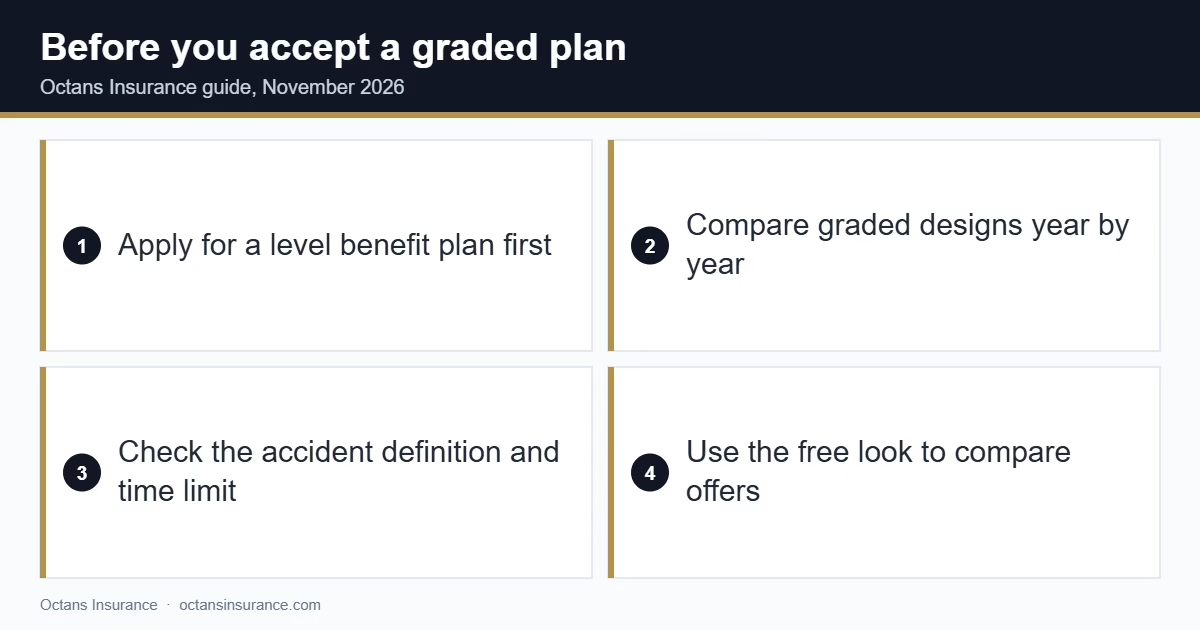
- Apply for a level benefit plan first. If you can answer the health questions, a level plan pays the full amount from the start. Our no exam life insurance guide covers the options.
- Compare several insurers. One company’s graded offer can be another company’s level approval.
- Answer every question accurately. The Texas Department of Insurance (TDI) says life policies have a two-year contestable period, so a wrong answer can cost more than a graded benefit. See our contestability period guide.
- Check group coverage at work. TDI says you usually don’t have to answer health questions or take a medical exam for a basic group life policy.
- If graded is your only offer, compare designs. Look at the year-by-year payout, the length of the graded period and the accident rules.
- Use the free look. In Missouri, a graded policy must state on its face that you can return it within 30 days for a full premium refund. Other states set their own free-look rules.
- Re-shop if your health improves. Keep the graded policy until a replacement is approved and in force. A new policy starts its own contestable period.
Questions to ask before you accept a graded plan
- How many years does the graded death benefit period last?
- Does the early benefit return premiums, and with what percentage or interest? Or does it pay a share of the face amount?
- Does the formula use premiums paid or earned premiums, and does it leave out policy fees?
- How does the policy define an accident, and how soon after an injury must death occur?
- On what date does the full benefit start, and does my state change the schedule?
- Does the policy build cash value, and what is the loan interest rate?
- Could I qualify for a level benefit plan with this or another insurer?
Graded death benefit: frequently asked questions
Is a graded death benefit the same as a waiting period?
Mostly. People often call the graded death benefit period a waiting period, but many designs still pay something. A death from illness in that window may return your premiums, sometimes with interest or an extra 10%, or pay a share of the face amount. Massachusetts describes these products as paying no or a limited benefit in the first few years, so read the schedule in your policy.
How long does a graded death benefit last?
Usually two or three years. Gerber’s guaranteed life plan and Bankers Life’s graded plan reach the full benefit after two years, while Royal Arcanum’s plan reaches it in year four. For whole life policies filed under the Insurance Compact standard, the reduced period can’t go beyond the first three policy years. Missouri also limits the period based on your age at issue.
Does a graded death benefit pay for accidental death?
In most cases, yes. The Insurance Compact standard requires the full face amount for accidental death at any time, though a policy may require death within 180 days of the accident. Missouri requires accidental death benefits of at least the face amount during the graded period, unless the policy already pays at least half the face amount in year one. Always check how your policy defines an accident.
What happens when the graded period ends?
The policy starts paying its full face amount for a death from illness, as long as it’s still in force. Your policy’s schedule shows exactly when that happens. Bankers Life’s graded plan, for example, pays 100% of the death benefit amount from year three, and Gerber’s plan pays the full amount after the first two years of coverage. Keep paying premiums so the policy doesn’t lapse.
Is graded death benefit whole life insurance worth it?
It depends on your health and your other options. If you can’t qualify for a level plan, a graded policy may be one of the few ways to get permanent coverage. If you can qualify for a level plan, taking on the early-death limit is hard to justify. Compare year-by-year payouts and premiums side by side before you decide, and ask whether a level offer is possible elsewhere.
Can I swap a graded policy for a level one later?
You can apply for a level policy at any time, and if your health has improved, you may qualify. Don’t cancel the graded policy until the new one is issued and past its free-look period. TDI notes that life policies have a two-year contestable period, and a new policy starts its own. Weigh that against how much of your graded period is left.

How a licensed Octans agent can help
A graded offer is a starting point, not the end of the search. A licensed Octans Insurance agent can compare level and graded plans from 120+ carriers, check whether your health history might earn a level benefit somewhere else, and lay out each policy’s year-by-year payout.
We can’t promise approval or a specific price. The insurer makes those decisions. What we can do is show you what each option would pay in years one, two and three before you sign.
Call (617) 935-9220 to talk with a licensed agent. If you’re paying for a funeral ahead of time, our guide to preneed vs final expense insurance compares the two approaches.
Keep Reading: Related Guides
- Life insurance with no waiting period
- Guaranteed issue life insurance
- Final expense insurance
- Simplified Issue Life Insurance
- Modified Whole Life Insurance
- Life Insurance Death Benefit
- Free Look Period Life Insurance
Important: Octans Insurance agents are licensed in the states in which they operate. Coverage availability and rates may vary by state. Premium examples, when provided, are illustrative samples from published sources, not quotes. Final rates are determined by the insurance carrier based on underwriting and applicable policy criteria. Policy terms, exclusions, limitations, riders, and availability vary by carrier and state.
About examples and tools: Hypothetical examples, sample rates, calculators and quizzes on this site are for general educational and illustrative purposes only. They are not quotes, offers of coverage, or guarantees of eligibility, approval, price or benefits, and they are not legal, tax, financial or medical advice. The insurance company decides eligibility and price; Medicare rules are set by CMS and the Social Security Administration.
See if a level benefit plan is an option for you
Start with a free, no-obligation quote review with a licensed Octans agent.
(617) 935-9220 | life@octansinsurance.com