
Accidental Death And Dismemberment Instructions – Massachusetts
Table of Contents
Make sure your family is financially protected today!
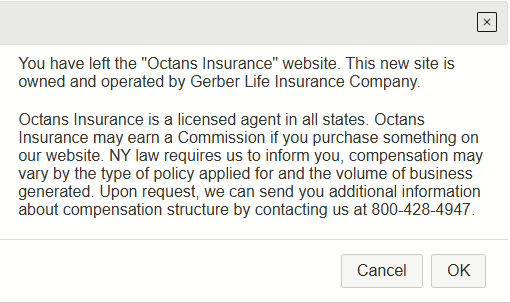
To Start Click OK
Choose State – Email is not required

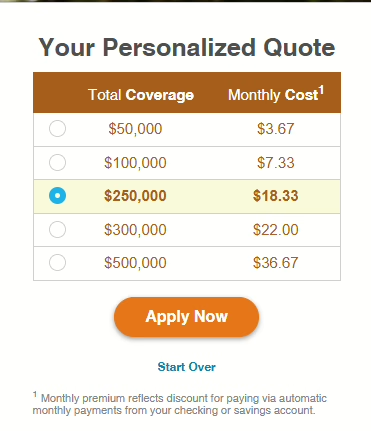
Choose which plan fits your budget
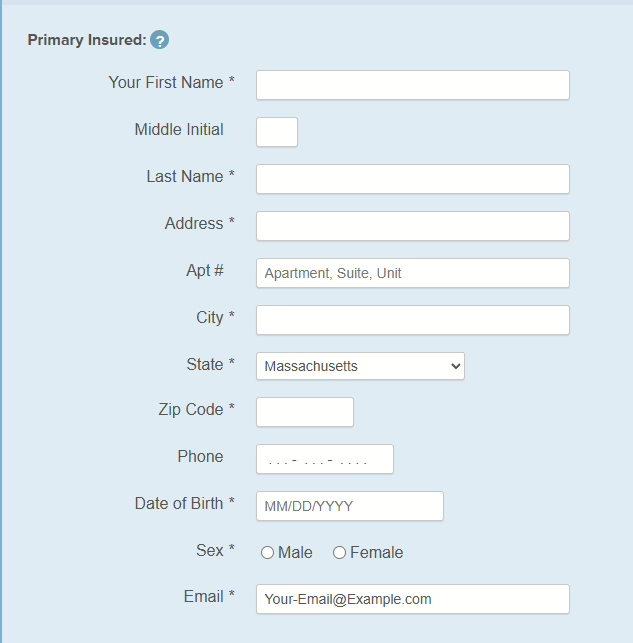
FILL OUT THE FORM – ALL “*” are REQUIRED FIELDS




Accidental death and dismemberment instructions for Massachusetts
These accidental death and dismemberment instructions walk you through our online enrollment form, one step at a time. The four short steps above are the core of the process. Below, each step is explained in more detail, followed by what AD&D covers, how to pick an amount, how to name a beneficiary, and what to do if the form gives you trouble.
If you’d rather have help, call a licensed agent at (617) 935-9220 or email life@octansinsurance.com. We can go through the form with you on the phone.
Step-by-step AD&D instructions
Step 1: To start, click OK
When the form opens, a prompt asks you to click OK. This simply starts the enrollment. If nothing appears, see the troubleshooting section below. A pop-up blocker is the usual cause.
Step 2: Choose your state (email is not required)
Select Massachusetts if you live here. Prices and policy terms are filed by state, so the state you pick decides which rates you see. Choose the state where you live, not where you work. The email field at this step is optional, so you can leave it blank and keep going.
Step 3: Choose which plan fits your budget
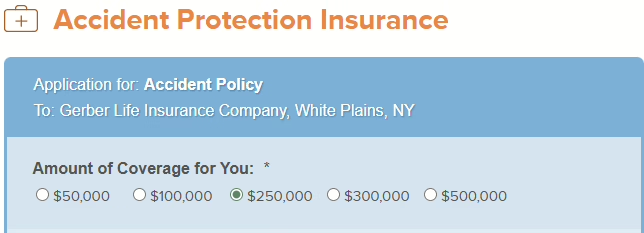
Next you’ll see coverage amounts with monthly prices. On our accident policy application, the choices for the primary insured run from $50,000 to $500,000. The price depends on the amount and on how you pay. See the Massachusetts table in the next section, and the worked example further down.
Step 4: Fill out the form (all * fields are required)
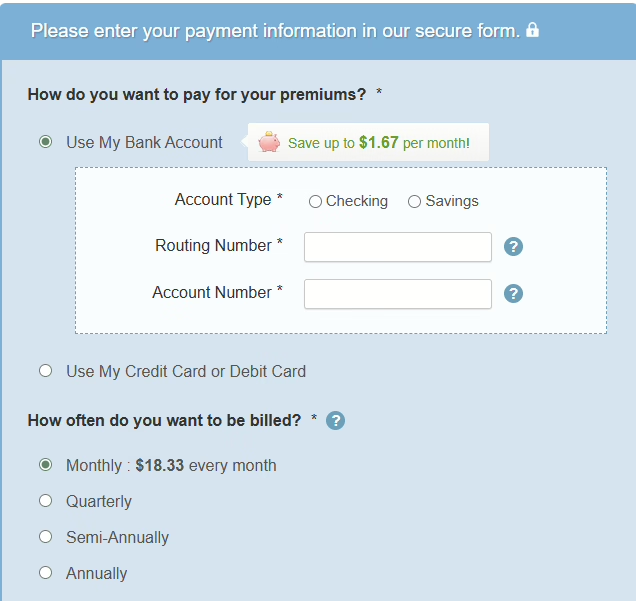
Every field marked with an asterisk (*) must be completed before the form will submit. Expect to enter:
- Your name, address, city, state, ZIP code, phone, date of birth, and sex.
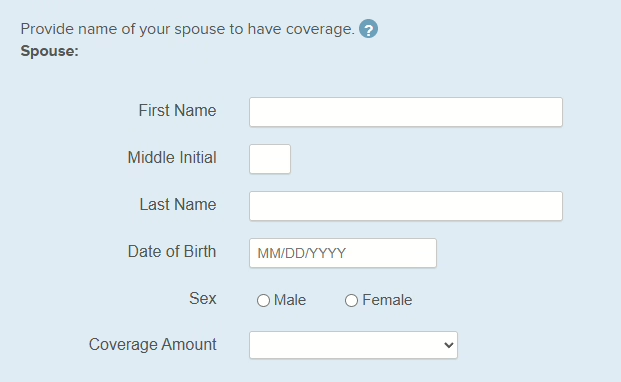
- Your coverage amount, plus a spouse amount if you want one (choose 0 if not).
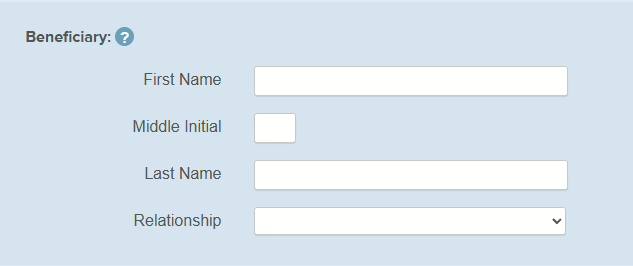
- At least one beneficiary’s name and relationship, with room for a second and a contingent beneficiary.
- Whether you plan to replace, cancel, or change any other accident insurance.
- Spouse and child details, if you are adding them.
- Your agreement to the authorization steps.
Following these accidental death and dismemberment instructions in order helps you avoid errors. A licensed Octans agent will follow up within 48 hours of your submission.
Massachusetts monthly rates shown on the form
These are the Massachusetts rates listed on our accident policy application. The form groups MA with NY and MN. Rates are samples, not a quote, and the carrier sets final terms.
| Coverage | Bank draft (ACH) | Credit/debit card |
|---|---|---|
| $50,000 | $3.67 | $4.00 |
| $100,000 | $7.33 | $8.00 |
| $200,000 | $14.67 | $16.00 |
| $300,000 | $22.00 | $24.00 |
| $400,000 | $29.33 | $32.00 |
| $500,000 | $36.67 | $40.00 |
The form also lists child coverage: $25,000 per child under 18, for 1 to 6 children, at $1.20 a month by bank draft or $1.31 a month by card.
What AD&D covers, and what it doesn’t
The NAIC glossary defines accidental death and dismemberment insurance as a contract that pays a stated benefit for death or dismemberment caused by an accident or specified kinds of accidents. In short, the cause has to be an accident.
The Maryland Insurance Administration adds that these policies do not pay due to sickness, and that benefits may not cover all of the costs of an injury. Death or dismemberment benefits are usually one-time cash payments.
How dismemberment benefits are commonly paid
AD&D policies commonly pay a share of the full amount for each listed loss, based on a schedule in the contract. Federal employees’ group life insurance is one published example. Per the OPM FEGLI handbook:
- Loss of one hand, one foot, or sight in one eye pays one-half of the AD&D amount.
- Loss of two or more of these in the same accident pays the full amount.
- Total benefits for one accident can’t exceed the full amount.
That is one program’s schedule, shown for illustration. Your policy may use different percentages or list different losses, so read its schedule when it arrives.
What AD&D commonly does not cover
- Death or disability from illness, such as heart disease or cancer.
- Self-inflicted injuries. Gerber Life’s Accident Protection page notes exclusions and limitations vary by state and to refer to your policy for details.
- Other exclusions commonly listed in AD&D contracts, such as losses while legally intoxicated. The FEGLI program, for example, excludes driving while intoxicated.
For a fuller comparison with life insurance, read our guides to accidental death and dismemberment insurance and AD&D protection.
How to choose a benefit amount: a worked example
Start with a simple question: if an accident took your life, what would your family need money for in the first few years? Then compare that number to the monthly price.
Hypothetical example: Dana lives in Massachusetts. Her household spends about $4,000 a month on essentials, and she wants her AD&D benefit to cover two years. She also has a $20,000 car loan.
- Two years of expenses: $4,000 x 24 = $96,000.
- Add the car loan: $96,000 + $20,000 = $116,000.
- The nearest choices on the form are $100,000 and $200,000.
Using the Massachusetts bank draft rates above, $100,000 costs $7.33 a month, or $7.33 x 12 = $87.96 a year. $200,000 costs $14.67 a month, or $14.67 x 12 = $176.04 a year. Dana picks $200,000 to clear her goal with room to spare.
Payment method matters a little too. By card, $200,000 costs $16.00 a month, or $192.00 a year. Paying by bank draft saves her $192.00 − $176.04 = $15.96 a year.
If her policy used a schedule like FEGLI’s, losing one hand in a covered accident would pay half: $200,000 x 0.5 = $100,000. Her actual schedule could differ.
Remember, AD&D pays only for accidents. If Dana’s family also needs protection against death from illness, she should look at term life insurance as her main coverage.
Naming a beneficiary
The death benefit goes to the people you name on the form, so take a minute to get this right:
- Use full legal names and the relationship, such as “spouse” or “son.”
- Add a contingent beneficiary. This person receives the benefit if your primary beneficiary dies before you.
- Think twice before naming a minor. An insurer may not be able to pay a large sum straight to a child. Ask your agent about options.
- Keep it current. Marriage, divorce, or a new child are good reasons to review your choices.
Note that dismemberment benefits are commonly paid to you, the insured, not your beneficiary. The FEGLI handbook, for example, says so for its program.
Who AD&D fits, and who should start with life insurance
AD&D is inexpensive because it pays in fewer situations than life insurance. Before you follow these accidental death and dismemberment instructions to enroll, it helps to be honest about what you need the coverage to do.
AD&D can be a good fit if you:
- Already have life insurance and want extra money for your family if a death is accidental.
- Drive a lot, work a physical job, or want a low-cost add-on while you shop for life coverage.
- Want coverage without a medical exam or health questions, and understand it pays only for covered accidents.
- Want a small benefit for listed injuries, such as the loss of a hand or eyesight, on top of other coverage.
Start with life insurance instead if you:
- Have people who depend on your income and no life coverage yet. Illness causes most deaths, and AD&D does not pay for illness.
- Want money for final expenses no matter how you die. A final expense policy pays for natural causes too.
- Have a health condition and assume you can’t qualify. Simplified issue and guaranteed issue policies exist for that situation; see our guaranteed issue guide.
Many families use both: a term or whole life policy as the foundation, and AD&D as a low-cost layer on top. If you are unsure which order makes sense, a licensed Octans agent can compare options with you at no cost. Call (617) 935-9220.
Questions to ask yourself before enrolling
- If I died from an illness tomorrow, would my family still be covered by something else?
- Is the monthly premium an amount I can keep paying without strain?
- Have I read which losses the schedule pays for, and the exclusions?
- Do my beneficiaries know this policy exists?
Massachusetts consumer help
If you have a question or complaint about any insurance product in Massachusetts, the Division of Insurance’s Consumer Services Unit can help. Per Mass.gov:
- Main line: (617) 521-7794
- Toll-free: (877) 563-4467
- Hours: Monday to Friday, 8:45 a.m. to 5:00 p.m.
You can also file an insurance complaint online. To check that an agent is licensed in the state, use the Division’s licensee lookup. Our agents’ license details are on our licenses page.
Troubleshooting the form
Most problems with the form come from a few simple causes. Try these AD&D instructions for fixing them:
- The form won’t submit. Scroll up and look for a field marked * that’s empty or highlighted. Date of birth and beneficiary fields are easy to miss.
- The OK prompt never appears. Allow pop-ups for octansinsurance.com, then reload the page.
- Fields look broken or don’t respond. Update your browser, make sure JavaScript is on, or try a different browser.
- Autofill put in the wrong data. Browsers sometimes drop old addresses or names into the wrong field. Check each entry before you submit.
- Your age is rejected. The application says applicants must be between 18 and 69.
- Still stuck? Call (617) 935-9220. An agent can take your details by phone.
After you enroll: what to keep and check
Once the form is submitted, a few simple habits make sure the coverage works when your family needs it:
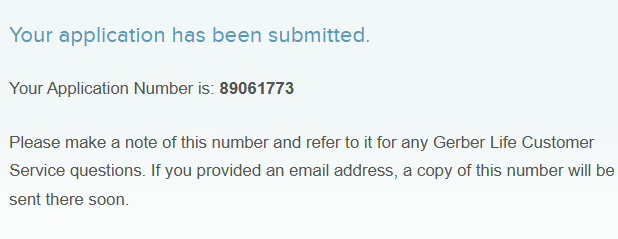
- Save your confirmation. Keep the confirmation email or a screenshot of the final screen, along with the date you applied.
- Read the policy when it arrives. Check your name, date of birth, coverage amount, and beneficiaries. Look at the schedule of losses and the exclusions section.
- Confirm the first payment. Coverage starts once the first premium is processed, so make sure the bank draft or card charge went through.
- Tell your beneficiary. A policy nobody knows about may never be claimed. Let the people you named know the policy exists and where to find it.
- Store a copy safely. Keep it with your will or other important papers.
If anything on the policy looks wrong, contact us right away so we can help you request a correction while you are still within the free look period.
AD&D instructions FAQs
Do I have to give my email address?
Not at the state selection step. The existing accidental death and dismemberment instructions note that email is not required there. Some later fields on the form may be marked required, so watch for the asterisk.
Is there a medical exam?
For the Gerber Life Accident Protection plan, the carrier says no medical exam or health questions are required for applicants aged 18 to 69.
When does coverage start?
Gerber Life says coverage begins when it successfully processes your first premium payment.
What if I change my mind?
Most policies include a free look period that lets you return the policy for a refund of premiums paid. The length varies by state and policy, so check the first pages of your contract or ask your agent.
I don’t live in Massachusetts. Can I still use these steps?
Yes. These accidental death and dismemberment instructions work the same way in other states. Just choose your own state in Step 2, and note that prices differ outside NY, MA, and MN. See our states page for where we’re licensed.
About examples and tools: Hypothetical examples, sample rates, calculators and quizzes on this site are for general educational and illustrative purposes only. They are not quotes, offers of coverage, or guarantees of eligibility, approval, price or benefits, and they are not legal, tax, financial or medical advice. The insurance company decides eligibility and price; Medicare rules are set by CMS and the Social Security Administration.