
Immigrant Families
Life Insurance for Immigrants: How Status, ID and Time Here Matter
Life insurance for immigrants depends less on citizenship than on your status, your time in the U.S., your tax ID and your ties here; this guide shows how insurers sort it out.
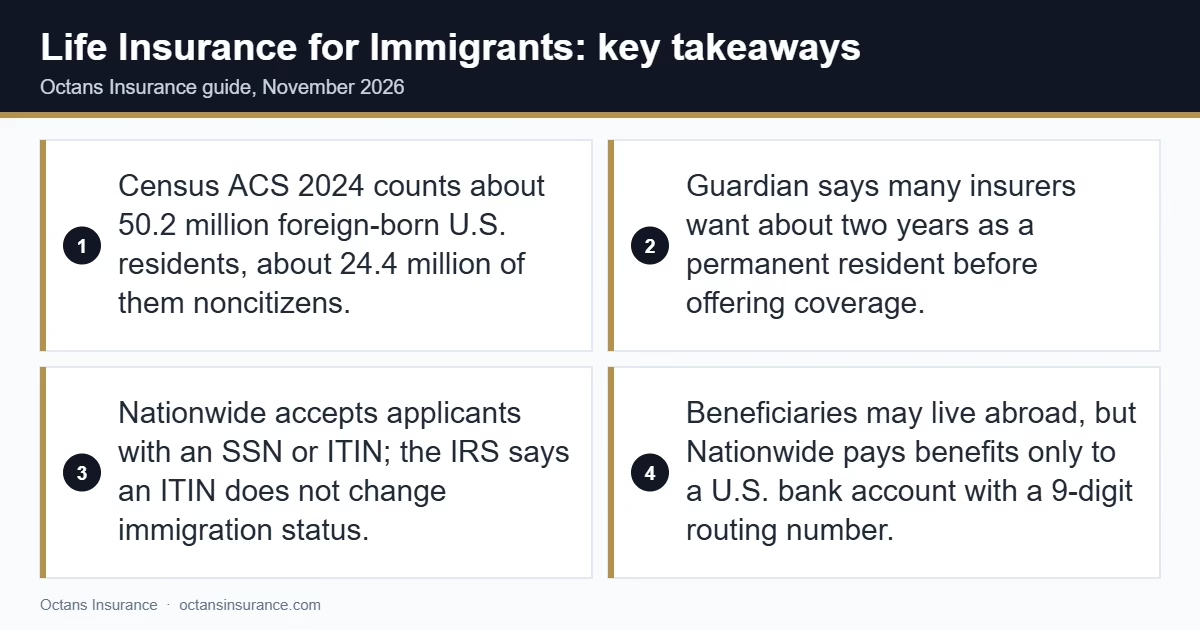
- Census ACS 2024 counts about 50.2 million foreign-born U.S. residents, about 24.4 million of them noncitizens.
- Guardian says many insurers want about two years as a permanent resident before offering coverage.
- Nationwide accepts applicants with an SSN or ITIN; the IRS says an ITIN does not change immigration status.
- Beneficiaries may live abroad, but Nationwide pays benefits only to a U.S. bank account with a 9-digit routing number.
Table of Contents
Life insurance for immigrants is available in the U.S., and you don’t have to be a citizen to apply. Each insurer sets its own rules. Most look at your immigration status, how long you’ve lived here, whether you have an SSN or ITIN, and your ties to the U.S. Green card holders (lawful permanent residents) usually have the most choices, visa holders have fewer, and people without lawful status have very few.
This page is general information, not legal or immigration advice. For questions about your status, check USCIS or speak with an immigration attorney. With life insurance for immigrants, the insurance company, not an agent, makes every underwriting decision, and no status guarantees an approval.
How does life insurance for immigrants work?
The policy itself works the same way it does for anyone. You choose an amount and a length, answer health questions, and may take a medical exam. The insurer then decides whether to offer coverage and at what price class. The difference is a set of extra questions about your status and your life in the U.S.
Guardian, a life insurer, puts it plainly on its page for non-permanent residents: “Your coverage options will vary depending on your visa type, duration, and the guidelines of the company issuing the policy.” Here is what insurers commonly review:
- Status. Guardian says U.S. citizens and green card holders “have an advantage” when they apply.
- Time in the U.S. Many carriers want you to have lived here for a while before they offer their best terms.
- A tax number. Guardian notes that insurers “often require a Social Security number or a Tax Identification Number.”
- Money ties. Guardian says many insurers require premiums to be paid in U.S. dollars from a U.S. bank account.
- Country and travel. Nationwide says on its foreign nationals page that it keeps a list of approved countries and requires proof of “a significant presence in the U.S.”
- Health, age and income. These matter for every applicant, citizen or not.
Where you sign also matters. Guardian says insurers will likely require you to sign the application, and complete steps such as a medical exam, in the United States.
Who needs life insurance for immigrants in the US?
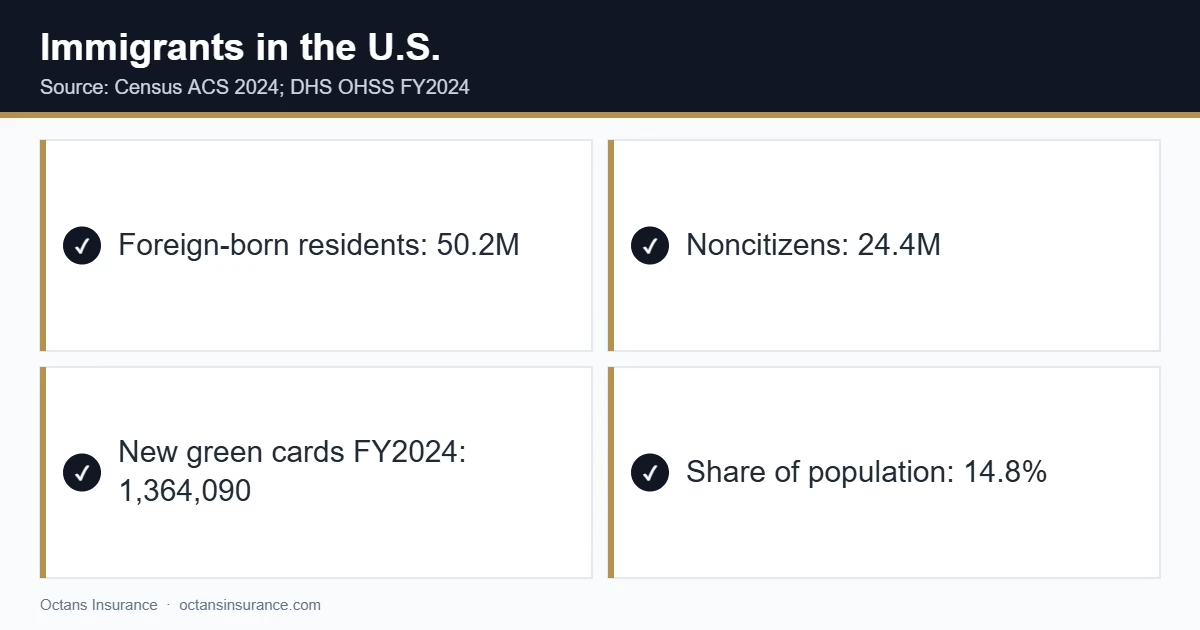
The market for life insurance for immigrants in the US is large. The Census Bureau’s American Community Survey counts about 50.2 million foreign-born residents in 2024, roughly 14.8% of the 340.1 million people in the country. About 24.4 million of them were not U.S. citizens (ACS 2024 1-year, table B05002).
New permanent residents arrive every year. The Department of Homeland Security counted 1,364,090 people who got lawful permanent resident status in fiscal year 2024 (DHS Yearbook 2024, Table 4).
The reasons to buy are the same ones any family has. A spouse and children may depend on one paycheck. A new mortgage or car loan would fall on a survivor. Many immigrants also support parents or siblings abroad, and that support stops if the earner dies. A policy replaces income that a family would otherwise lose.
How do insurers sort applicants by immigration status?
When you shop for life insurance for immigrants, you’ll find that most insurers place applicants into a few broad groups, then apply different rules to each. The table shows the general pattern from carriers’ public pages. It is not any one insurer’s rulebook, and rules change. For a deeper look at each status, read our guide to life insurance for non-US citizens.
| Immigration status | What insurers usually ask you to show | What to expect |
|---|---|---|
| U.S. citizen, including naturalized | U.S. ID and SSN | Standard underwriting |
| Green card holder (lawful permanent resident) | Green card, SSN, how long you’ve lived here | Usually the widest choice; many companies want about two years as a permanent resident |
| Conditional resident (2-year card) | Card, plus proof you filed to remove conditions on time | Some carriers consider it; each insurer sets its own rules |
| Work visa (H-1B, L-1, O-1, E) | Valid visa, employer, SSN, time in the U.S. | Guardian says these holders can often get coverage if they shop different companies |
| TN visa (USMCA) and TD | Valid status and U.S. ties | Guardian lists TN and TD among visas that can often get coverage |
| Dependent visas (H-4, L-2) | Valid status, household income | Some carriers list them (Nationwide’s page lists H4); others do not |
| Student visa (F-1, OPT) | Valid status, school or job details | Guardian says few companies issue coverage to students |
| DACA, TPS, asylee or refugee | Work permit (EAD), SSN or ITIN, time here | Limited; depends entirely on the carrier |
| No lawful status | Varies | Very limited; no option can be promised |
| Living mainly outside the U.S. | Country of residence, U.S. assets | Separate foreign-national programs with country limits |
Sources: Guardian non-permanent residents page (updated Nov. 13, 2025) and foreign nationals page (updated Nov. 17, 2025); Nationwide foreign nationals page, read November 2026.
Two-year residence comes from Guardian’s foreign nationals guide, which says “many insurance companies require a minimum of two years as a permanent resident before providing coverage.” Other carriers ask for less time, so it pays to compare.
Can an immigrant get life insurance without a Social Security number?
Sometimes. Whether an immigrant can get life insurance without an SSN usually turns on whether you have an ITIN. The IRS describes an ITIN as “a 9-digit number the IRS issues” for federal tax purposes, for people who aren’t eligible for a Social Security number. The IRS also says an ITIN does not authorize work in the U.S. and does not provide or change immigration status.
Some insurers accept it. Nationwide says non-U.S. citizens can apply “if they have a Social Security number (SSN) or an Individual Taxpayer Identification Number (ITIN).” Guardian mentions an SSN or a Tax Identification Number, or a W-8 form for people who are not U.S. taxpayers.
An ITIN only answers the tax ID question. Insurers still ask about your status, photo ID, time in the U.S. and bank account. If you have neither an SSN nor an ITIN, your choices narrow sharply. These carrier names are examples from public pages, not a list of insurers Octans offers.
What types of life insurance for immigrants make sense?
Many workers already have some coverage through a job. Be careful about relying on it alone. The Texas Department of Insurance (TDI) says “If you get life insurance through your employer, coverage typically ends when you leave your job.” If your visa is tied to that employer, a job loss can hit your status and your coverage at once.
- Term life. Pays a death benefit if you die within a set number of years, such as 20 or 30. It usually gives the most coverage per dollar, so it fits young families and mortgages.
- Whole life. Lasts your whole life and builds cash value, but costs much more for the same amount.
- Final expense. A small whole life policy meant for funeral costs. It often suits older relatives who have green cards. See our final expense insurance guide.
- Group life at work. Easy to get, but tied to the job.
Before you buy, read the residence and travel terms. Guardian warns that “some policies may only be valid as long as you remain a US resident.” If you might move back home one day, ask how the policy treats that before you sign.
How much coverage do immigrant families need?
Sizing life insurance for immigrants starts the same way it does for anyone: the money your family would lose and the debts they would owe. Then subtract what you already have. Our guide to how much life insurance you need walks through the full method. The example below shows how support for family abroad fits in.
Hypothetical example: Ana is 34, a green card holder, and earns $60,000 a year. She has two children and owes $250,000 on her home. She also sends her parents $400 a month.
- 10 years of income: $60,000 × 10 = $600,000
- Mortgage payoff: $250,000
- Education fund for the children: $50,000
- 10 years of support for her parents: $400 × 12 × 10 = $48,000
- Total need: $600,000 + $250,000 + $50,000 + $48,000 = $948,000
- Minus group life at work (her plan pays one year’s salary) and savings: $60,000 + $20,000 = $80,000
- Gap to cover: $948,000 − $80,000 = $868,000
Ana might apply for $850,000 to $900,000 of term coverage. Since her group life ends if she leaves her job, she may decide not to count it at all. These figures are made up to show the math. They are not a quote, and the insurer decides how much it will offer.
Can a non-US citizen be a beneficiary?
Generally, yes. Guardian says “Generally speaking, a beneficiary does not need to be a US citizen.” Nationwide says “Beneficiaries of life insurance policies do not necessarily need to be U.S. residents.” That lets you name parents, a spouse or children who live in another country.
There are practical limits when you set up life insurance for immigrants with family overseas. Nationwide says benefits “may only be sent to a U.S. bank account with a 9 digit routing number.” Guardian says a beneficiary abroad typically must have an “insurable interest” in your life, such as close family, and that international beneficiaries may face tax implications. A tax professional can explain those.
- Use full legal names that match passports.
- Add a contingent beneficiary, ideally one who lives in the U.S.
- Keep current addresses and phone numbers on file.
- Tell your beneficiaries the policy exists and where to find it.
How to apply for life insurance for immigrants
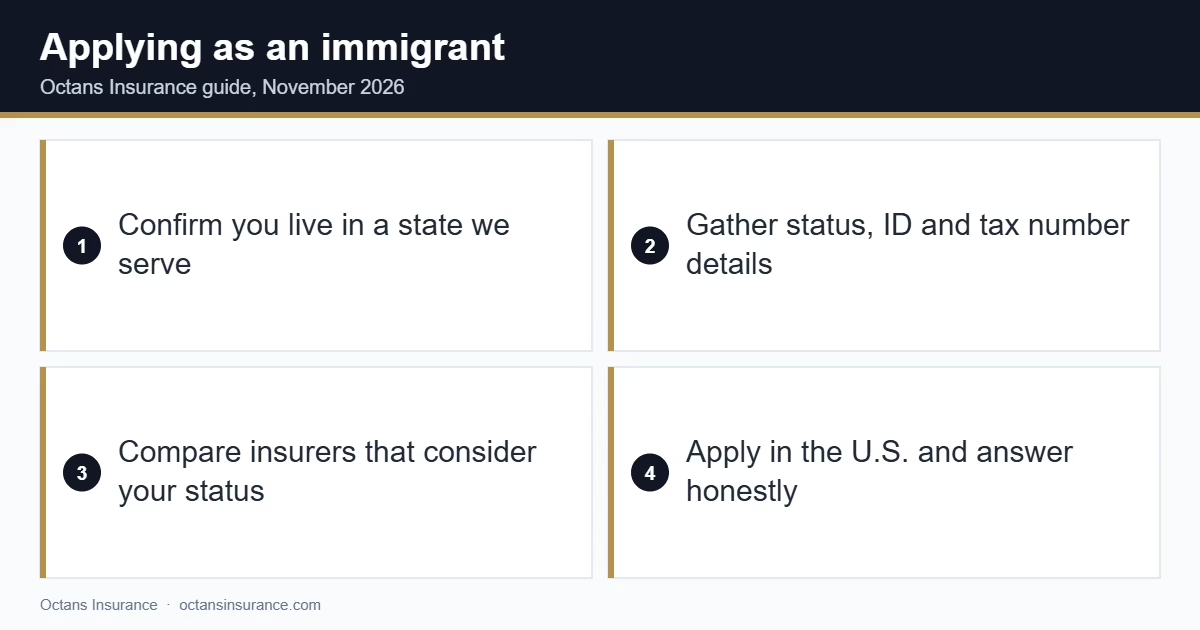
- Confirm where you live. An agent can only help residents of states where the agent is licensed.
- Gather your documents (checklist below), but don’t send copies yet.
- Pick an amount and a term using the steps above.
- Compare insurers that consider your status. Rules differ by visa type, time in the U.S. and country, so one “no” doesn’t mean every insurer will say no.
- Apply in the U.S. and answer every question honestly. TDI notes that “Life insurance policies have a two-year contestable period.” A wrong answer can cost your family the claim.
- Read the policy when it arrives, including the residence and travel terms.
Documents insurers commonly ask about:
- Green card, or passport with a valid visa
- I-94 record and work permit (EAD), if you have one
- SSN card or ITIN letter
- U.S. driver’s license or state ID
- Proof of a U.S. address and a U.S. bank account
- Pay stubs or tax returns
- Your doctor’s name, and English translations of foreign medical records (Guardian says insurers will likely want a certified translation)
Protect your information. Never send passport, visa or I-94 images, or your SSN or ITIN, through a web form or email. A licensed agent will explain the insurer’s secure application step.
Life insurance for immigrants by state
Octans is licensed in 19 states: MA, GA, FL, TX, NC, PA, OH, MS, NJ, MI, ME, AL, MD, MO, TN, VA, WY, SC and AZ. We picked the 10 states below for our first state guides, based on immigrant population, new green cards and work-visa activity. Those guides, with each state’s guaranty association limit, free-look period and insurance department contacts, are on the way.
| State | Foreign-born residents (2024) | Share of population | New green cards (FY2024) |
|---|---|---|---|
| Texas | 5,762,477 | 18.4% | 160,400 |
| Florida | 5,392,412 | 23.1% | 219,470 |
| New Jersey | 2,376,424 | 25.0% | 58,180 |
| Massachusetts | 1,337,811 | 18.7% | 36,180 |
| Georgia | 1,333,177 | 11.9% | 35,100 |
| Virginia | 1,193,581 | 13.5% | 37,850 |
| North Carolina | 1,093,166 | 9.9% | 28,120 |
| Pennsylvania | 1,090,675 | 8.3% | 34,850 |
| Maryland | 1,070,852 | 17.1% | 31,320 |
| Michigan | 778,787 | 7.7% | 20,750 |
Sources: Census Bureau, ACS 2024 1-year estimates, table B05002 (share calculated from the same table); DHS Office of Homeland Security Statistics, Yearbook 2024, Table 4 (rounded to the nearest 10).
Florida had more new lawful permanent residents in fiscal year 2024 than any other state, at 219,470. New Jersey had the highest foreign-born share of these 10 states, at 25.0%.
En español: lea nuestra guía de seguro de vida para inmigrantes, o las guías estatales para Texas, Florida y Nueva Jersey.
Life insurance for immigrants: frequently asked questions
Can an immigrant get life insurance in the U.S.?
Often, yes. Green card holders usually have the most options, and many work visa holders can find coverage by comparing insurers. Each company sets its own rules on status, time in the U.S., tax ID and country of citizenship. The insurer makes the final decision, so no status guarantees approval. Comparing several carriers gives you the best chance of finding one that considers your situation.
Do I need a green card to get life insurance?
No. A green card helps, and Guardian says permanent residents have an advantage. Some carriers also consider holders of certain work and dependent visas, such as H-1B, L-1 and TN visa (USMCA). They usually ask for a valid visa, an SSN or ITIN, a U.S. bank account and some time living here. Rules for DACA, TPS and other statuses are narrower and vary by carrier.
Is life insurance more expensive for immigrants?
Life insurance for immigrants can cost more, depending on status. Guardian says premiums for non-permanent residents are often higher due to perceived additional risks. Green card holders who have lived here a while are often priced like citizens, based on age, health and habits. Country of citizenship and travel plans can also affect the price class. The only way to know your price is to apply and see the insurer’s offer.
Can I buy life insurance on my parents who live abroad?
It is usually hard. Insurers generally want the insured person to have real U.S. ties, and Guardian says insurers will likely require the application to be signed in the U.S. Parents who are green card holders living here have far more options, including final expense coverage. Tourist visas don’t appear on Guardian’s or Nationwide’s public visa lists. You can still name parents abroad as beneficiaries on your own policy.
Is life insurance through my job enough?
Usually not on its own. The Texas Department of Insurance says employer coverage typically ends when you leave your job, and basic group plans often skip health questions but come in set amounts. For immigrants whose visa depends on one employer, a job loss can end both at once. Many families keep group life as a base and add an individual term policy they own.
Are there options for undocumented immigrants?
Options are very limited and depend on the carrier. Some insurers accept an ITIN in place of an SSN, but they still ask about status, ID, time in the U.S. and bank accounts, so choices for people without lawful status are few. We can’t promise coverage. Be wary of anyone who guarantees approval. For questions about your status, talk with an immigration attorney.

How Octans can help you explore options
Octans is an independent agency, and our licensed agents compare life insurance for immigrants across plans from 120+ insurance carriers. Not sure which insurance companies may consider your visa category? Octans can help you explore potential options based on your individual circumstances.
Our short screening form asks for your state, age range, coverage amount, visa category, time in the U.S., whether you have an SSN or ITIN (yes or no only), and a phone number or email. Each question has a reason. Carriers set rules by status, residence time and ID, and your state decides whether we can help. Octans agents can help residents of the states where we are licensed.
Please don’t send documents or ID numbers through the form or by email. An agent will call you, explain which insurers may consider your situation, and walk you through the secure application step. You can also reach us at (617) 935-9220.
Keep Reading: Related Guides
- Life insurance for non-US citizens
- How much life insurance do I need
- Final expense insurance
- Life Insurance for Green Card Holders
- Life Insurance for H1B Visa Holders
- Life Insurance for Immigrants in Florida
- Life Insurance for Immigrants in Georgia
- Life Insurance for Immigrants in Maryland
- Life Insurance for Immigrants in Massachusetts
- Life Insurance for Immigrants in Michigan
- Life Insurance for Immigrants in New Jersey
- Life Insurance for Immigrants in North Carolina
- Life Insurance for Immigrants in Pennsylvania
- Life Insurance for Immigrants in Texas
- Life Insurance for Immigrants in Virginia
- Life Insurance for L1 Visa Holders
- Life Insurance for TN Visa Holders
- Life Insurance With ITIN
- Life Insurance Without Green Card
Important: Octans Insurance agents are licensed in the states in which they operate. Coverage availability and rates may vary by state. Premium examples, when provided, are illustrative samples from published sources, not quotes. Final rates are determined by the insurance carrier based on underwriting and applicable policy criteria. Policy terms, exclusions, limitations, riders, and availability vary by carrier and state.
About examples and tools: Hypothetical examples, sample rates, calculators and quizzes on this site are for general educational and illustrative purposes only. They are not quotes, offers of coverage, or guarantees of eligibility, approval, price or benefits, and they are not legal, tax, financial or medical advice. The insurance company decides eligibility and price; Medicare rules are set by CMS and the Social Security Administration.
Explore life insurance options based on your visa status
Answer a few short questions, and a licensed Octans agent will look for insurers that may consider your situation.
(617) 935-9220 | life@octansinsurance.com