
Visa Holders
Life Insurance for H1B Visa Holders and Their H-4 Families
Life insurance for H1B visa holders can protect a one-income family through job changes, a green card wait or a move home, if you pick a policy whose terms fit your plans.
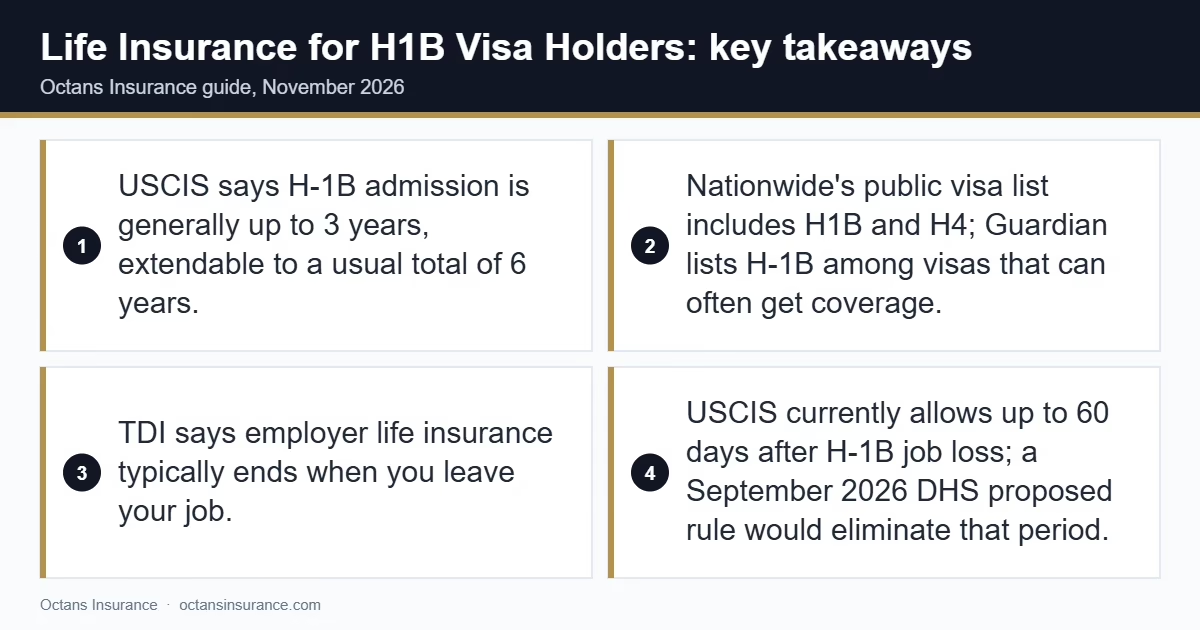
- USCIS says H-1B admission is generally up to 3 years, extendable to a usual total of 6 years.
- Nationwide’s public visa list includes H1B and H4; Guardian lists H-1B among visas that can often get coverage.
- TDI says employer life insurance typically ends when you leave your job.
- USCIS currently allows up to 60 days after H-1B job loss; a September 2026 DHS proposed rule would eliminate that period.
Table of Contents
Life insurance for H1B visa holders is available from a number of U.S. insurers, including term policies that last 20 or 30 years. Each insurer sets its own rules. Many want a valid H-1B, a Social Security number, a U.S. bank account and some time living here. Your country of citizenship, travel plans and health also shape the offer.
This page is general information, not legal or immigration advice. For questions about your visa or status, check with USCIS or an immigration attorney. The insurer makes the underwriting decision, and no visa type guarantees coverage.
Can H-1B holders get life insurance?
Yes, many can. Guardian, a life insurer, lists “H1B – temporary work visa for someone in a specialty occupation” among the visa types that can often get coverage, on its page for non-permanent residents. Nationwide’s foreign nationals page lists H1B and H4 among its valid visa types, with the note that “Acceptable visa types vary by life insurance product.”
These are examples from carriers’ own public pages, not a list of insurers Octans offers. For other statuses, see our guide to life insurance for non-US citizens. Other carriers have their own lists, and some don’t insure visa holders at all.
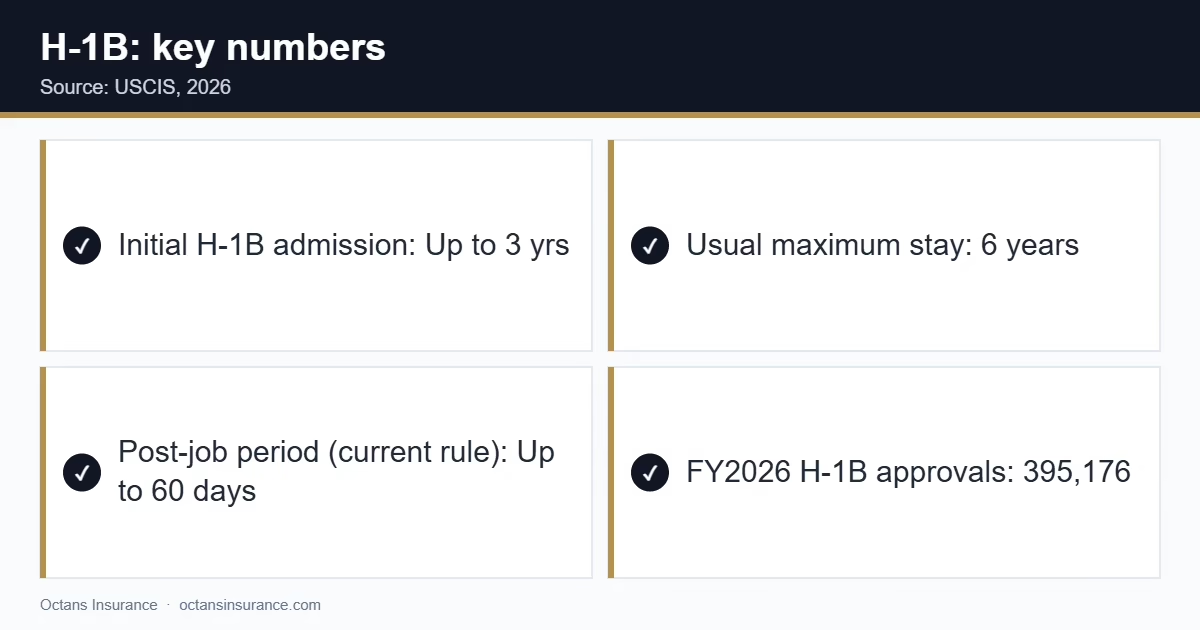
The H-1B itself is a temporary work status. USCIS says it applies to people who “perform services in a specialty occupation,” which generally needs a bachelor’s degree or higher. You “may generally be admitted for a period of up to 3 years,” with extensions to a usual total of 6 years. Insurers know this, so they look for signs that you plan to stay.
What insurers check on life insurance for H1B visa holders
Shopping for life insurance in USA for H1B visa holders means the usual health and money questions, plus a set about your visa. Guardian says “it’s essential to ensure that your visa is up to date and valid when purchasing life insurance.” Here is what usually comes up:
- Visa and I-94 dates. A visa close to expiring, with no extension filed, can be a problem.
- Time in the U.S. Some carriers want you to have lived here for a period before they offer coverage or their best price class. The required time varies by insurer.
- SSN. Most H-1B workers have one. Guardian notes insurers “often require a Social Security number or a Tax Identification Number.”
- U.S. bank account. Guardian says many insurers require premiums paid in U.S. dollars from a U.S. bank account.
- Country of citizenship and travel. Nationwide says it “assesses the current political and social stability of your home country” when it reviews an application.
- Income and job. Your salary supports the coverage amount you ask for.
Price is also a factor. Guardian says “premiums for non-permanent residents are often higher due to perceived additional risks.” Comparing several insurers is the main way to manage that.
Life insurance for H1B visa holders’ families: H-4 spouses and children
USCIS says that for H-1B workers, “Your spouse and unmarried children under 21 years of age may seek admission in the H-4 nonimmigrant classification.” Many H-1B families have one paycheck, so the H-1B worker’s policy is the first priority.
Life insurance for H1B visa holders should also cover a spouse who stays home. Childcare, housework and the support that lets the H-1B worker do the job all cost money to replace. Some carriers consider H-4 applicants; Nationwide’s list includes H4. Others do not list H-4 at all, so ask before you apply.
Work rules for H-4 spouses matter too. Only certain H-4 spouses can apply for work permission, for example when the H-1B worker is the principal beneficiary of an approved Form I-140. USCIS adds, “You will not be authorized to work until USCIS approves your Form I-765” (USCIS H-4 work permits). If your H-4 spouse earns income, that income can support a larger policy on them. Our guide to life insurance for a spouse covers how to size it.
Children are usually covered through a child rider on a parent’s policy or a small separate policy. Riders and limits vary by insurer.
From F-1 to OPT, STEM OPT and H-1B: when can you buy?
Many H-1B workers start as F-1 students. Coverage is hard to find on a student visa. Guardian says “Few companies will issue coverage for student visa holders.”
The next steps can change that. USCIS describes Optional Practical Training (OPT) as “temporary employment that is directly related to an F-1 student’s major area of study.” It allows up to 12 months, and students with certain STEM degrees “may apply for a 24-month extension.” Students with a timely filed H-1B petition whose status would run out before the change to H-1B, typically on Oct. 1, may be eligible for a “cap-gap” extension.
| Stage | Typical life insurance picture |
|---|---|
| F-1 student | Very few insurers; mostly no individual coverage |
| OPT or STEM OPT | A few insurers may consider it; many wait for H-1B |
| Working on an H-1B | Many more insurers consider it, often after some time in the U.S. |
| Green card holder (lawful permanent resident) | Usually the widest choice, similar to citizens |
Sources: USCIS OPT page (published Nov. 25, 2024); Guardian non-permanent residents page (updated Nov. 13, 2025). The middle column is a general market pattern, not any one insurer’s rule.
If you’re on OPT, it may pay to start shopping as soon as your H-1B status begins rather than waiting. Your age and health on the day you apply set your price.
Employer group life vs an individual policy
Many H-1B employers offer group life as a benefit. It’s useful, but it belongs to the job. The Texas Department of Insurance (TDI) says “If you get life insurance through your employer, coverage typically ends when you leave your job.” For an H-1B worker, a job change already brings visa paperwork. Losing coverage at the same moment adds risk.
| Feature | Employer group life | Individual term policy |
|---|---|---|
| Who owns it | The employer’s plan | You |
| Health questions | TDI says usually none for basic coverage | Yes, often with an exam |
| Leaving the job | Typically ends | Stays in force while premiums are paid |
| Amount | Set by the plan | You choose, within the insurer’s limits |
| Price | Basic coverage often employer-paid | You pay; locked for the term on level term |
Source: TDI life insurance guide; plan details vary by employer. See our group life and health insurance guide for more.
Most families use both. Group life is a base, and a term life policy you own fills the gap that would stay open if the job ends.
What happens if you change employers or lose your job?
An individual policy you own doesn’t depend on your employer. As long as you keep paying the premium, a job change by itself doesn’t cancel it. What does change is your immigration timeline.
Under current rules, USCIS says that if your H-1B job ends, you “may have up to 60 consecutive days or until the end of your authorized validity period, whichever is shorter” to find new employment, change status or leave the country (USCIS H-1B page). The regulation, 8 CFR 214.1(l)(2), allows this once per validity period, and you can’t work during it unless otherwise authorized.
That could change. On Sept. 11, 2026, DHS published a proposed rule, “Eliminating the Discretionary 60-Day Grace Period,” that would remove this period for H-1B, L-1, O-1, TN visa (USMCA) and certain other workers and their dependents (Federal Register). As of November 2026 it is a proposal, not a final rule. Check with USCIS or an attorney for the rule in effect when you need it.
USCIS also says that under H-1B portability you may start working for a new employer once it properly files a non-frivolous H-1B petition, or as of the requested start date, whichever is later.
- Keep paying premiums from your U.S. bank account during any gap.
- Don’t cancel your individual policy to save money while you job hunt.
- Know your policy’s grace period for late premiums; see our guide on grace periods and lapse.
- Ask an immigration attorney about your status timeline.
What happens if you leave the US or your visa ends?
Life insurance for H1B visa holders often outlasts the visa, so read the policy before you buy it. Guardian warns that “some policies may only be valid as long as you remain a US resident.” Others stay in force wherever you live, as long as premiums are paid. Ask the insurer to confirm, in writing, how the policy treats a move abroad.
Your visa end date matters when you apply, not usually after. Insurers check that your visa is valid on the day you buy. A 20- or 30-year term can outlast a 6-year H-1B. Many H-1B workers apply for green cards, and many others move home, so the right question is how the policy behaves in both cases.
Be honest about travel plans on the application. Every policy has a contestable period; TDI says “Life insurance policies have a two-year contestable period.” Our contestability guide explains what that means for your family.
How much term life insurance for H1B visa holders do you need?
H-1B workers are a big group. The USCIS H-1B Employer Data Hub shows 395,176 approvals in fiscal year 2026 (initial plus continuing). Counted by the employer’s (petitioner’s) state, that includes 45,625 in Texas, 28,227 in New Jersey, 27,961 in Virginia and 17,087 in Massachusetts.
Most of those workers support families on one income. Term life insurance for H1B visa holders is usually sized to that family, not to the worker alone. Size coverage to your debts and your household’s needs, not to your visa’s end date. Our how much life insurance guide shows the full method.
Hypothetical example: Ravi is 31 and works on an H-1B. He earns $120,000. His wife is on H-4 and isn’t working, and they have a one-year-old. They owe $350,000 on a home.
- 10 years of income: $120,000 × 10 = $1,200,000
- Mortgage payoff: $350,000
- Child’s education fund: $100,000
- Total need: $1,200,000 + $350,000 + $100,000 = $1,650,000
- Minus savings: $50,000
- Gap: $1,650,000 − $50,000 = $1,600,000
Ravi’s group life (say $240,000, two times salary) ends if he leaves the job, so he doesn’t count it. He might apply for about $1.6 million of 25-year term on himself and a smaller policy on his wife. These numbers are made up to show the math, not a quote. The insurer decides how much it will issue.
How to apply for life insurance as an H-1B worker
- Confirm your state. Agents can only help residents of states where they’re licensed.
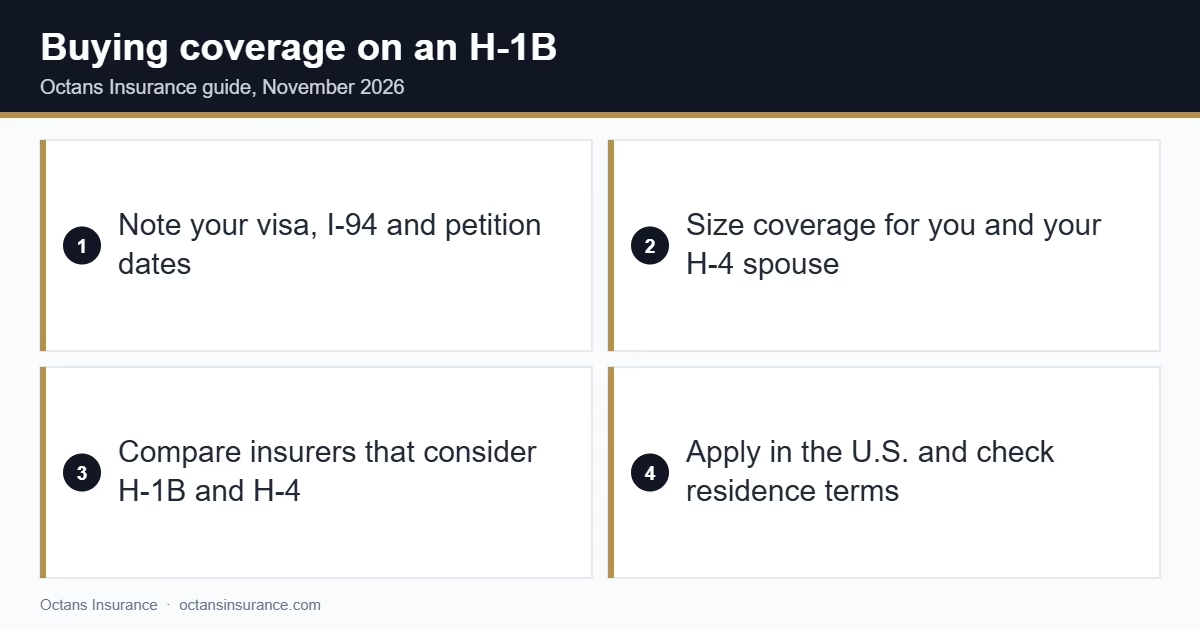
- Check your dates. Note your visa, I-94 and petition end dates, and any pending extension.
- Pick an amount and term for yourself, then decide on coverage for your H-4 spouse.
- Compare insurers that consider H-1B and H-4. Rules differ by country of citizenship and time in the U.S.
- Apply and take the exam in the U.S. Guardian says insurers will likely require you to sign the application, and complete steps such as a medical exam, in the United States.
- Review the policy when it arrives, including residence and travel terms.
Protect your information. Never send passport, visa or I-94 images, or your SSN or ITIN, through a web form or email. A licensed agent will explain the insurer’s secure application step.
Life insurance for H1B visa holders: frequently asked questions
Can H-1B holders get term life insurance in the USA?
Many can. Several insurers consider H-1B workers for term coverage, often after some time living in the U.S. and with a valid visa, an SSN and a U.S. bank account. Each insurer sets its own rules on visa type, time in the U.S. and country of citizenship. The insurer makes the decision, so no one can promise approval before you apply.
Can my H-4 spouse get life insurance?
Some carriers consider H-4 applicants. Nationwide’s public visa list includes H4, while other insurers don’t list it. A spouse with no income can usually get a smaller amount than an earning spouse, because insurers tie coverage to the household’s needs. Comparing carriers matters more for H-4 spouses than for H-1B workers, since fewer insurers accept them.
Does my policy end if I lose my H-1B job?
An individual policy you own doesn’t end because you lose a job, as long as you keep paying premiums. Employer group life is different: TDI says it typically ends when you leave your job. Your immigration status is a separate question. USCIS currently describes a period of up to 60 days after H-1B employment ends, and a 2026 DHS proposed rule would eliminate it. Ask an attorney about your case.
Can I keep my policy if I move back to my home country?
It depends on the policy. Guardian warns that some policies may only be valid as long as you remain a U.S. resident. Others continue anywhere if premiums are paid, often from a U.S. bank account. Ask the insurer, in writing, before you buy, and keep the answer with your policy papers.
Is life insurance more expensive on an H-1B?
It can be. Guardian says premiums for non-permanent residents are often higher. Your price also depends on age, health, tobacco use, the amount, the term and, at some insurers, your country of citizenship. Applying younger and healthier usually costs less, which is why many H-1B workers buy soon after they start work on the visa.
Should I wait for my green card before buying?
Not necessarily. A green card can open more options later, but waiting means you’re older when you apply, and your family is unprotected in the meantime. Many people buy a term policy on the H-1B and review it after the green card arrives. Your existing policy’s terms decide what happens when your status changes.

How Octans can help H-1B families
Octans is an independent agency. Our licensed agents compare life insurance for H1B visa holders across plans from 120+ insurance carriers, so we can look for insurers whose rules fit your visa and history. Not sure which insurance companies may consider your visa category? Octans can help you explore potential options based on your individual circumstances.
Our short screening form asks for your state, age range, coverage amount, visa category, time in the U.S., whether you have an SSN or ITIN (yes or no only), and a phone number or email. Carriers set rules by status, residence time and ID, so these answers tell us which insurers to check first. Octans agents can help residents of the states where we are licensed.
Don’t send documents or ID numbers through the form or by email. An agent will call you and explain the secure application step. You can also call (617) 935-9220.
Keep Reading: Related Guides
- Life insurance for non-US citizens
- Term life insurance
- Life insurance for a spouse
- Life Insurance for Immigrants
- Life Insurance for Green Card Holders
- Life Insurance With ITIN
- Life Insurance Without Green Card
- Life Insurance for L1 Visa Holders
- Life Insurance for TN Visa Holders
Important: Octans Insurance agents are licensed in the states in which they operate. Coverage availability and rates may vary by state. Premium examples, when provided, are illustrative samples from published sources, not quotes. Final rates are determined by the insurance carrier based on underwriting and applicable policy criteria. Policy terms, exclusions, limitations, riders, and availability vary by carrier and state.
About examples and tools: Hypothetical examples, sample rates, calculators and quizzes on this site are for general educational and illustrative purposes only. They are not quotes, offers of coverage, or guarantees of eligibility, approval, price or benefits, and they are not legal, tax, financial or medical advice. The insurance company decides eligibility and price; Medicare rules are set by CMS and the Social Security Administration.
Explore life insurance options based on your visa status
Answer a few short questions, and a licensed Octans agent will look for insurers that may consider your situation.
(617) 935-9220 | life@octansinsurance.com