
Life Insurance
Life Insurance for Spouse: How to Cover Your Wife or Husband
A practical guide to life insurance for spouse coverage: consent rules, how much to buy, valuing a stay-at-home spouse’s work honestly, policy and rider options, ownership choices, and what changes after a divorce.
- Your spouse generally must consent in writing; in Florida, signing the application counts as written consent (Fla. Stat. § 627.404).
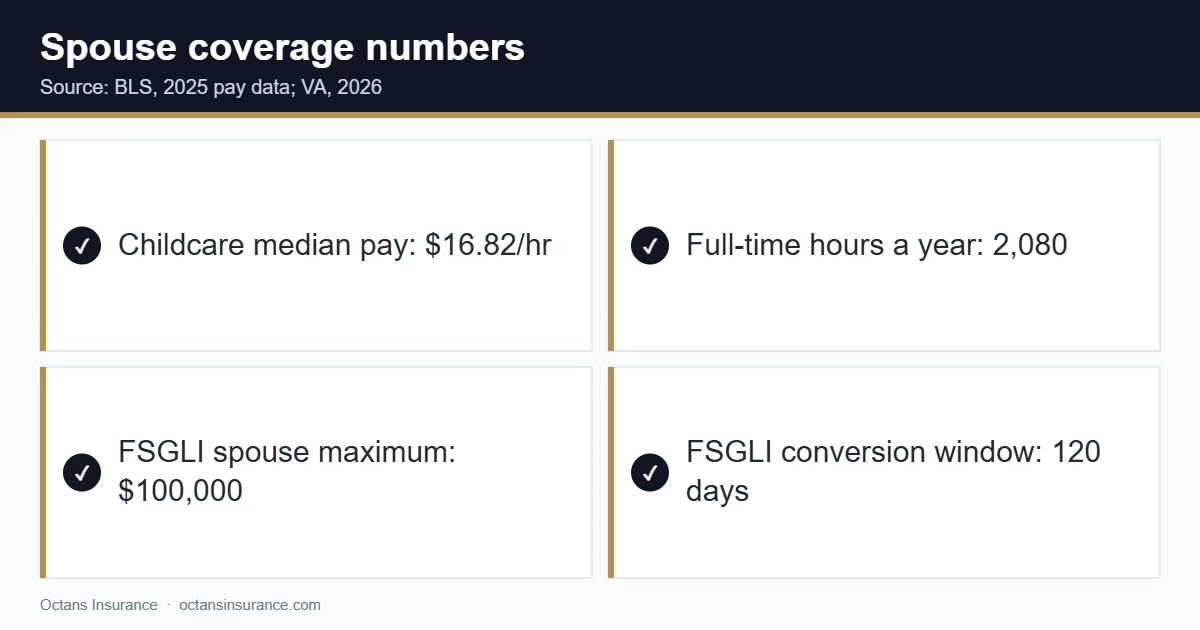
- BLS lists 2025 median pay for childcare workers at $16.82 an hour, a fair base for valuing a stay-at-home spouse’s childcare.
- A spousal rider adds term life insurance for your spouse to your own policy (Texas Department of Insurance).
- Family SGLI covers a military spouse for up to $100,000, but never more than the service member’s SGLI (VA).
Table of Contents
Make sure your family is financially protected today!
Yes, you can buy life insurance for spouse coverage, but your spouse generally must consent in writing, usually by signing the application. Size the policy to what your family would lose: their income, plus the cost of replacing childcare and household work. Options include two separate policies, a spousal rider on your policy, or one joint policy.
This guide covers consent, how much coverage makes sense, what a stay-at-home spouse’s work is worth, ownership choices, and what changes in a divorce.
Can you buy life insurance on your spouse without consent?
Generally, no. Two rules apply. First, you need an insurable interest, meaning a real stake in the person staying alive. Florida’s law, for example, recognizes people “closely related by blood or by law” with “a substantial interest engendered by love and affection.”
Second, the person insured usually has to agree. The same Florida statute requires the insured to apply for or consent in writing, and says their signature on the application counts as written consent. In Massachusetts, M.G.L. c. 175, § 123 bars issuing a policy except on a written application “signed or assented to in writing by the person to be insured.”
There are narrow exceptions. Massachusetts lets a husband or wife sign the application for a single family policy covering two or more family members, and both states have rules for young children. For a stand-alone policy, plan on your spouse answering the health questions and signing. Life insurance for wife or life insurance for husband works the same way.

How much life insurance for spouse coverage do you need?
Start with what your household would lose. The NAIC Life Insurance Buyer’s Guide lists what a death benefit can protect against: loss of income, funeral expenses, medical or nursing care expenses, debt repayments, and child care costs after a death.
For an earning spouse, the core number is income for the years your family would need it, plus debts like a mortgage. For a spouse who earns less or stays home, the core number is the cost to replace their work. Add both up for each of you. Our guide to how much life insurance you need walks through the full calculation.
Don’t count on work coverage alone. The NAIC warns that a workplace policy’s death benefit is usually less than you need, and that the coverage may not follow you if you leave the employer. A private life insurance policy for spouse coverage stays with you when either of you changes jobs.
What is a stay-at-home spouse’s work worth?
More than nothing, and often less than the big “salary” figures you may see online. The honest way to value it is replacement cost: what you would actually pay someone to do the work your family couldn’t absorb. That number is the base for life insurance for wife or husband when one of you stays home.
Childcare is usually the biggest piece. The U.S. Bureau of Labor Statistics lists 2025 median pay for childcare workers at $16.82 an hour (May 2025 data), or $34,980 a year. That’s what workers earn, not what a family pays an agency or center, and it leaves out self-employed and private-household workers, such as nannies a family hires directly. Your local cost may be higher or lower.
Hypothetical example: Dana stays home with two children, ages 1 and 4. If Dana died, the family would need full-time care until the younger child starts first grade, then after-school and summer care until age 13. Using the BLS median rate:
- Full-time, 5 years: 40 hours × 52 weeks = 2,080 hours × $16.82 = $34,985.60 a year. Over 5 years: $174,928.
- Part-time, 7 more years: 20 hours × 52 weeks = 1,040 hours × $16.82 = $17,492.80 a year. Over 7 years: $122,449.60.
- Total: $174,928 + $122,449.60 = $297,377.60.
That points to roughly $300,000 of life insurance for spouse coverage on Dana, on a term long enough to reach the 12-year mark. It leaves out inflation, cooking, cleaning and driving. It also leaves out income the working spouse may lose by cutting hours, which can matter just as much.
Term or permanent life insurance for spouse coverage?
For most of the needs above, term coverage fits. TDI describes term life as protection “for a set period of time.” The need to replace income or childcare usually has an end date, such as when your youngest finishes school, so match the term to that date. Our term life insurance guide covers term lengths.
Permanent coverage fits needs that never expire, such as final expenses or money for the surviving spouse whenever the first death comes. TDI notes that premiums for permanent life insurance are higher than for term life. Some couples cover the large, temporary need with term and a smaller lifelong need with whole life.
Life insurance for husband and wife doesn’t have to match. A spouse who earns more may need a larger, longer policy. A spouse with serious health problems may qualify only for a smaller policy, such as final expense insurance, so apply for the healthier spouse’s coverage too rather than waiting.
Life insurance for spouse: your coverage options
You can set up life insurance for spouse coverage in several ways. Here’s how the main choices compare.
| Option | How it works | What to watch |
|---|---|---|
| A separate policy for each spouse | Each policy pays at that person’s death, with its own amount and term | Two applications and two premiums |
| Spousal rider | Adds term life insurance for your spouse to your policy | It depends on your policy staying in force |
| Joint first-to-die policy | One policy on two people; pays when the first one dies | The survivor may need new coverage afterward |
| Survivorship (second-to-die) policy | Pays only after both spouses die | Pays nothing at the first death |
| Coverage through work | Group coverage, sometimes with spouse options | Usually less than you need; may not follow you to a new job |
| Family SGLI (military) | Up to $100,000 for a spouse, not more than the service member’s SGLI | Premiums rise as the spouse ages |
Sources: Texas Department of Insurance life insurance guide (spousal rider; updated Dec. 12, 2025); NAIC Life Insurance Buyer’s Guide (work coverage; 2026); VA Family SGLI page (updated Oct. 14, 2026); Northwestern Mutual, an insurer, on joint and survivorship policies (July 14, 2025). Read November 2026.
The Texas Department of Insurance (TDI) describes a spousal rider simply: it “provides term life insurance for your spouse.” Ask whether it can be converted to a policy of your spouse’s own. Our life insurance riders guide covers other add-ons.
For military families, the VA’s Family SGLI page says spouse coverage can be converted to a permanent individual policy. Our guide to survivorship life insurance explains second-to-die coverage for estate planning.
Who should own a life insurance policy for spouse coverage?
Every policy has an owner, an insured and a beneficiary. The owner is in charge. The NAIC notes that as the policy owner, you can change beneficiaries at no cost. So ownership decides who controls the money, not just who pays.
The simplest setup is for each spouse to own the policy on their own life and name the other as beneficiary. Some couples instead have each spouse own the life insurance policy for spouse coverage on the other, so the person who depends on it controls it. Either works, but talk it through.
State rules can add protection. In Massachusetts, a beneficiary change must be witnessed by a disinterested person, and the insurer must send written notice of the change to the insured.
Two more points. IRS Publication 555 lists Arizona and Texas among the community property states, so ask an attorney how marital property rules affect a policy bought with shared income. And TDI says that if you don’t name a beneficiary, or your beneficiary has died, the company pays your estate. Name a backup.
What happens to spouse coverage in a divorce?
A divorce doesn’t cancel a policy, but it changes who should own it and who should be paid. Coverage tied to one spouse’s policy, like a spousal rider or work coverage, may not last for the other spouse after the split. Review any life insurance for spouse coverage as soon as a separation begins.
Military spouses get a window. The VA says spousal Family SGLI can be converted within 120 days of a divorce or the service member’s separation from the military.
A court order may also require one spouse to keep life insurance for the other or for the children. Our guide to life insurance and divorce covers decrees, beneficiary updates and the rules that differ by state.
How to buy life insurance for spouse coverage
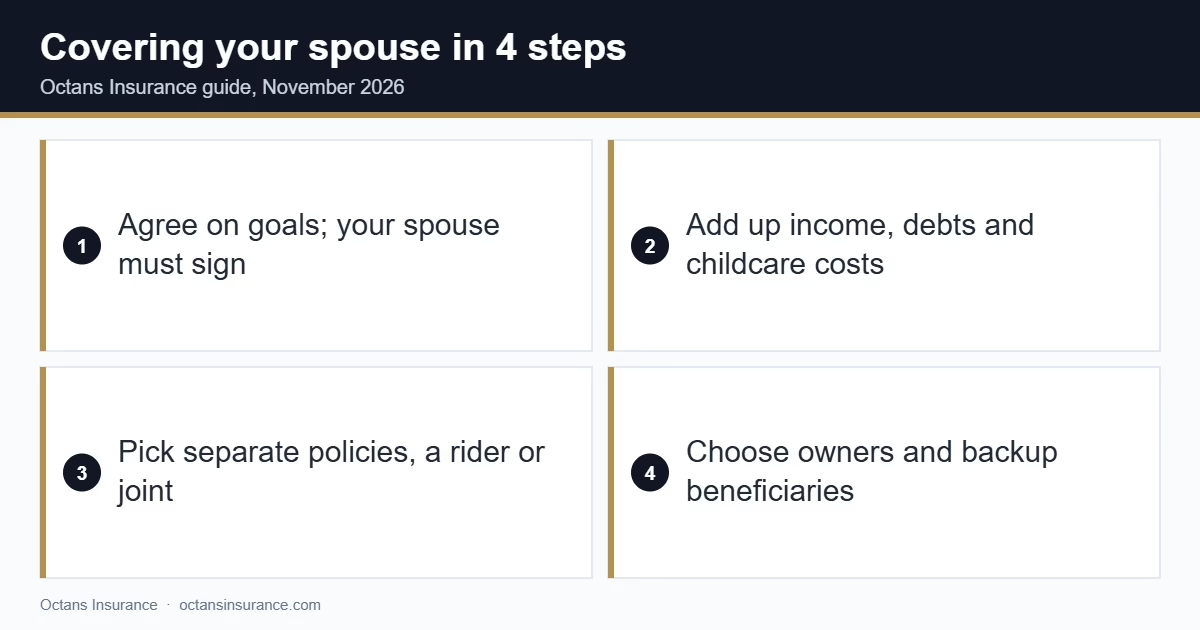
- Talk it through together, and agree on goals. Your spouse will need to sign.
- Add up income, debts, childcare and household costs, and the years your family would need help.
- Check what you already have through work or the military, and whether it would last.
- Choose a structure: separate policies, a spousal rider, a joint policy or survivorship coverage.
- Decide who owns each policy, and name primary and backup beneficiaries.
- Apply. Each insured person answers health questions, and some policies need a medical exam.
- Review coverage after a birth, adoption, job change, death or divorce, as the NAIC recommends.
Questions to ask the agent or insurer:
- How much coverage will you issue on a spouse who doesn’t earn income?
- Can a spousal rider be converted to my spouse’s own policy, and until what age?
- What happens to joint coverage after the first death or a divorce?
- Who can change the beneficiary, and will the insured be notified?
- Are the premiums level for the whole term?
Life insurance for spouse: frequently asked questions
Can I get life insurance on my spouse without them knowing?
Generally, no, though each state sets its own rules. Florida law, for example, requires the insured to apply for or consent in writing, and Massachusetts requires a written application signed or agreed to in writing by the person insured. In practice, life insurance for husband or wife means your spouse answers the health questions, signs the application, and may need a medical exam.
Should a stay-at-home spouse have life insurance?
Often, yes, especially with young children. If a stay-at-home spouse dies, the family may have to pay for childcare and other work they did for free. The BLS lists 2025 median pay for childcare workers at $16.82 an hour. Multiply your likely hours and years of care to size life insurance for wife or husband realistically.
Does life insurance pay if a spouse dies by suicide?
It depends on how long the policy has been in force. TDI says that during the first two years of a policy, companies usually won’t pay the death benefit if the cause of death is suicide. After that, the policy’s normal terms apply. See deaths not covered by life insurance. If you are struggling, call or text 988 to reach the 988 Suicide & Crisis Lifeline, free and confidential, 24/7.
Is a spousal rider better than a separate policy?
Not always. A rider adds term coverage for your spouse to your policy, so it’s one bill, but it depends on your policy staying in force. A separate policy belongs to its own contract and can have its own amount and term. Ask the insurer what happens to the rider if your policy ends or you divorce.
Do military spouses get life insurance?
Spouses of service members covered under SGLI can be covered by Family SGLI. The VA says spouse coverage goes up to $100,000, but not more than the service member’s SGLI amount. Premiums rise as the spouse ages, and coverage can be converted to an individual policy within 120 days of separation or divorce.
Who should be the beneficiary of my spouse’s policy?
Usually the surviving spouse, with a backup. TDI says you can name more than one beneficiary, and if you don’t name one, or your beneficiary has died, the company pays the death benefit to your estate. Naming a contingent beneficiary, such as a trust for the children, helps the money go where you intend.

How a licensed Octans agent can help
A licensed Octans Insurance agent can quote life insurance for spouse coverage from 120+ carriers and compare separate policies with spousal riders and joint options. We can also help you set a realistic amount for a stay-at-home spouse.
Approval and price depend on each person’s health and answers, so we can’t promise either. We don’t give legal or tax advice; for ownership questions in a divorce or estate plan, talk with an attorney.
To talk it through, call (617) 935-9220 and ask for a licensed agent.
Keep Reading: Related Guides
- Survivorship life insurance
- Life insurance and divorce
- How much life insurance do I need?
- Life Insurance Trust
- Life Insurance Beneficiary
- Can You Have Multiple Life Insurance Policies? Limits and Rules
- Social Security Death Benefit
- Life Insurance for H1B Visa Holders and Their H-4 Families
Important: Octans Insurance agents are licensed in the states in which they operate. Coverage availability and rates may vary by state. Premium examples, when provided, are illustrative samples from published sources, not quotes. Final rates are determined by the insurance carrier based on underwriting and applicable policy criteria. Policy terms, exclusions, limitations, riders, and availability vary by carrier and state.
About examples and tools: Hypothetical examples, sample rates, calculators and quizzes on this site are for general educational and illustrative purposes only. They are not quotes, offers of coverage, or guarantees of eligibility, approval, price or benefits, and they are not legal, tax, financial or medical advice. The insurance company decides eligibility and price; Medicare rules are set by CMS and the Social Security Administration.
Quote coverage for both spouses with a licensed agent
Start with a free, no-obligation quote review with a licensed Octans agent.
(617) 935-9220 | life@octansinsurance.com