
Life Insurance
Life Insurance Beneficiary: How to Name, Change and Claim
Choosing a life insurance beneficiary takes minutes, but mistakes can send the money to the wrong person. Here’s how primary and contingent beneficiaries work, what divorce changes and what a beneficiary needs to claim.
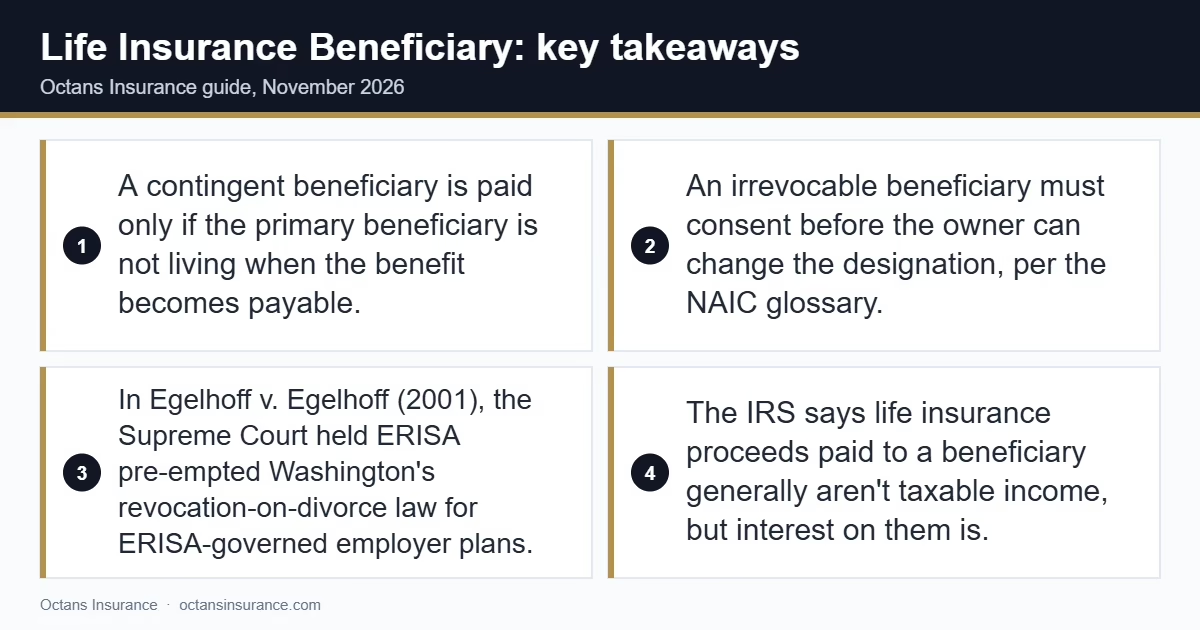
- A contingent beneficiary is paid only if the primary beneficiary is not living when the benefit becomes payable.
- An irrevocable beneficiary must consent before the owner can change the designation, per the NAIC glossary.
- In Egelhoff v. Egelhoff (2001), the Supreme Court held ERISA pre-empted Washington’s revocation-on-divorce law for ERISA-governed employer plans.
- The IRS says life insurance proceeds paid to a beneficiary generally aren’t taxable income, but interest on them is.
Table of Contents
Make sure your family is financially protected today!
A life insurance beneficiary is the person or organization that receives the death benefit when the insured person dies. As the policy owner, you can name a primary beneficiary and a contingent (backup) beneficiary, split the money by percentage, and change a revocable designation at any time. Review your choices after a marriage, divorce or birth.
What is a beneficiary for life insurance?
The NAIC, the national group of state insurance regulators, puts it simply in its guide to beneficiaries: a beneficiary is the person or organization who receives the payout from a life insurance policy. The policy pays that money, called a death benefit, if you die while the policy is in effect.
Three roles can belong to one person or to different people:
- Owner: controls the policy and names the beneficiaries.
- Insured: the person whose death triggers the payout.
- Beneficiary: the person, trust, charity or estate that receives the money.
Your beneficiary doesn’t need an insurable interest in you. The Maryland Insurance Administration’s consumer guide to life insurance says that as the owner of a policy on your own life, you can name anyone as beneficiary, even a stranger.
Life insurance beneficiary: contingent vs primary
Your primary beneficiary is first in line. You can name one person or several, with a percentage for each, such as 50% and 50%. Your contingent beneficiary is the backup. The federal Office of Personnel Management, in its retirement handbook, describes a contingent beneficiary as a secondary beneficiary who is paid only if the primary beneficiary is not living when the benefit becomes payable.
Naming a contingent life insurance beneficiary is one of the simplest protections you have. If your primary beneficiary dies before you and no backup is named, the money may not go where you intended, so ask your insurer how its policy handles that case. NAIC suggests checking your policies once a year to make sure all beneficiaries are listed and their contact information is correct.
What is the difference between revocable and irrevocable beneficiaries?
The NAIC glossary defines an irrevocable life insurance beneficiary as one with a vested interest in the policy proceeds even during the insured’s lifetime, because the owner can change the designation only after getting that beneficiary’s consent. A revocable designation doesn’t carry that consent requirement, so the owner can change it without the beneficiary’s approval by sending the insurer a change-of-beneficiary form.
Think carefully before making anyone irrevocable. Once you do, you can’t remove or replace that person without their agreement, even if your life changes.

What do per stirpes and per capita mean?
These terms decide what happens to a life insurance beneficiary’s share if that person dies before you:
- Per stirpes (by branch): the share passes down to that beneficiary’s own children, or to grandchildren if the children aren’t alive. That’s how the Office of Personnel Management explains it for federal employees’ FEGLI coverage, which does not accept per stirpes designations.
- Per capita (by head): in the way insurance resources most often explain it, the share is divided among the surviving named beneficiaries, and the deceased beneficiary’s children get nothing.
A 2023 study in the NAIC’s Journal of Insurance Regulation found that consumer and professional materials define per capita in different ways, which can lead to payouts the owner didn’t intend. Ask your insurer exactly how its form defines each option.
Hypothetical example: Melinda owns a $300,000 policy and names her three children, Betty, Susan and John, as equal primary beneficiaries. John dies before Melinda and leaves two children. Each original share is $300,000 ÷ 3 = $100,000.
| Who receives money | Per stirpes | Per capita (surviving beneficiaries) |
|---|---|---|
| Betty | $100,000 | $300,000 ÷ 2 = $150,000 |
| Susan | $100,000 | $150,000 |
| John’s two children | $100,000 ÷ 2 = $50,000 each | $0 |
| Total paid | $300,000 | $300,000 |
Source: distribution methods as illustrated in the NAIC Journal of Insurance Regulation (2023). The names and the $300,000 amount are hypothetical.
Should you name your estate, a trust or a minor?
Your estate. If you name your estate as your life insurance beneficiary, the money is handled with the rest of your property, which can bring it into probate. The Florida Bar’s probate pamphlet, for example, lists a life insurance policy payable to the decedent’s estate as a probate asset, while a policy payable to a beneficiary may not be. Probate rules vary by state, so ask an estate attorney before naming your estate.
A trust. You can name a trust, and the trustee then manages the money under the trust’s terms. This can make sense for children, a family member with special needs or a larger estate plan. A trust is a legal document, so an attorney should draft it. Our page on survivorship life insurance touches on irrevocable life insurance trusts.
A minor child. NAIC notes that insurance companies generally do not give benefits to minors. If your beneficiary is a minor, read our guide to naming a minor as life insurance beneficiary before you choose.
What happens to a life insurance beneficiary after divorce?
It depends on your state and on the kind of policy. Many states have laws that automatically revoke a former spouse’s designation at divorce, but not every state does, and the rules differ.
In Sveen v. Melin (2018) (opinion via Cornell’s Legal Information Institute), the U.S. Supreme Court ruled that applying Minnesota’s law to a designation made before the law passed did not violate the Constitution. Under that law, divorce automatically revokes a spouse’s designation, so the proceeds go to the contingent beneficiary or the policyholder’s estate.
When it decided the case, the Court noted that 26 states had adopted revocation-on-divorce laws similar to a model law, the Uniform Probate Code. It also pointed out that a policyholder who wants the ex-spouse to stay can rename them by sending a change-of-beneficiary form to the insurer.
Employer group plans can follow different rules. Many are governed by the federal law known as ERISA. In Egelhoff v. Egelhoff (2001) (syllabus via Cornell’s Legal Information Institute), a case about an employer life insurance policy and pension plan, the Court held that ERISA pre-empts Washington’s revocation-on-divorce law as applied to ERISA plans, which must be run by their plan documents. The safest step after a divorce is to update every beneficiary form yourself. Our guide to life insurance and divorce covers court orders too.
How to make a life insurance beneficiary change
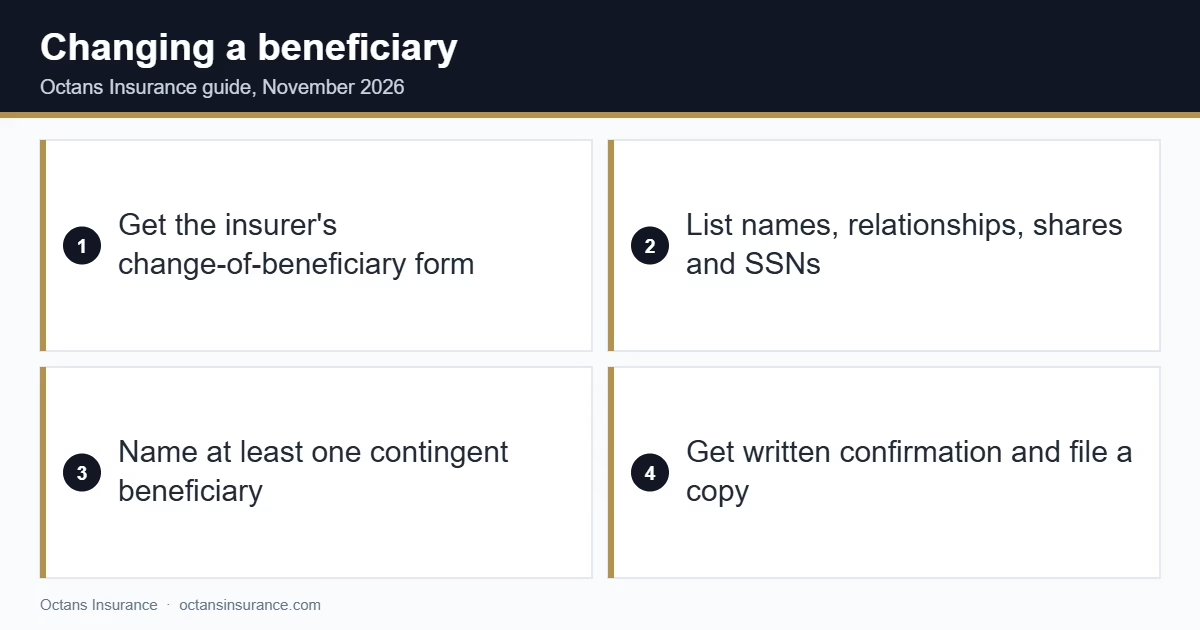
A life insurance beneficiary change is usually a short form, but small mistakes can cause big delays later. Here are the steps:
- Find the policy number and the insurer’s contact details. For coverage through work, contact your employer’s benefits office or plan administrator.
- Ask for the change-of-beneficiary form, or use the insurer’s online service if it has one.
- List each beneficiary clearly: full legal name, relationship, contact details and percentage. NAIC suggests including each beneficiary’s Social Security or tax ID number.
- Name at least one contingent beneficiary.
- Get written consent from any irrevocable beneficiary before you change anything.
- Sign, submit and get written confirmation from the insurer that the change is on file.
- Store a copy of the policy and the confirmation with your will or other estate papers, and tell your beneficiaries where they are.
Group life insurance through work usually has its own beneficiary form, separate from any individual policy and from your will. Check it too, especially after a job change, marriage or divorce.
Before you sign, ask yourself:
- Do the percentages add up to 100%?
- Have I named a contingent beneficiary?
- Does my state’s divorce law, or my employer plan, change anything?
- Is any beneficiary a minor, or someone who receives public benefits?
- Do my will and my beneficiary forms tell the same story?
What does a life insurance beneficiary need to file a claim?
As a life insurance beneficiary, you start the claim by contacting the insurer. The Maryland Insurance Administration tells beneficiaries to contact the insurance company in a timely manner after the death and to be prepared to provide a death certificate to start the claim. NAIC adds that beneficiaries should know the insurer’s name, the benefit amount, the policy number and where the policy is stored. Our guide on how to file a life insurance claim walks through the paperwork.
You may be offered several ways to receive the money:
- Lump sum: the entire proceeds in one payment.
- Installments: a fixed amount or a fixed period, or payments for the rest of your life.
- Interest only: the insurer holds the money and pays you interest.
- Retained asset account: an account held by the insurer that works like a checking account.
Take your time; Maryland’s guide says you should not be pressured to act quickly. On taxes, the IRS says life insurance proceeds you receive as a beneficiary generally aren’t includable in gross income, but any interest you receive is taxable. See is life insurance taxable for details, and ask a tax professional about your situation.
If you think you’re a life insurance beneficiary but can’t find the policy, the NAIC Life Insurance Policy Locator is a free tool that searches participating life insurance and annuity companies. Our guide to finding a lost life insurance policy lists other places to look.
Life insurance beneficiary frequently asked questions
Can I name anyone as my life insurance beneficiary?
Generally, yes. Maryland’s Insurance Administration says the owner of a policy on their own life can name anyone as beneficiary, even a stranger, because the beneficiary doesn’t need an insurable interest. You can name people, a charity, a trust or your estate. A minor can be named, but insurers generally won’t pay benefits directly to a child.
Can I name more than one life insurance beneficiary?
Yes. You can name several primary beneficiaries and give each a percentage, as long as the shares add up to 100%, plus one or more contingent beneficiaries. If a primary beneficiary dies first, what happens to that share depends on how the form is written, such as per stirpes or per capita, so ask the insurer how its form handles it.
What happens if my beneficiary dies before me?
If you named a contingent beneficiary, that person is next in line. If you used a per stirpes designation, the share can pass to the deceased beneficiary’s children. Without either, ask your insurer how its policy handles the share, since the money may not go where you intended. Update the form as soon as you can after a beneficiary dies.
Does a will override a life insurance beneficiary designation?
Usually not. The Florida Bar’s probate pamphlet, for example, says probate applies only to probate assets, and that a policy payable to a beneficiary may not be one, while a policy payable to the estate is. If you want your will to control the money, you would name your estate instead, which can bring probate. Rules vary by state, so ask an estate attorney.
Can I change my life insurance beneficiary after a divorce?
Yes, if the designation is revocable and no court order requires otherwise. Some states revoke an ex-spouse’s designation automatically, but in Egelhoff v. Egelhoff (2001) the Supreme Court held that ERISA pre-empts such a law as applied to employer plans that ERISA governs. The safest step is to file a new change-of-beneficiary form with each insurer and plan.
Do beneficiaries pay income tax on life insurance?
Generally not. The IRS says life insurance proceeds you receive as a beneficiary because the insured died generally aren’t includable in gross income, and you don’t have to report them. Any interest you receive is taxable and should be reported as interest. A tax professional can tell you how this applies to you.

How a licensed Octans agent can help
A licensed Octans agent can help you name each life insurance beneficiary correctly when you buy a policy, and explain the choices on the form: primary and contingent, percentages, and per stirpes or per capita where the insurer offers them. We can’t give legal or tax advice, so for trusts, estates or divorce orders we’ll suggest you talk with an attorney.
If you’re reviewing coverage you already have, an agent can also help you request the insurer’s change form. Octans compares coverage from more than 120 carriers in 19 states. Call (617) 935-9220.
Keep Reading: Related Guides
- Primary vs contingent beneficiary
- How to change a life insurance beneficiary
- Naming a minor as a beneficiary
- What to Do When Someone Dies
- Social Security Death Benefit
- Can You Have Multiple Life Insurance Policies?
- Life Insurance Trust
- Life Insurance Death Benefit
- Does Life Insurance Go Through Probate?
- Medicaid Estate Recovery
- How to Buy Life Insurance
- Can you get life insurance on someone else
Important: Octans Insurance agents are licensed in the states in which they operate. Coverage availability and rates may vary by state. Premium examples, when provided, are illustrative samples from published sources, not quotes. Final rates are determined by the insurance carrier based on underwriting and applicable policy criteria. Policy terms, exclusions, limitations, riders, and availability vary by carrier and state.
About examples and tools: Hypothetical examples, sample rates, calculators and quizzes on this site are for general educational and illustrative purposes only. They are not quotes, offers of coverage, or guarantees of eligibility, approval, price or benefits, and they are not legal, tax, financial or medical advice. The insurance company decides eligibility and price; Medicare rules are set by CMS and the Social Security Administration.
Set up your beneficiaries the right way
Start with a free, no-obligation quote review with a licensed Octans agent.
(617) 935-9220 | life@octansinsurance.com