
Life Insurance
How to Buy Life Insurance: 7 Steps From Need to Free Look
Learning how to buy life insurance is mostly about doing things in the right order. This guide uses state regulators’ buyer’s guides to walk you from estimating your need to reviewing the policy you receive.
- The NAIC says you can apply for life insurance through agents, by mail and online.
- Texas regulators say to confirm the agent and company are licensed and not to choose on price alone.
- Texas regulators say life policies have a two-year contestable period, so answer every application question truthfully.
- The NAIC says you can usually return a new policy for a full refund within 10 days.
Table of Contents
Make sure your family is financially protected today!
How to buy life insurance comes down to six moves: figure out what your family would need, pick term or permanent coverage, choose an amount, compare quotes through a licensed agent or company, apply honestly and go through underwriting, then use your free look period to review the policy. Underwriting can take anywhere from a day to several weeks.

How to buy life insurance in 7 steps
State regulators publish guides to buying life insurance, including the 2026 NAIC Life Insurance Buyer’s Guide from the National Association of Insurance Commissioners. Here’s how to get life insurance in an order that works for most people:
- List who depends on you. Write down whose life would change financially if you died: a spouse, kids, a parent you support or a business partner.
- Estimate the amount. Add income to replace, debts, education goals and final expenses. Subtract savings and coverage you already have.
- Choose the type. Term covers a set period at a lower cost. Cash value (permanent) coverage can last for life, and some policies build savings over time.
- Check your budget. Pick a premium you can keep paying for years, not just this month.
- Compare quotes. Get prices for the same amount and type from several licensed companies.
- Apply and complete underwriting. Answer every question truthfully. You may have health questions, an exam or both.
- Review the policy when it arrives. Check names, amounts and beneficiaries, and use the free look period if something is wrong.
The rest of this guide on how to buy life insurance walks through each step, with links to our deeper pages where you need more detail.

How much life insurance should you buy?
Settle the amount before buying life insurance, so quotes compare like with like. The NAIC says the right amount depends on the financial needs that would continue after your death, such as supporting your family, paying for a child’s education or paying off a mortgage. Its guide suggests you ask yourself:
- Does anyone depend on me financially?
- How much of the family income do I provide?
- How would my family pay final expenses and debts?
- Do I want to leave money to family or charity?
- If I have coverage through work, is it enough?
That last question matters. The NAIC notes that employer coverage usually pays less than you need, and you may not be able to take it with you if you leave the job. The Texas Department of Insurance gives a similar checklist: your debts, the income your family must replace and the bills they’ll still have.
Hypothetical example: Dana is 40, earns $60,000 a year and wants to replace 10 years of income: $600,000. She adds a $180,000 mortgage, a $50,000 college goal for her child and $8,300 for a funeral (the national median for a funeral with viewing and burial in the National Funeral Directors Association’s 2023 price study, which leaves out cemetery costs). Total need: $600,000 + $180,000 + $50,000 + $8,300 = $838,300. She subtracts $120,000 of group coverage at work and $30,000 in savings: $838,300 − $150,000 = $688,300. She might shop for about $700,000.
That’s one simple method, and it’s enough to start buying life insurance. Our guide on how much life insurance you need covers other methods, kids, stay-at-home parents and people with no dependents.
Which type of life insurance should you buy?
The NAIC sorts the choices into a few pairs. This table sums up its descriptions.
| Choice | How it works | Points to weigh |
|---|---|---|
| Term | Lower-cost coverage for a set period (the “term”) | Most term policies don’t build cash value |
| Renewable term | Can usually be continued at the end of the term, even if your health has changed | Premiums are higher when you renew; ask if renewal stops at a certain age |
| Nonrenewable term | Ends at the end of the term | You’d have to apply for a new policy to keep coverage |
| Whole life | Cash value coverage; premiums are usually paid on a set schedule | Can last your lifetime; may be more cost-effective for long periods |
| Universal life | Cash value coverage with flexible premiums | You must pay enough to keep the policy in force |
| Variable life | Cash value depends on investments you choose, such as stock and bond funds | Greatest potential growth and greatest risk of losing cash value |
Source: NAIC Life Insurance Buyer’s Guide (2026), “compare the different types of insurance policies.”
A simple way to decide which life insurance to buy: if your need has an end date, such as raising kids or paying a mortgage, term is built for that. If you want coverage for life, such as final expenses, look at cash value policies. Our term vs whole life insurance page compares costs and trade-offs in depth.
Where to buy life insurance
Where to buy life insurance is your next choice. The NAIC says you can apply through life insurance agents, by mail and online. Each route works differently:
- An agent who works for one company: you’ll mainly see that company’s products.
- An independent agent or broker: can quote several companies side by side. Octans agents, for example, compare more than 120 carriers.
- Online or by mail, directly with a company: you fill out the application yourself.
- Through work: the NAIC says employer coverage may be free or low-cost, but it usually pays less than you need and may not go with you if you leave.
Wherever you buy life insurance, Texas regulators say to make sure the agent and company are licensed to sell insurance; your state insurance department can check. They also say not to choose a policy on price alone and to make sure the policies you compare offer similar coverage.
What happens when you apply for life insurance?
The application is where buying life insurance gets personal. When you apply, the NAIC says you’ll give basic details, such as your name, address, employer, job title and date of birth, plus more personal information. Depending on the policy, the insurer may ask health questions, require a doctor visit or send a medical professional to your home or office.
The Texas Department of Insurance calls this process underwriting. It’s how a company decides whether to sell you a policy, and it often includes a medical exam and questions about your health, job and habits. Timing varies: Guardian Life, an insurance company, says underwriting can take as little as 24 hours but could last 4 to 6 weeks. Our guide to the life insurance medical exam explains what to expect on exam day.
A policy that skips detailed health information usually costs more and offers less coverage, according to the NAIC. Our page on no exam life insurance explains when that trade-off makes sense.
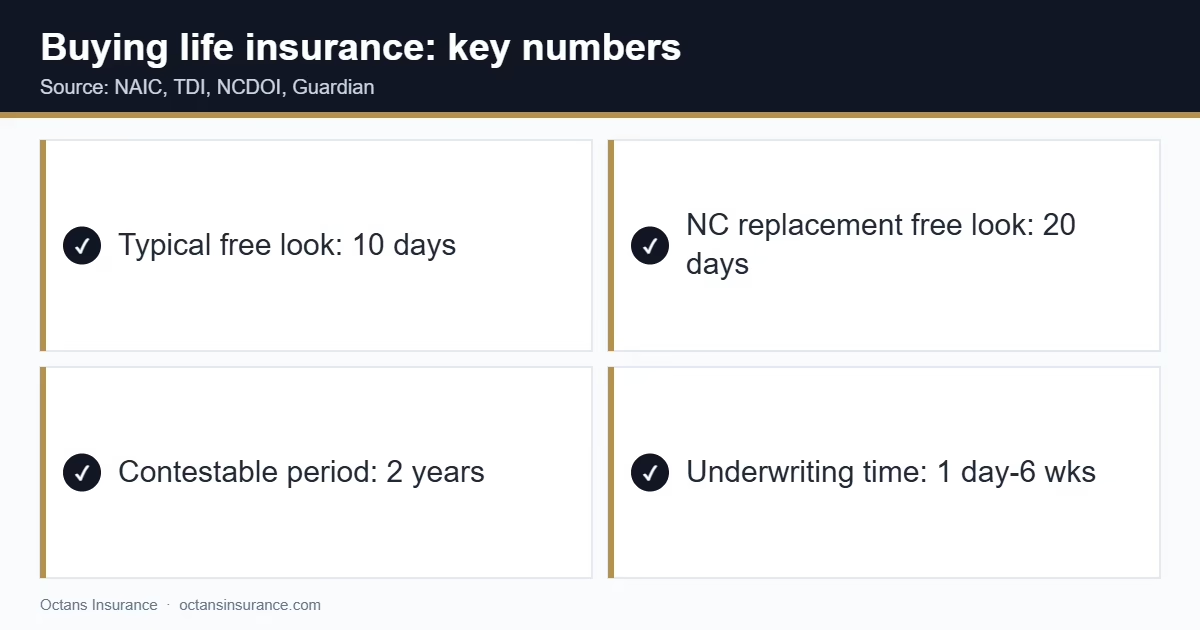
The most important rule in how to get life insurance that actually pays: tell the truth on every answer. The NAIC says the company will check your answers and could reduce or cancel your coverage if it finds false statements after issuing the policy. Life insurance policies have a two-year contestable period, according to Texas regulators, and North Carolina’s insurance department says contracts may be voided within the first two years. Learn more on our contestability period page.
Who should you name as your beneficiary?
Your beneficiary is the person or organization you name to receive the death benefit. You choose them on the application, so decide before buying life insurance. A few rules from the NAIC guide:
- Have the Social Security or tax ID number for every beneficiary.
- Don’t name a minor child directly. Insurance companies won’t pay a minor; consider your estate or a trust instead.
- Name more than one person if you like. Texas regulators note you can name more than one beneficiary.
- As the policy owner, you can change beneficiaries at no cost.
Our life insurance beneficiary guide covers primary and contingent beneficiaries, divorce and how claims work.
What should you do after you buy life insurance?
Knowing how to buy life insurance includes knowing what to do once you own it. Read the policy as soon as it arrives. The NAIC says that if you’re not satisfied, you can return a new policy for a full refund within a set period, usually 10 days after you receive it, and the review period is usually stated on the policy’s first page. This is called the free look period. States set their own minimums. North Carolina, for example, requires at least 10 days on new policies and at least 20 days on replacement policies.
During that window, check:
- Is your personal information correct?
- Do premiums or policy values change from year to year?
- What part of the premium or policy value isn’t guaranteed?
- Are your beneficiaries named exactly as you intended?
After that, review your coverage every few years and after life events such as a birth, adoption, marriage, job change, death or divorce, as the NAIC suggests. If you’re replacing an older policy, the NAIC says not to cancel it until the new one is in force. Texas regulators add that it’s illegal for an agent to replace a policy just to earn a new commission.
How to buy life insurance with confidence: questions to ask
Use this checklist with any agent or company before buying life insurance:
- Are you and the company licensed in my state?
- How many companies are you comparing for me?
- Is this premium guaranteed, or can it go up? What’s the highest it could be?
- For term: can I renew or convert it, and until what age?
- For cash value: can I see an illustration of future values and benefits?
- Will I need an exam, and what records will you check?
- How long is the free look period on this policy?
- What happens if I miss a payment?
The NAIC also says to ask what the highest premium might be to keep your coverage, since some policies are sensitive to the company’s investment earnings, claims costs and expenses.
How to buy life insurance: frequently asked questions
How long does it take to get life insurance?
It depends on the policy and your health. Guardian Life, an insurance company, says underwriting can take as little as 24 hours but could last 4 to 6 weeks. To get life insurance faster, have your doctors’ names, medication list and beneficiary details ready before you apply, and answer follow-up requests promptly.
Can I buy life insurance online?
Yes. The NAIC says you can apply through agents, by mail and online. Applying directly online shows you one company’s products, while an independent agent can compare several companies for the same coverage. Either way, check that the company and any agent are licensed in your state before you sign.
Do I need a medical exam to buy life insurance?
Not always. Depending on the policy, an insurer may ask only health questions, or it may require an exam or a visit from a medical professional. The NAIC notes that policies without detailed health information usually cost more and provide less coverage than policies that ask for it, so compare both if your health is good.
Can I cancel a life insurance policy after I buy it?
Yes. During the free look period, usually 10 days after you receive the policy (some states require more, such as North Carolina’s 20 days for replacement policies), you can return it for a full refund. After that, you can usually stop paying or ask to cancel, but you may lose money or coverage. Don’t drop an old policy until a new one is in force.
Is employer life insurance enough?
Often not. The NAIC says employer coverage usually pays less than people need, and you may not be able to keep it if you leave the job. Group coverage is still a useful base. Count it in your estimate, then decide whether a personal policy should fill the gap.
What is the cheapest way to buy life insurance?
The NAIC describes term insurance as lower-cost coverage for a specific period, so term is usually where budget shoppers start. Compare several companies for the same amount and type, and buy the amount you need rather than more. The NAIC also notes that changes in your health can affect the premium you’ll pay later.

How a licensed Octans agent can help
If you’re still deciding how to get life insurance or where to buy life insurance, a licensed Octans agent can help. We can estimate an amount, explain term and permanent options in plain terms and compare quotes from more than 120 carriers in the states we serve. We’ll tell you what each company is likely to ask during underwriting so there are fewer surprises.
We can’t promise approval or a price; the insurance company decides both after it reviews your application. Call (617) 935-9220 to get started.
Keep Reading: Related Guides
- How much life insurance do I need?
- Term vs whole life insurance
- Choosing a life insurance beneficiary
- Can you get life insurance on someone else
Important: Octans Insurance agents are licensed in the states in which they operate. Coverage availability and rates may vary by state. Premium examples, when provided, are illustrative samples from published sources, not quotes. Final rates are determined by the insurance carrier based on underwriting and applicable policy criteria. Policy terms, exclusions, limitations, riders, and availability vary by carrier and state.
About examples and tools: Hypothetical examples, sample rates, calculators and quizzes on this site are for general educational and illustrative purposes only. They are not quotes, offers of coverage, or guarantees of eligibility, approval, price or benefits, and they are not legal, tax, financial or medical advice. The insurance company decides eligibility and price; Medicare rules are set by CMS and the Social Security Administration.
Compare life insurance quotes with a licensed agent
Start with a free, no-obligation quote review with a licensed Octans agent.
(617) 935-9220 | life@octansinsurance.com