
Estate Planning
Life Insurance Trust: How ILITs Work and When You Need One
A plain-English guide to the life insurance trust: how revocable trusts and ILITs differ, the three-year rule, Crummey gifts, what setup involves, and when the federal exclusion makes one unnecessary.
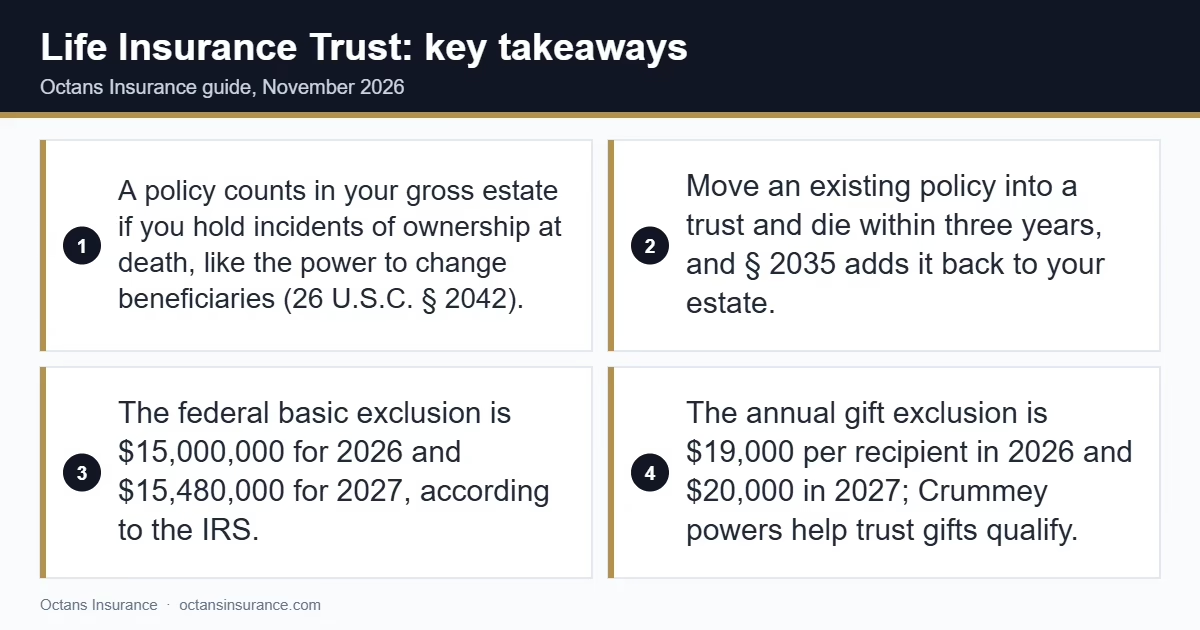
- A policy counts in your gross estate if you hold incidents of ownership at death, like the power to change beneficiaries (26 U.S.C. § 2042).
- Move an existing policy into a trust and die within three years, and § 2035 adds it back to your estate.
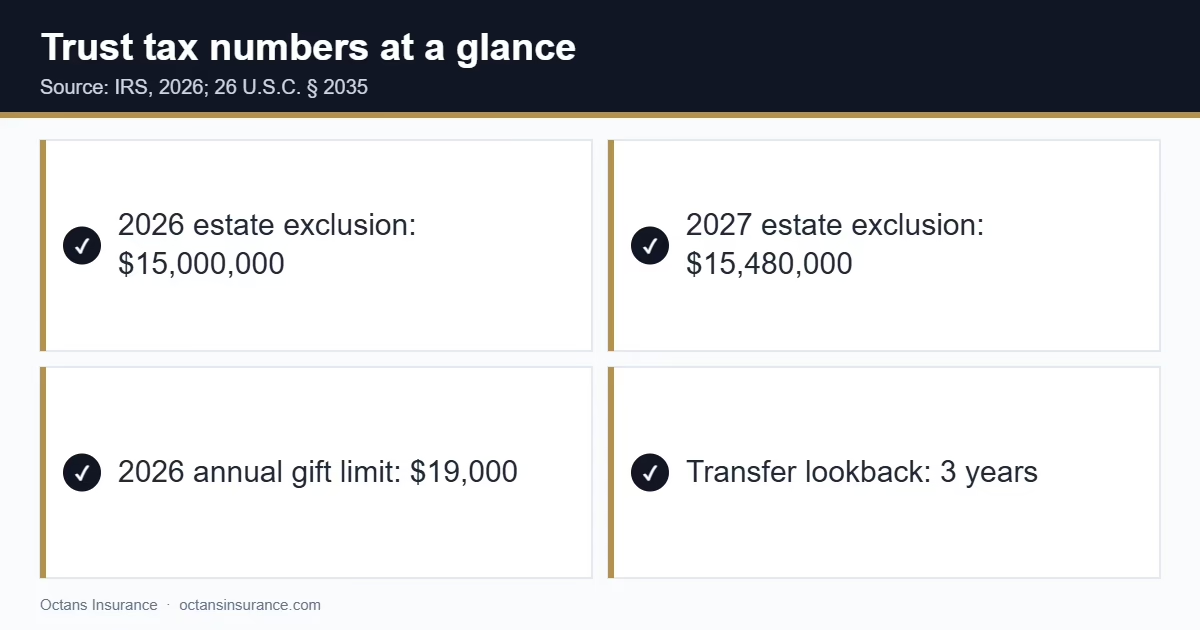
- The federal basic exclusion is $15,000,000 for 2026 and $15,480,000 for 2027, according to the IRS.
- The annual gift exclusion is $19,000 per recipient in 2026 and $20,000 in 2027; Crummey powers help trust gifts qualify.
Table of Contents
Make sure your family is financially protected today!
A life insurance trust is a trust that owns your life insurance policy or receives its payout, then manages the money for your family under rules you set. An irrevocable life insurance trust (ILIT) can keep the payout out of your taxable estate; a revocable one can’t. If your estate is well under the $15,000,000 federal exclusion for 2026, you may not need one for federal estate tax.
This guide is general information, not legal or tax advice.
What is a life insurance trust?
A life insurance trust has three roles. You, the grantor, create it. A trustee manages it. Beneficiaries, such as a spouse or children, receive the money under the trust’s terms. The trust can own the policy and be its beneficiary, or simply be named as beneficiary of a policy you own.
Ownership is what matters for estate tax. Under 26 U.S.C. § 2042, life insurance counts in your gross estate if it is payable to your executor, or if you held any “incidents of ownership” in the policy when you died. Treasury regulation § 20.2042-1 gives examples: the power to change the beneficiary, to surrender or cancel the policy, or to assign it.
So the real question isn’t whether a trust is involved. It’s who holds those powers on the day you die. If the trust holds them and you don’t, a life insurance policy in a trust can stay outside your taxable estate.
Revocable vs irrevocable life insurance trust
A revocable trust, often called a living trust, is one you can change or cancel. That flexibility has a tax cost. Under 26 U.S.C. § 2038, property you transferred in trust still counts in your estate if, at death, you had the power “to alter, amend, revoke, or terminate” the arrangement.
An irrevocable life insurance trust is built to be hard to change, so the policy is treated as the trust’s, not yours. Here’s how the two compare.
| Feature | Revocable trust | Irrevocable life insurance trust (ILIT) |
|---|---|---|
| Can you change or cancel it? | Yes | Generally no |
| Who owns the policy? | You, or a trust you control | The trust |
| Death benefit in your taxable estate? | Yes, under §§ 2038 and 2042 | Can stay out if you hold no incidents of ownership and the three-year rule doesn’t apply |
| Main use | Managing money for heirs | Keeping the payout out of the taxable estate, plus managing money for heirs |
| Who pays premiums? | You | The trustee, using money you give the trust |
| Main drawback | No estate tax savings | Loss of control and yearly paperwork |
Sources: 26 U.S.C. §§ 2035, 2038 and 2042 and Treas. Reg. § 20.2042-1 (Cornell Law School’s Legal Information Institute), read November 2026.
A revocable trust can still be a useful beneficiary, for example to manage money for young children. See our guide to naming a minor as life insurance beneficiary.
Why put life insurance in a trust?
Life insurance for estate planning usually solves a cash problem: money is needed quickly, and the estate’s assets are hard to sell or split. Putting life insurance in a trust adds control over that money.
- Estate tax. A trust-owned policy can supply cash for a federal or state estate tax bill without adding to the taxable estate.
- Cash for an illiquid estate. If the trust document allows it, the trustee can lend cash to the estate or buy assets from it, so heirs aren’t forced to sell a family business or home.
- Control. The trust can pay money out over time, such as at set ages, instead of in one lump sum.
- Fair shares. If one child takes over a business, insurance can give the others a comparable inheritance. See our guide to buy sell agreement life insurance.
- Giving. A trust can direct part of the payout to charity. See donating life insurance to charity.
Married couples sometimes have a trust own survivorship life insurance, which pays only after both spouses have died.
What is the three-year rule for transferred policies?
The three-year rule catches people who move a policy they already own into a trust. Under 26 U.S.C. § 2035, a transfer of an interest in property, or the release of a power over it, “during the 3-year period ending on the date of the decedent’s death” can bring its value back into your gross estate. It reaches life insurance because § 2042 is one of the four inclusion sections it cross-references.
In plain terms, if you give an existing policy to an ILIT, you need to live more than three years after the transfer. If you die sooner, the estate tax result is as if you never moved it.
The rule is written around transfers you make. So ask your attorney whether the trust should apply for a new policy as its original owner instead. If your health would make new coverage costly or hard to get, transferring an old policy and waiting out the three years may still be the better path.
How do Crummey notices work?
An ILIT needs money to pay premiums, so you typically give it cash and the trustee pays the insurer. Those gifts raise a question: do they qualify for the annual gift tax exclusion? The IRS lists the annual exclusion as $19,000 per recipient for 2026.
Only gifts of a “present interest” qualify. The IRS Form 709 instructions say a gift is a present interest if the person receiving it has all immediate rights to use, possess and enjoy it. They also say “a gift of a future interest cannot be excluded under the annual exclusion.” Money locked in a trust until after your death looks like a future interest.
An ILIT can handle this with a Crummey power. Each beneficiary gets the right to withdraw their share of each new gift for a limited time, and courts have treated that right as making the gift a present interest, even when no one uses it. If no one withdraws, the money stays in the trust, and the trustee can use it for the premium. Ask your attorney how beneficiaries will be told about each right; those letters are called Crummey notices.
The IRS instructions add that for a gift in trust, “each beneficiary having a present interest in such gift is treated as a separate donee.” If the gifts don’t qualify as present interests, the IRS says they aren’t covered by the annual exclusion and Form 709 must be filed. Your trustee should keep a copy of every notice.

How to set up a life insurance trust
The order matters, because ownership has to be settled before a policy is issued or moved.
- List your assets, including the death benefit of every policy you own. Our guide to how much life insurance you need helps with the coverage side.
- Meet an estate planning attorney licensed in your state. Ask whether an ILIT fits, or whether a will, beneficiary designations or a revocable trust would do.
- Choose a trustee and a backup trustee. For an ILIT, avoid giving yourself powers over the policy.
- Have the attorney draft the trust, sign it, and open a bank account in the trust’s name.
- Have the trustee apply for coverage, with the trust named as owner and beneficiary. If you’re moving an existing policy instead, file the insurer’s change-of-ownership form and note the date.
- Make premium gifts to the trust’s account, not to the insurer. The trustee sends any required Crummey notices and then pays the premium.
- Review the trust, the policy and the tax rules every few years.
Questions to ask your estate attorney:
- Would an ILIT lower federal or state estate tax for my estate at today’s exclusion amounts?
- Should the trust buy a new policy, or should I transfer one I own?
- Who should be trustee, and which powers should I avoid keeping?
- Will the trust use Crummey powers, and who will send the notices?
- What will drafting cost, and what will it cost to run the trust each year?
- What happens if we divorce, or if the tax law changes again?
What does a life insurance trust cost?
There is no standard price. Legal fees depend on your state, the attorney and how complex the trust is, so we don’t quote a typical figure. Ask for a written fee quote, and plan for costs beyond the first bill:
- Drafting. A one-time legal fee for the trust, plus any updates to your will.
- Trustee fees. A family member may serve without pay. A bank or trust company charges, so ask how.
- Paperwork. Crummey notices, records of each gift and premium, and any tax filings the trust needs.
- Gift reporting. The Form 709 instructions say that if you gave someone more than the annual exclusion in a year, other than your spouse, you must generally file the form.
The largest cost may be control. With an ILIT, you generally can’t change the beneficiaries or take the cash value back. Our guide to whether life insurance is taxable covers related tax questions.
When is a life insurance trust probably not needed?
For federal estate tax, the key number is the basic exclusion. The IRS says recent law raised it to $15,000,000 for 2026. On November 5, 2026, the IRS announced that estates of people who die during 2027 have a basic exclusion of $15,480,000, and that the annual gift exclusion rises to $20,000.
A policy you own counts toward that total. Married couples may also be able to use both spouses’ amounts: the IRS says an estate can elect to pass the deceased spouse’s unused exclusion to the surviving spouse.
If your estate, counting your life insurance, is well below those amounts, an ILIT may add cost without saving federal tax. You might still want a trust for other reasons: a state estate tax with a lower threshold, a child with special needs, a blended family, or heirs who shouldn’t get a lump sum.
Hypothetical example: Diane is single. She dies in 2026 with $14,200,000 in other assets and owns a $2,000,000 policy on her own life. This simplified example ignores debts, deductions, prior taxable gifts and state tax.
- Policy in her name: gross estate = $14,200,000 + $2,000,000 = $16,200,000. That’s $16,200,000 − $15,000,000 = $1,200,000 over the 2026 exclusion.
- Estimated federal tax: the federal rate table taxes amounts over $1,000,000 at 40 percent. Because the exclusion is far above $1,000,000, each dollar over it falls in that bracket: $1,200,000 × 40% = $480,000.
- Policy bought by an ILIT from the start: gross estate = $14,200,000, which is $800,000 under the exclusion. No federal estate tax, and the trust collects the full $2,000,000.
- Policy moved to an ILIT in 2025: because she died within three years, § 2035 pulls the $2,000,000 back in, and the $480,000 estimate returns.
- Same facts, death in 2027: $16,200,000 − $15,480,000 = $720,000 over the exclusion, and $720,000 × 40% = $288,000.
If the trust had three beneficiaries with Crummey powers, Diane could give it up to 3 × $19,000 = $57,000 in 2026 (3 × $20,000 = $60,000 in 2027) within the annual exclusion, if the gifts qualify. Real plans have more moving parts, so treat this as a picture of how the rules interact.
Life insurance trust: frequently asked questions
Does life insurance need to be in a trust?
No. You can simply name beneficiaries, and the insurer pays them directly. A life insurance trust makes sense when estate tax is a real risk, when you want money managed over time, or when a minor will inherit. When you use life insurance for estate planning, an attorney can tell you whether a trust is worth its cost and loss of control.
Can I put an existing life insurance policy in a trust?
Yes. The insurer has a change-of-ownership form, and the trust becomes the owner and usually the beneficiary. But under 26 U.S.C. § 2035, if you die within three years of the transfer, the death benefit can be pulled back into your gross estate. If you’re healthy, a new policy owned by the trust may be cleaner.
Can I be the trustee of my own life insurance trust?
For an irrevocable trust, it’s risky. Treasury rules say you can be treated as holding an incident of ownership in a policy held in trust if you have the power, as trustee or otherwise, to change who benefits from it. That could put the death benefit back in your taxable estate. Ask your attorney who should serve instead.
Can my revocable living trust be the beneficiary of my policy?
Yes. The trustee then follows the trust’s instructions after your death. But it won’t remove the policy from your taxable estate, because you keep control. Under 26 U.S.C. § 2038, property you could still alter, amend, revoke or terminate at death stays in your estate. Below the federal exclusion, that may not matter for federal estate tax.
What happens to a life insurance trust when I die?
The trustee files the death claim, and the insurer pays the trust because it is the named beneficiary. The trustee then follows the trust document. That may mean paying beneficiaries at set ages, holding money for minors, or lending cash to your estate so it can pay taxes and bills.
How much does a life insurance trust cost?
Costs vary by state, attorney and how complex the trust is. Expect a one-time legal fee to draft the trust, then yearly costs for records, Crummey notices, and any trustee fees or tax filings. Ask attorneys for written quotes. Policy premiums are separate and usually funded with your gifts to the trust.

How a licensed Octans agent can help
An estate attorney designs the trust. A licensed Octans Insurance agent can handle the insurance side: comparing term, whole life and survivorship options from 120+ carriers, and making sure the application names the trust correctly as owner and beneficiary.
We can also review a policy you already own and help you weigh moving it against new coverage in the trust’s name. We don’t give legal or tax advice, so we work alongside your attorney and tax professional.
To talk it through, call (617) 935-9220 and ask for a licensed agent.
Keep Reading: Related Guides
- Survivorship life insurance
- Naming a minor as beneficiary
- Is life insurance taxable?
- Life Insurance Beneficiary
- Life Insurance for Spouse
- Permanent Life Insurance
- Universal Life Insurance
Important: Octans Insurance agents are licensed in the states in which they operate. Coverage availability and rates may vary by state. Premium examples, when provided, are illustrative samples from published sources, not quotes. Final rates are determined by the insurance carrier based on underwriting and applicable policy criteria. Policy terms, exclusions, limitations, riders, and availability vary by carrier and state.
About examples and tools: Hypothetical examples, sample rates, calculators and quizzes on this site are for general educational and illustrative purposes only. They are not quotes, offers of coverage, or guarantees of eligibility, approval, price or benefits, and they are not legal, tax, financial or medical advice. The insurance company decides eligibility and price; Medicare rules are set by CMS and the Social Security Administration.
Coordinate your trust’s policy with a licensed agent
Start with a free, no-obligation quote review with a licensed Octans agent.
(617) 935-9220 | life@octansinsurance.com