
Permanent Life Insurance
Universal Life Insurance: Flexible Coverage and How to Keep It
Universal life insurance gives you flexible premiums and an adjustable death benefit. Learn how the policy value works, why underfunded policies lapse, how it compares with whole life and IUL, and how to read the illustration.
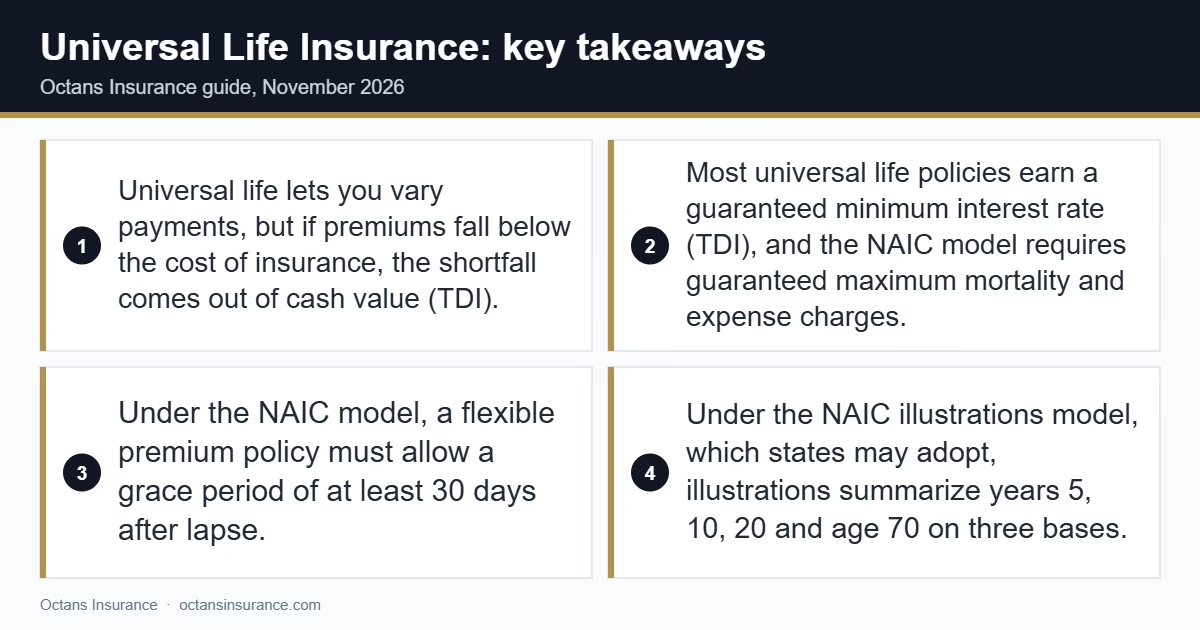
- Universal life lets you vary payments, but if premiums fall below the cost of insurance, the shortfall comes out of cash value (TDI).
- Most universal life policies earn a guaranteed minimum interest rate (TDI), and the NAIC model requires guaranteed maximum mortality and expense charges.
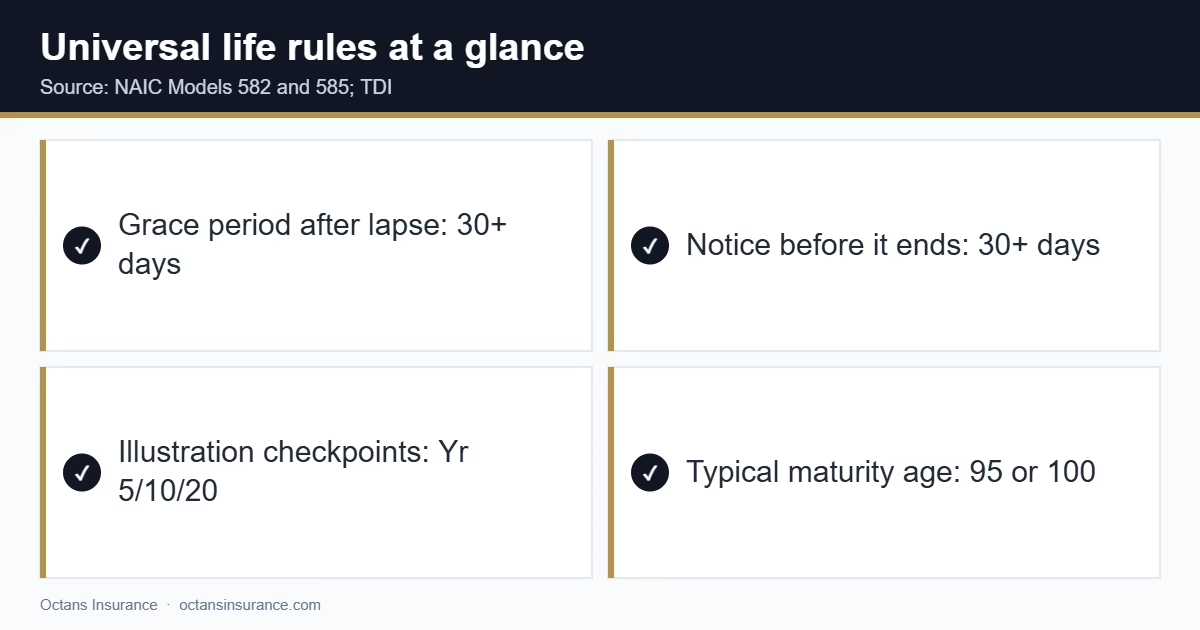
- Under the NAIC model, a flexible premium policy must allow a grace period of at least 30 days after lapse.
- Under the NAIC illustrations model, which states may adopt, illustrations summarize years 5, 10, 20 and age 70 on three bases.
Table of Contents
Make sure your family is financially protected today!
Universal life insurance is permanent life insurance with flexible premiums and an adjustable death benefit. Your payments go into a policy value that earns interest, and the insurer deducts the cost of insurance and other charges from it. If the value can’t cover those charges, the policy can lapse, so it needs regular checkups. Most policies guarantee a minimum interest rate.
This guide explains how the policy works, why some lapse, how it compares with whole life and indexed universal life, and how to read the illustration before you buy.
What is universal life insurance?
The NAIC Life Insurance Buyer’s Guide groups universal life with whole life as cash value insurance. It contrasts how you pay: with universal life, “you can choose a flexible premium payment pattern as long as you pay enough to keep your policy in force.”
FINRA’s investor guide describes it the same way: coverage for the insured’s life with flexible premium payments and insurance coverage. “The cost of your insurance protection and in some cases other costs are deducted from the cash or policy account value.”
So what is universal life insurance, in one line? A life policy with an account inside it that you can track on your annual statement. Money goes in, interest is credited, charges come out, and the death benefit stays in force as long as the account can keep paying the bills.
How does universal life insurance work?
The NAIC’s Universal Life Insurance Model Regulation, which states use to write their own rules, defines the product by its “separately identified interest credits” and “mortality and expense charges.” Here’s what that means for you:
- Premiums. A flexible premium policy lets you vary the amount or timing of payments, or the amount of insurance.
- Charges. The cost of insurance, also called the mortality charge, plus expense charges and any rider charges, comes out of the policy value.
- Interest. The Texas Department of Insurance (TDI) says most universal life policies earn a guaranteed minimum interest rate on the cash value.
- Guarantees. The NAIC model requires the policy to guarantee minimum interest credits and maximum mortality and expense charges. Current charges can be lower than the maximum. The NAIC also warns that premiums for many policies depend on the insurer’s investment earnings, claims costs and other expenses, and if those are worse than expected, you may have to pay a much higher premium.
- Surrender charges. TDI’s guide to permanent policies warns of a possible surrender fee if you withdraw money early.
TDI also notes you can change the amount of your premiums and death benefit, but changing payments “will affect your death benefit, cash value, or both.” On the plus side, TDI says cash value growth is tax-deferred.
Why do universal life policies lapse?
Because the flexibility cuts both ways. TDI explains: “If your premiums are lower than the cost of insurance, the difference is taken from the cash value.” If the cash value reaches zero, the policy could lapse. TDI adds that low interest rates can affect cash value, “which might increase your premiums.”
The NAIC’s life insurance overview puts it plainly: “The policy remains active as long as the cash value is enough to cover insurance costs.” Non-guaranteed charges and interest credits can also change. Under the NAIC illustrations model, you sign a statement that non-guaranteed elements “are subject to change and could be either higher or lower,” so a payment that worked when you bought the policy may fall short later.
Hypothetical example: Lena’s universal life policy has a policy value of $9,000. Her monthly charges, cost of insurance plus fees, total $260, and she pays $110 a month. (These numbers are made up; interest, surrender charges and loans are ignored to keep the math simple.)
- Shortfall: $260 − $110 = $150 a month, taken from the policy value.
- Time until the value runs out: $9,000 ÷ $150 = 60 months, or 5 years.
- If her charges later rise to $335 a month, the shortfall becomes $335 − $110 = $225, and the same $9,000 lasts $9,000 ÷ $225 = 40 months.
The NAIC model gives some warning. Unless the policy says otherwise, lapse occurs when the net cash surrender value first equals zero. A flexible premium policy must then allow a grace period of at least 30 days, and the insurer must mail notice at least 30 days before coverage ends. To keep coverage, Lena would need to pay more, lower the death benefit, or both. Our guide to the life insurance grace period and lapse covers what happens next.
Whole life vs universal life insurance vs IUL
Whole life vs universal life insurance comes down to guarantees versus flexibility. Indexed universal life (IUL) is a type of universal life that links interest to a market index.
| Feature | Universal life | Whole life | Indexed universal life |
|---|---|---|---|
| Premiums | Flexible, within limits | Paid on a set schedule | Flexible, within limits |
| Cash value growth | Interest credits; most policies guarantee a minimum rate | Guaranteed values; dividends possible but not guaranteed | Interest tied to an index, such as the S&P 500 |
| Death benefit | Can be changed, within policy rules | Guaranteed | Can be changed, within policy rules |
| Main risk | Lapse if the cash value runs out | Costs more than term; little or no cash value in the first few years | Credits depend on the index; lapse if underfunded |
Sources: TDI life insurance guide (updated Dec. 12, 2025); NAIC Life Insurance Buyer’s Guide (2026); NAIC life insurance topic page (updated Nov. 14, 2025). Read November 2026.
Our whole life insurance guide and indexed universal life insurance guide cover those products in depth. Variable universal life is different again: FINRA treats it as a security that combines universal life with an investment account.
What is guaranteed universal life?
Guaranteed universal life (GUL) is built around a promise to stay in force rather than around cash value. The NAIC’s reserve rules for universal life describe policies with a “secondary guarantee,” including a guarantee that the policy will remain in force “subject only to the payment of specified premiums.”
That last part is the catch. The guarantee depends on paying the specified premium, so ask what happens to it if you pay late, pay less, or take a loan. Our guide to life insurance over 60 explains how older buyers use GUL for lifetime coverage.
How to read a universal life insurance illustration
An illustration projects how a policy might perform. The NAIC’s Life Insurance Illustrations Model Regulation, a model that states may adopt as written or change, sets the format. It bars sellers from calling a plan to use non-guaranteed values a “vanishing premium.” Under the model, use these steps:
- Check the date the illustration was prepared. The model requires it to be labeled with that date.
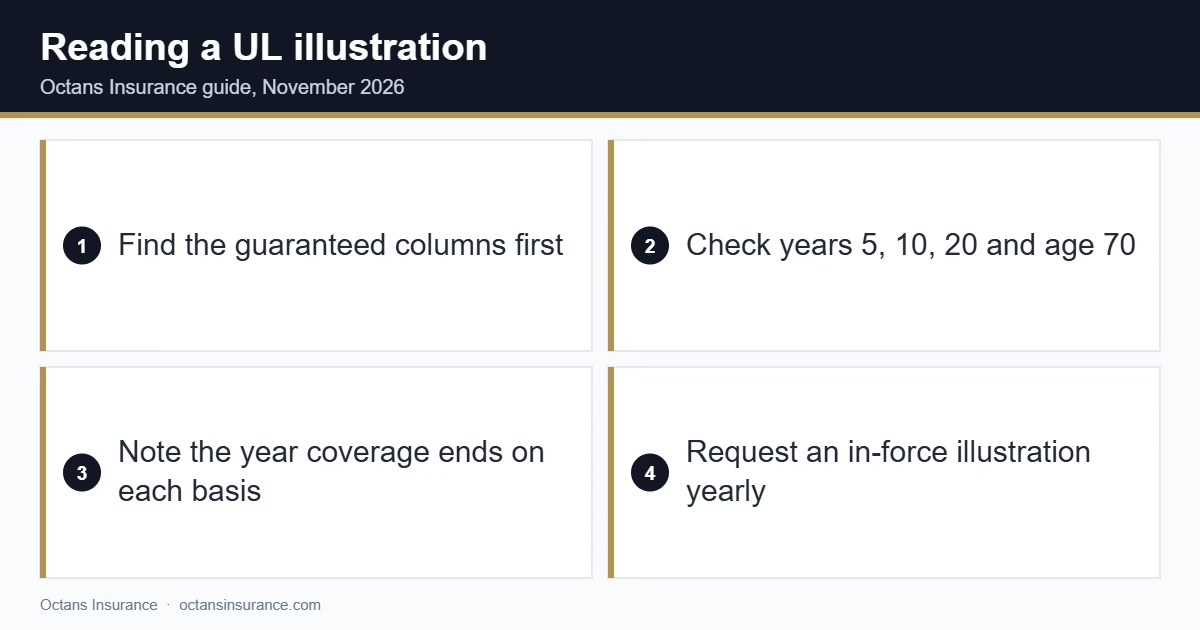
- Find the guaranteed columns first. Guaranteed elements must be shown before non-guaranteed ones and clearly labeled.
- Read the numeric summary. It shows values at years 5, 10 and 20, and at age 70 if it applies, on three bases: guarantees, the insurer’s illustrated scale, and a midpoint.
- Find the year coverage would end. If coverage would stop before maturity or age 100, the model requires that year to be shown for each basis.
- Read the required statement that current values continuing unchanged “is not likely to occur.”
- Sign only once you understand it. You and the agent each sign a statement that non-guaranteed elements can change.
- After you buy, read each annual report. For a policy sold with illustrations, the model requires a notice if, on guaranteed assumptions, the policy won’t stay in force to the next report without more premium.
The midpoint basis is simple math. If the guaranteed interest rate were 2% and the illustrated rate 5%, the midpoint would use (2% + 5%) ÷ 2 = 3.5%. Non-guaranteed charges are averaged the same way.
Universal life insurance pros and cons
Here are the main universal life insurance pros and cons, drawn mainly from TDI’s guide and its comparison of policy types.
Pros:
- Flexible premiums and an adjustable death benefit.
- A guaranteed minimum interest rate in most policies.
- Tax-deferred cash value growth.
- Coverage that lasts to the maturity date, usually age 95 or 100, if it stays funded.
Cons:
- More expensive than term life.
- The payment isn’t guaranteed, and low interest rates can push premiums up.
- Commissions and fees can affect returns.
- A surrender fee may apply if you take money out early.
- Lapse risk if you underfund it or skip reviews.
Who should consider universal life insurance?
Universal life insurance can fit if you want permanent coverage, value flexibility, and will review the policy every year. It can also help if your income varies and you want room to adjust payments.
It may not fit if you want a set-and-forget policy with fixed premiums, or if you only need coverage for a set period, such as until a mortgage is paid. Our guide to term vs whole life insurance covers when term is enough.
Questions to ask before you buy:
- What premium keeps this policy in force to age 100 on guaranteed assumptions?
- What are the maximum cost of insurance charges, and have you ever raised current charges?
- What would it cost to surrender in year 1, year 5 and year 10?
- Is there a no-lapse or secondary guarantee, and what keeps it in place?
- What is the guaranteed minimum interest rate?
- Can I get a free in-force illustration each year?
Universal life insurance: frequently asked questions
Can universal life insurance lapse even if I pay premiums?
Yes, if your payments don’t cover the policy’s charges. TDI says a shortfall is taken from the cash value, and the policy could lapse if the cash value reaches zero. The NAIC model also requires a warning when a policy may not reach its maturity date “even if scheduled premiums are paid in a timely manner.”
What is the difference between whole life and universal life insurance?
Whole life typically has premiums on a set schedule and guaranteed premiums, death benefits and cash values, per the NAIC and TDI. Universal life lets you vary payments and the death benefit within limits, but the policy value can run out if charges outpace payments and interest. Whole life trades flexibility for certainty.
Does universal life insurance have cash value?
Yes. Payments build a policy value that earns interest and pays the policy’s charges. What you’d receive if you cancel is the net cash surrender value, which the NAIC model defines as the maximum amount payable upon surrender. Surrender charges and loans can make it lower than the policy value, especially in early years.
What happens at the maturity date?
TDI says a universal life policy stays in effect until the maturity date, usually at age 95 or 100, as long as you have cash value. If coverage may not last to the maturity date even with on-time premiums, the NAIC model requires the policy to say so right next to where that date appears. Read that page of your policy.
Can I lower my universal life premiums?
Usually, within limits. TDI says most policies let you change your premium payments, but it will affect your death benefit, cash value, or both. Mortality charges are based on the net amount at risk, so lowering the death benefit can reduce them. Before you cut payments, ask for an in-force illustration showing how long the policy would last.
Is universal life insurance a security?
Only one kind is. FINRA says variable life and variable universal life insurance are considered securities and must be registered with the SEC, and sellers must be FINRA registered representatives as well as licensed insurance agents. Universal life without that investment account follows state insurance rules, such as those based on the NAIC’s universal life model.

How a licensed Octans agent can help
A universal life policy is only as good as its funding. A licensed Octans Insurance agent can review a policy you already own, request an in-force illustration, and show how long it lasts at your current payment.
If you’re shopping, we can compare universal life with whole life and term options from 120+ carriers. If you’re thinking about replacing an older policy, see our 1035 exchange guide first. We don’t give tax or investment advice.
To talk it through, call (617) 935-9220 and ask for a licensed agent.
Keep Reading: Related Guides
- Indexed universal life insurance
- Whole life insurance
- Life insurance grace period and lapse
- Permanent Life Insurance
- Life Insurance Cash Value
- How to Cancel Life Insurance
- Life Insurance With Long Term Care Rider
- Guaranteed Universal Life Insurance and the No-Lapse Guarantee
Important: Octans Insurance agents are licensed in the states in which they operate. Coverage availability and rates may vary by state. Premium examples, when provided, are illustrative samples from published sources, not quotes. Final rates are determined by the insurance carrier based on underwriting and applicable policy criteria. Policy terms, exclusions, limitations, riders, and availability vary by carrier and state.
About examples and tools: Hypothetical examples, sample rates, calculators and quizzes on this site are for general educational and illustrative purposes only. They are not quotes, offers of coverage, or guarantees of eligibility, approval, price or benefits, and they are not legal, tax, financial or medical advice. The insurance company decides eligibility and price; Medicare rules are set by CMS and the Social Security Administration.
Have a licensed agent review your universal life policy
Start with a free, no-obligation quote review with a licensed Octans agent.
(617) 935-9220 | life@octansinsurance.com