
Life Insurance Riders
Life Insurance With Long Term Care Rider: Benefits, Taxes, Costs
Life insurance with long term care rider coverage can pay for care while you’re alive. Learn the benefit triggers, how payouts shrink the death benefit, the 2026 and 2027 IRS limits, and what to compare.
- Medicare and most health insurance, including Medigap, don’t pay for long term care services such as custodial nursing home care (Medicare.gov).
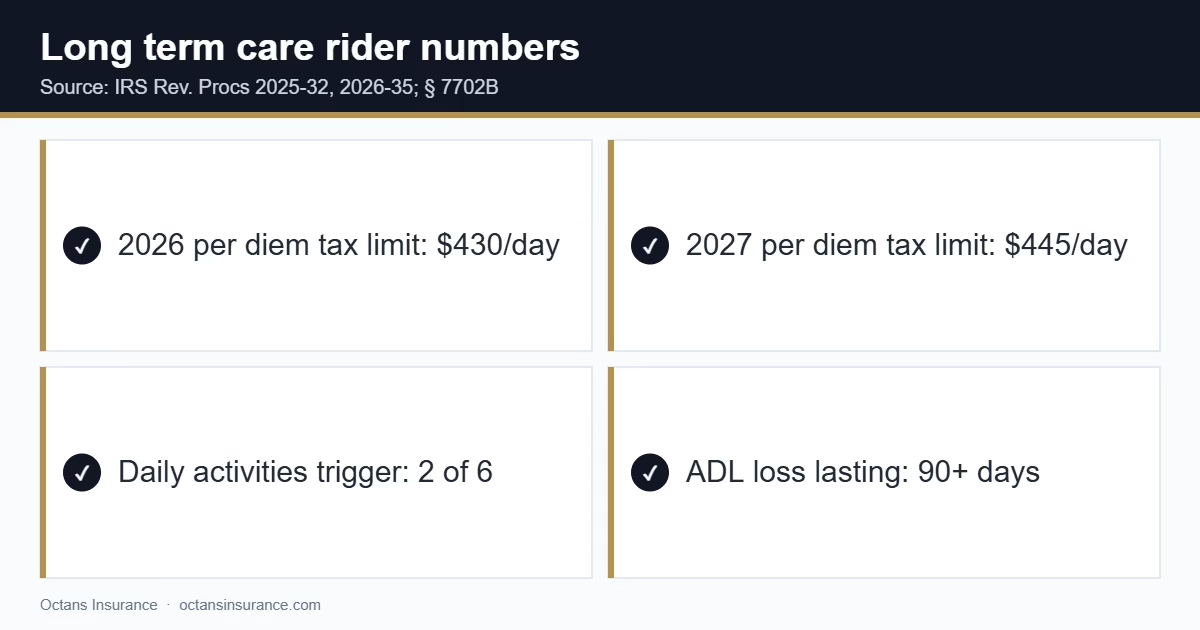
- Tax-qualified trigger: unable to do 2 of 6 daily activities for at least 90 days, or severe cognitive impairment (26 U.S.C. § 7702B).
- The IRS per diem limit on periodic care payments is $430 a day in 2026 and $445 a day in 2027.
- Care benefits reduce the death benefit: use $60,000 of a $100,000 policy and your beneficiary gets $40,000 (NAIC example).
Table of Contents
Make sure your family is financially protected today!
Life insurance with long term care rider coverage lets you use some or all of your death benefit while you’re alive to pay for care once you meet its triggers, such as being unable to do two of six daily activities or having severe cognitive impairment. Anything you use reduces what your beneficiaries get. Benefits can be tax-free within IRS limits, such as $430 a day in 2026.
Below: how life insurance with long term care rider coverage works, the tax rules, and how to compare policies. For other riders that pay while you’re alive, see life insurance with living benefits.
How does a long term care rider work?
A long term care rider is an add-on to a life insurance policy. The NAIC’s Shopper’s Guide to Long-Term Care Insurance says this kind of benefit “lets you access some or all of the policy’s death benefit while you’re alive.” You usually pay an extra premium for the rider.
Why do people want one? Medicare.gov says Medicare and most health insurance, including Medigap, “don’t pay for long-term care services, including care in a nursing home or in the community.” This care is also called custodial care.
To start benefits, you must meet the rider’s triggers. The NAIC says the usual triggers are being unable to perform a certain number of activities of daily living, or being cognitively impaired. The Texas Department of Insurance (TDI) lists the six: bathing, eating, dressing, using the bathroom, continence, and moving from place to place.
The rider then pays in one of two ways, per the NAIC. It reimburses your actual care costs, or it pays a set amount each month, called an indemnity benefit. Either way, there may be a monthly minimum and maximum. Ask, too, whether payments start right away or only after a waiting period.

LTC rider vs chronic illness rider: what’s the difference?
The two can look alike on a quote, but the rules behind them can differ. The NAIC says a life insurance policy with an accelerated benefit rider for long term care “must follow all the laws and regulations that apply to long-term care policies.” Federal tax law also treats the two separately, as the tax section below explains.
A chronic illness rider also accelerates the death benefit, but it may not be regulated as long term care insurance. The NAIC’s Accelerated Benefits Model Regulation covers accelerated benefits that aren’t subject to long-term care insurance law, and it says products under it “shall not be described or marketed as long-term care insurance.” The model doesn’t name chronic illness riders, and states adapt NAIC models, so ask which rules a rider follows and read its title and disclosures.
| Feature | Long term care rider | Accelerated benefit rider (not LTC) | Stand-alone LTC policy |
|---|---|---|---|
| Rules it follows | Long term care insurance laws | Accelerated benefit rules, as your state adopts them; can’t be marketed as LTC insurance | Long term care insurance laws |
| Where the money comes from | Your death benefit, plus any extension rider | Your death benefit | The policy’s own benefits |
| How it pays | Reimbursement of costs or a set monthly amount | Under the NAIC model, a lump-sum option is required and use of the money can’t be restricted | Set by the policy |
| How you pay for it | Usually an extra premium | A premium charge, a discount on the benefit, or interest on a lien | Its own premium |
| Effect on the death benefit | Reduced by what you use | Reduced; a discount or lien can reduce it by more than you receive | None, since it isn’t life insurance |
Sources: NAIC Shopper’s Guide to Long-Term Care Insurance (2022); NAIC Accelerated Benefits Model Regulation (Model 620, 1998); Texas Department of Insurance long-term care guide (updated Oct. 29, 2024). Read November 2026.
Our life insurance riders guide covers waiver of premium, child term and the other common add-ons.
How do benefits reduce the death benefit?
Every dollar of care paid from the rider usually comes out of the death benefit. TDI says the company “will subtract the amount you get for long-term care from the death benefit” owed to your beneficiaries. The NAIC gives this example: on a $100,000 policy, if you use $60,000 for care, your beneficiary gets $40,000.
Some policies add more. The NAIC says some may leave a small death benefit even after the full amount is used for care. Others offer an extension of benefits rider, which keeps paying for a set period after the death benefit is used up, and some of those benefits may rise by a set inflation percentage.
Accelerated benefit riders that aren’t LTC insurance can cost more at claim time. Under the NAIC accelerated benefits model, an insurer may charge a premium for the benefit, pay a discounted “present value of the face amount,” or charge interest on a lien. With a discount or lien, the death benefit can drop by more than the cash you receive.
The same model requires a disclosure that accelerated benefit payments “may adversely affect the recipient’s eligibility for Medicaid or other government benefits.” If Medicaid may be part of your plan, ask before you file.
Is life insurance with long term care rider coverage taxable?
Often it isn’t, within limits. Under 26 U.S.C. § 7702B, a qualified long term care contract is “treated as an accident and health insurance contract.” Its benefits count as amounts received for personal injuries and sickness. When the coverage is part of a life policy, the law treats that portion as a separate contract.
For chronic illness and other accelerated benefits, 26 U.S.C. § 101(g) can treat payments to a terminally ill or chronically ill insured as “an amount paid by reason of the death of an insured,” if the payments and the policy meet the law’s conditions. Chronically ill means certified by a licensed health care practitioner as unable to do at least 2 of the 6 activities for at least 90 days, or needing substantial supervision due to severe cognitive impairment.
Daily or other periodic payments have a cap. The IRS per diem limit is $430 a day for 2026 (Rev. Proc. 2025-32) and $445 for 2027 (Rev. Proc. 2026-35). Under § 7702B(d), the limit is the greater of that daily amount or your actual qualified care costs, minus reimbursements.
Hypothetical example: Ray owns $300,000 of life insurance with long term care rider benefits. The tax-qualified rider pays a set monthly amount of 4% of the death benefit. (This 4% design is illustrative only, not any insurer’s actual rider.) In 2026 he’s certified as chronically ill and moves to assisted living.
- Monthly benefit: $300,000 × 4% = $12,000.
- 2026 limit for a 30-day month: $430 × 30 = $12,900. His $12,000 is under the limit.
- After 12 months: 12 × $12,000 = $144,000 paid, so $300,000 − $144,000 = $156,000 is left for his beneficiaries.
- If the rider paid 5% instead, that’s $15,000 a month, or $15,000 − $12,900 = $2,100 over the limit. That part could be taxable unless his actual qualified care costs that month were at least $15,000.
- In 2027 the same 30-day limit is $445 × 30 = $13,350.
Tax rules have more detail than this example shows, so ask a tax professional before you claim.
Term life insurance with long term care rider: does it make sense?
It can, with one big catch. A rider accelerates the death benefit, so it can only pay while the policy is in force. Term life insurance with long term care rider coverage protects you during the term, such as the years you’re raising kids. Once the term ends, the death benefit and the rider end with it.
So think about when you’d most likely use the rider. If you buy a 20-year term at 45, the coverage ends at 65. A rider on a permanent policy, such as whole life insurance or indexed universal life, can stay available as long as that policy stays in force, subject to the rider’s own terms.
If you prefer term, ask whether the policy can be converted to permanent coverage, and whether the rider carries over. Our guide to converting term life insurance to whole life explains deadlines and costs.
What does life insurance with long term care rider coverage cost?
There’s no single price. Life insurance with long term care rider cost depends on your age, health, the death benefit and the rider’s design, so only a quote can tell you. What you can compare is how each policy charges for the rider:
- Extra premium. The NAIC says you usually pay an extra premium for a long term care rider.
- Charge at claim time. Under the NAIC accelerated benefits model, an accelerated benefit rider that isn’t LTC insurance may be paid for through a premium charge, a discount, or interest on a lien.
- Fees. The same model requires insurers to disclose any administrative expense charge.
The NAIC says a life policy that can pay for long term care may be called a “hybrid,” “linked benefits” or “combo” policy. It also warns that, all else being equal, the premium for a stand-alone long term care policy “could be much less” than for a hybrid. The trade-off: a stand-alone policy leaves no death benefit if you never need care.
If an accelerated benefit rider has a premium or cost of insurance charge, the NAIC model calls for an illustration showing how a payout would affect the policy’s cash value, death benefit, premium and loans. Ask for it.
Who should consider life insurance with long term care rider coverage?
Life insurance with long term care rider coverage can fit if you need life insurance anyway and want some protection against care costs from the same policy.
It may fit less well if:
- your family needs the full death benefit, since care costs would shrink it;
- your budget is tight, given the NAIC’s note on hybrid premiums;
- you expect to rely on Medicaid, since the NAIC accelerated benefits model warns that payments may affect eligibility; or
- you already own long term care insurance and would be paying twice.
How to compare a life insurance policy with long term care rider options
- Decide how much of the death benefit your family must keep, no matter what.
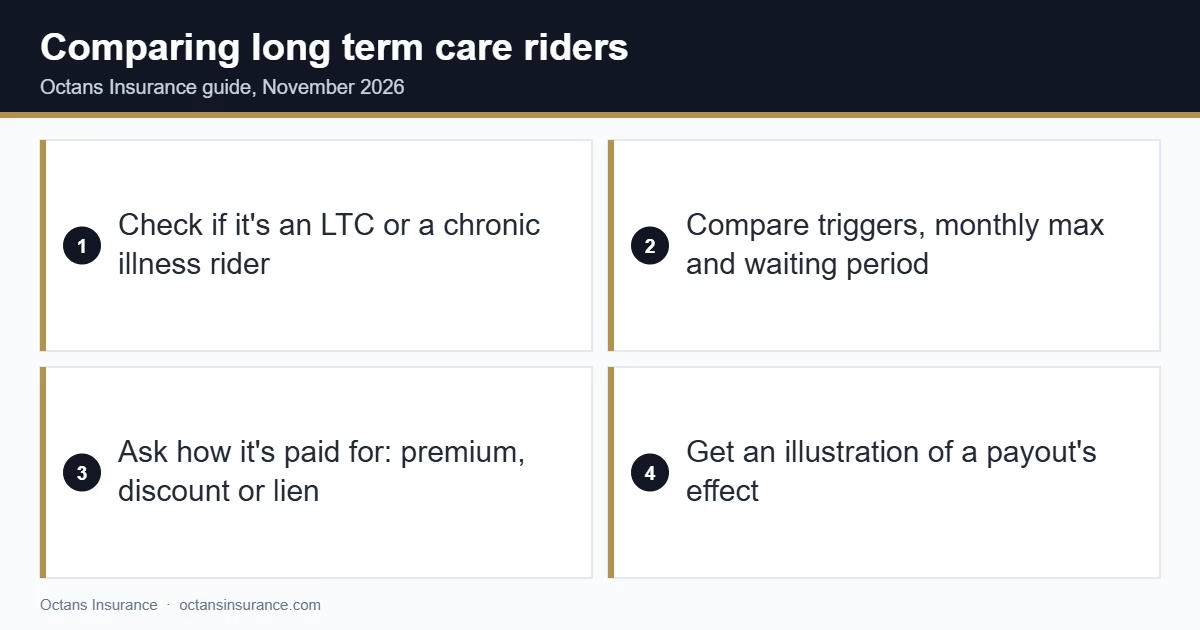
- Ask whether the rider is a long term care rider or a chronic illness rider, and whether it is tax-qualified.
- Compare the triggers: which activities count, cognitive impairment, the 90-day rule, and who certifies you.
- Compare the monthly maximum, reimbursement vs a set monthly amount, and the waiting period.
- Ask how the rider is paid for, and get the illustration showing a payout’s effect on the policy.
- Ask about extension of benefits and inflation options.
- Confirm the rider is offered in your state, and read the disclosures before you sign.
Questions to ask before you buy:
- What percentage of the death benefit can I use each month, and in total?
- Does the rider reimburse costs, or pay a set amount?
- Is there a discount, lien or interest charge when I claim?
- Does home care count, or only facility care?
- Will premiums stop while I’m receiving benefits?
- What is left for my beneficiaries if I use the full benefit?
Life insurance with long term care rider: frequently asked questions
Is a long term care rider worth it?
It depends on what you need the policy to do. Life insurance with long term care rider coverage can make sense if you want a death benefit and some help with care costs, and you can afford the added premium. If your family needs every dollar of the death benefit, compare a stand-alone long term care policy, which the NAIC says could cost much less, all else being equal.
What is the difference between a long term care rider and long term care insurance?
A rider is part of a life insurance policy and pays care costs by using up the death benefit. Long term care insurance is a separate policy with its own benefits and premium. The NAIC says a life policy with a long term care rider must still follow the laws that apply to long term care policies.
What happens if I never need long term care?
Then life insurance with long term care rider coverage works like regular life insurance. When you die, your beneficiaries receive the death benefit, minus any loans or other reductions the policy describes. That’s the main appeal over a stand-alone long term care policy, which pays nothing if you never need care. You still pay any rider premium while you own it.
Can a long term care rider affect Medicaid eligibility?
It can, depending on the rider. For accelerated benefit riders that aren’t long term care insurance, the NAIC Accelerated Benefits Model Regulation requires a disclosure that payments may adversely affect eligibility for Medicaid or other government benefits. If Medicaid is part of your plan, ask your state Medicaid office or an elder law attorney how rider payments would count before you claim.
Does Medicare pay for long term care?
No. Medicare.gov says Medicare and most health insurance, including Medicare Supplement (Medigap) plans, don’t pay for long term care services, including care in a nursing home. That’s why people look at riders, stand-alone long term care insurance, savings, or Medicaid to plan for custodial care.
Can I add a long term care rider to a policy I already own?
Ask your insurer. The NAIC describes a rider as an optional form that can be attached to a policy on or after its date of issue, so some insurers may allow it and others may not. Adding coverage later may require new health questions, and the rider has to be offered in your state.

How a licensed Octans agent can help
Riders with similar names can work very differently. A licensed Octans Insurance agent can compare life insurance with long term care rider options from 120+ carriers and show you, side by side, which type each rider is, how it’s paid for, and what it leaves your beneficiaries.
We can also request the illustrations that show how a claim would change your death benefit. We don’t give tax or legal advice, so we’ll point you to a tax professional or elder law attorney for those questions.
To talk it through, call (617) 935-9220 and ask for a licensed agent.
Keep Reading: Related Guides
- Life insurance with living benefits
- Life insurance riders
- Whole life insurance
- Permanent Life Insurance
- Universal Life Insurance
- Does Medicare Cover Long Term Care? What It Pays and What It Won’t
- Does Medicare Cover Nursing Home Care? What Pays and for How Long
Important: Octans Insurance agents are licensed in the states in which they operate. Coverage availability and rates may vary by state. Premium examples, when provided, are illustrative samples from published sources, not quotes. Final rates are determined by the insurance carrier based on underwriting and applicable policy criteria. Policy terms, exclusions, limitations, riders, and availability vary by carrier and state.
About examples and tools: Hypothetical examples, sample rates, calculators and quizzes on this site are for general educational and illustrative purposes only. They are not quotes, offers of coverage, or guarantees of eligibility, approval, price or benefits, and they are not legal, tax, financial or medical advice. The insurance company decides eligibility and price; Medicare rules are set by CMS and the Social Security Administration.
Compare long term care rider options with an agent
Start with a free, no-obligation quote review with a licensed Octans agent.
(617) 935-9220 | life@octansinsurance.com