
Long-Term Care
Does Medicare Cover Long Term Care? What It Pays and What It Won’t
Does Medicare cover long term care? Only short bursts of skilled care. This guide explains the custodial care gap and the Medicaid, insurance, VA and PACE options people use to fill it.
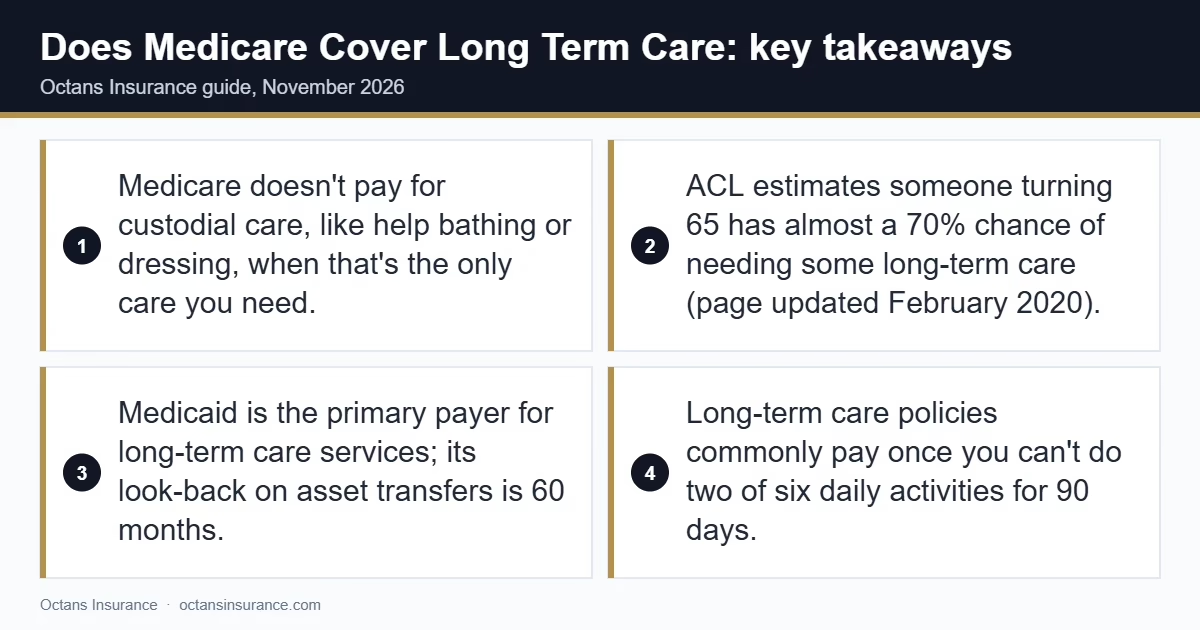
- Medicare doesn’t pay for custodial care, like help bathing or dressing, when that’s the only care you need.
- ACL estimates someone turning 65 has almost a 70% chance of needing some long-term care (page updated February 2020).
- Medicaid is the primary payer for long-term care services; its look-back on asset transfers is 60 months.
- Long-term care policies commonly pay once you can’t do two of six daily activities for 90 days.
Table of Contents
Make sure your family is financially protected today!
Does Medicare cover long term care? No, not the kind most people need. Medicare doesn’t pay for custodial care, like help with bathing, dressing or eating, when that’s the only care you need. It pays only for short-term skilled care, like up to 100 days in a skilled nursing facility after a qualifying hospital stay. For ongoing care, look to Medicaid, long-term care insurance, VA benefits or savings.
What counts as long term care?
Long-term care, also called custodial care or long-term services and support, is mostly help with everyday personal tasks called activities of daily living. Medicare describes it as non-skilled personal care, like bathing, dressing, eating, getting in or out of a bed or chair, moving around and using the bathroom. It can also include health-related care most people do for themselves, like using eye drops.
You can get this care at home, in the community, in an assisted living facility or in a nursing home, according to Medicare.gov. Skilled care is different. It needs a nurse or therapist for things like changing dressings, giving IV drugs or physical therapy. That line between skilled and custodial care decides almost every question about Medicare and long term care.
It’s worth knowing the answer to “Does Medicare pay for long term care?” before you need care. The Administration for Community Living (ACL) estimates, on a page last updated in February 2020, that someone turning 65 has almost a 70% chance of needing some type of long-term care services and supports. Women need care longer (3.7 years) than men (2.2 years). One-third of 65-year-olds may never need it, but 20% will need it for more than 5 years.
When does Medicare cover long term care for a short time?
Does Medicare pay for long term care in any form? Only when you need skilled or rehabilitative care, and only for a limited time. These four Medicare benefits can look like long-term care coverage, but each has limits:
| Medicare benefit | What it covers | Your 2026 cost in Original Medicare | The catch |
|---|---|---|---|
| Skilled nursing facility (Part A) | Daily skilled nursing or therapy after a 3-day inpatient hospital stay | $0 for days 1-20 after the Part A deductible; $217 a day for days 21-100 | 100 days per benefit period, and only while you need daily skilled care |
| Home health (Part A or Part B) | Part-time skilled nursing or therapy, plus aide visits, if you’re homebound | $0 for covered visits; 20% for medical equipment | Aide visits end when skilled care ends |
| Hospice (Part A) | Care for a terminal illness when a doctor certifies a life expectancy of 6 months or less | $0 for hospice care; up to $5 per prescription; 5% for inpatient respite care | Room and board isn’t covered |
| Long-term care hospital (Part A) | Hospital care for patients with more than one serious medical condition | Inpatient hospital cost-sharing | It’s hospital care, not custodial care |
Source: Medicare.gov coverage pages for skilled nursing facility care, home health services, hospice care and long-term care hospitals; CMS 2026 Part A and B figures. Checked November 2026.
So does Medicare cover long term care? Only these short-term pieces. Help with daily living or supervision, when that’s all you need, isn’t covered in any setting. Our guides to the Medicare hospice benefit and Medicare basics explain these benefits in more depth.
Does Medicare cover long term care through Medigap or Medicare Advantage?
Not really. Medigap is private insurance that fills gaps in Original Medicare, so it follows Medicare’s rules. Medicare.gov lists long-term care among the things Medigap plans generally don’t cover. Some Medigap policies pay all or part of the $217 daily skilled nursing coinsurance, but that help ends when Medicare’s coverage ends. See our guide to Medicare Supplement plans.
A Medicare Advantage plan has to cover what Parts A and B cover, with a few exclusions, so you get the same short-term skilled nursing and home health benefits under the plan’s own costs and rules. Custodial care isn’t one of those benefits. Some plans offer extra benefits, which vary by plan and area, so ask any plan in writing what it covers before you count on it for long-term needs.

Who pays for long term care if Medicare doesn’t?
Does Medicare pay for long term care once skilled care ends? No, and you pay all costs for care Medicare doesn’t cover unless another payer steps in. These are the main options:
- Medicaid. Medicaid.gov describes Medicaid as the main payer for long-term care nationwide, in settings that range from institutions to community-based services. Eligible adults 21 and older can get nursing home care, and states can use home and community-based services waivers to pay for care at home or in the community. Waiver services and eligibility vary by state.
- Long-term care insurance. These private policies can pay for both skilled and non-skilled care. Some cover only nursing home care, while others cover a range of services, like adult day care, assisted living or medical equipment.
- Life insurance. Some insurance companies let you use a life insurance policy to pay for long-term care, often through an accelerated death benefit or a long-term care rider.
- VA benefits. VA offers nursing home care, home-based care, adult day health care, homemaker and home health aide care, and respite care, though you may owe copays. Veterans and survivors who need help with daily activities may also get Aid and Attendance payments added to a VA pension. See Medicare for veterans.
- PACE. In states that offer it, PACE combines medical, social and long-term care services and prescription drug coverage for people 55 and older who qualify. If you have Medicaid, you won’t pay a monthly PACE premium.
Medicaid rules to know before you need care
Most planning for Medicare and long term care comes down to Medicaid. Its programs and eligibility vary from state to state, including how much income and countable assets you can have. Three federal rules matter most:
- The 60-month look-back. Under the Social Security Act, for transfers made on or after the Deficit Reduction Act of 2005, Medicaid looks back 60 months. Giving away assets for less than fair market value in that window can make you ineligible for nursing facility care and certain other long-term care services for a period of months.
- Estate recovery. For people 55 or older, states must seek repayment from the estate for nursing facility services, home and community-based services, and related hospital and drug services. They can’t recover while a spouse, a child under 21, or a blind or disabled child survives, and they must have hardship waivers.
- Spousal protections. Under spousal impoverishment rules, the spouse who stays at home can keep a portion of the couple’s assets.
These rules are legal questions, so talk with your state Medicaid office or an elder law attorney before you move money. In Massachusetts, see our guide to MassHealth life insurance and burial rules.
Long-term care insurance and hybrid life insurance
Medicare and long term care insurance do different jobs. Medicare pays for short-term skilled care, while a policy pays once you meet its benefit triggers. The most common, according to the NAIC’s Shopper’s Guide to Long-Term Care Insurance (revised 2019), is being expected to be unable to do two of six activities of daily living without help for 90 days. The six are bathing, continence, dressing, eating, toileting and transferring. Cognitive impairment is another trigger. Unlike Medicare, today’s policies generally don’t require a hospital stay first.
Most policies start with an elimination period of 20, 30, 60, 90 or 100 days, and you pay for your own care until it ends. Health matters: if you already have a condition like Alzheimer’s or Parkinson’s disease, you probably won’t be able to buy a policy. Be sure you could keep paying the premium, including any increases, for the rest of your life.
A hybrid life policy adds long-term care benefits to life insurance, usually through a rider that lets you use some or all of the death benefit while you’re alive. A rider for long-term care must follow the laws that apply to long-term care policies, and you usually pay extra for it. All else being equal, a stand-alone long-term care policy could cost much less than a hybrid. Our guides to life insurance with living benefits and life insurance riders explain how riders work.
Hypothetical example: Joan, 80, is a hospital inpatient for 4 days after a stroke and pays the 2026 Part A deductible of $1,736. Back home, her Medicare-covered therapy visits cost $0. When therapy ends six weeks later, she still needs daily help bathing and dressing. That’s custodial care, so Medicare pays $0 toward it.
Joan’s life policy has a $100,000 death benefit and a long-term care rider. If she uses $60,000 for care, her beneficiaries would get $40,000 ($100,000 minus $60,000). These amounts follow an example in the NAIC’s shopper’s guide (revised 2019). Some policies still pay a small death benefit even after the full amount is used for care, so ask before you buy.

How to plan for long term care costs
Because Medicare and long term care coverage barely overlap, the earlier you plan, the more choices you keep.
- Check what you already own. Review your life insurance, employer benefits and any long-term care coverage. If you take cash value from a life policy for care, first ask how it affects the death benefit and talk with a tax professional.
- Price care where you live. Call local home care agencies, adult day centers, assisted living facilities and nursing homes for their current rates.
- Decide on insurance while you’re healthy. Insurers use medical underwriting, and some conditions make a policy hard to buy later.
- Learn your state’s Medicaid rules. Ask your state Medicaid office or an elder law attorney about the look-back, estate recovery and spousal rules before you move assets.
- Talk with family. Agree on where you’d want care, who would help, and who can act for you if you can’t.
Questions to ask about any long-term care policy or rider:
- What triggers benefits: two of six daily activities, cognitive impairment, or both?
- Do I need hands-on help to qualify, or does stand-by help count?
- How long is the elimination period, and does it count calendar days or only days I pay for care?
- Do I meet the elimination period once, or with each episode of care?
- Does it include inflation protection?
- Which settings does it cover, and how does it define an assisted living facility?
- Can the premium go up, and how would each claim reduce my death benefit?
Does Medicare cover long term care? Frequently asked questions
Does Medicare pay for long term care at home?
No. Medicare’s home health benefit pays for part-time skilled nursing or therapy if you’re homebound, and aide visits only while that skilled care continues. It doesn’t pay for help with bathing, dressing or meals when that’s all you need. Medicaid home and community-based services, which vary by state, PACE or VA programs may help, depending on where you live and your eligibility.
Does Medicare Part A cover long term care hospitals?
Yes, but that isn’t long-term care in the usual sense. Part A covers care in a long-term care hospital, which typically treats patients with more than one serious medical condition. You generally won’t pay another deductible if you transfer there directly from an acute care hospital or are admitted within 60 days of a hospital discharge.
Does Medicare cover long term care if I have Medigap?
Generally, no. Medicare.gov lists long-term care, like care in a nursing home, among the things Medigap plans don’t usually cover. A Medigap policy can help with your share of costs for covered skilled care, such as some or all of the skilled nursing facility coinsurance for days 21 through 100, but it stops when Medicare’s coverage stops.
Does Medicare cover long term care in a Medicare Advantage plan?
Only the short-term skilled care that Original Medicare covers, such as skilled nursing facility and home health care, under the plan’s own costs and rules. For a long nursing home stay, Medicare.gov tells members to check with their plan, since plans usually pay only when the home has a contract with them. Ask the plan what it covers and get the answer in writing.
Can Medicaid recover long-term care costs from my estate?
Yes, in many cases. Federal law requires states to try to recover what Medicaid spent on nursing facility care, home and community-based services, and related hospital and drug costs for people who were 55 or older. Recovery can’t happen while a spouse, a child under 21, or a blind or disabled child survives, and states must offer hardship waivers. Ask an elder law attorney about your situation.
When should I buy long-term care insurance?
The NAIC says the decision depends on your age, health, retirement goals, income and assets. Waiting has a cost: insurers use medical underwriting, and people who already have conditions like Alzheimer’s or Parkinson’s disease probably can’t buy a policy. Only buy coverage you could keep paying, including possible premium increases, for life.

How an Octans agent can help
In the 19 states we serve, a licensed Octans agent can walk you through Medicare Supplement (Medigap), Medicare Advantage and Part D choices, so you know what Medicare and your plan will and won’t pay for. If life insurance with living benefits is part of your plan, an agent can explain how the riders on the policies we offer work. Call (617) 935-9220.
Your State Health Insurance Assistance Program (SHIP) offers free, personalized counseling, including help with questions about paying for care; look up your local office at shiphelp.org. Medicare’s own helpline is 1-800-MEDICARE (1-800-633-4227; TTY 1-877-486-2048).
Medicaid eligibility, asset transfers and estate planning are legal and tax questions. An agent isn’t the right adviser for them, so talk with an elder law attorney or a tax professional.
Keep Reading: Related Guides
- Life insurance with living benefits
- Life insurance riders
- Medicare hospice benefit
- Medicare and Home Health Care
- Does Medicare Cover Nursing Home Care?
- Does Medicare Cover Assisted Living?
We do not offer every plan available in your area. Please contact Medicare.gov or 1-800-MEDICARE to get information on all of your options.
This article is for general information and is not tax, legal, or medical advice.
About examples and tools: Hypothetical examples, sample rates, calculators and quizzes on this site are for general educational and illustrative purposes only. They are not quotes, offers of coverage, or guarantees of eligibility, approval, price or benefits, and they are not legal, tax, financial or medical advice. The insurance company decides eligibility and price; Medicare rules are set by CMS and the Social Security Administration. Octans Insurance is not connected with or endorsed by the U.S. government or the federal Medicare program.
Plan your Medicare and life coverage together
Start with a free, no-obligation quote review with a licensed Octans agent.
(617) 935-9220 | life@octansinsurance.com