
Medicare Coverage
Does Medicare Cover Assisted Living? What It Pays and Who Else Can
Does Medicare cover assisted living? Not the rent or daily care, but your medical coverage still applies there. Learn how home health, hospice, Medicaid waivers and VA pension fit in.
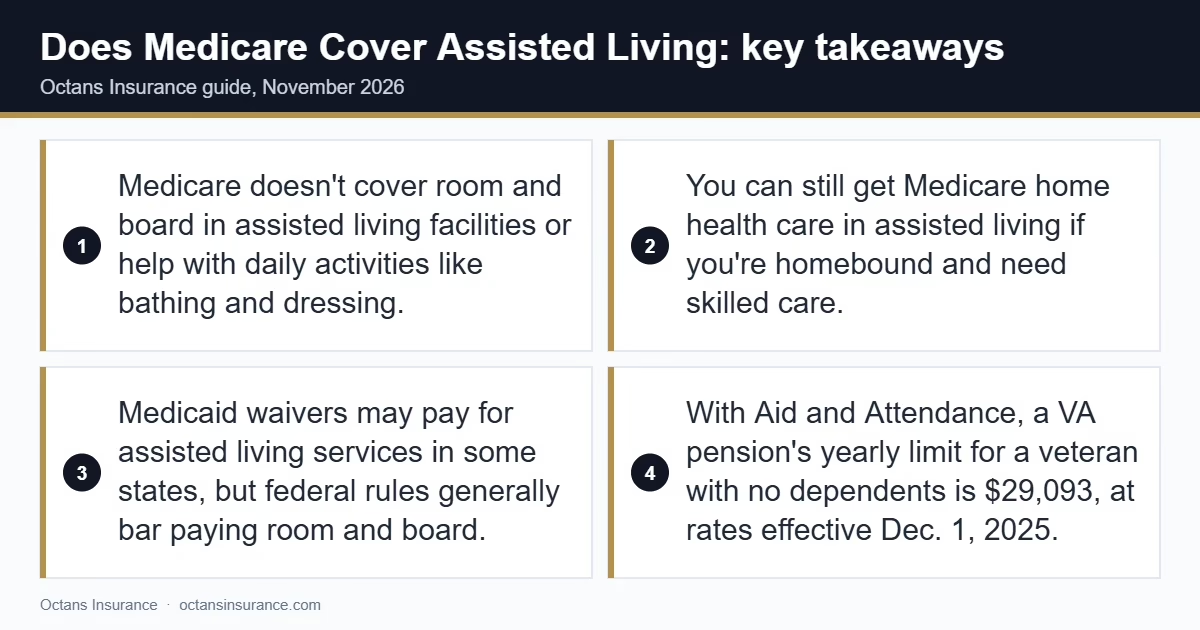
- Medicare doesn’t cover room and board in assisted living facilities or help with daily activities like bathing and dressing.
- You can still get Medicare home health care in assisted living if you’re homebound and need skilled care.
- Medicaid waivers may pay for assisted living services in some states, but federal rules generally bar paying room and board.
- With Aid and Attendance, a VA pension’s yearly limit for a veteran with no dependents is $29,093, at rates effective Dec. 1, 2025.
Table of Contents
Make sure your family is financially protected today!
Does Medicare cover assisted living? No. Medicare doesn’t pay for rent, meals or personal care, like help with bathing and dressing. It still covers your medical care while you live there, including doctor visits, home health visits if you qualify, hospice care and, with a drug plan, prescriptions. To pay the bill, families use savings, VA benefits, long-term care insurance and, in some states, Medicaid waivers for care services.
Does Medicare cover assisted living rent or personal care?
No. Medicare’s booklet Medicare Coverage of Cancer Treatment Services (September 2025) lists room and board in assisted living facilities among the things Medicare doesn’t cover. Help with daily activities is long-term care, and Medicare.gov says Medicare doesn’t pay for it, whether you get it at home, in assisted living or in a nursing home. The same booklet lists adult day care as not covered, too.
Assisted living facilities generally provide room and board, social and recreational activities, and help with personal care and other daily activities. According to the Administration for Community Living, residents usually pay a monthly rent plus extra fees for added services, and they pay for medical and nursing services separately.
So does Medicare cover assisted living if your doctor says you need it? Still no. Help with daily activities is custodial care, and when that’s all the help you need, Original Medicare won’t pay for it in any setting. The facility’s bill is yours unless another program or policy helps.
What Medicare still pays for while you live in assisted living
Medicare and assisted living do work together in one way: Medicare still covers your medical care while you live there. Here’s how the costs split in Original Medicare in 2026:
| Cost while you live in assisted living | Does Medicare pay? | What you pay in 2026 |
|---|---|---|
| Rent, meals and other room and board | No | All costs |
| Help with bathing, dressing and other daily activities | No | All costs |
| Doctor visits and other Part B services | Yes | 20% of the Medicare-approved amount after the $283 Part B deductible |
| Home health visits, if you qualify | Yes | $0 for covered visits |
| Hospice care, if you qualify | Yes | $0 for hospice care; up to $5 per prescription; room and board still yours |
| Prescription drugs, with a Part D plan | Yes | Plan costs, with a $2,100 out-of-pocket limit in 2026 |
| Hospital stay, then short-term skilled nursing care, after a fall or illness | Yes, under Part A rules | $1,736 deductible per benefit period; $217 a day for skilled nursing days 21-100 |
| Part B premium | Not applicable | $202.90 a month standard premium |
Source: CMS Product No. 11931 (September 2025); Medicare.gov coverage and cost pages; CMS, “2026 Medicare Parts A & B Premiums and Deductibles.” Checked November 2026.
Hospice care can be given where you live, like an assisted living facility, but Medicare doesn’t cover your room and board during hospice. Our guide to the Medicare hospice benefit covers eligibility. For drug plan basics, see what Medicare Part D covers.
Can you get Medicare home health care in assisted living?
Often, yes, and this is where Medicare and assisted living overlap most. Under the CMS Medicare Benefit Policy Manual, your residence is wherever you make your home, and that can include an assisted living facility. Medicare covers reasonable and necessary home health care there if the facility isn’t primarily engaged in providing skilled or medical care. That’s a key difference from most nursing homes, which can’t count as your home for this benefit.
Living in a facility doesn’t relax the eligibility rules. You must still be homebound, need intermittent skilled nursing or therapy, and get care under a plan your doctor or allowed provider oversees. The homebound test applies where you live. There’s one more limit: Medicare won’t pay a home health agency for services that duplicate what the facility must provide under its state license or its contract with you.
If you’re caring for someone with memory loss, see our guide to Medicare and dementia care.

Does Medicaid pay for assisted living?
Does Medicare pay for assisted living through Medicaid? No. Medicaid is a separate joint federal and state program, and it sometimes pays for the services but not the rent. States can run home and community-based services waivers for people who want long-term care at home or in the community instead of an institution. Services can include case management, homemaker, home health aide, personal care, adult day health and respite care.
Coverage depends on your state. ACL notes that some states cover assisted living services, while others do not. Each state sets the groups a waiver serves and the maximum number of people it covers. Federal rules (42 CFR 441.310) also bar waiver funds from paying room and board in most cases, so expect to pay the rent and food part yourself. ACL puts it plainly: Medicaid will not pay for your rent, mortgage, utilities or food.
Call your state Medicaid office to ask whether a waiver covers assisted living where you live, what the income and asset limits are, and whether there’s a limit on enrollment. In Massachusetts, Medicaid rules also affect life insurance and burial funds; see MassHealth life insurance and burial rules.
How VA Aid and Attendance can help
VA doesn’t pay a veteran’s rent in assisted living, according to VA’s geriatrics office. But Aid and Attendance adds a monthly amount to a VA pension for eligible veterans and survivors. You may qualify if you need another person’s help with daily activities like bathing, feeding and dressing, or if you spend most of the day in bed because of illness, live in a nursing home because of a disability, or have very limited eyesight.
VA may also pay for some extra services a veteran needs in the facility, and a VA social worker can help decide whether extra nursing or aide help is needed.
The pension itself has rules. A veteran generally needs wartime service, a discharge that isn’t dishonorable, income and net worth within limits set by Congress, and must be 65 or older or meet one of VA’s disability-related conditions. From December 1, 2025, to November 30, 2026, the net worth limit is $163,699, according to VA’s pension rate tables. VA pays the difference between your income for VA purposes and a yearly limit called the Maximum Annual Pension Rate (MAPR).
Hypothetical example: Frank is a single wartime veteran with no dependents, living in assisted living, who needs help bathing and dressing. Suppose VA approves him for pension with Aid and Attendance and counts his income as $16,800 a year (a made-up amount). His MAPR at the rates in effect since December 1, 2025, is $29,093. VA would pay $29,093 minus $16,800, or $12,293 a year, which is about $1,024 a month.
If Frank also pays unreimbursed medical expenses, VA may deduct the part above $872, the threshold VA lists for a veteran with no spouse or child at the same rates, which would raise his payment. Medicare still pays none of his rent. Veterans can learn more in our guide to Medicare for veterans.
Does Medicare cover assisted living costs through Medigap or Medicare Advantage?
Not the room, the board or the personal care. Medigap policies pick up costs left after Original Medicare pays, and Medicare pays nothing toward assisted living rent or personal care. Medicare.gov also names long-term care as something Medigap generally doesn’t cover. A Medicare Advantage plan covers your Part A and Part B benefits, and neither part pays assisted living rent or custodial care. Any extra benefits vary by plan and area, so get in writing anything a plan says it covers for assisted living.
Other ways families pay for assisted living
Does Medicare cover assisted living costs in any other way? No, so these are the main sources families use:
- Savings and income. You pay the monthly rent and service fees yourself unless a program or policy helps.
- Long-term care insurance. Check whether your policy lists assisted living as a covered setting and whether your facility fits its definition. The NAIC says that if you don’t live in the kind of facility your policy names, the insurer may not pay.
- Life insurance. Some life policies let you draw part of the death benefit early to pay for care, which likely leaves less for your beneficiaries. See life insurance with living benefits and life insurance riders.
- VA and Medicaid. Aid and Attendance and a state Medicaid waiver can each help with care costs, as described above.
How to check an assisted living facility before you sign
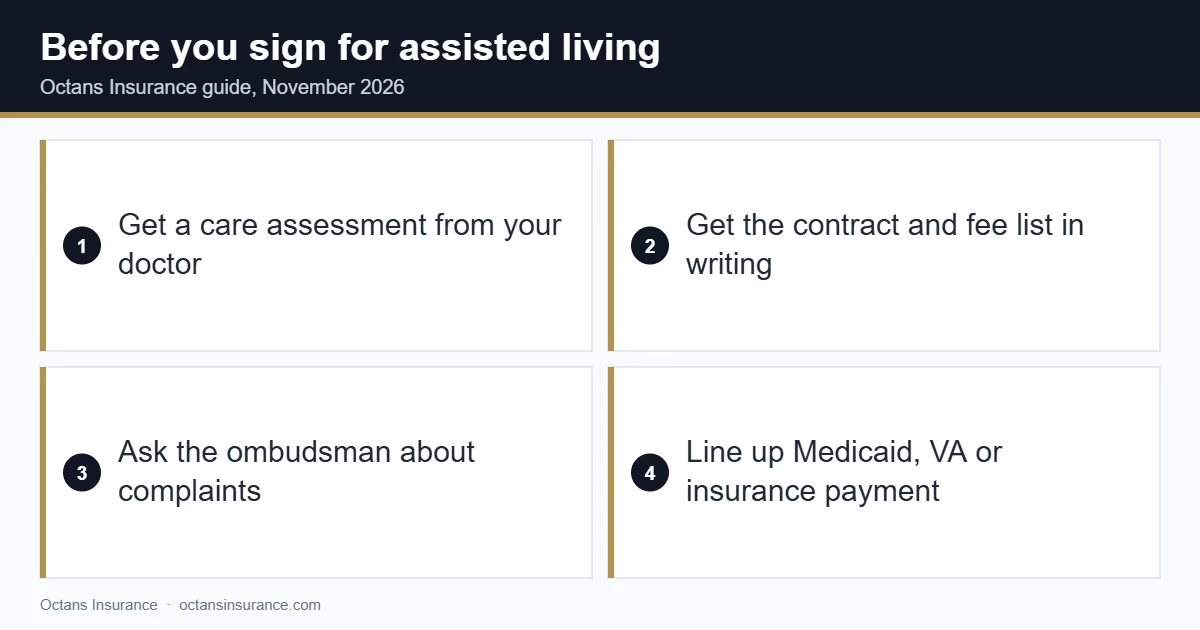
- Get a care assessment. Ask your doctor what help you need now and what you may need later, so you can compare facilities on the right services.
- Get the contract and fee list in writing. See what the monthly rent includes and what each added service costs.
- Check the license and reports. Ask your state licensing agency for the facility’s license status and any inspection or complaint reports.
- Call the long-term care ombudsman. Ombudsmen are independent advocates who work to solve problems for assisted living and nursing home residents. Ask about complaints at the facility.
- Line up payment. Confirm whether the facility accepts your state’s Medicaid waiver, whether your long-term care policy covers this type of facility, and, for veterans, file VA Form 21-2680 for Aid and Attendance.
Questions to ask on a tour:
- What does the base rent include, and what costs extra?
- How much notice do you give before fees go up?
- When would a resident have to move out because care needs grew?
- Is staff awake and on site 24 hours a day?
- Can residents use their own home health agency, hospice and doctors?
- Do you accept Medicaid waiver payments for services?
Does Medicare cover assisted living? Frequently asked questions
Does Medicare pay for assisted living for dementia care?
No. Memory care in an assisted living facility is still room, board and help with daily activities, which Medicare doesn’t cover. Medicare does cover the medical side, like doctor visits, and home health visits if the person is homebound and needs skilled care. A Medicaid waiver, where a state offers one, may cover some care services, and VA Aid and Attendance or long-term care insurance may help with the bill.
Does Medicare pay for assisted living after a hospital stay?
No. After a hospital stay of at least 3 inpatient days in a row, Medicare may cover up to 100 days in a skilled nursing facility for daily skilled care, but not assisted living. If you move to assisted living instead, you may still qualify for Medicare home health visits there, at $0 for covered visits.
Does Medicaid pay for assisted living in every state?
No. ACL says some states cover assisted living services, while others do not. Where a state does, a home and community-based services waiver may pay for services like personal care, and Medicaid.gov notes that each state designs its own waivers, so the details vary by state. Federal rules generally bar waiver money from paying room and board, so you still pay the rent and food.
Does VA pay for assisted living?
VA doesn’t pay a veteran’s rent in assisted living. But a veteran or survivor who qualifies for VA pension can get Aid and Attendance added if they need help with daily activities, and that money can go toward the bill. In the rates effective December 1, 2025, the yearly limit for a veteran with no dependents is $29,093.
Does Medicare cover assisted living costs during hospice care?
Medicare covers hospice care itself, and you can usually get it in an assisted living facility. You pay $0 for hospice care from a Medicare-approved provider and up to $5 per prescription for pain and symptom drugs. But Medicare doesn’t cover room and board during hospice, so the facility’s monthly charges are still yours.
Does long-term care insurance cover assisted living?
Some policies do, but not all of them. Medicare.gov notes that some policies pay only for nursing home care. If yours includes assisted living, read how it defines the facility, because the NAIC warns that states, companies and policies define assisted living differently. Before you move, especially to another state, ask the insurer whether the facility you’re considering qualifies.

How an Octans agent can help
Moving to assisted living doesn’t change what Medicare covers, but it’s a good time to make sure your plan’s doctors and pharmacies work from your new address. If you’re moving within the 19 states we serve, a licensed Octans agent can check how your Medigap, Medicare Advantage or Part D plan fits the new location and compare other options. Call (617) 935-9220.
A counselor at your State Health Insurance Assistance Program (SHIP) can review your Medicare choices at no charge; find the program at shiphelp.org. Medicare answers coverage questions at 1-800-MEDICARE (1-800-633-4227; TTY 1-877-486-2048). For VA pension questions, contact VA or an accredited representative.
An agent can’t decide Medicaid or VA eligibility. If you’re weighing life insurance with living benefits to help with future care costs, an agent can explain how riders work on the policies we offer.
Keep Reading: Related Guides
- Medicare hospice benefit
- Medicare for veterans
- Life insurance with living benefits
- Medicare and Home Health Care
- Does Medicare Cover Long Term Care?
- Does Medicare Cover Nursing Home Care?
We do not offer every plan available in your area. Please contact Medicare.gov or 1-800-MEDICARE to get information on all of your options.
This article is for general information and is not tax, legal, or medical advice.
About examples and tools: Hypothetical examples, sample rates, calculators and quizzes on this site are for general educational and illustrative purposes only. They are not quotes, offers of coverage, or guarantees of eligibility, approval, price or benefits, and they are not legal, tax, financial or medical advice. The insurance company decides eligibility and price; Medicare rules are set by CMS and the Social Security Administration. Octans Insurance is not connected with or endorsed by the U.S. government or the federal Medicare program.
Check your Medicare plan before you move
Start with a free, no-obligation quote review with a licensed Octans agent.
(617) 935-9220 | life@octansinsurance.com