
Medicare Coverage
Does Medicare Cover Nursing Home Care? What Pays and for How Long
Does Medicare cover nursing home care? Here’s how the 3-day rule, observation status, the 100-day limit and 2026 coinsurance work, plus what Medicaid and other payers cover once skilled care ends.
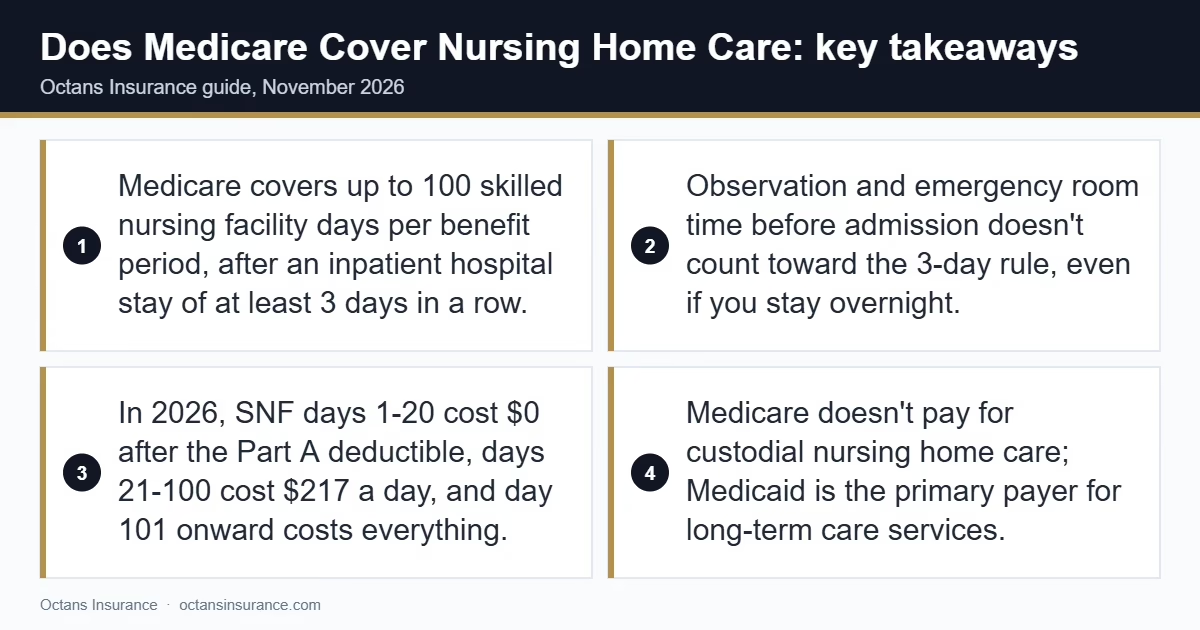
- Medicare covers up to 100 skilled nursing facility days per benefit period, after an inpatient hospital stay of at least 3 days in a row.
- Observation and emergency room time before admission doesn’t count toward the 3-day rule, even if you stay overnight.
- In 2026, SNF days 1-20 cost $0 after the Part A deductible, days 21-100 cost $217 a day, and day 101 onward costs everything.
- Medicare doesn’t pay for custodial nursing home care; Medicaid is the primary payer for long-term care services.
Table of Contents
Make sure your family is financially protected today!
Does Medicare cover nursing home care? Only short-term skilled care. Part A covers up to 100 days in a skilled nursing facility (SNF) per benefit period after a 3-day inpatient hospital stay. In 2026, after the $1,736 Part A deductible, you pay $0 for days 1 through 20 and $217 a day for days 21 through 100. Medicare doesn’t pay for long-term custodial care in a nursing home.
When does Medicare cover nursing home care?
Does Medicare cover nursing homes at all? Yes, but generally not for long-term stays unless you’re getting skilled nursing care. That short-term care happens in a SNF, and most nursing homes also offer SNF care. Medicare’s booklet Medicare Coverage of Skilled Nursing Facility Care (August 2025) says Part A covers a SNF stay only if all of these are true:
- You have Part A and days left in your benefit period.
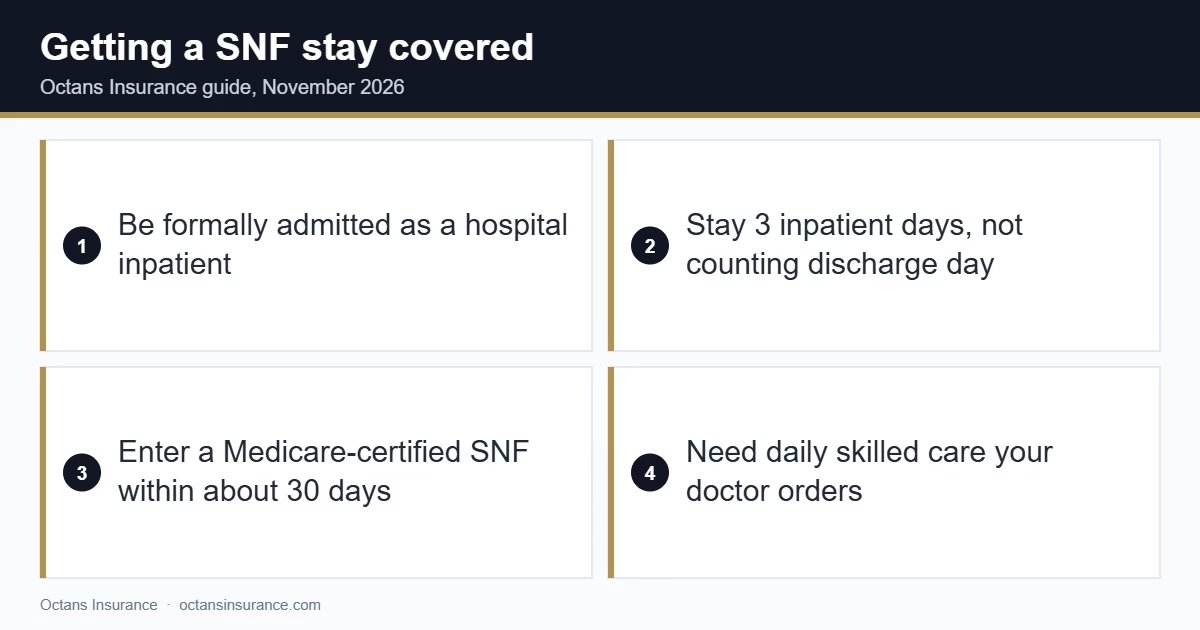
- You had a medically necessary inpatient hospital stay of at least 3 days in a row. Count the day you were admitted as an inpatient, but not the day you were discharged.
- You enter the SNF within a short time, generally 30 days, after you leave the hospital.
- Your doctor orders skilled care you need daily that, as a practical matter, can only be given in a SNF. Therapy counts as daily if you need it 5 to 7 days a week.
- The care is for a condition treated during your hospital stay, or a new condition that started while you were in the SNF for that condition.
- The SNF is certified by Medicare.
When you qualify, Medicare covers a semi-private room, meals, skilled nursing, therapy, medical social services, medications, medical supplies and equipment used in the facility, dietary counseling, and ambulance trips in certain cases.
Does Medicare cover nursing home care after an observation stay?
Only if you also had 3 inpatient days. You’re an inpatient starting when a doctor formally admits you with an order. Time under observation or in the emergency room before that doesn’t count, even if you spend the night in a regular hospital bed, according to Medicare’s fact sheet Medicare Hospital Benefits (December 2025).
If you get outpatient observation services for more than 24 hours, the hospital must give you a Medicare Outpatient Observation Notice (MOON). CMS requires it no later than 36 hours after observation starts, or sooner if you’re released. The MOON explains that you’re an outpatient and what that means for your costs and for SNF coverage after the hospital.
Ask the hospital or your doctor each day whether you’re an inpatient or an outpatient. If you were admitted as an inpatient and the hospital changes you to outpatient observation, you have the right to ask for a fast appeal while you’re still in the hospital, if you meet certain requirements.
You may not need the 3-day stay if your doctor is in an Accountable Care Organization approved for a SNF 3-Day Rule Waiver, and Medicare Advantage plans may also waive it. Without a qualifying stay, ask whether home health care, Medicaid or veterans’ benefits could cover your care instead.
How long does Medicare cover nursing home care?
Up to 100 days of SNF care in each benefit period. Your benefit period starts on the day you’re admitted as an inpatient to a hospital or SNF. It closes once you’ve gone 60 days in a row without inpatient hospital care or skilled care in a SNF. There’s no limit on benefit periods, but you pay the Part A deductible in each one; see our guide to Medicare deductibles.
A break in SNF care changes what happens next. Out for less than 30 days, you don’t need a new 3-day hospital stay, though you must still meet the other rules, and your current benefit period continues. Out for 30 to 59 days, you must meet every requirement again, including a new qualifying stay. Out for 60 days or more, a new benefit period with up to 100 days can start once you qualify again.
So does Medicare cover nursing home care for all 100 days? Only while you need daily skilled care. When that ends, you’ll get a Notice of Medicare Non-Coverage, and you can ask for a fast appeal if you think care is ending too soon. The SNF doesn’t have to warn you in writing when your 100 days run out, so keep your own count.
What you pay for skilled nursing care in 2026
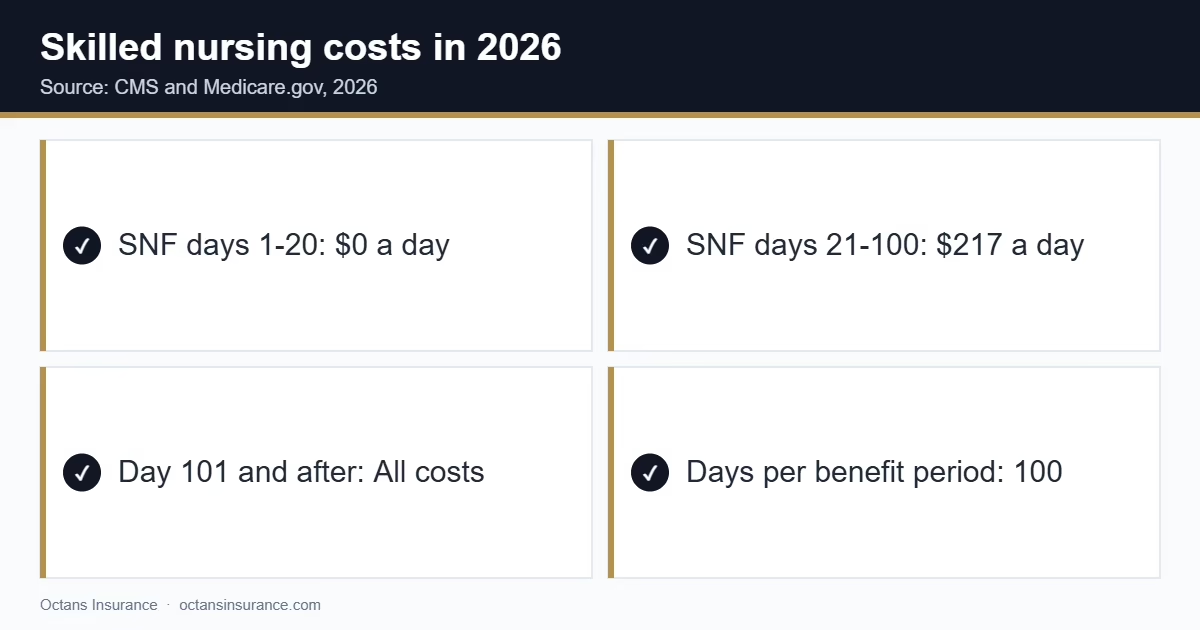
Does Medicare pay for skilled nursing in full? Only for the first 20 days. Here’s the 2026 split in Original Medicare:
| Stage of care | You pay | Medicare pays |
|---|---|---|
| Qualifying hospital stay | $1,736 Part A deductible per benefit period | The rest of covered inpatient costs for days 1 to 60 |
| SNF days 1 to 20 | $0 a day, if you already paid the deductible this benefit period | All covered costs |
| SNF days 21 to 100 | $217 a day | The rest of covered costs |
| SNF day 101 and beyond | All costs | Nothing |
| Extras, like phone and laundry fees | All charges | Nothing |
Source: CMS, “2026 Medicare Parts A & B Premiums and Deductibles” (November 14, 2025); Medicare.gov, “Skilled nursing facility care”; CMS booklet 10153 (August 2025). Checked November 2026.
Hypothetical example: Ruth goes to the emergency room on a Monday and stays overnight under observation. Her doctor admits her as an inpatient on Tuesday, and she goes home on Friday. Her inpatient days are Tuesday, Wednesday and Thursday. Monday and Friday, the discharge day, don’t count. That’s 3 days, so she qualifies. She pays the $1,736 Part A deductible for the hospital stay.
Ruth then spends 40 days in a SNF in the same benefit period. Days 1 to 20 cost her $0. Days 21 to 40 are 20 days at $217, or $4,340. Her total is $1,736 plus $4,340, or $6,076. Had she stayed all 100 days, days 21 to 100 would cost 80 times $217, or $17,360. If her doctor had admitted her on Wednesday, she’d have only 2 inpatient days, and Medicare wouldn’t pay for the SNF.
Some Medigap policies pay all or some of the SNF coinsurance for days 21 to 100; see how Medicare Supplement plans work. A Medicare Advantage plan may charge copayments during the first 20 days, and some plans require a SNF in their network or notice before you’re admitted.
Does Medicare pay for a nursing home long term?
No. Most nursing home care is custodial care, which helps with activities of daily living like bathing, dressing and eating. Original Medicare doesn’t cover custodial care if it’s the only care you need. So does Medicare pay for a nursing home once your skilled care ends? Not for the room, the meals or the daily help.
If your covered stay ends and you choose to stay, a SNF must give you a written notice before it can charge you, if you have Original Medicare. You can ask it to send a claim to Medicare, and you don’t have to pay coinsurance or for non-covered items until Medicare decides. For memory care, see Medicare and dementia care.
Who pays when Medicare stops?
Does Medicare cover nursing homes once your SNF days run out? No, and that’s where Medicaid comes in. Medicaid.gov calls Medicaid the primary payer across the nation for long-term care services. Nursing facility care is a required Medicaid benefit in every state for people 21 or older who need it.
Eligibility usually depends on your income and resources. Rules vary by state, and many states have higher income limits for nursing home residents. Most people who enter nursing homes start out paying out of pocket and may “spend down” their assets until they qualify. Most, but not all, nursing homes accept Medicaid, and a SNF can’t make you leave while you’re waiting to get Medicaid. For how Massachusetts treats life insurance and burial funds, see MassHealth life insurance and burial rules.
If you have long-term care insurance, check your policy or call the insurance company to find out whether it covers non-medical care in a nursing home, as CMS’s SNF booklet advises. Veterans can ask about VA nursing home care, which VA provides in its own community living centers, in community nursing homes it contracts with and in state veterans homes. A veteran who is in a nursing home because of a disability may also qualify for Aid and Attendance on top of a VA pension.
What Medicare still pays for in a nursing home
Part B still covers doctor visits and physical, speech and occupational therapy, even if you get them while living in a nursing home. If you have both Medicare and full Medicaid, you pay nothing for covered Part D drugs once Medicaid has paid for your stay for at least one full calendar month, according to Medicare.gov.
Living in a nursing home, or moving out of one, opens a Special Enrollment Period. You can join, switch or drop a Medicare Advantage or drug plan for as long as you live there and for 2 full months after the month you move out. Medicare Advantage plans usually don’t help pay for nursing home care unless the home has a contract with the plan.
Considering an Institutional Special Needs Plan? Check that it has providers who serve people where you live; see Medicare Special Needs Plans. Hospice care can happen in a nursing home, but Medicare doesn’t cover room and board there; see the Medicare hospice benefit.
How to check a nursing home on Care Compare
Does Medicare cover nursing home care in any facility? No, only in a Medicare-certified SNF. Start your search here:
- Go to Care Compare and choose “Nursing homes including rehab services” to list Medicare- and Medicaid-certified facilities near you.
- Check each home’s rating of 1 to 5 stars and its separate ratings for health inspections, staffing and quality measures.
- Read the inspection reports and staffing details too. CMS says to use the site together with other information, including a visit.
- Call your Long-Term Care Ombudsman or State Survey Agency to ask about complaints.
- Visit, or send family, with a fresh checklist for each home. Ask to see the latest inspection report, which the home must show you on request.
- Pick a home with a bed available. If you’re in a Medicare Advantage plan, tell the plan before you’re admitted.
Questions to ask on your visit:
- Is the home both Medicare- and Medicaid-certified?
- Does it offer the skilled care you need, or a special unit for dementia or therapy?
- Is there a full-time registered nurse in the building at all times, besides the administrator or director of nursing?
- Who are the doctors who will care for you, and can you still see your own doctor?
- Has the home corrected every problem from its last health inspection?
- Will it hold your bed if you go back to the hospital, and is there a charge?
Does Medicare cover nursing home care? Frequently asked questions
Does Medicare cover nursing homes for dementia care?
Only skilled care, on the same terms as anyone else: a qualifying 3-day inpatient stay, a daily skilled need and a Medicare-certified SNF. Daily help in a memory care unit is custodial care, which Medicare doesn’t cover when it’s the only care needed. Medicaid is the main public payer for that care, and eligibility rules vary by state.
Does Medicare pay for skilled nursing after an observation stay?
Not unless you also had 3 inpatient days in a row. Observation days are outpatient days and don’t count toward the 3-day rule, so ask each day whether you’re an inpatient. If your doctor is in an Accountable Care Organization with a SNF 3-Day Rule Waiver, or your Medicare Advantage plan waives the rule, you may not need the stay.
Does Medicare pay for skilled nursing after day 100?
No. Medicare stops paying, and you pay all costs from day 101 on in that benefit period. The SNF doesn’t have to warn you in writing that your benefit days are used up, so track them yourself. A Medigap policy stops paying when Medicare does, so before then, ask whether Medicaid or long-term care insurance could pay.
Does Medicare Advantage cover skilled nursing facility care?
Yes. Medicare Advantage plans must provide your Part A benefits, including SNF care, but costs and rules can differ. A plan may waive the 3-day hospital stay, may charge copayments during the first 20 days, and may require a SNF in its network. If you don’t tell the plan before you’re admitted, you may pay more.
Can I get another 100 days of skilled nursing coverage?
Yes, in a new benefit period. Your current one ends after you’ve gone 60 days in a row without inpatient hospital care or skilled SNF care. If you then have a new qualifying hospital stay and meet the other rules, up to 100 new SNF days become available. There’s no limit on benefit periods.
Does Medicare pay for a nursing home if you have Medigap?
Partly. Some Medigap policies pay all or some of the $217 daily SNF coinsurance for days 21 through 100 in 2026. But Medigap generally doesn’t cover long-term care, like a custodial nursing home stay, so it won’t pay once Medicare’s skilled care coverage ends. Check your policy or call the insurance company.

How an Octans agent can help
A Medigap policy and a Medicare Advantage plan handle SNF costs differently, from the $217 daily coinsurance to network rules and approval steps. A licensed Octans agent can compare those options in the 19 states we serve before a hospital stay forces a quick choice. Call (617) 935-9220.
For free, personalized counseling, contact your State Health Insurance Assistance Program (SHIP) at shiphelp.org. For questions about Original Medicare coverage of a SNF stay, call 1-800-MEDICARE (1-800-633-4227; TTY 1-877-486-2048).
An agent can’t decide Medicare coverage or Medicaid eligibility. Your state Medicaid office decides eligibility, and an elder law attorney can advise on asset questions.
Keep Reading: Related Guides
- Medicare Supplement (Medigap) plans
- Medicare Special Needs Plans
- Medicare deductibles explained
- Medicare and Home Health Care
- Does Medicare Cover Long Term Care?
- Does Medicare Cover Assisted Living?
- Medicare Observation Status
- Does Medicare Cover Respite Care for Family Caregivers?
We do not offer every plan available in your area. Please contact Medicare.gov or 1-800-MEDICARE to get information on all of your options.
This article is for general information and is not tax, legal, or medical advice.
About examples and tools: Hypothetical examples, sample rates, calculators and quizzes on this site are for general educational and illustrative purposes only. They are not quotes, offers of coverage, or guarantees of eligibility, approval, price or benefits, and they are not legal, tax, financial or medical advice. The insurance company decides eligibility and price; Medicare rules are set by CMS and the Social Security Administration. Octans Insurance is not connected with or endorsed by the U.S. government or the federal Medicare program.
Compare how Medicare plans handle SNF costs
Start with a free, no-obligation quote review with a licensed Octans agent.
(617) 935-9220 | life@octansinsurance.com