
What is Medicare Part D?
Medicare Part D: The Short Answer
Medicare Part D is optional prescription drug coverage sold by private insurers, either as a stand-alone plan paired with Original Medicare or built into a Medicare Advantage plan. In 2026, a standard Part D plan has a deductible of up to $615, then copays or coinsurance until your out-of-pocket drug costs reach $2,100, after which you pay $0 for covered drugs for the rest of the year. Going 63 days or more without creditable drug coverage can lead to a late enrollment penalty.
Table of Contents
Make sure your family is financially protected today!
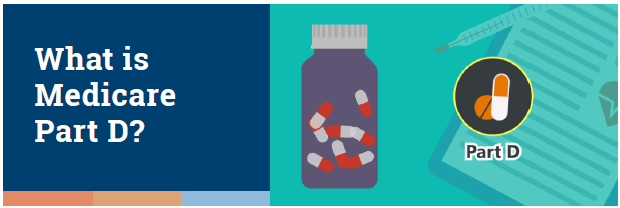
Introduced in 2006, Medicare Part D prescription drug plans are the most recent addition to the Medicare program.
There are two ways of getting Part D coverage. The first is through purchasing a stand-alone plan to pair with Original Medicare coverage. The second is to enroll in a Medicare Advantage plan with prescription drug benefits, often called an MAPD plan.
Part D plans are sold by private insurers and are available to anyone enrolled in Original Medicare. There is no required physical exam, and you cannot be denied for financial or health reasons.
Though Medicare Part D coverage is optional, you may pay a late-enrollment penalty if you don’t enroll as soon as you’re eligible. This makes it worth at least exploring your options.
What Does Medicare Part D Cover?
Medicare Part D helps beneficiaries afford necessary medications. Because of this, Part D plans are sometimes known as PDPs, or prescription drug plans. How Medicare Part D works is that each plan offers a formulary that breaks out drugs into tiers. Each tier will cost you a different amount out-of-pocket. You’ll also owe an annual Part D deductible before coverage will start each year. Your out-of-pocket costs are capped, though. Once your out-of-pocket spending on covered drugs reaches $2,100 in 2026, you pay nothing for covered Part D drugs for the rest of the calendar year.
What Does Part D Cost?
The cost of a Part D plan varies from insurer to insurer. Each plan has a monthly premium, an annual deductible, and a share of the prescription costs, called a copay.
Through a combination of Medicare Parts A, B, and D, you can have a comprehensive health care plan.
What is the Coverage Gap?
The coverage gap, sometimes called the donut hole, was the period after reaching your initial coverage limit when beneficiaries were responsible for a larger percentage of prescription costs.
Due to the Inflation Reduction Act of 2022 capping out-of-pocket drug costs ($2,000 in 2025 and $2,100 in 2026), the coverage gap has been closed. Once you reach that limit, you pay nothing for covered Part D drugs for the rest of the year.
Read more:
Medicare.gov. Drug Coverage (Part D). – https://www.medicare.gov/drug-coverage-part-d
Not affiliated or endorsed by Medicare or any government agency.
How Medicare Part D Works in 2026
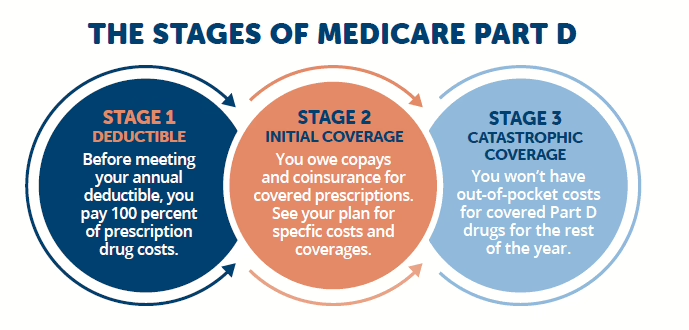
Medicare Part D was redesigned starting in 2025, and the old “donut hole” is gone. For 2026, a standard Part D plan works in three stages:
| Stage | What you pay (2026) |
|---|---|
| 1. Deductible | Up to $615 a year. Some plans have a lower deductible or none. |
| 2. Initial coverage | Your copays or coinsurance for each drug, based on its tier, until your out-of-pocket costs reach $2,100 |
| 3. Catastrophic coverage | $0 for covered Part D drugs for the rest of the calendar year |
Source: CMS, Final CY 2026 Part D Redesign Program Instructions. The $2,100 cap counts what you pay out of pocket for covered drugs, not your monthly premium. Premiums are separate and vary by plan.
The Medicare Prescription Payment Plan
If you take expensive drugs, you may hit the out-of-pocket cap early in the year. The Medicare Prescription Payment Plan lets you spread those costs into monthly payments across the year instead of paying large amounts at the pharmacy. It’s free to join through your Part D plan. It doesn’t lower your total costs, but it can make them easier to budget. It mainly helps people who expect high drug costs early in the year.
Insulin and Vaccines Under Part D
Under the Inflation Reduction Act, people with Medicare Part D pay no more than $35 for a month’s supply of each covered insulin, and the deductible doesn’t apply to it. Recommended adult vaccines covered under Part D, such as shingles and Tdap, are available at no cost. Read more in our guide to what the Inflation Reduction Act means for Medicare.
How Part D Formularies, Tiers and Pharmacies Work
Every Medicare Part D plan has a formulary, a list of covered drugs. Drugs are placed in tiers. Lower tiers (usually generics) cost less, and higher tiers (brand-name and specialty drugs) cost more. Before choosing a plan, check three things:
- Is each of your drugs on the formulary, and on which tier?
- Are there restrictions, such as prior authorization, step therapy (trying a cheaper drug first) or quantity limits?
- Is your pharmacy “preferred” in the plan’s network? Preferred pharmacies and mail order often cost less.
Plans can change their formularies and costs each year, so review your plan every fall, even if you’re happy with it.
Stand-Alone Part D vs. Medicare Advantage With Drug Coverage
| Stand-alone Part D plan (PDP) | Medicare Advantage plan with drugs (MA-PD) | |
|---|---|---|
| Works with | Original Medicare, often with a Medigap plan | Replaces Original Medicare for Parts A and B |
| Premium | Separate monthly Part D premium | Drug coverage built into the plan premium (some plans have $0 premium) |
| Doctor choice | Any provider who accepts Medicare | Usually a network (HMO or PPO) |
| Best for | People who want Medigap and nationwide provider choice | People comfortable with a network and wanting one plan |
Learn more about Medicare Advantage (Part C) and Medicare Supplements.
When Can You Enroll in Medicare Part D?
- Initial Enrollment Period: the 7-month window around your 65th birthday month (3 months before, your birthday month and 3 months after)
- Annual Enrollment Period: October 15 to December 7 each year, with changes effective January 1. See our annual enrollment period guide.
- Special Enrollment Periods: after certain events, such as moving, losing employer coverage or qualifying for Extra Help
The Part D Late Enrollment Penalty
If you go 63 days or more in a row without Part D or other creditable drug coverage after your initial enrollment period ends, you may pay a penalty for as long as you have Part D. The penalty is 1% of the national base beneficiary premium ($38.99 in 2026) for each full month you went without coverage. For example, 24 months without coverage is 24% × $38.99 = about $9.40 a month, added to your premium, and it is recalculated each year. Details are on Medicare.gov and in our guide to the Medicare Part D penalty.
Have drug coverage through work? Your employer or union should send a yearly notice saying whether it is “creditable,” meaning at least as good as standard Part D. Keep those notices. They prove you don’t owe a penalty if you enroll in Part D later.
Extra Help With Part D Costs
People with limited income and resources may qualify for Extra Help, a federal program that lowers Part D premiums, deductibles and copays. Many people who qualify never apply. You can apply through the Social Security Administration. Some states also run pharmaceutical assistance programs.
How to Choose a Medicare Part D Plan
- List every prescription, with dose and how often you take it.
- Enter them in the Medicare Plan Finder, or ask a licensed agent to compare plans for you.
- Compare total yearly cost (premiums plus drug costs), not just the premium.
- Check that your pharmacy is in the network, ideally as a preferred pharmacy.
- Look at the plan’s star rating and any restrictions on your drugs.
Medicare Part D Premiums in 2026 and 2027
Each Part D plan sets its own monthly premium. Medicare also publishes a “national base beneficiary premium” that is used to calculate the late penalty. It is $38.99 for 2026, and CMS has announced $41.33 for 2027. People with higher incomes pay an extra amount on top of their plan premium, called the Part D income-related monthly adjustment amount (IRMAA). Social Security sets it based on your tax return from two years earlier. If your income has dropped because of retirement or another life-changing event, you can ask Social Security to reconsider.
What Medicare Part D Doesn’t Cover
By law, Part D plans generally don’t cover:
- Drugs used for weight loss or weight gain (some drugs are covered for other approved uses)
- Drugs for cosmetic purposes or hair growth
- Fertility drugs
- Most over-the-counter drugs and most prescription vitamins and minerals
- Drugs Medicare Part B already covers
If a drug you need isn’t on your plan’s formulary, your doctor can ask the plan for an exception, or you can switch plans during an enrollment period.
Part B vs. Part D: Which Covers Your Drug?
| Usually covered by Part B | Usually covered by Part D |
|---|---|
| Drugs given by a doctor or nurse in a clinic or office, such as many infusions and injections | Prescriptions you fill at a pharmacy and take at home |
| Some oral cancer drugs and anti-nausea drugs | Most brand-name and generic pills, inhalers and insulin pens |
| Certain vaccines (flu, pneumonia, COVID-19, hepatitis B for some people) | Other recommended vaccines, such as shingles and Tdap |
| Insulin used with a covered insulin pump | Insulin you inject yourself |
Common Medicare Part D Mistakes
- Choosing by premium alone. A $0-premium plan can cost more overall if your drugs sit on high tiers.
- Not reviewing the plan every fall. Formularies, tiers and pharmacy networks change on January 1.
- Skipping Part D because you take no drugs. The late penalty lasts for life, so a low-cost plan is often worth having.
- Ignoring the yearly notice from your plan, called the Annual Notice of Change, which arrives each fall.
- Forgetting creditable coverage letters from an employer plan, which you may need later to avoid a penalty.
How to Switch Medicare Part D Plans
Most people switch Part D plans during the Annual Enrollment Period, October 15 to December 7. If you’re in a Medicare Advantage plan, you can also make one change between January 1 and March 31 during the Medicare Advantage Open Enrollment Period. Some events, such as moving out of your plan’s area, also allow a change. When you enroll in a new stand-alone Part D plan, your old Part D plan usually ends automatically. See our guide on how and when to change Medicare plans.
Do You Need Part D if You Have Other Drug Coverage?
Maybe not. You can usually delay Medicare Part D without a penalty if you have creditable drug coverage from:
- An employer or union plan, while you or your spouse is still working
- A retiree plan that is creditable (some retiree plans require you to stay off Part D, so ask before enrolling)
- TRICARE, VA health care or the Federal Employees Health Benefits program
Before you drop or decline any of these, ask the plan administrator how Part D would affect your coverage. In some cases, joining a Part D plan can cause you to lose your retiree coverage, and you may not be able to get it back.
Medicare Part D Star Ratings
Medicare rates Part D plans from 1 to 5 stars based on customer service, member complaints, drug safety and pricing accuracy. Higher-rated plans tend to deliver a smoother experience. If a 5-star plan is available in your area, you can switch into it once during the year using a special enrollment period. Star ratings are shown in the Medicare Plan Finder.
Questions to Ask a Licensed Agent About Medicare Part D
- Which plans cover all of my current drugs, and on which tiers?
- What will I pay in total for the year, including premiums?
- Is my pharmacy preferred in the plan’s network?
- Do any of my drugs need prior authorization or step therapy?
- Do I qualify for Extra Help or a state program?
Example: How the 2026 Cap Can Help
Here’s a hypothetical example. Maria takes a brand-name heart medication that has a total cost of about $1,200 a month. In January she pays the $615 deductible. After that, she pays her plan’s 25% coinsurance, about $300 a fill. By about June, what she has paid out of pocket reaches $2,100. From then until December 31, she pays $0 for that medication and any other covered drugs. Before the redesign, someone in her situation could have paid thousands more. If Maria joins the Medicare Prescription Payment Plan, she can spread that $2,100 over the year instead of paying most of it in the first few months.
Your own costs will differ, because each plan sets its own copays, coinsurance and tiers. That’s why comparing total yearly cost matters.
Octans agents can compare drug plans in your area at no cost to you, by phone or video.
Keep Reading: Related Guides
- How Medicare supplement (Medigap) plans work
- Who is eligible for Medicare
- When to enroll in Medicare
- Medicare Extra Help
- Medicare IRMAA
- Medicare changes 2027
Medicare Part D: Frequently Asked Questions
What does Medicare Part D cover?
Medicare Part D covers outpatient prescription drugs through private plans approved by Medicare. In 2026, Part D deductibles can be up to $615 and out-of-pocket drug costs are capped at $2,100 per year.
How do I choose a Part D plan?
Compare plans using the Medicare Plan Finder with your exact medications and preferred pharmacies, and review the formulary, tiers, and premium. Medicare Part D plans can change every year.
Is Medicare Part D free for seniors?
No, Part D isn’t automatically free. Most people pay a monthly premium to a private plan, plus deductibles and copays; the 2026 national base beneficiary premium is $38.99. Some areas have $0-premium plans, and people with limited income and resources may qualify for Extra Help, which lowers premiums and drug costs. Your exact cost depends on the plan you choose.
Is Part D deducted from social security?
It can be. You can ask your drug plan, not Social Security, to have your monthly Part D premium withheld from your Social Security payment; Medicare.gov says it may take up to 3 months to start. If you owe the income-related surcharge (Part D IRMAA), that amount is deducted from your Social Security benefit no matter how you pay the plan premium.
How much do most people pay for Medicare Part D?
There’s no single price, because each plan sets its own premium, but Medicare’s benchmark for 2026 is the national base beneficiary premium of $38.99 a month. On top of the premium you pay the plan’s deductible and copays, though 2026 out-of-pocket costs for covered drugs are capped at $2,100. Higher earners also pay an IRMAA surcharge.
Does Medicare cover Zepbound, including for sleep apnea?
Yes, in some cases, as of October 2026. Part D plans and Medicare Advantage drug plans can cover Zepbound for moderate-to-severe obstructive sleep apnea, subject to each plan’s drug list and rules. For weight management, the temporary Medicare GLP-1 Bridge (July 1, 2026 to December 31, 2027) covers the Zepbound KwikPen for a $50 monthly copay. You must meet BMI and health criteria, and you need prior authorization, according to CMS. Zepbound vials and single-dose pens aren’t included.
Who can get Medicare Part D, and when?
You can join a Part D plan if you have Medicare Part A or Part B, live in the plan’s service area, and, as of October 2026, are a U.S. citizen or national, lawful permanent resident, Cuban-Haitian entrant, or COFA migrant, per Medicare.gov. Most people first join during their 7-month Initial Enrollment Period around age 65. After that, you can join or switch from October 15 to December 7, with coverage starting January 1. Moving, losing other coverage, or getting Extra Help can open a Special Enrollment Period.
How much does Medicare Part D cost per month?
It depends on the plan. CMS says the average stand-alone Part D plan premium is $35.09 a month in 2026, projected to rise to about $36 in 2027, according to CMS (Sept. 28, 2026). You also pay a deductible of up to $615 and copays, but your out-of-pocket drug costs are capped at $2,100 for 2026. People with higher incomes pay an extra amount. Extra Help can lower costs for people with limited income: the 2026 limit for a single person is $23,940 a year.
Does Medicare Part D cover Ozempic and Mounjaro for diabetes?
Yes. Part D plans can cover GLP-1 drugs like Ozempic and Mounjaro for type 2 diabetes, according to CMS. Each plan sets its own drug list, cost tier, and rules, such as prior authorization to confirm the diagnosis. Ozempic is also among the drugs whose Medicare-negotiated prices start January 1, 2027. What you pay still depends on your plan, and your yearly out-of-pocket costs are capped at $2,100 in 2026 and $2,400 in 2027.
Does Medicare Part D cover Wegovy?
Yes, in some cases, as of October 2026. Part D plans can cover Wegovy to lower the risk of heart attack and stroke, or for certain liver disease (MASH), subject to each plan’s drug list. For weight management, the temporary Medicare GLP-1 Bridge (July 1, 2026 to December 31, 2027) covers Wegovy injections and tablets for a $50 monthly copay. You must meet BMI and health criteria, and you need prior authorization, according to CMS. The $50 doesn’t count toward your out-of-pocket cap.
Does Medicare cover GLP-1 weight-loss drugs?
By law, Part D plans generally can’t cover drugs used only for weight loss. As of October 2026, the temporary Medicare GLP-1 Bridge is an exception, according to CMS. From July 1, 2026 to December 31, 2027, eligible people with a stand-alone Part D plan or a Medicare Advantage drug plan can get Wegovy, Foundayo, or the Zepbound KwikPen for a $50 monthly copay. You must meet BMI and health criteria, and you need prior authorization. Check eligibility at Medicare.gov/glp1bridge or call 1-800-MEDICARE.
When and why was Medicare Part D created?
Medicare Part D was created by the Medicare Prescription Drug, Improvement, and Modernization Act, signed on December 8, 2003 (Public Law 108-173). Its drug coverage began January 1, 2006. The law added an optional prescription drug benefit, which Original Medicare generally didn’t cover, delivered through private plans approved by Medicare. It also created Extra Help for people with limited income. The Inflation Reduction Act of 2022 later added the yearly out-of-pocket cap.
Does Medicare Part D cover Repatha?
Repatha is a prescription drug that Part D plans can cover, but coverage depends on each plan’s drug list (formulary), cost tier, and rules. Plans choose which drugs they cover and can change their lists under Medicare guidelines, according to Medicare.gov. To check, enter Repatha in Medicare Plan Finder or ask the plan. If your plan doesn’t cover it, your prescriber can ask for an exception. Your out-of-pocket costs are capped at $2,100 in 2026.
Does Medicare Part D cover Eliquis?
Yes. Eliquis was one of the first 10 drugs with a Medicare-negotiated price, in effect since January 1, 2026, according to CMS. The law requires Part D plans to include drugs with a negotiated price on their drug lists. Your cost still depends on your plan’s tier, deductible, and pharmacy, and your yearly out-of-pocket costs are capped at $2,100 in 2026.
How do I find the Part D plan that covers my drugs?
No single plan covers the most drugs or is best for everyone, so compare plans using your own prescriptions. Enter your drugs, doses, and pharmacy in Medicare Plan Finder, then compare: whether each drug is on the formulary, its tier, any prior authorization or quantity limits, whether your pharmacy is preferred, the premium and deductible, and the estimated yearly total. Star ratings (1 to 5) can help too. Check again every fall, because drug lists and costs change each year.
How does the Medicare Part D deductible work?
The Part D deductible is what you pay for covered drugs each year before your plan starts sharing the cost. For 2026, no plan may charge a deductible above $615, and some plans have none, according to Medicare.gov. After that, you pay copays or coinsurance (25% in the standard benefit) until your out-of-pocket costs reach $2,100. Then you pay $0 for the rest of the year. Covered insulin stays at $35 a month or less, with no deductible. For 2027, the deductible limit rises to $700.
Can I cancel Medicare Part D?
Yes, but usually only during an enrollment period, such as October 15 to December 7, which takes effect January 1, or a Special Enrollment Period. You can call 1-800-MEDICARE or send your plan a signed request. Be careful: if you go 63 or more days in a row without Part D or other creditable drug coverage, you may owe a permanent late enrollment penalty and have to wait to rejoin, according to Medicare.gov. If you have a Medicare Advantage plan, dropping its drug coverage works differently.
Can Medicare Part D notices be sent by email?
Yes, if you agree. Federal rules let Part D plans deliver required materials electronically once you consent to the delivery method and the specific documents, under 42 CFR 423.2267. Even without consent, a plan may post the Evidence of Coverage, directories, and drug list online and mail you a notice explaining how to find them. Either way, you can ask for paper copies, one time or permanently, and the plan must send them within three business days.
Can people with Medicare Part D use a drug discount card like GoodRx?
Yes. You can pay with a discount card instead of using your Part D plan, but Medicare.gov warns that those purchases don’t count toward your deductible or your out-of-pocket maximum, per Medicare.gov. Discount cards also aren’t creditable drug coverage, so they don’t protect you from the late enrollment penalty. A card may help with a cheap generic. For costly drugs, using your plan moves you toward the $2,100 cap for 2026.
Can a Part D plan deny coverage for a drug?
Yes. A plan can refuse to pay if the drug isn’t on its formulary or you haven’t met a plan rule. You or your prescriber can ask for a coverage determination or an exception, and the prescriber must explain the medical reason. If the plan still says no, you can appeal within 65 days from the date on the denial notice. The plan must decide a standard appeal within 7 days, or 72 hours for a fast appeal. There are 5 appeal levels, per Medicare.gov.
Do I need Part D if I have a Medicare Advantage plan?
Usually not, because most Medicare Advantage plans include drug coverage. If you join a separate Part D plan while in most Advantage plans, you’ll be disenrolled from the Advantage plan and switched back to Original Medicare, according to Medicare.gov. If you’re in an HMO Point-of-Service or PPO plan without drug coverage, you can’t add a separate drug plan. Private Fee-for-Service plans without drug coverage, and Medical Savings Account plans, are exceptions that allow a separate Part D plan.
Is Medicare Part D worth it?
It depends on your situation. Part D makes sense if you take regular or costly medications, because 2026 out-of-pocket drug costs are capped at $2,100. It also protects against a permanent late penalty if you need drugs later. It matters less if you already have creditable drug coverage, such as from an employer, union, or TRICARE. The trade-off is paying a premium even in years you use few drugs. The 2026 average stand-alone premium is $35.09 a month, per CMS.
Medicare Part D: Next Steps With a Licensed Agent
Questions about medicare part d usually depend on your age, health, state, and budget. A licensed Octans agent can review your situation, compare options from more than 120 carriers, and explain the trade-offs before you decide. Call (617) 935-9220 or request a free quote.


Related guides
We do not offer every plan available in your area. Please contact Medicare.gov or 1-800-MEDICARE to get information on all of your options.
Sources: Medicare.gov; Centers for Medicare & Medicaid Services. This article is for general information and is not tax, legal, or medical advice.
About examples and tools: Hypothetical examples, sample rates, calculators and quizzes on this site are for general educational and illustrative purposes only. They are not quotes, offers of coverage, or guarantees of eligibility, approval, price or benefits, and they are not legal, tax, financial or medical advice. The insurance company decides eligibility and price; Medicare rules are set by CMS and the Social Security Administration. Octans Insurance is not connected with or endorsed by the U.S. government or the federal Medicare program.