
What the Inflation Reduction Act of 2022 Means for Medicare
Inflation Reduction Act Medicare: What This Guide Covers
This guide explains inflation reduction act medicare in plain language, reviewed by a licensed Octans agent. Use the summary below to jump to the section you need, and contact us with questions about your own situation.
- What inflation reduction act medicare means and who it applies to
- The rules, costs, and timelines to know
- Common mistakes to avoid
- When to talk to a licensed agent

Table of Contents
On August 16, 2022, the Inflation Reduction Act (IRA) of 2022 was signed into law. This government reconciliation bill promised to fund environmental efforts, close tax loopholes, work to lower inflation, and reduce health care costs under the Medicare program. The changes this bill brought has the potential to save Medicare insurance beneficiaries thousands of dollars annually.
Unless directly cited elsewhere, all facts and figures from the bill can be found directly in the legislative text of the Inflation Reduction Act of 20221 or the topline messages for the drug pricing reforms2.
The Medicare Program to Negotiate Certain Drug Prices
Starting in 2026, the Medicare program will be allowed to negotiate pricing on 10 drugs covered by Medicare Part D. Additionally, the Medicare program will be able to start negotiating prices for drugs covered under Medicare Part B in 2028. This will increase each subsequent year until 2029, when the Medicare program will have 60 total drugs with negotiated prices — 10 Medicare Part D drugs in 2026, 15 more Part D drugs in 2027, 15 Medicare Part B and Part D drugs in 2028, and 20 Medicare Part B and D drugs in 2029. These medications’ prices will be finalized closer to the kickoff date.
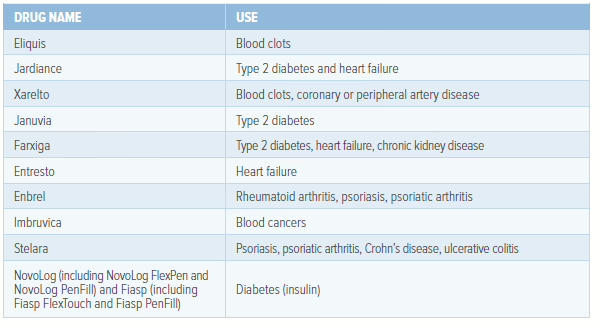
The first 10 of these medications were:
In January 2025, CMS announced the next 15 Part D drugs that would be applicable for negotiations
in 2027. They were:

Insulin Price Capped in Medicare
One essential drug with a new price implemented outside of the negotiations is insulin. The bill capped the monthly price of insulin at $35. Prior to this, the cost of insulin ranged from $45 to $1,000 each month.
All Vaccines Covered Under Medicare
The Inflation Reduction Act of 2022 also opened the possibility of preventive vaccinations to be covered under the Medicare program. Previously, Medicare insurance covered vaccines for COVID-19, the annual flu, and pneumonia, while vaccines for Hepatitis A and B or shingles are only covered in certain circumstances or by Medicare Part D. But now, all vaccines will be zero cost.
New Medicare Out-of-Pocket Drug Insurance Costs Cap
Perhaps the most significant change of all is the new cap on out-of-pocket drug costs for Medicare insurance beneficiaries.
As a result of the IRA, the out-of-pocket limit for Part D costs will be fixed and set annually. In 2020, around 1.4 million Medicare Part D enrollees3 had out-of-pocket costs of $2,000 or more. Beneficiaries will also have the option to break their out-of-pocket costs into affordable monthly payments.
Other Part D Adjustments
There were two other major changes and effects on Medicare Part D from the Inflation Reduction Act. First, the IRA is capping the annual growth of Medicare Part D premiums to six percent between 2024 and 2030. Furthermore, the IRA will be expanding access to the Part D Low-Income Subsidy by eliminating the partial subsidy level. This will allow anyone making 150 percent of the Federal Poverty Level to utilize this subsidy and lower their out-of-pocket costs even more.
You can read more about the timeline when each facet of the IRA will come into effect below (graphic courtesy of the Kaiser Family Foundation).

Inflation Reduction Act Medicare timeline: what changed each year
The Inflation Reduction Act Medicare drug rules did not arrive all at once. They phase in over several years. The table below shows when each change starts, based on KFF’s summary of the law and CMS fact sheets.
| Year | What changed for people with Medicare |
|---|---|
| 2023 | Covered insulin capped at $35 a month in Part D (January 1) and for pump insulin under Part B (July 1). Recommended adult vaccines under Part D at no cost. |
| 2024 | The 5% coinsurance in the Part D catastrophic phase ended. Full Extra Help opened to people with incomes up to 150% of the federal poverty level. |
| 2025 | A $2,000 yearly cap on out-of-pocket costs for covered Part D drugs. The Medicare Prescription Payment Plan began. |
| 2026 | The cap rose to $2,100. Negotiated prices for the first 10 drugs took effect on January 1. |
| 2027 | Negotiated prices for 15 more Part D drugs take effect on January 1. |
| 2028 | The first negotiated prices for Part B drugs (given in a doctor’s office) are scheduled. |
The 2024 change helped people with very high drug costs first. KFF estimated that ending the catastrophic coinsurance held 2024 spending to about $3,300 for many brand-name drugs. In 2025 the hard cap took over.
How does the $35 insulin cap work?
If you have a Medicare drug plan, you pay no more than $35 for a month’s supply of each covered insulin. The Part D deductible does not apply to insulin. That means you get the $35 price from your first fill in January.
The cap also covers insulin you use with a traditional pump under Part B. That part started on July 1, 2023, according to KFF.
There is one catch. Plans must charge no more than $35 for the insulins they cover, but they do not have to cover every insulin brand. Before you pick a plan, check that your insulin is on its drug list (formulary). Our Medicare diabetes coverage guide covers supplies and other diabetes benefits.
Insulin is also part of drug price negotiation. NovoLog and Fiasp were among the first 10 negotiated drugs, at $119 for a 30-day supply. KFF notes that from 2026, the law limits Part D insulin copays to the lowest of $35, 25% of the negotiated price, or 25% of the plan’s price.
Which drugs have negotiated Medicare prices in 2026?
Drug price negotiation is the biggest long-term piece of the Inflation Reduction Act Medicare changes. These 10 Part D drugs have had negotiated prices since January 1, 2026. CMS calls them “maximum fair prices.” The figures below come from the CMS fact sheet on 2026 negotiated prices. List prices are for 2023.
| Drug | Common uses | 2023 list price (30 days) | Negotiated price (30 days) | Discount |
|---|---|---|---|---|
| Januvia | Diabetes | $527 | $113 | 79% |
| NovoLog / Fiasp | Diabetes (insulin) | $495 | $119 | 76% |
| Farxiga | Diabetes, heart failure, kidney disease | $556 | $178.50 | 68% |
| Enbrel | Rheumatoid arthritis, psoriasis | $7,106 | $2,355 | 67% |
| Jardiance | Diabetes, heart failure, kidney disease | $573 | $197 | 66% |
| Stelara | Psoriasis, Crohn’s disease, ulcerative colitis | $13,836 | $4,695 | 66% |
| Xarelto | Blood clots, artery disease risk | $517 | $197 | 62% |
| Eliquis | Blood clots | $521 | $231 | 56% |
| Entresto | Heart failure | $628 | $295 | 53% |
| Imbruvica | Blood cancers | $14,934 | $9,319 | 38% |
CMS projects that people with Medicare drug coverage will save about $1.5 billion in out-of-pocket costs in 2026 from these prices. Each year after, the negotiated price can rise only with inflation (CPI-U), unless it is renegotiated.
Which 15 drugs get negotiated prices in 2027?
CMS finished the second round of talks on November 1, 2025. These prices start January 1, 2027. The figures come from the CMS fact sheet on 2027 negotiated prices, with 2024 list prices.
| Drug | Common uses | 2024 list price (30 days) | Negotiated price (30 days) |
|---|---|---|---|
| Ozempic / Rybelsus / Wegovy | Type 2 diabetes, heart disease and obesity | $959 | $274 |
| Trelegy Ellipta | Asthma, COPD | $654 | $175 |
| Xtandi | Prostate cancer | $13,480 | $7,004 |
| Pomalyst | Multiple myeloma, Kaposi sarcoma | $21,744 | $8,650 |
| Ofev | Idiopathic pulmonary fibrosis | $12,622 | $6,350 |
| Ibrance | Breast cancer | $15,741 | $7,871 |
| Linzess | Chronic constipation, IBS with constipation | $539 | $136 |
| Calquence | Leukemia, lymphoma | $14,228 | $8,600 |
| Austedo / Austedo XR | Huntington’s chorea, tardive dyskinesia | $6,623 | $4,093 |
| Breo Ellipta | Asthma, COPD | $397 | $67 |
| Xifaxan | Hepatic encephalopathy, IBS with diarrhea | $2,696 | $1,000 |
| Vraylar | Bipolar I, depression, schizophrenia | $1,376 | $770 |
| Tradjenta | Type 2 diabetes | $488 | $78 |
| Janumet / Janumet XR | Type 2 diabetes | $526 | $80 |
| Otezla / Otezla XR | Psoriasis, psoriatic arthritis, Behçet’s ulcers | $4,722 | $1,650 |
CMS estimates these prices will save enrollees about $685 million in out-of-pocket costs in 2027. The Ozempic price applies across forms. For example, CMS lists a higher-dose Wegovy pack at $385.63.
The third round is underway now. It includes Part B drugs for the first time, with prices due in 2028. CMS’s selected drugs page also shows that Stelara, Entresto, Xarelto, and NovoLog/Fiasp leave the program on January 1, 2027, under CMS’s rules for drugs that face generic or biosimilar competition.
What does this mean for you? Two hypothetical examples
These are hypothetical examples using the 2026 standard Part D benefit from CMS. You pay 100% until the $615 deductible. Then you pay 25% until your costs reach $2,100. After that, you pay $0 for covered drugs for the rest of the year. Real plans often use flat copays instead, so your numbers will differ.
Example 1: a costly cancer drug. Pat takes Imbruvica at its $9,319 negotiated price. In January, Pat pays the $615 deductible. Then Pat owes 25% of the rest: 25% x ($9,319 – $615) = $2,176. That adds up to $2,791, which is more than the cap. So Pat pays $2,100 in January and $0 for covered drugs the rest of 2026.
Example 2: a common blood thinner. Lee fills Eliquis 12 times. At the $231 negotiated price, the year costs $2,772. Lee pays $615 toward the deductible over the first three fills. The rest is $2,772 – $615 = $2,157, and 25% of that is $539.25. Lee’s total is $615 + $539.25 = $1,154.25.
For comparison, run the same math at the old $521 list price. Twelve fills cost $6,252. After the $615 deductible, 25% of $5,637 is $1,409.25, for a total of $2,024.25. In this simplified case, the negotiated price lowers Lee’s cost by $870. Plans did not always pay full list price before, so treat this as a rough guide only.
How does the Medicare Prescription Payment Plan work?
This payment option started in 2025. All Medicare drug plans and Medicare Advantage plans with drug coverage must offer it, and joining is free and voluntary. Instead of paying the pharmacy, you get a monthly bill from your plan, according to Medicare.gov.
Once you join, you pay $0 at the pharmacy for covered drugs. It does not lower what you owe, and it does not change your deductible or cap. It only spreads the cost out. In Pat’s case above, $2,100 spread over 12 months would be $175 a month instead of $2,100 in January. Your plan figures the actual bill, and you still pay any premium separately.
You can join before the year starts or in any month during the year, per the CMS fact sheet. Medicare.gov says it may not help if you join late in the year (after September), have low or steady drug costs, or qualify for Extra Help. To sign up, call your plan or visit its website. You can also opt out during the year and keep paying off any balance monthly.
Who gets more Extra Help under the law?
Extra Help, also called the Low-Income Subsidy (LIS), lowers Part D premiums, deductibles, and copays. Before 2024, people with incomes between 135% and 150% of the federal poverty level could get only partial help. Since 2024, the law gives full Extra Help to people up to 150% who also meet the resource limits, according to KFF.
This matters when you weigh the payment plan. CMS says Extra Help, for those who qualify, is more advantageous than the payment plan alone, because it actually lowers costs. CMS urges people to check Extra Help and the Medicare Savings Programs first.
How to use these changes at your next plan review
The savings only reach you if your plan fits your drugs. Use this short list each fall.
- List every drug and dose you take, including insulin and inhalers.
- Check each plan’s formulary. Plans must cover the negotiated drugs, but tiers and copays still differ.
- Estimate your yearly cost. Add the deductible, your copays, and 12 months of premiums. Remember the $2,100 cap on covered drug costs in 2026.
- Look for high early-year costs. If one fill could cost hundreds of dollars in January, ask the plan about the Prescription Payment Plan.
- Check Extra Help if your income is near 150% of the poverty level.
- Read your Annual Notice of Change in the fall. Drugs can move tiers, and some negotiated drugs leave the program in 2027.
Want a second set of eyes? Learn when you can change Medicare plans and how Part D works with your other coverage.
What did the Inflation Reduction Act not change in Medicare?
The law cut drug costs, but it left a lot of Medicare the same. Knowing the limits helps you avoid surprises.
- Original Medicare still has no yearly cap. For Part A and Part B services, there is no limit on what you pay out of pocket each year unless you have other coverage, such as a Medicare Supplement, says Medicare.gov. After the $283 Part B deductible in 2026, you usually pay 20%.
- The cap is for covered Part D drugs only. The $2,100 limit counts your deductible and cost sharing for covered drugs, per Medicare.gov. Your monthly premium is a separate cost.
- Premiums did not go away. The 2026 Part B premium is $202.90 a month, per CMS. Part D premiums vary by plan.
- A negotiated price is not your copay. It is the price Medicare’s plans pay for the drug. What you pay still depends on your plan’s design and the cap.
- Most drugs are not negotiated. Only selected high-cost brand drugs with no generic or biosimilar competition qualify.
- The late enrollment penalty still applies. See our guide to the Part D penalty.
Because drug lists and prices change each year, compare plans every fall during the Annual Enrollment Period. The Inflation Reduction Act Medicare changes help most when your plan covers the drugs you take.
Read more:
1 The Senate Democratic Caucus. H. R. 5376 – https://www.democrats.senate.gov/imo/media/doc/inflation_reduction_act_ of_2022.pdf
2 The Senate Democratic Caucus. FY22 Budget Reconcilliation – https://www.democrats.senate.gov/imo/media/doc/topline_ messages_for_senate_prescription_drug_pricing_reforms__fy22_budget_reconciliation.pdf
3 KFF. How Will the Prescription Drug Provisions in the Inflation Reduction Act Affect Medicare Beneficiaries? – https://www. kff.org/medicare/issue-brief/how-would-the-prescription-drug-provisions-in-the-senate-reconciliation-proposal-affect-medicare-beneficiaries/#table
Not affiliated or endorsed by Medicare or any government agency.
Keep Reading: Related Guides
- Medicare basics: the four parts explained
- What Original Medicare (Parts A and B) covers
- Medicare Part C (Medicare Advantage) explained
Inflation Reduction Act Medicare: Frequently Asked Questions
How did the Inflation Reduction Act change Medicare?
The Inflation Reduction Act Medicare changes include a Part D out-of-pocket cap ($2,100 in 2026), a $35 monthly cap on covered insulin, free recommended vaccines under Part D, and Medicare price negotiation for selected drugs.
When does Medicare drug price negotiation take effect?
Negotiated prices for the first ten drugs took effect January 1, 2026, with more drugs added in later years under the Inflation Reduction Act Medicare program.
Inflation Reduction Act Medicare: Next Steps With a Licensed Agent
Questions about inflation reduction act medicare usually depend on your age, health, state, and budget. A licensed Octans agent can review your situation, compare options from more than 120 carriers, and explain the trade-offs before you decide. Call (617) 935-9220 or request a free quote.


Related guides
We do not offer every plan available in your area. Please contact Medicare.gov or 1-800-MEDICARE to get information on all of your options.
Sources: Medicare.gov; Centers for Medicare & Medicaid Services. This article is for general information and is not tax, legal, or medical advice.