
Am I Eligible for Medicare Insurance?
Medicare Eligibility: What This Guide Covers
This guide explains medicare eligibility in plain language, reviewed by a licensed Octans agent. Use the summary below to jump to the section you need, and contact us with questions about your own situation.
- What medicare eligibility means and who it applies to
- The rules, costs, and timelines to know
- Common mistakes to avoid
- When to talk to a licensed agent
Table of Contents

Once you have a foundational understanding of the four Parts of the Medicare program, the only question that remains is do you qualify for Medicare insurance?
Isn’t It Based on Age?
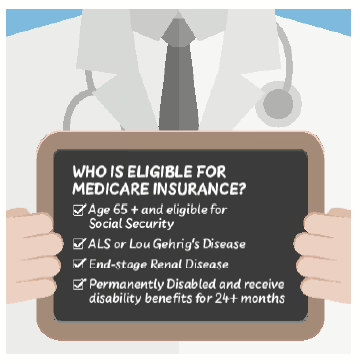
There are actually a few boxes that you can tick to be eligible for Medicare insurance. The first of these is to be 65 or older. This is the simplest way to qualify for Medicare enrollment. All you need is patience.
I’m Not 65. Does That Mean I Can’t Enroll?
No, that’s not always the case. While being 65 is the most common way to qualify, it’s not the only method. If you receive Social Security Disability Insurance (SSDI), you’ll be automatically enrolled into Medicare insurance once you roll into the 25th month of receiving SSDI checks. One exception, which begins your eligibility immediately, is if you have Amyotrophic Lateral Sclerosis, better known as Lou Gehrig’s Disease or ALS.
Additionally, you’re eligible for Medicare insurance if you have End-Stage Renal Disease (ESRD) and are undergoing dialysis treatments or receiving a kidney transplant.

Are There Other Criteria?
There are other factors that affect what you’ll pay for your coverage. If you or your spouse paid Medicare taxes during at least 10 years of work, you qualify for “premium-free” Part A coverage. If you don’t have enough credits, you can still get Medicare insurance, but you must pay for your Part A coverage.
Finally, to qualify, you must be a U.S. citizen or a permanent resident who’s been here for at least five years. You automatically qualify if you were a Federal employee on January 1, 1983.
Eligible or enrolled? How Medicare eligibility turns into coverage
Medicare eligibility and Medicare coverage aren’t the same thing. Being eligible means you meet the rules. Being enrolled means your coverage is actually active. For some people that happens on its own. For others, nothing happens until they sign up.
Enrolled for you. Medicare.gov says you’re enrolled in Parts A and B automatically if you get Social Security benefits at least 4 months before you turn 65. The same is true after 24 months of Social Security disability benefits. With ALS, it starts as soon as disability benefits begin. Your card arrives about 3 months before coverage starts (Medicare.gov).
You must sign up. If you aren’t getting Social Security benefits yet, you contact Social Security to enroll. Medicare.gov calls ssa.gov/medicare/sign-up the easiest and fastest way. If you or your spouse worked for a railroad, contact the Railroad Retirement Board at 1-877-772-5772.
A special case. If you live in Puerto Rico or outside the U.S., Part A is automatic but you must sign up for Part B yourself.
One more rule applies to everyone. Medicare.gov says you must be lawfully present in the U.S. for Medicare to pay for Part A and Part B services.
When does coverage start if you qualify through kidney failure?
End-Stage Renal Disease (ESRD) is the one path to Medicare eligibility with no age limit and no 24-month wait. Medicare.gov says you can qualify at any age if your kidneys no longer work, you need regular dialysis or have had a transplant, and you meet a work requirement. That can be your own work record under Social Security, the Railroad Retirement Board or as a government employee. You may also qualify as the spouse or dependent child of someone who meets it.
The start date depends on your treatment:
| Treatment | When Medicare usually starts |
|---|---|
| In-center dialysis | The first day of the fourth month of dialysis |
| Home dialysis training | As early as the first month of regular dialysis, if you finish a Medicare-certified home training program in your first 3 months and meet the other conditions |
| Kidney transplant | The month you’re admitted to a Medicare-certified hospital for the transplant, if it happens that month or within the next 2 months |
| Transplant delayed more than 2 months after admission | 2 months before the month of the transplant |
Enrolling late doesn’t always cost you coverage here. Medicare.gov says ESRD coverage can start up to 12 months before the month you apply. One gap to know about: Medicare doesn’t cover preparation services before coverage begins, such as fistula surgery, unless you complete home dialysis training.
ESRD also has its own rule for Marketplace plans. People with ESRD who haven’t enrolled in Medicare can get a Marketplace plan.
What does Part A cost if you don’t have enough work history?
You can be eligible for Medicare and still owe a Part A premium. Most people pay no Part A premium because they or a spouse paid Medicare taxes long enough while working. If you don’t qualify for that, Medicare.gov says you may be able to buy Part A. The 2026 cost depends on how many quarters you or your spouse worked:
| Quarters of Medicare-covered work | 2026 Part A premium |
|---|---|
| 40 or more (about 10 years) | $0 for most people |
| 30 to 39 | $311 per month |
| Fewer than 30 | $565 per month |
Source: CMS 2026 fact sheet. If you buy Part A, Medicare.gov says you also have to sign up for Part B.
Timing matters here too. If you must buy Part A and don’t sign up when first eligible, your premium may go up 10%. Medicare says that higher premium lasts for twice the number of years you didn’t sign up. For example, waiting 2 years means 4 years of the higher premium. A spouse’s work record may help, so check both records before you decide.
Hypothetical example. Sam turns 65 with 34 quarters of Medicare-covered work, and Sam’s spouse has fewer. Under the 2026 figures, Sam would pay $311 a month for Part A, or $3,732 a year, plus the Part B premium. If either spouse reaches 40 quarters, the Part A premium generally drops to $0. Social Security can tell you exactly how many quarters are on each record.
Does income affect Medicare eligibility?
Income isn’t one of the Medicare eligibility rules covered on this page. A high earner and a low earner who are both 65 can qualify the same way. But income does change what you pay.
Higher incomes pay more. CMS adds an income-related amount to Part B and Part D premiums. For 2026, the standard Part B premium is $202.90. It rises in steps once income on an individual return is over $109,000, or over $218,000 on a joint return. Here are the 2026 tiers from the CMS 2026 fact sheet:
| Income, individual return | Income, joint return | 2026 Part B monthly premium | Part D add-on |
|---|---|---|---|
| $109,000 or less | $218,000 or less | $202.90 | $0.00 |
| Over $109,000 to $137,000 | Over $218,000 to $274,000 | $284.10 | $14.50 |
| Over $137,000 to $171,000 | Over $274,000 to $342,000 | $405.80 | $37.50 |
| Over $171,000 to $205,000 | Over $342,000 to $410,000 | $527.50 | $60.40 |
| Over $205,000 to under $500,000 | Over $410,000 to under $750,000 | $649.20 | $83.30 |
| $500,000 or more | $750,000 or more | $689.90 | $91.00 |
Married people who file separate returns have different tiers. The Part D add-on is paid on top of your drug plan’s premium.
Lower incomes may get help. Medicare Savings Programs and Extra Help exist for people with limited income and resources. Medicare notes that people who enroll in a Medicare Savings Program generally don’t pay a Part B late penalty. People who qualify for Extra Help generally don’t pay a Part D late penalty (Medicare.gov).
Who is eligible for Medicare Advantage, Part D and Medigap?
Each part of Medicare has its own entry rules. Being eligible for Part A doesn’t automatically make you eligible for every plan type.
| Coverage | What you need first |
|---|---|
| Medicare Advantage (Part C) | Both Part A and Part B |
| Medicare drug plan (Part D) | Part A or Part B |
| Medigap (Medicare Supplement) | Part B; your 6-month Medigap Open Enrollment Period starts the month you’re 65 or older and have Part B |
Sources: Medicare.gov joining a plan and Medicare.gov Medigap timing.
Medigap has two more limits. Medicare says insurers generally can’t sell you a Medigap policy if you have Medicaid. It’s also illegal for anyone to sell you one while you have a Medicare Advantage Plan.
Under 65? The federal Medigap Open Enrollment Period is tied to being 65. Some states go further. New Jersey, for example, requires insurers to offer Medigap to people under 65 who have Medicare due to disability, if they apply within 12 months after enrolling in Part B, per the NJ Department of Banking and Insurance. See our New Jersey under-65 Medigap guide.
What changes at 65 if you already have Medicare through disability?
If you got Medicare before 65 because of a disability, you keep your coverage. Medicare.gov says your Parts A and B continue automatically at 65, but you’ll still have decisions to make, such as whether you need drug coverage.
Turning 65 can also open a new door for Medigap. Medicare’s 6-month Medigap Open Enrollment Period starts the first day of the month you’re 65 or older and signed up for Part B. Medicare calls this window the best time to buy a Medigap policy. After it ends, Medicare says there’s no federal guarantee an insurer will sell you a policy, and it may cost more because of health problems.
So if you’re on Medicare under 65, put the month you turn 65 on your calendar. It’s a good time to review your options with Medicare.gov, 1-800-MEDICARE or a licensed agent.
Do you have to use Medicare as soon as you’re eligible?
Not always. It depends on the other coverage you have.
Job coverage. If you or your spouse have group health coverage through a current job, Medicare says you can delay Part B without a penalty until the job or coverage ends. You then get an 8-month window to sign up. If you don’t pay a Part A premium, you can enroll in Part A at 65 or later. COBRA and retiree coverage don’t count as job coverage for this rule.
Marketplace coverage. Here the answer is different. Medicare.gov says to sign up when you’re first eligible, even if you have a Marketplace plan. Once you can get Part A without a premium, you lose Marketplace help with premiums. If you keep getting it, you may have to pay some or all of it back at tax time. Medicare.gov suggests ending your Marketplace plan before Medicare starts so the two don’t overlap. You can do that through HealthCare.gov or by calling 1-800-318-2596 (TTY 1-855-889-4325).
HSA owners. If you have a Health Savings Account, Medicare says to stop contributions about 6 months before you retire or apply for Social Security, to avoid a tax penalty. Our when to enroll guide and working and Medicare guide cover timing in more detail.
A quick Medicare eligibility checklist
Use these questions to sort out where you stand. Each one points to a rule above, so you can jump back to the section that fits.
- Are you 65, or turning 65 within 3 months? Your Initial Enrollment Period may already be open.
- Do you get Social Security or RRB benefits? If so, Parts A and B may start on their own. If not, you need to sign up.
- Are you under 65? Check whether you’ve had 24 months of disability benefits, or have ALS or ESRD.
- Do you or your spouse have about 10 years of Medicare-covered work? If not, plan for the Part A premium.
- Do you have job, COBRA, retiree or Marketplace coverage? Each one affects your timing differently.
- Is your income above $109,000 (single) or $218,000 (joint)? Expect a higher Part B and Part D premium.
- Do you want extra coverage? Note what each plan type requires before you apply.
If your answers are mixed, or you’re not sure which rule applies, a licensed agent can help you sort out the order of steps. You can also call 1-800-MEDICARE, or contact Social Security for questions about your work record and Medicare eligibility.
What documents prove Medicare eligibility when you sign up?
Social Security usually confirms your age, work record and citizenship from its own files, but it may ask for papers. Have these ready before you apply:
- Proof of age. An original birth certificate or other proof of birth.
- Proof of citizenship or lawful status. For example, a U.S. passport or your immigration documents.
- Your Social Security number and your spouse’s, if you qualify on a spouse’s work record.
- Job coverage proof, if you delayed Part B. When you sign up during a Special Enrollment Period, Social Security uses Form CMS-40B (the Part B application) and Form CMS-L564, which your employer fills out to show when you had group health coverage.
Keep copies of anything you send. If Social Security needs more, it will tell you, and a delay in sending papers can push back the date your coverage starts.
Read more:CMS.gov. Original Medicare (Part A and B) Eligibility and Enrollment. – https://www.cms.gov/medicare/enrollment-renewal/original-part-a-b
Keep Reading: Related Guides
- When to enroll in Medicare
- Working while on Medicare
- The Medicare Part D late enrollment penalty
- Medicare for veterans: how VA, TRICARE and Medicare work together
- How the Medicare Part B late enrollment penalty works
Medicare Eligibility: Frequently Asked Questions
Who is eligible for Medicare?
Medicare eligibility generally begins at age 65 for U.S. citizens and permanent residents of at least five years. People under 65 can qualify after 24 months of Social Security disability benefits, or with end-stage renal disease or ALS.
Do I have to pay for Part A?
Most people get premium-free Part A because they or a spouse paid Medicare taxes for at least 40 quarters. Otherwise, Part A costs up to $565 per month in 2026, which matters when reviewing Medicare eligibility.
Medicare Eligibility: Next Steps With a Licensed Agent
Questions about medicare eligibility usually depend on your age, health, state, and budget. A licensed Octans agent can review your situation, compare options from more than 120 carriers, and explain the trade-offs before you decide. Call (617) 935-9220 or request a free quote.


Related guides
We do not offer every plan available in your area. Please contact Medicare.gov or 1-800-MEDICARE to get information on all of your options.
Sources: Medicare.gov; Centers for Medicare & Medicaid Services. This article is for general information and is not tax, legal, or medical advice.