
Life Insurance Types
Permanent Life Insurance: Types Compared and When You Need It
Permanent life insurance covers you for life if you keep it in force. Compare whole life, universal life, IUL, variable life and guaranteed universal life, see what drives the cost, and learn when term coverage is enough.
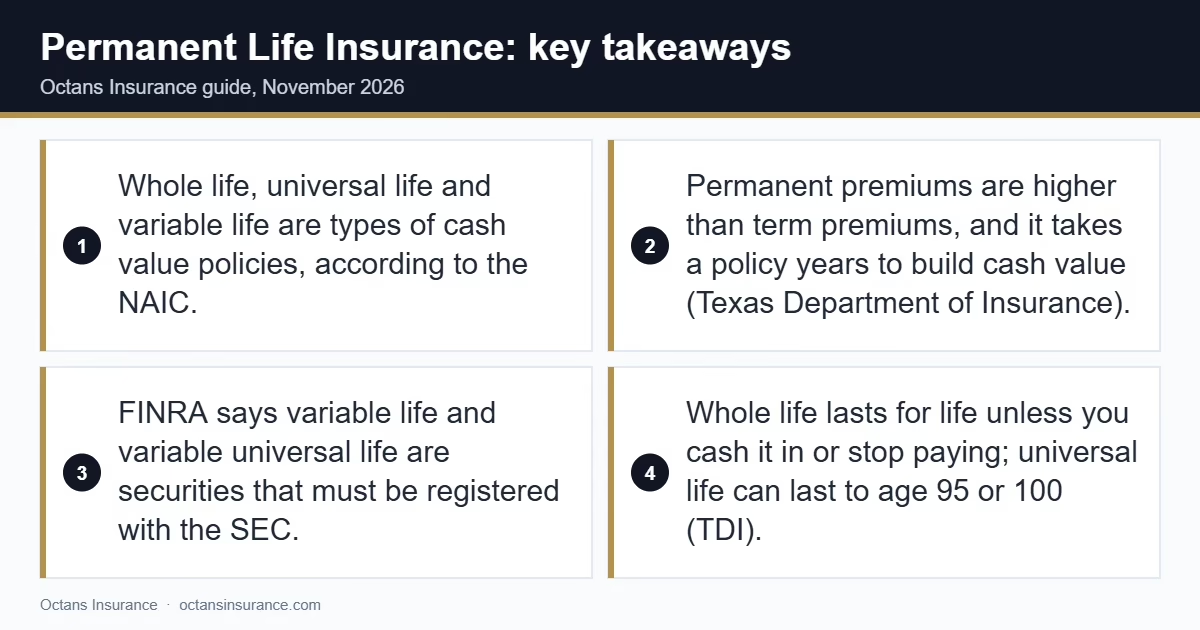
- Whole life, universal life and variable life are types of cash value policies, according to the NAIC.
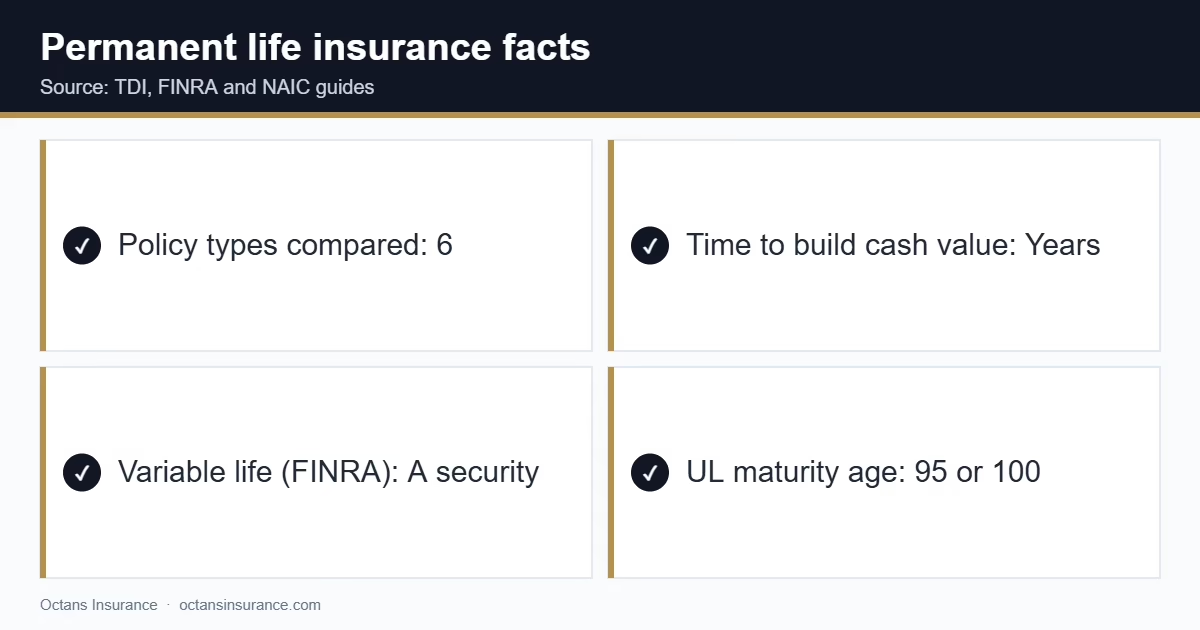
- Permanent premiums are higher than term premiums, and it takes a policy years to build cash value (Texas Department of Insurance).
- FINRA says variable life and variable universal life are securities that must be registered with the SEC.
- Whole life lasts for life unless you cash it in or stop paying; universal life can last to age 95 or 100 (TDI).
Table of Contents
Make sure your family is financially protected today!
Permanent life insurance is coverage that can last the rest of your life as long as you keep it in force, and many types build cash value. The main types are whole life, universal life, indexed universal life, variable life and guaranteed universal life. Premiums are higher than for term life, so it fits lifelong needs better than temporary ones.
This guide compares the types side by side, explains what drives the cost, and shows when term coverage is enough.
What is permanent life insurance?
What is permanent life insurance, in plain terms? It’s a policy built to last for life rather than for a set term. The NAIC’s consumer guide says these policies “include both a death benefit and, in some cases, cash savings,” and that whole life, universal life and variable life are types of cash value policies.
The Texas Department of Insurance (TDI) explains the savings part: “A portion of each of your premiums is put into an account, known as the cash value.” It also cautions that “it takes a policy years to build a cash value,” and that premiums for permanent life insurance are higher than for term life.
Term insurance works differently. The NAIC Life Insurance Buyer’s Guide says term is meant to provide lower cost coverage for a specific period, and most term policies don’t build cash values you can use later.
Types of permanent life insurance
The types of permanent life insurance differ in how you pay, how the cash value grows, and what’s guaranteed.
- Whole life. FINRA says premium payments typically stay the same for the life of the insured. TDI says premiums, death benefits and cash values are guaranteed, and some policies pay dividends, which aren’t guaranteed. See our whole life insurance guide.
- Universal life. Flexible premiums and an adjustable death benefit. The NAIC’s life insurance overview says the policy “remains active as long as the cash value is enough to cover insurance costs.”
- Indexed universal life (IUL). A universal life policy whose interest is tied to an index such as the S&P 500, per the NAIC. Our indexed universal life guide covers caps, floors and illustrations.
- Variable life and variable universal life. The cash value is invested in securities, in a mix you choose from the policy’s options. FINRA says the return “is not guaranteed, and the cash value will fluctuate.”
- Guaranteed universal life (GUL). Built to stay in force rather than to grow cash. NAIC reserve rules describe a guarantee that the policy will remain in force “subject only to the payment of specified premiums.”
- Final expense (burial) insurance. A smaller whole life policy meant to cover a funeral and final bills. See our final expense insurance guide.
Permanent life insurance compared
Here’s how each permanent life insurance policy type compares on the points that matter most.
| Type | Premiums | Cash value | Main risk |
|---|---|---|---|
| Whole life | Usually level for life | Guaranteed; dividends possible, not guaranteed | Higher premiums than term; early cash value is low or zero |
| Universal life | Flexible, within limits | Earns interest; most policies have a guaranteed minimum rate | Can lapse once the cash value hits zero |
| Indexed universal life | Flexible, within limits | Interest linked to a market index | Index-linked credits can be low; underfunding can cause a lapse |
| Variable life or variable universal life | Fixed (variable life) or flexible (variable universal) | Invested in securities; not guaranteed | Cash value can fall with the market |
| Guaranteed universal life | Specified premiums keep the guarantee | Varies; ask for guaranteed values | Late or missed payments can affect the guarantee |
| Final expense whole life | Typically level, like other whole life | Whole life cash value on a smaller policy | The death benefit may not cover larger needs |
Sources: TDI life insurance guide (updated Dec. 12, 2025); FINRA insurance investor guide; NAIC life insurance topic page (updated Nov. 14, 2025); NAIC Valuation of Life Insurance Policies Model Regulation. Read November 2026.
Variable products sit in a separate regulatory lane. According to FINRA, variable life and variable universal life count as securities that must be registered with the SEC, and anyone selling them must be both a FINRA registered representative and a licensed insurance agent.
How much does permanent life insurance cost?
There’s no single price, and we don’t publish sample rates here. TDI says the cost depends on your age, health and risk factors, is usually lower for younger people, and depends on the amount of coverage and the features you choose.
What’s consistent is the comparison with term. The NAIC’s overview says term insurance “is generally more affordable than permanent insurance, particularly in the early policy durations.” One reason: a permanent policy is built to pay out eventually, not just during a set period.
Leaving early is expensive too. The NAIC advises: “Do not buy life insurance unless you intend to stick with your plan.” It adds that it “may be very costly if you quit during the early years of the policy.” With universal life, the NAIC’s model regulation, which states may adopt or change, also expects the policy to describe any surrender or partial withdrawal charges, so read that section before you buy.
When is term life insurance enough?
Often, when the need has an end date. Raising children, paying off a mortgage and replacing income until retirement are all temporary. TDI calls term a good option if you want coverage for a specific period, such as when you’re raising a family. Our term vs whole life insurance guide compares the two in detail.
Permanent coverage earns its higher cost when the need lasts as long as you do: final expenses, a lifelong dependent, an estate that will need cash, or money you want to leave no matter when you die. Some people use both. TDI also notes that convertibility lets you exchange a term policy for a permanent one, though converting will raise your premiums.
Hypothetical example: Mark and Tina are both 50. They owe $240,000 on a mortgage with 20 years left, and they want their funerals paid for whenever they die.
- The temporary need: a 20-year term policy on each of them for the mortgage. That need ends when the loan does.
- The lifelong need: the National Funeral Directors Association’s 2023 study put the national median cost of a funeral with viewing and burial at $8,300, or $8,300 + $1,695 for a vault = $9,995.
- What the median leaves out: NFDA says it doesn’t include cemetery, monument or marker costs. So each buys a $15,000 permanent policy, leaving $15,000 − $9,995 = $5,005 for those items.
- Prices rise: NFDA’s median went from $7,848 in 2021 to $8,300 in 2023, a 5.8% increase in two years, so some cushion makes sense.
After year 20, the term policies end and the two small permanent policies remain. This is an illustration of matching policy types to needs, not a recommendation for your situation.
Who should consider a permanent life insurance policy?
A permanent life insurance policy tends to fit people with needs that never expire:
- anyone who wants funeral and final costs covered at any age;
- parents of a child who will need support for life;
- people whose estate will need cash for taxes or debts, for example through survivorship life insurance;
- business owners funding a buyout, as in our buy sell agreement life insurance guide; and
- people who want to leave a set amount to heirs or a charity, whenever they die.
It’s usually a poor fit if your budget is tight and your need is temporary. A larger term policy may protect your family better for the same money.
How to choose permanent life insurance
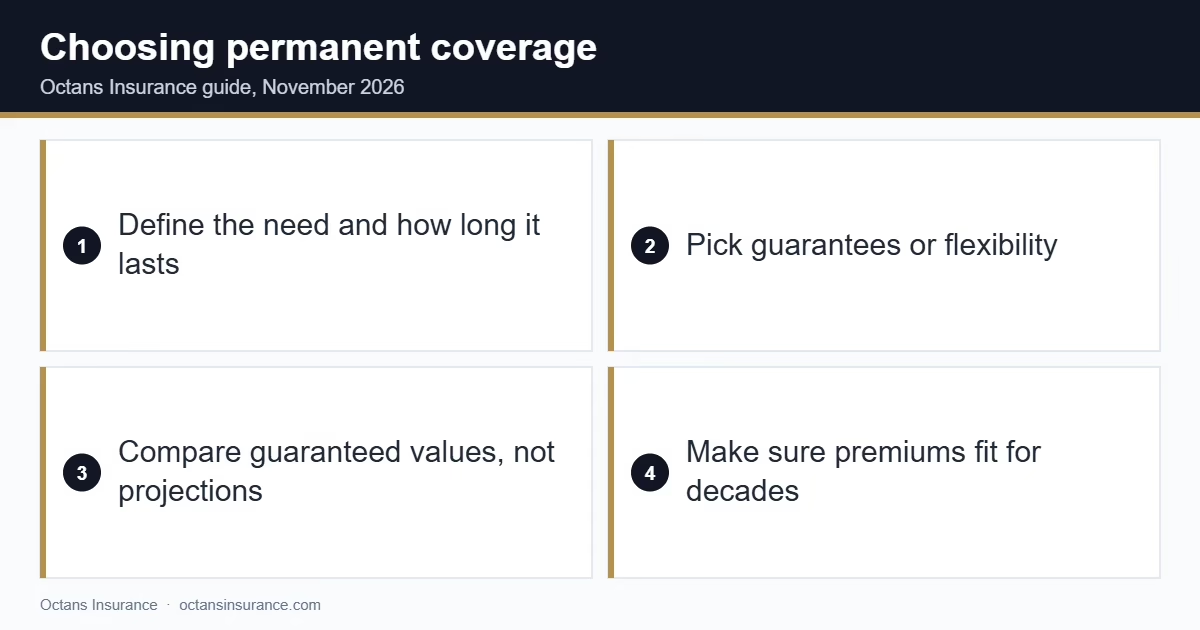
- Write down the need and how long it lasts. If it ends, start with term.
- Decide how much certainty you want: guarantees (whole life, GUL) or flexibility (universal life, IUL).
- Decide whether you want market exposure. If so, variable products are securities with their own rules.
- Get quotes for the same death benefit across types, and ask for the guaranteed values, not only projections.
- Ask what happens if you miss payments, take a loan or surrender early.
- Make sure the premium fits your budget for decades, not just this year.
Questions to ask before you buy:
- Which parts of this policy are guaranteed, and which are projections?
- What is the highest premium I could ever be charged to keep this coverage?
- When does the cash value exceed what I’ve paid in, on guaranteed values?
- What surrender charges apply, and for how long?
- Can I reduce the coverage later instead of dropping it?
Permanent life insurance: frequently asked questions
Is permanent life insurance worth it?
It can be, if you need coverage that lasts your whole life and you can keep paying. It costs more than term, and the NAIC warns it may be very costly to quit in the early years. If your need ends, such as a mortgage or raising children, term usually covers it for less. Some people combine the two.
Is whole life the same as permanent life insurance?
Whole life is one kind of permanent life insurance. Universal life, indexed universal life, variable life and guaranteed universal life are others. FINRA describes whole life as a type of permanent life insurance that covers the insured for life and can build cash value, with premiums that typically stay the same for the life of the insured.
Does permanent life insurance expire?
Not on a set date, but it can end. TDI says whole life stays in effect for your entire life unless you cash it in or stop paying premiums. Universal life stays in effect until the maturity date, usually age 95 or 100, as long as you have cash value. Underfunded policies can lapse.
Can I convert term life insurance to permanent coverage?
Often, if your policy has a conversion option. TDI says convertibility lets you exchange your term policy for a permanent life policy, though converting will raise your premiums. Deadlines and eligible products vary by policy, so check your contract. Our guide to converting term life insurance to whole life explains the steps.
Can permanent life insurance premiums go up?
It depends on the type. TDI says whole life premiums usually don’t go up after you buy. With universal life, TDI warns that low interest rates can affect cash value, which might increase your premiums. The NAIC adds that many policies’ premiums are sensitive to the company’s investment earnings, claims costs and other expenses, and could rise sharply if those turn out worse than expected. Ask which premiums are guaranteed.
Is variable life insurance a security?
Yes. A variable policy’s cash value is invested in a portfolio of securities, and FINRA says variable life and variable universal life are securities that must be registered with the SEC. Anyone who sells one must be both a FINRA registered representative and a licensed insurance agent. FINRA adds that the investment return isn’t guaranteed and the cash value will fluctuate.

How a licensed Octans agent can help
Choosing among the types of permanent life insurance is easier with quotes side by side. A licensed Octans Insurance agent can compare whole life, final expense and other permanent options from 120+ carriers, along with term, for the same death benefit.
We’ll show you which values are guaranteed and which are projections. Approval and price depend on your age and health, so we can’t promise either, and we don’t give investment or tax advice.
To talk it through, call (617) 935-9220 and ask for a licensed agent.
Keep Reading: Related Guides
- Whole life insurance
- Indexed universal life insurance
- Term vs whole life insurance
- Universal Life Insurance
- Life Insurance Cash Value
- Is Life Insurance Worth It? Who Needs It, What It Costs
- Life Insurance With Long Term Care Rider
- Guaranteed Universal Life Insurance and the No-Lapse Guarantee
Important: Octans Insurance agents are licensed in the states in which they operate. Coverage availability and rates may vary by state. Premium examples, when provided, are illustrative samples from published sources, not quotes. Final rates are determined by the insurance carrier based on underwriting and applicable policy criteria. Policy terms, exclusions, limitations, riders, and availability vary by carrier and state.
About examples and tools: Hypothetical examples, sample rates, calculators and quizzes on this site are for general educational and illustrative purposes only. They are not quotes, offers of coverage, or guarantees of eligibility, approval, price or benefits, and they are not legal, tax, financial or medical advice. The insurance company decides eligibility and price; Medicare rules are set by CMS and the Social Security Administration.
Compare permanent and term options with an agent
Start with a free, no-obligation quote review with a licensed Octans agent.
(617) 935-9220 | life@octansinsurance.com