
Permanent Life Insurance
Life Insurance Cash Value: How It Builds and How to Use It
Life insurance cash value grows inside whole life and universal life policies. See how it builds, how to borrow, withdraw or surrender, what surrender charges and taxes take, and when selling a policy is an option.
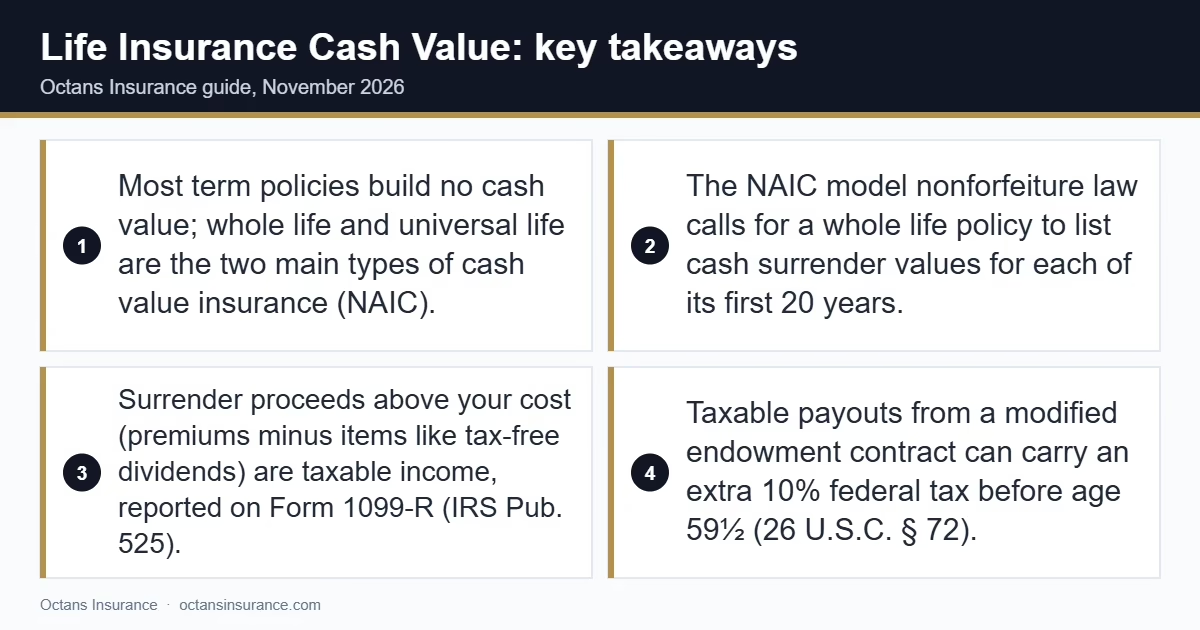
- Most term policies build no cash value; whole life and universal life are the two main types of cash value insurance (NAIC).
- The NAIC model nonforfeiture law calls for a whole life policy to list cash surrender values for each of its first 20 years.
- Surrender proceeds above your cost (premiums minus items like tax-free dividends) are taxable income, reported on Form 1099-R (IRS Pub. 525).
- Taxable payouts from a modified endowment contract can carry an extra 10% federal tax before age 59½ (26 U.S.C. § 72).
Table of Contents
Make sure your family is financially protected today!
Life insurance cash value is money that builds up inside a permanent policy, such as whole life or universal life. You can borrow against it, withdraw some of it, or cancel the policy and take the cash. Most term policies have no cash value. What you actually get if you cancel is the cash surrender value, after any surrender charges and loans.
How does life insurance cash value build?
Life insurance cash value builds in different ways depending on the policy. The NAIC Life Insurance Buyer’s Guide calls whole life and universal life two types of cash value insurance. The key difference is how you pay. Whole life premiums typically follow a set schedule. Universal life lets you choose a flexible payment pattern, as long as you pay enough to keep the policy in force.
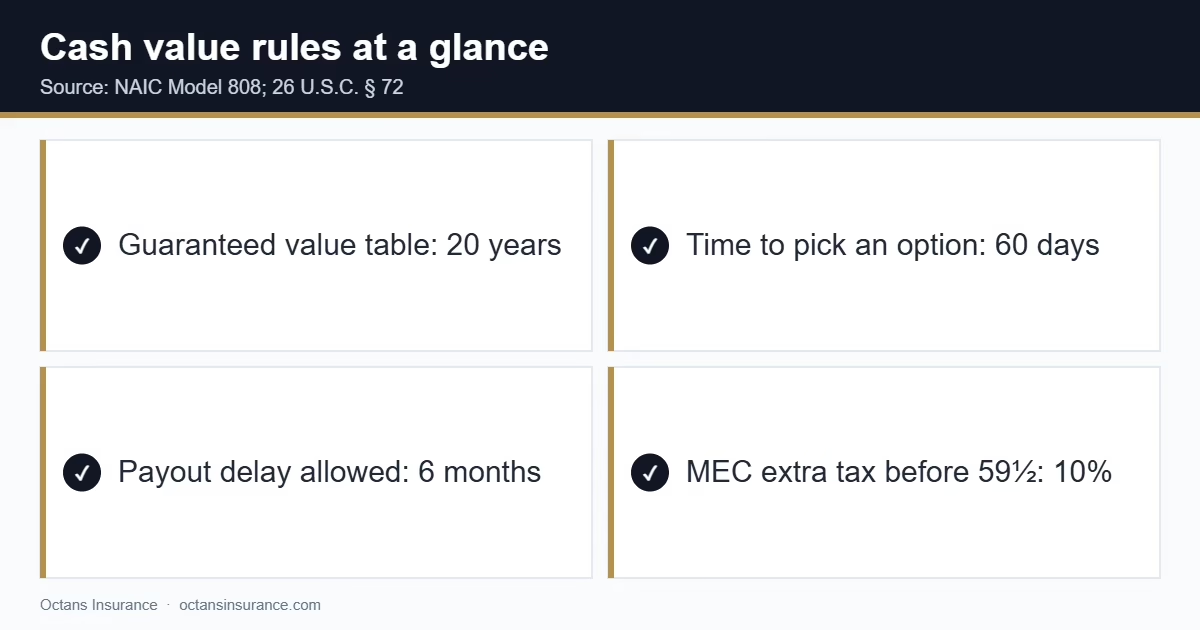
Whole life insurance cash value comes with guarantees. The Texas Department of Insurance (TDI) life insurance guide says whole life premiums, death benefits and cash values are guaranteed. The NAIC’s Standard Nonforfeiture Law for Life Insurance, a model law written for states to adopt, calls for a policy like this to include a table of cash surrender values for each of the first 20 policy years, or the policy term if that is shorter. Your state’s version of the law and your contract control.
Some whole life policies, often called participating policies, might pay a dividend each year. TDI says you can take it in cash, add it to the policy’s cash value, or use it to pay premiums. Dividends aren’t guaranteed, though, and your dividend could be lower than the company’s projection.
Universal life works more like an account. TDI says most universal life policies earn a guaranteed minimum interest rate on the cash value, and the policy could lapse if the cash value reaches zero. Some policies tie growth to an index, such as the S&P 500, or to sub-accounts you choose. Our indexed universal life insurance guide covers index-linked policies and their trade-offs.
Which policies have cash value?
Here is how the main policy types compare. Your contract has the final word.
| Policy type | Cash value? | How it grows | What to watch |
|---|---|---|---|
| Term life | Most term policies have none | Not applicable | Premiums go up if you renew at the end of the term |
| Whole life | Yes | Guaranteed values on a set schedule; some policies may also pay dividends | Dividends are not guaranteed; early values can be low |
| Universal life | Yes | Interest credits, usually with a guaranteed minimum rate | Surrender fee if you withdraw early; lapse if the value reaches zero |
| Indexed universal life | Yes | Linked to an index such as the S&P 500 | Growth depends on the index; read the illustration |
| Variable life | Yes | Sub-accounts you choose, such as stock and bond funds | Greatest risk of losing cash value |
Sources: NAIC Life Insurance Buyer’s Guide (2026) and Texas Department of Insurance life insurance guide (updated Dec. 12, 2025), read November 2026.
So, does term life insurance have cash value? Usually not. The NAIC says most term policies don’t build up cash values you can use in the future. Return of premium term is a different design, and our return of premium term guide explains what happens if you cancel early.
Five ways to use your life insurance cash value
There are five main ways to use life insurance cash value. Each one changes your coverage differently.
- Take a policy loan. TDI says you can take a loan on a policy that has built up cash value. Western & Southern Financial Group, a life insurance group, notes that an unpaid loan reduces the death benefit. Our guide to borrowing against whole life insurance covers loan interest, lapse risk and taxes.
- Make a withdrawal. You can also withdraw money. That lowers your cash value, and with universal life, a lower balance leaves less to keep the policy going.
- Surrender the policy. When you cash a policy in, TDI explains, you cancel it and get the money built up in the cash value.
- Pay premiums. Dividends can pay premiums, and universal life lets you vary payments as long as enough goes in to keep the policy in force.
- Switch to reduced paid-up. Western & Southern describes this nonforfeiture option as trading your policy for one with a smaller death benefit and no more premiums for the rest of your life.
A related option, extended term, uses your cash value to buy term coverage for the same death benefit for a limited time. If you stop paying and don’t choose, the contract decides. Under the NAIC model law, the paid-up benefit named in the policy takes effect unless you pick another option within 60 days after the missed due date. Western & Southern says that default is typically extended term. Our grace period and lapse guide explains the timeline.
Can you cash in a life insurance policy?
Yes, if the policy has a cash surrender value. Can you cash in a life insurance policy that is term? Usually not, because most term coverage has no cash value. If you stop paying a permanent policy, the NAIC model law sets a floor: once premiums have been paid for at least three full years on ordinary life insurance, the insurer must pay a cash surrender value if you surrender within 60 days after the missed premium’s due date.
Your life insurance surrender value is the amount you would actually receive. Start with the cash value, then subtract any surrender charge and any loan you owe. The NAIC model requires the policy to explain how loans and paid-up additions change these values.
Early surrenders can cost extra. TDI warns that you might pay a surrender fee if you withdraw money from a permanent policy early, and Western & Southern notes that variable and universal life policies may deduct a surrender charge. Ask the insurer for the current charge and when it ends. Payment can take time, too. The NAIC model lets insurers reserve the right to defer paying a cash surrender value for up to six months after you ask.
Surrender ends the coverage for good. The NAIC buyer’s guide warns that changes in your health may affect your ability to get a new policy or the premium you’ll pay. If anyone still relies on the death benefit, look at a loan or reduced paid-up coverage first.
How to find your life insurance surrender value
Online calculators can’t see your contract, so get the real figure from the insurer.
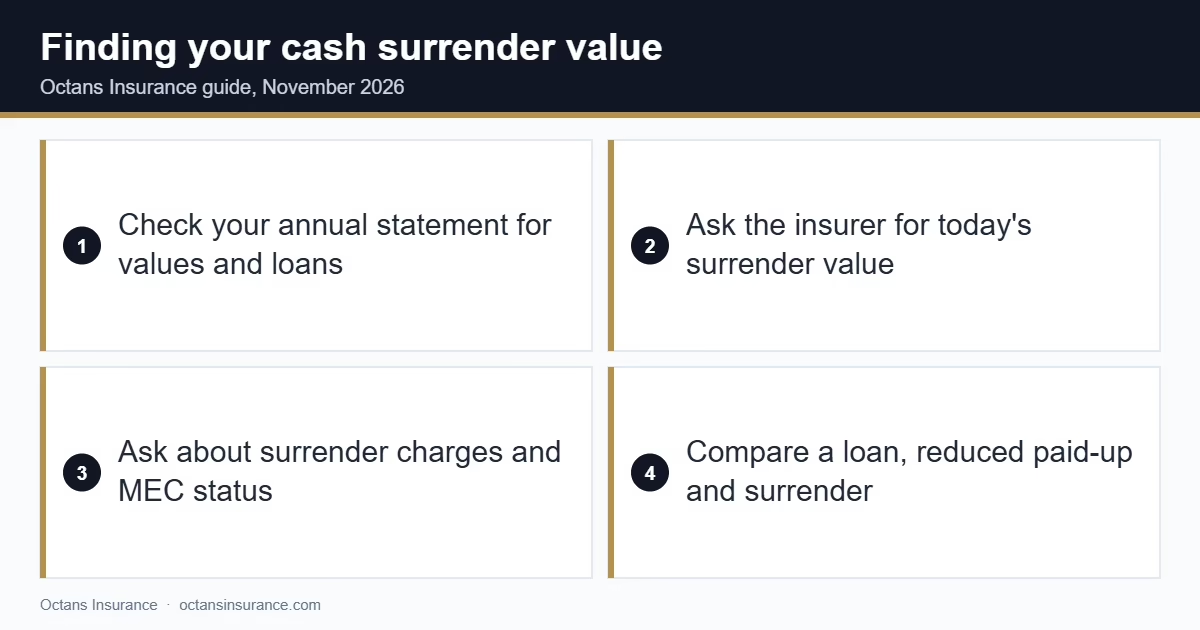
- Check your latest annual statement for the cash value, the surrender value and any loan.
- If you have whole life, find the table of values in your policy. It shows guaranteed cash surrender values for the early policy years.
- Call the insurer or log in. Ask for today’s life insurance surrender value, any surrender charge and any unpaid loan interest.
- Ask for an in-force illustration showing projected future values and benefits.
- Ask for your cost basis and whether the policy is a modified endowment contract (MEC).
- Compare your options side by side: loan, withdrawal, reduced paid-up, surrender or sale.
Is life insurance cash value taxable?
Taxes on life insurance cash value depend on how you take the money and how the policy was funded. This is general information, not tax advice, so check your own case with a tax professional.
When you surrender a policy for cash, IRS Publication 525 counts any proceeds above the policy’s cost as income. In most cases, your cost is the premiums you paid, minus refunded premiums, rebates, dividends or unrepaid loans that weren’t included in your income. Expect a Form 1099-R that lists the total proceeds and the taxable part.
Watch for the MEC rules. 26 U.S.C. § 7702A applies a 7-pay test to policies entered into on or after June 21, 1988, and a policy that fails it is a MEC. In plain terms, a policy fails if, at any point in its first seven contract years, the total paid in is more than the running total of the net level premiums that would pay it up in seven annual payments. So paying a lot into a policy early can make it a MEC.
MEC status changes how money you take out while living is taxed. Under 26 U.S.C. § 72, a loan from a MEC is treated as an amount received under the contract. The taxable part of a MEC payout also carries an extra 10% tax unless you are 59½ or older, become disabled, or take substantially equal periodic payments. Our guide Is life insurance taxable? covers the death benefit side.
What a surrender really pays: a worked example
Hypothetical example: Dana, 55, owns a whole life policy she bought 20 years ago. She has paid $2,000 a year in premiums, or $40,000 in total. Over the years she took $3,000 in dividends as cash, and none of it was included in her income. She has no loan. Her statement shows her whole life insurance cash value and a cash surrender value of $47,500.
- Cost basis, using the IRS Publication 525 method: $40,000 in premiums minus $3,000 in dividends = $37,000.
- Cash received if she surrenders: $47,500.
- Taxable part: $47,500 minus $37,000 = $10,500, shown on Form 1099-R.
- If the policy were a MEC: assuming the same $37,000 basis, the taxable part of a full surrender is still $10,500. Because Dana is under 59½, the 10% additional tax would add $1,050 (10% of $10,500), unless an exception applies.
These figures are made up; Dana’s real numbers depend on her contract and tax situation. Before surrendering, she could compare reduced paid-up coverage or a loan, which keep some coverage in force.
Should you sell your policy instead of surrendering it?
A life settlement means selling your policy to a company that pays you now, then takes over the policy and pays the premiums. Check your state’s rules first. In Texas, TDI says companies that buy policies must be licensed with the department, and you can check a license at 800-252-3439.
Buyers are selective. TDI says you’ll probably need at least a $100,000 policy and to be over 65, and companies pay more if a health condition lowers your life expectancy. You stop paying premiums, but your family won’t get the death benefit.
TDI also warns that you might owe taxes on the sale money, that it could disqualify you from Medicaid and other public assistance, and that it might not be exempt from creditors. Before selling, ask about an accelerated death benefit. TDI says it prepays part or all of the death benefit if you meet the policy’s terms, such as having a terminal illness. Our living benefits guide explains these riders.
Questions to ask before you surrender or sell:
- What is my cash surrender value today, and what will it be after the next policy anniversary?
- Is there a surrender charge, and when does it end?
- Do I have a loan, and how much unpaid interest is on it?
- What is my cost basis, and is the policy a MEC?
- What would reduced paid-up or extended term coverage give me?
- Does anyone still depend on this death benefit?
- If I sell, is the buyer licensed in my state, and how would the money affect my taxes and public benefits?
Life insurance cash value: frequently asked questions
Does term life insurance have cash value?
Most term policies don’t. The NAIC says most term policies don’t build up cash values that you can use in the future, and it describes term as lower cost coverage for a specific period. For coverage that builds value, compare whole life, universal life and indexed universal life for the same death benefit.
How long does it take to build cash value?
It depends on the policy. TDI says it takes a policy years to build a cash value. The NAIC notes that some policies have low values in the early years that build later, while others build gradually. A whole life policy’s table of values shows the guaranteed cash surrender value for each of the early policy years, so check yours.
What is the difference between life insurance cash value and surrender value?
Cash value is the balance that has built up in the policy. Your life insurance surrender value, also called the cash surrender value, is what you would actually receive if you cancel. It equals the cash value minus any surrender charge and any loan you owe. With no surrender charge and no loan, the two amounts can match.
Can I get my life insurance cash value without canceling the policy?
Often, yes. TDI says that if your policy has built up cash value, you can withdraw money or take a loan on the policy. Western & Southern notes that an unpaid loan reduces the death benefit, and withdrawals shrink the value that keeps a universal life policy going. To stop paying premiums but keep some coverage, ask about reduced paid-up insurance.
Can you cash in a life insurance policy at any time?
You can ask, but the money may not be instant. Under the NAIC’s model nonforfeiture law, insurers keep the right to defer paying a cash surrender value for up to six months after you request it. TDI also notes that you might pay a surrender fee if you withdraw money from a permanent policy early. Ask the insurer for its timeline and charges first.

How a licensed Octans agent can help
Deciding what to do with life insurance cash value is easier with the numbers side by side. A licensed Octans Insurance agent can help you read your annual statement and in-force illustration, and show how a loan, a withdrawal or a reduced paid-up switch would change your death benefit.
If you still need coverage, an agent can compare term, whole life and final expense options from 120+ carriers before you give up an old policy. We don’t give tax or legal advice, so we’ll point you to a tax professional for MEC and cost basis questions.
To talk it through, call (617) 935-9220 and ask for a licensed agent.
Keep Reading: Related Guides
- Borrow against whole life insurance
- Whole life insurance guide
- Indexed universal life insurance
- Is Life Insurance Worth It?
- Can You Have Multiple Life Insurance Policies?
Important: Octans Insurance agents are licensed in the states in which they operate. Coverage availability and rates may vary by state. Premium examples, when provided, are illustrative samples from published sources, not quotes. Final rates are determined by the insurance carrier based on underwriting and applicable policy criteria. Policy terms, exclusions, limitations, riders, and availability vary by carrier and state.
About examples and tools: Hypothetical examples, sample rates, calculators and quizzes on this site are for general educational and illustrative purposes only. They are not quotes, offers of coverage, or guarantees of eligibility, approval, price or benefits, and they are not legal, tax, financial or medical advice. The insurance company decides eligibility and price; Medicare rules are set by CMS and the Social Security Administration.
Compare your cash value options with an agent
Start with a free, no-obligation quote review with a licensed Octans agent.
(617) 935-9220 | life@octansinsurance.com