
Green Card Holders
Life Insurance for Green Card Holders: Rules, Documents and Options
Life insurance for green card holders is close to what citizens get, but your time as a resident, your card type and your trips abroad can change which insurers say yes.
- Guardian says many insurers want about two years as a permanent resident before offering coverage.
- USCIS says a conditional green card is valid for two years; file I-751 or I-829 in the 90 days before it expires.
- Guardian says some insurers treat green card holders abroad more than 12 weeks a year as foreign nationals.
- The IRS says life insurance proceeds paid at death generally aren’t gross income; any interest is taxable.
Table of Contents
Life insurance for green card holders works much like it does for citizens. Many insurers offer a green card holder (lawful permanent resident) the same term, whole life and final expense products. The main extra checks are how long you’ve lived in the U.S., whether your card is a standard or a conditional 2-year card, and how much time you spend abroad.
This page is general information, not legal or immigration advice. For questions about your status, see USCIS or speak with an immigration attorney. Each insurer sets its own rules and makes its own underwriting decision.
Can green card holders get life insurance?
Yes, in most cases, green card holders can get life insurance. Guardian, a life insurer, says on its foreign nationals guide that “a non-US citizen with a green card generally enjoys access to the widest range of life insurance options.” The same guide adds a catch: “many insurance companies require a minimum of two years as a permanent resident before providing coverage.”
Guardian goes on to say that once you’ve held a green card and lived here for two consecutive years, you’ll generally have the same options as citizens. Not every insurer has a two-year rule, and some ask for less time. A newer permanent resident can often still apply; the offer may just come from fewer companies or at a different price class.
Status isn’t the only factor in life insurance for green card holders. Guardian notes that “age, gender, health status, income level and other factors will still affect the cost and coverage options available to you.” Those are the same things every applicant faces.

How insurers view life insurance for green card holders
Underwriters want to know you’ll keep living in the U.S. and that they can verify who you are. For life insurance for permanent residents, they usually ask about:
- Time as a permanent resident. Guardian says many insurers want about two years; some accept less.
- Your card type and dates. A standard card is simpler than a conditional 2-year card.
- Time outside the U.S. Guardian says some companies treat a green card holder “who spends more than 12 weeks a year outside the US” like a foreign national.
- An SSN, U.S. address and U.S. bank account. Guardian says many insurers require premiums paid in U.S. dollars from a U.S. bank account.
- Health history. Insurers may ask for records from your home country. Guardian says that if those are acceptable, the insurer “will likely require a certified translation.”
Where you sign matters as well. Guardian says the insurer will likely require you to sign the application, and complete steps such as a medical exam, in the United States.

Permanent vs conditional green card: does the 2-year card matter?
It can affect life insurance for green card holders in the first two years. USCIS says “A conditional permanent resident receives a Green Card valid for two years.” Conditional status usually comes from a recent marriage or from investing in a U.S. business. To keep your status, you file Form I-751 (marriage) or Form I-829 (investor) “within the 90-day period before your conditional Green Card expires.”
USCIS is direct about what happens if you don’t: “If your conditions are not removed, you will lose your permanent resident status.” Insurers know this. Some treat a conditional card more like a temporary visa until conditions are removed. Others treat it like a standard card if your filing is on time.
| Feature | Standard green card | Conditional 2-year card |
|---|---|---|
| How long the card is valid | Until the date on the card; replaced with Form I-90 | 2 years; cannot be renewed |
| Next USCIS step | Replace the card if it has expired or will expire within 6 months | File I-751 or I-829 in the 90 days before it expires |
| What insurers may ask | Card dates, time in the U.S. | Card dates, plus proof you filed to remove conditions |
| Typical insurer view | Often close to a citizen’s | Varies by insurer; some are stricter |
Sources: USCIS conditional permanent residence page (updated April 24, 2025) and replace your green card page (published Sept. 12, 2025). Insurer views are a general pattern, not any one company’s rule.
If your card has expired and you’ve filed to remove conditions or renew it, keep the USCIS receipt notice. An insurer may ask to see proof of the filing.
What documents do green card holders need to apply?
Applying for life insurance for green card holders takes a few more papers than a citizen needs. You won’t send most of these up front. An agent or the insurer will tell you which ones to have ready and how to provide them safely. A typical list:
- Your green card (Form I-551), front and back, or the USCIS receipt notice if it’s being renewed
- Your Social Security number
- A U.S. driver’s license or state ID
- Proof of a U.S. address
- A U.S. bank account for premium payments
- Income proof, such as pay stubs or a tax return
- Your doctor’s name and contact details, plus certified English translations of any foreign medical records
- Planned travel for the next year or two, with countries and lengths of stay
Protect your information. Never send images of your green card, passport, visa or I-94, or your SSN or ITIN, through a web form or email. A licensed agent will explain the insurer’s secure application step.
What if you travel or live abroad for long stretches?
Long trips raise two separate questions: one for USCIS and one for the insurer. Our guide to life insurance for non-US citizens covers how insurers treat people who live mainly abroad.
For your status, USCIS says on its travel page that “temporary or brief travel usually does not affect your permanent resident status.” It uses absences of more than a year as “a general guide” for abandonment, but says abandonment “may be found to occur in trips of less than a year.”
If you plan to be away for more than a year, USCIS says “it is advisable to first apply for a reentry permit” (Form I-131) before you leave, though a permit doesn’t guarantee reentry. It also notes that absences of six months or more “may disrupt the continuous residency required for naturalization.”
For life insurance for green card holders, the travel questions come at application time. Guardian’s point about green card holders who spend more than 12 weeks a year outside the U.S. means a frequent traveler may be underwritten like a foreign national. Be specific about trips you plan. If you later move abroad, check your policy’s residence terms and keep paying premiums from your U.S. account.
Does becoming a U.S. citizen change your policy?
Many green card holders plan to naturalize. USCIS says the general rule is to “Show you have been a lawfully admitted permanent resident of the United States for at least five years” (USCIS). You also need at least 30 months of physical presence out of those five years. If you’ve been married to and living with a U.S. citizen spouse, the wait is generally three years, with 18 months of physical presence.
A policy you already own is a contract. Its terms decide what happens next, not your new passport. Your price class was set when you applied, so citizenship by itself usually won’t lower an existing premium. Ask your insurer if you’re unsure.
Naturalizing can still help in two ways. New policies you apply for later are underwritten like any citizen’s. And if you were offered a lower amount or class because of time in the U.S., you can apply again later and compare. Don’t cancel a policy until the new one is in force.
Can you name a beneficiary who lives abroad?
Yes, with most insurers. Guardian says “most insurance companies will allow a non-US citizen, such as a family member living abroad, to be named,” though that person typically must have an insurable interest. Nationwide’s foreign nationals page says benefits “may only be sent to a U.S. bank account with a 9 digit routing number,” so ask how a payout would reach someone overseas.
Income tax usually isn’t the issue. The IRS says that “Generally, life insurance proceeds you receive as a beneficiary due to the death of the insured person” aren’t counted as gross income, though any interest is taxable.
Estate tax can be different. If your spouse is not a U.S. citizen, special rules may apply: the IRS says “The QDOT rules apply only in those situations where a decedent’s surviving spouse is not a U.S. citizen” (Form 706-QDT instructions). Ask a tax professional or estate attorney about your case.
See our beneficiary guide and is life insurance taxable for the basics.
Life insurance for green card holders: which type and how much?
Most green card holders choose among three types.
- Term life. Covers a set period, such as 20 or 30 years, at the lowest price per dollar of coverage. It fits working parents and homeowners.
- Whole life. Lasts your whole life and builds cash value, at a much higher premium.
- Final expense. A small whole life policy for funeral and end-of-life costs. It often fits older green card holders, including parents who came to join their children.
To size a term policy, add up the income your family would lose and the debts they’d owe, then subtract coverage and savings you already have.
Hypothetical example: Lucia, 40, is a green card holder. She and her husband earn $95,000 together; her share is $55,000. They have two kids and owe $280,000 on their home. Their youngest child is 7, and Lucia’s widowed mother lives with them.
- 8 years of Lucia’s income: $55,000 × 8 = $440,000
- Half of the mortgage: $280,000 ÷ 2 = $140,000
- Childcare until the youngest is 13: $9,000 × 6 = $54,000
- Total need: $440,000 + $140,000 + $54,000 = $634,000
- Minus group life at work ($55,000) and savings ($30,000): $634,000 − $85,000 = $549,000
Lucia might look at $550,000 of 20-year term. Her mother, 68, could look at a small final expense policy. These numbers are made up to show the math. They are not a quote, and each insurer decides what it will offer.
How to apply for life insurance for green card holders
- Confirm your state. Agents can only help residents of states where they’re licensed.
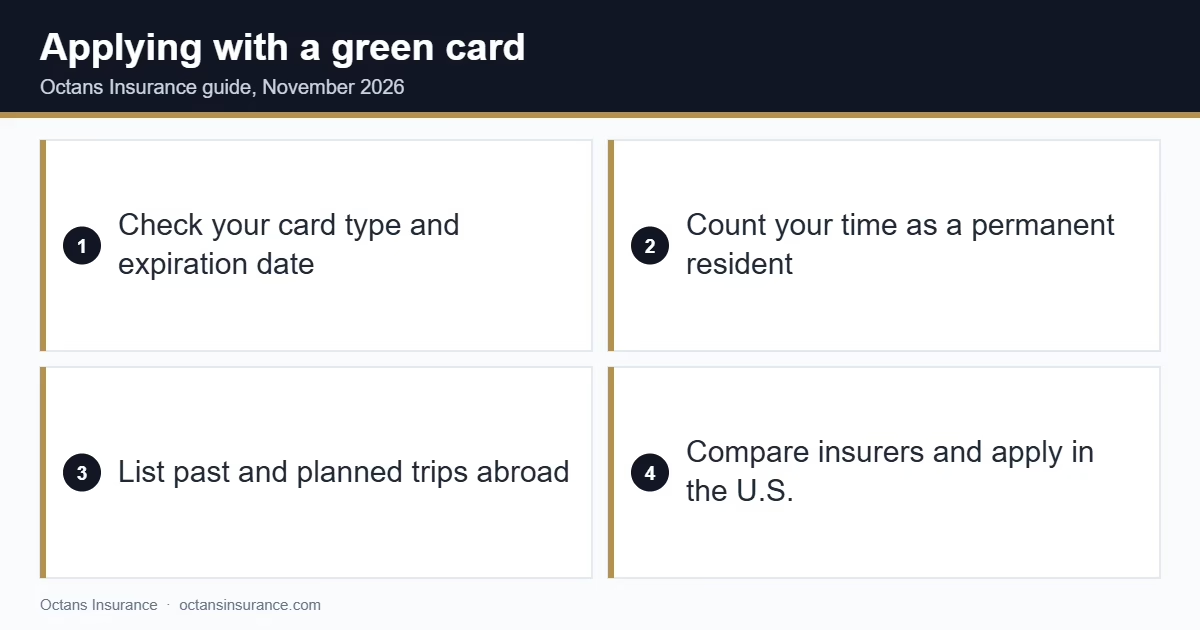
- Check your card. Note whether it’s a standard or conditional card, and its expiration date. If conditions need removing, confirm the filing is on time.
- Count your time here. Note when you became a permanent resident and how long you’ve lived in the U.S.
- List your travel. Write down trips in the past two years and any you plan.
- Choose a type and amount using the steps above.
- Compare insurers. Their time-in-U.S. and travel rules differ, so one decline doesn’t mean every insurer will say no.
- Apply in the U.S., answer honestly, and read the policy when it arrives.
Life insurance for green card holders: frequently asked questions
Can I get life insurance with a new green card?
Often, yes, though you may see fewer offers at first. Guardian says many insurers want about two years as a permanent resident before providing coverage, while some accept less time. Steady U.S. work, an SSN and a U.S. bank account generally help, since insurers look for ties to the U.S. Each insurer makes its own decision, so comparing several matters most in your first years.
Is life insurance more expensive for permanent residents?
Often not, once you’ve lived here a while. Guardian says that once you’ve held a green card and lived in the U.S. for two consecutive years, you’ll generally be eligible for all the options citizens have. From there, price depends mostly on age, health, tobacco use, the amount and the term. Frequent long trips abroad or certain countries of citizenship can still affect the price class at some insurers.
Can I get life insurance with a conditional green card?
Some insurers consider it. They usually ask when the card expires and whether you’ve filed Form I-751 or I-829 on time. USCIS says you must file within the 90 days before the conditional card expires, and that you lose permanent resident status if conditions are not removed. Keep your receipt notice handy, since an insurer may ask about it.
What if my green card expires while my policy is in force?
Your policy’s terms control, so read them. Insurers check your status when you apply, which is why valid documents matter at that point. Your immigration status is a separate matter: USCIS says to replace a card that has expired or will expire within six months. Keep your card current, since lapsed status can affect other parts of your life.
Can my parents abroad be my beneficiaries?
Generally, yes. Guardian says most insurers allow a non-U.S. citizen, such as a family member living abroad, to be named, as long as they have an insurable interest. Some insurers pay only to a U.S. bank account, so plan how the money would reach them. A contingent beneficiary who lives in the U.S. can make a claim easier.
Will a long trip abroad affect my green card or my policy?
It can affect both, in different ways. USCIS uses absences of more than a year as a general guide for abandoning permanent residence, and suggests a reentry permit before a trip that long. On the insurance side, Guardian says some companies treat a green card holder who spends more than 12 weeks a year outside the U.S. like a foreign national. List planned trips honestly on your application. For status questions, ask an immigration attorney.

How Octans can help green card holders
Octans is an independent agency. Our licensed agents compare life insurance for green card holders across plans from 120+ insurance carriers and can look for insurers whose residence and travel rules fit your history. Not sure which insurance companies may consider your visa category? Octans can help you explore potential options based on your individual circumstances.
Our short screening form asks for your state, age range, coverage amount, visa category (choose green card), time in the U.S., whether you have an SSN or ITIN (yes or no only), and a phone number or email. Carriers set rules by status, residence time and ID, so these answers point us to the right insurers. Octans agents can help residents of the states where we are licensed.
Don’t send your card or ID numbers through the form or by email. Prefer Spanish? Read our guía de seguro de vida para inmigrantes. An agent will call you and explain the secure application step. You can also reach us at (617) 935-9220.
Keep Reading: Related Guides
- Life insurance for non-US citizens
- Term life insurance
- Life insurance beneficiary guide
- Life Insurance for Immigrants
- Life Insurance for H1B Visa Holders
- Life Insurance With ITIN
- Life Insurance Without Green Card
- Life Insurance for L1 Visa Holders
- Life Insurance for TN Visa Holders
Important: Octans Insurance agents are licensed in the states in which they operate. Coverage availability and rates may vary by state. Premium examples, when provided, are illustrative samples from published sources, not quotes. Final rates are determined by the insurance carrier based on underwriting and applicable policy criteria. Policy terms, exclusions, limitations, riders, and availability vary by carrier and state.
About examples and tools: Hypothetical examples, sample rates, calculators and quizzes on this site are for general educational and illustrative purposes only. They are not quotes, offers of coverage, or guarantees of eligibility, approval, price or benefits, and they are not legal, tax, financial or medical advice. The insurance company decides eligibility and price; Medicare rules are set by CMS and the Social Security Administration.
Explore life insurance options based on your visa status
Answer a few short questions, and a licensed Octans agent will look for insurers that may consider your situation.
(617) 935-9220 | life@octansinsurance.com