
Life Insurance
Life Insurance Without Green Card: What Each Status Can Expect
Life insurance without green card status is possible for many visa holders, while DACA, TPS, asylee, refugee and no-status situations face real limits set by each insurer.
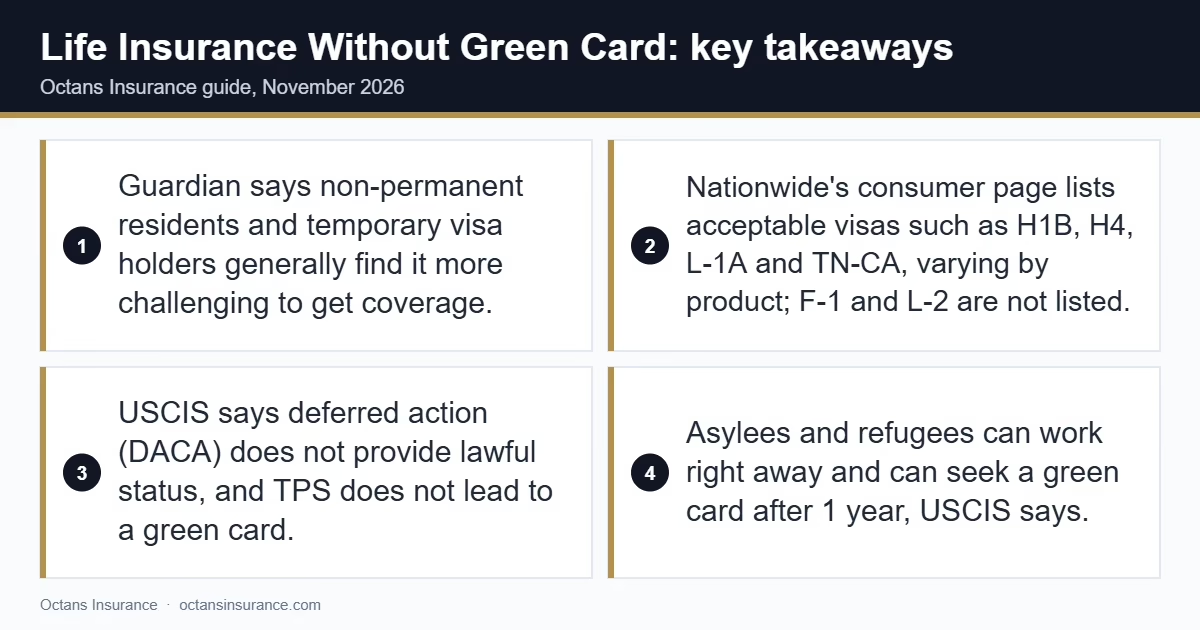
- Guardian says non-permanent residents and temporary visa holders generally find it more challenging to get coverage.
- Nationwide’s consumer page lists acceptable visas such as H1B, H4, L-1A and TN-CA, varying by product; F-1 and L-2 are not listed.
- USCIS says deferred action (DACA) does not provide lawful status, and TPS does not lead to a green card.
- Asylees and refugees can work right away and can seek a green card after 1 year, USCIS says.
Table of Contents
You can sometimes buy life insurance without green card status, but your options depend on what status you do have. Holders of common work visas have the most choices. DACA recipients, TPS holders, asylees and refugees have fewer, and people with no lawful status have very few. Each insurer sets its own rules, and the insurer makes the underwriting decision.
This page is general information, not legal or immigration advice. Nothing here can tell you your status or change it. For status questions, check with U.S. Citizenship and Immigration Services (USCIS) or talk with an immigration attorney.
Can you get life insurance without green card status?
Often, yes, if you live in the U.S. lawfully and can show strong ties here. Guardian’s page for non-permanent residents (updated Nov. 13, 2025) says “Non-permanent residents and temporary visa holders will generally find it more challenging to get coverage.” Harder is not the same as impossible, but it does mean fewer insurers and more paperwork.
When you shop for life insurance without green card status, insurers want to know you will keep living here and paying premiums. Nationwide’s foreign nationals page says it requires proof of “a significant presence in the U.S.” It says eligibility typically depends on your residency status, purpose of stay and how much time you spend outside the country. Country of origin matters too.
Most insurers also want a tax ID. Nationwide asks for an SSN or an ITIN plus a valid ID such as a visa, green card or passport. Guardian lists an SSN or ITIN, or a W-8 form if you are not a U.S. taxpayer. Our guide to life insurance for non-US citizens covers green card holders (lawful permanent residents) and the full picture by status.
Life insurance without green card: options by status
This table pairs what USCIS says about each status with what you can realistically expect when you apply. The right column describes general market patterns, not any one insurer’s rules.
| Your status | What it means (official source) | What to expect when you apply |
|---|---|---|
| Work visa (for example H-1B, L-1, E, O, TN visa (USMCA)) | Temporary, lawful stay for a set purpose and time | The most choices outside a green card. Visa must be valid when you buy. Time in the U.S. and country of origin affect the offer. |
| Dependent visa (for example H-4, L-2, TD) | Spouse or child of a visa holder | Some insurers list dependent visas, others do not. Nationwide’s consumer list includes H-4 and TD but not L-2. |
| Student visa (F-1) | Temporary stay to study | Guardian says few companies will issue coverage for student visa holders. |
| Green card application pending | Applying for permanent residence from inside the U.S. (adjustment of status) | Expect questions about your current visa or work permit until the green card arrives. |
| DACA | Deferred action; USCIS says it “does not provide lawful status” | Limited. Some insurers may consider DACA recipients; each insurer sets its own rules. |
| TPS | Temporary protection; work permit available; no path to a green card by itself | Limited. Some insurers may consider TPS holders; others do not. |
| Asylee or refugee | Allowed to work; can seek a green card after 1 year | Limited at first. Choices usually widen once you get a green card. |
| No lawful status | No current immigration status | Very limited, and many insurers decline. Guardian says it “may be possible to get a small amount of protection.” |
Sources: USCIS DACA, TPS, asylum, refugee and adjustment of status pages; Guardian and Nationwide consumer pages, as of November 2026.
Which visas do insurers list for life insurance for visa holders?
Insurers publish visa lists for life insurance for visa holders, and the lists differ. Nationwide’s consumer page lists E1, E2, E3, EB5, H1B, H1C, H2B, H4, I5, K1 to K4, L-1A, L-1B, O1 to O3, TD, TN-CA (the TN visa for Canadians), V1 and V2. It adds that “Acceptable visa types vary by life insurance product.” Notice what is missing: F-1 students and L-2 spouses are not on that list.
Guardian says “Your ability to get coverage will depend mainly on the type of visa you have.” It also says your visa should be “up to date and valid when purchasing life insurance.” If your visa expires soon, ask whether the insurer wants proof of an extension or a pending petition first.
Plan for life insurance for visa holders to have an end-of-stay question. Guardian says some policies sold to non-permanent residents “may only be valid as long as you remain a US resident.” Ask what happens if you leave the U.S. before you sign. Term life insurance is the usual choice for visa holders who want a large amount for a set number of years.
What about life insurance for DACA recipients?
Options for life insurance for DACA recipients exist but are narrow. The USCIS DACA page says “Deferred action does not provide lawful status.” It also says USCIS will continue to accept initial DACA requests “but will not process initial DACA requests at this time,” while it continues to accept and process renewal requests. DACA is not a visa, so it does not appear on visa lists like Nationwide’s, and insurer rules for DACA recipients vary.
Some insurers may consider DACA recipients. If one does, expect questions about how long you have lived in the U.S., your work permit, your SSN, your income and your U.S. bank account. Each insurer sets its own rules, so no general list can promise an approval.
Keep your renewal current. A DACA approval and work permit that are still valid on the day you apply give the insurer something to verify. If your renewal is pending, say so on the application rather than guessing.
What about TPS holders?
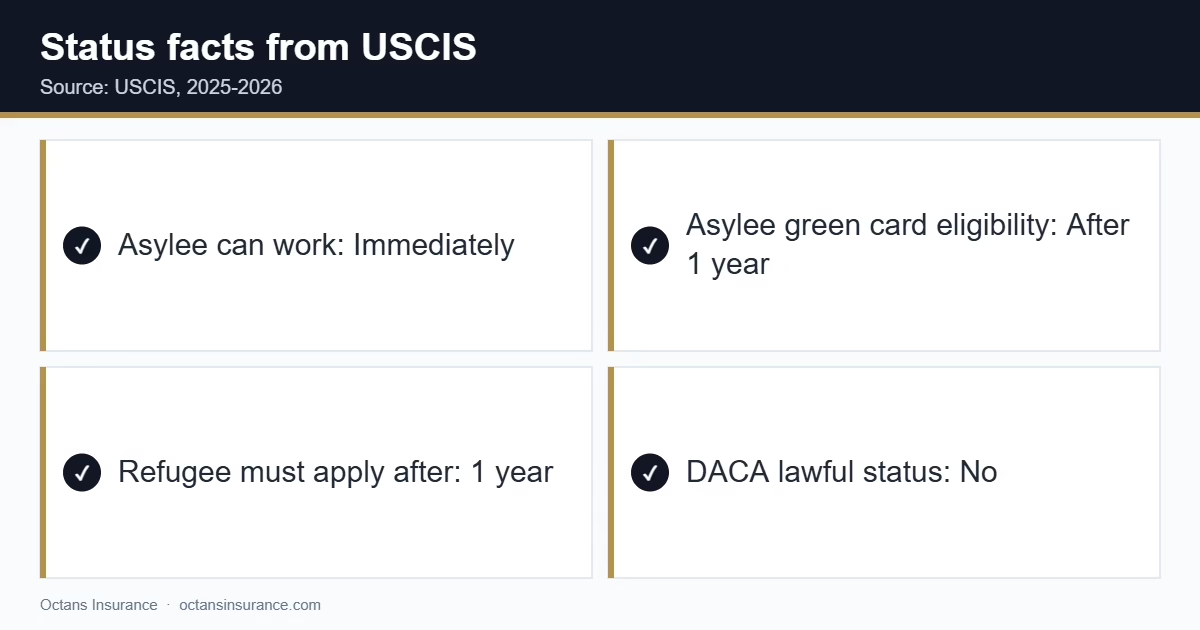
USCIS says on its TPS page that during a designated period, TPS beneficiaries are not removable from the U.S., can obtain a work permit (employment authorization document) and may be granted travel authorization. It also says “TPS is a temporary benefit that does not lead to lawful permanent resident status or give any other immigration status.”
That temporary nature is what insurers weigh. A country’s TPS designation can be extended or ended, and USCIS publishes the current list. Some insurers may consider TPS holders, and others do not. Those that do are likely to ask about your work permit, tax ID and U.S. income. Expect questions about your designation dates and how long you have lived in the U.S.
Asylees and refugees: life insurance without green card
Asylees and refugees can work, which helps. The USCIS asylum page says “If you are granted asylum, you are immediately authorized to work.” USCIS’s Green Card for Asylees page says an asylee becomes eligible after being physically present in the U.S. for at least 1 year after the asylum grant. The refugees page says an admitted refugee “may legally work in the United States as soon as you arrive” and must apply for a green card one year after arriving.
Insurance can still be hard in the first year. Guardian says options for asylees, refugees and undocumented immigrants “tend to be quite limited, but it still may be possible to get a small amount of protection.” Some carriers may want proof of residency in the U.S. The green card is often the turning point. Guardian’s foreign nationals overview says a non-US citizen with a green card “generally enjoys access to the widest range of life insurance options.”
Hypothetical example: Samir is admitted as a refugee on June 15, 2026. On November 23, 2026, he has been in the U.S. for 161 days (15 days left in June, plus 31, 31, 30 and 31 days for July through October, plus 23 days in November).
He applies with a hypothetical insurer that wants 12 months in the U.S. for a term policy. He would reach that on June 15, 2027, the same date USCIS expects him to apply for his green card.
In the meantime, Samir could ask about a smaller policy. Guardian’s final expense page says these policies tend to range from $5,000 to $30,000. The 12-month rule here is made up for the example. Real insurers set their own rules.
Is there life insurance for people with no lawful status?
The honest answer is that life insurance without green card or any other lawful status is very limited, and it depends on the insurer. Many insurers ask for a valid visa or other lawful status. Guardian’s final expense page says many insurers “will only sell final expense policies to US citizens and permanent residents,” and that without U.S. residence and ties, an SSN or ITIN, and a U.S. bank account, “it will be very difficult to obtain coverage.”
Be careful with anyone who promises easy approval. A policy is only useful if it pays. Every answer on the application must be true, because an insurer can contest a policy over misstatements during the contestability period. If someone suggests leaving out facts about your status, walk away.
If a family member relies on you, ask an agent about small policies you can apply for honestly, and keep savings or a funeral plan as a backup. For status questions, including whether you may qualify for any status, talk with an immigration attorney.
How to apply for life insurance without green card
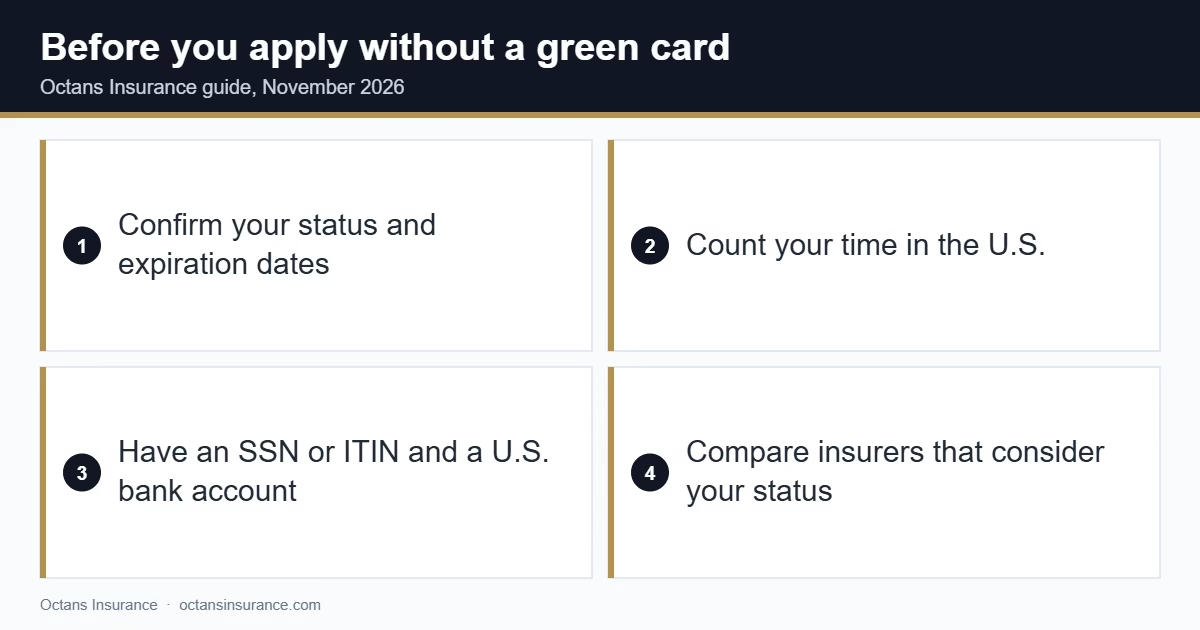
- Know your exact status and dates. Have your visa, I-94 record, work permit or USCIS approval notice handy, with expiration dates.
- Count your time in the U.S. Many insurers ask how long you have lived here and how often you travel abroad.
- Get your tax ID ready. Most insurers ask for an SSN or an ITIN.
- Open or confirm a U.S. bank account. Guardian says many insurers require premiums in U.S. dollars from a U.S. bank account.
- Choose an amount. Our coverage needs guide shows how to size it to your debts and income.
- Compare insurers that consider your status before you apply, so you apply where you have a real chance.
- Apply and take any exam in the U.S. Answer every question truthfully.
Two records come up often. Your I-94 shows your latest admission. CBP says it now gathers arrival and departure information automatically from electronic travel records, and you can print your own copy with “Get Most Recent I-94” on its I-94 website. If you hold a work permit, USCIS calls the Employment Authorization Document (Form I-766/EAD) one way to prove you may work “for a specific time period.”
Insurers may ask about the dates on these records, since time in the U.S. and status end dates shape many decisions. USCIS suggests filing to renew an EAD once it is within 180 days of expiring, so mention a pending renewal up front. Keep the records ready to discuss, but do not upload them through a web form.
Questions to ask before you buy:
- Does this insurer accept my visa or status, and for which policy types?
- How long must I have lived in the U.S.?
- Is there a coverage cap for my status?
- What happens to the policy if I leave the U.S. or my status changes?
- Can my beneficiary live abroad, and how is the benefit paid?
Never send passport, visa or I-94 images, or your SSN or ITIN, through a web form or email. An agent will explain the insurer’s secure application step.
Life insurance without green card: frequently asked questions
Can non-US residents get life insurance?
Sometimes. Insurers mostly cover people who live in the U.S. and have strong ties here. Nationwide says you don’t need to live in the U.S. permanently, but you may need to show you spend a significant amount of time here. Guardian says non-permanent residents generally find it more challenging to get coverage. Each insurer decides.
Can I get life insurance on a work permit alone?
It depends on what the work permit is based on. Insurers look at the underlying status, such as TPS, a pending green card application or DACA, and how long you have been here. Some insurers accept certain work-permit holders, and others want a visa from their list. Ask before applying.
Will I need a medical exam?
Possibly. Larger term policies may include an exam. Guardian says most final expense policies are simplified issue, so they don’t require a medical exam but may ask about your health. Our final expense insurance guide explains how these smaller policies work.
Does applying for life insurance affect my immigration case?
We can’t give immigration advice. Nationwide says it uses application information solely for the purpose of life insurance underwriting. If you have concerns about how any application could relate to your case, talk with an immigration attorney before you apply.
What happens to my policy when I get a green card?
Your policy usually stays as it is. A green card can widen your choices if you want more coverage later. Guardian notes that many insurers want a minimum of two years as a permanent resident, so timing still matters. Ask your insurer how to update your file, and compare new offers before replacing any policy you already own.

How Octans can help you explore options
Not sure which insurance companies may consider your visa category? Octans can help you explore potential options based on your individual circumstances. A licensed agent compares 120+ carriers and checks which ones may offer life insurance without green card status to someone in your situation before you apply. Octans agents can help residents of the states where we are licensed.
Our short screening form asks for your state, age range, coverage amount, visa category, time in the U.S., whether you have an SSN or ITIN (yes or no only), and your phone or email. We ask because carriers set their rules by status, time in the U.S. and the ID you hold.
Do not type your SSN or ITIN, or send passport, visa or I-94 images, through the form or by email. For more help, read our guide in Spanish, seguro de vida para inmigrantes, or call (617) 935-9220.
Keep Reading: Related Guides
- Life insurance for non-US citizens
- Term life insurance
- Final expense insurance
- Life Insurance for Immigrants
- Life Insurance for H1B Visa Holders
- Life Insurance for Green Card Holders
- Life Insurance With ITIN
- Life Insurance for L1 Visa Holders
- Life Insurance for TN Visa Holders
Important: Octans Insurance agents are licensed in the states in which they operate. Coverage availability and rates may vary by state. Premium examples, when provided, are illustrative samples from published sources, not quotes. Final rates are determined by the insurance carrier based on underwriting and applicable policy criteria. Policy terms, exclusions, limitations, riders, and availability vary by carrier and state.
About examples and tools: Hypothetical examples, sample rates, calculators and quizzes on this site are for general educational and illustrative purposes only. They are not quotes, offers of coverage, or guarantees of eligibility, approval, price or benefits, and they are not legal, tax, financial or medical advice. The insurance company decides eligibility and price; Medicare rules are set by CMS and the Social Security Administration.
Explore life insurance options based on your visa status
Answer a few short questions, and a licensed Octans agent will look for insurers that may consider your situation.
(617) 935-9220 | life@octansinsurance.com