
Visa Holders
Life Insurance for L1 Visa Holders and L-2 Families
Life insurance for L1 visa holders takes more comparison than usual, because insurers set their own rules for L-1A, L-1B and L-2 status, time in the U.S. and living abroad.
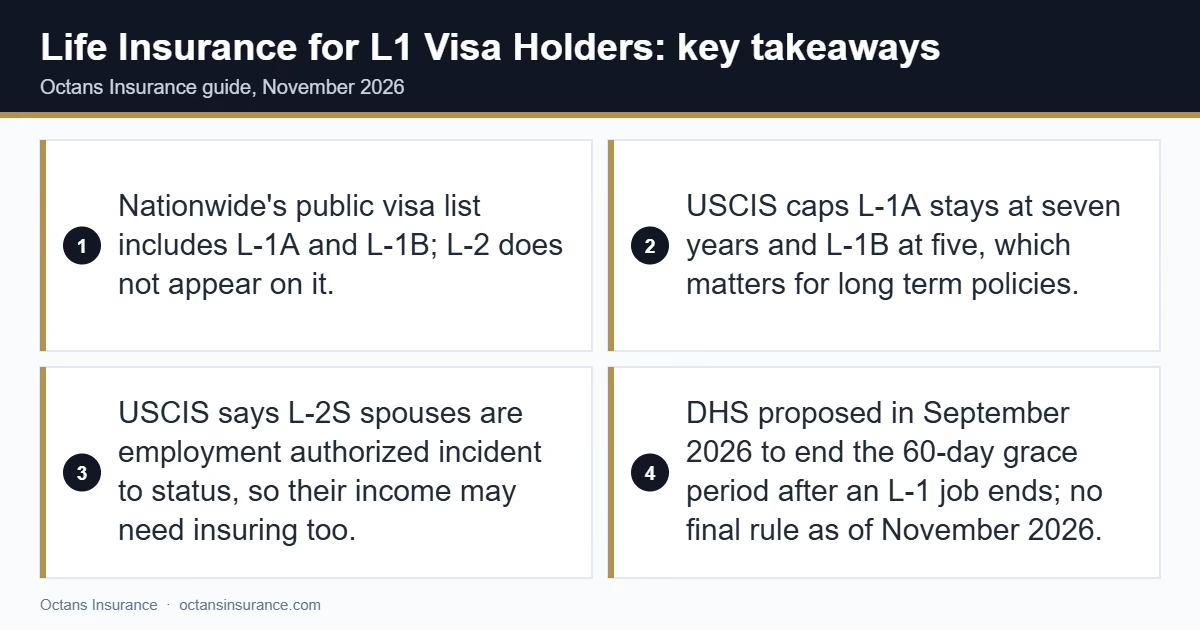
- Nationwide’s public visa list includes L-1A and L-1B; L-2 does not appear on it.
- USCIS caps L-1A stays at seven years and L-1B at five, which matters for long term policies.
- USCIS says L-2S spouses are employment authorized incident to status, so their income may need insuring too.
- DHS proposed in September 2026 to end the 60-day grace period after an L-1 job ends; no final rule as of November 2026.
Table of Contents
Life insurance for L1 visa holders is available from some U.S. insurers, but each insurer sets its own rules. Many carriers consider L-1A and L-1B workers who hold a valid visa, an SSN or ITIN, and real ties to the U.S. Your L-2 spouse may face different rules. The insurer makes the underwriting decision, so compare carriers before you apply.
This page is general information, not legal or immigration advice. For questions about your status, check USCIS or talk to an immigration attorney. For a broader look at every status, from green cards to DACA, see our guide to life insurance for non-US citizens.
How life insurance for L1 visa holders works
An L-1 visa lets a multinational company move an employee from an office abroad to a related U.S. office. That matters to insurers because your stay is tied to one employer and has a time limit. Underwriters want to know that you live here, earn here and plan to keep the policy.
The policy itself is the same product a citizen buys. Most L-1 families look at term life insurance, which covers a set number of years at a level price. Some look at permanent coverage. The difference with life insurance for L1 visa holders is in the application: more questions about status, residence, travel and your home country.
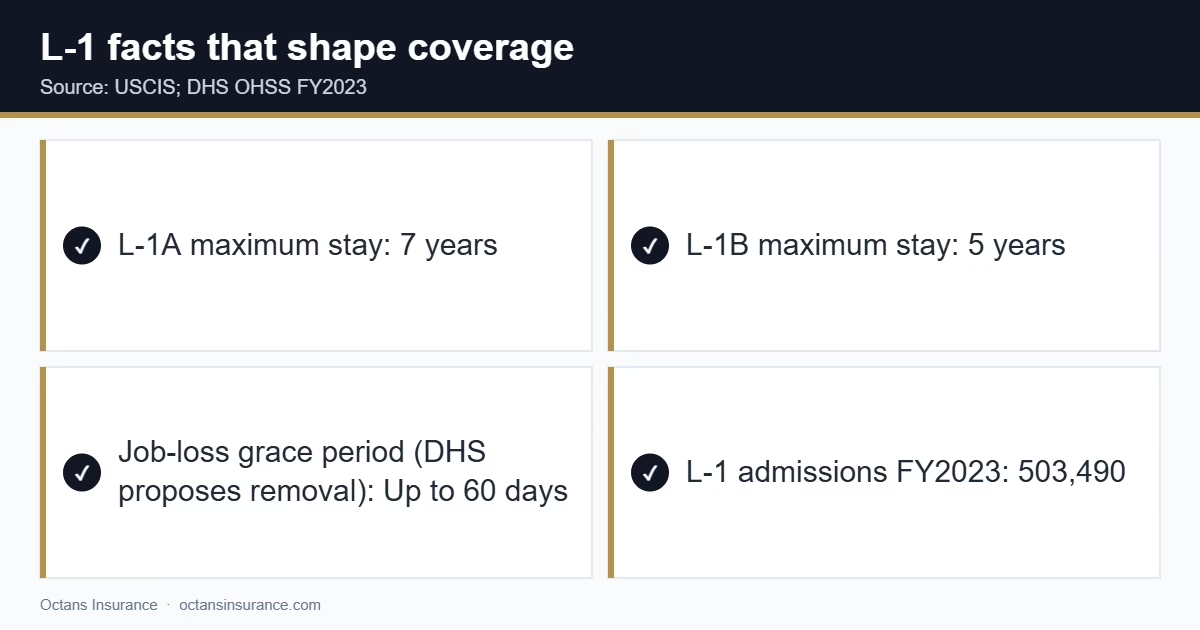
L-1 activity is concentrated in a few states. DHS counted 503,490 L-1 admissions in fiscal year 2023. Texas had the most, 73,350 (14.6%). Other large shares went to Michigan, 42,080 (8.4%), Florida, 31,490 (6.3%), and New Jersey, 20,770 (4.1%), per the DHS OHSS nonimmigrant yearbook, FY2023. These count arrivals, not people, and the destination state is self-reported, so treat them as a rough guide.
Does L-1A or L-1B status change your options?
Not much on the insurance side, but the time limits differ, and time is something insurers notice. Both categories require that you generally worked for a qualifying company abroad for one continuous year, within the three years before you came to the U.S.
- L-1A (executives and managers): USCIS allows a maximum initial stay of three years, or one year to open a new office. Extensions come in steps of up to two years, up to a seven-year total.
- L-1B (specialized knowledge): the same initial stay rules apply, but the USCIS L-1B page sets a five-year maximum.
Nationwide’s consumer page lists both L-1A and L-1B among the visa types it accepts. It also says acceptable visa types vary by life insurance product. So the category on your I-94 matters less than the specific policy you apply for.
What do insurers check on an L-1 application?
Each insurer weighs these factors in its own way. The table shows what public carrier pages say about life insurance for visa holders, and what it means for an L-1 worker.
| Factor | What public carrier pages say | What it means for an L-1 worker |
|---|---|---|
| Visa type | Nationwide lists L-1A and L-1B; Guardian says L visa holders “can often get coverage” | L-1 is a commonly listed category, but it is not a guarantee |
| Valid visa | Guardian says your visa should be “up to date and valid when purchasing” | Apply well before your I-94 end date, not in the last weeks |
| Tax ID | Nationwide asks for an SSN or ITIN; Guardian also lists a W-8 form for non-taxpayers | Have your SSN (or ITIN) number ready, but never email it |
| U.S. presence | Nationwide requires proof of “a significant presence in the U.S.” | A U.S. lease or home, U.S. pay and a U.S. bank account help |
| Home country and travel | Nationwide looks at time spent outside the country and its approved-country list | Frequent trips to the home office can bring extra questions |
| Health and age | Guardian assesses health, age and other risk factors | The medical part works the same as for a citizen |
Sources: Nationwide foreign nationals page and Guardian non-permanent residents page (updated November 13, 2025), as of November 2026.
Neither page states a minimum time in the U.S. for visa holders. Some insurers ask for a period of U.S. residence before they offer their best rate classes. Others do not. That gap is where life insurance for work visa holders gets uneven, and it is why one quote from one company tells you little.
Can L-2 spouses and children get coverage?
Sometimes, but the rules for L-2 dependents are less settled than for the L-1 worker. USCIS lets the transferring employee bring a spouse and unmarried children under 21 in L-2 status. It also says spouses in valid L-2S status are “considered employment authorized incident to status.” In plain terms, an L-2 spouse in valid L-2S status can work without first applying for a separate work permit, though USCIS says they may still request one.
For insurance, that matters in two ways. A working L-2 spouse has income to replace, so they may need their own policy. And a non-working spouse still has value to the household, such as child care, that a policy can cover. Our guide to life insurance for a spouse explains how to size it.
Carrier lists differ for dependents. Nationwide’s public visa list names L-1A and L-1B, but L-2 does not appear on it. Guardian lists “L” visa holders without splitting worker and dependent. Each insurer sets its own rules, so ask about the L-2 spouse before you assume one policy fits both of you.
For L-2 children, coverage options such as a child rider on a parent’s policy depend on the carrier. Ask before you apply.
Is employer life insurance for L1 visa holders enough?
Usually not on its own. If your employer offers group life insurance, it is a useful start and takes little effort to keep. But it has two limits that matter more for a transferee than for most workers.
- It is tied to the job. Your L-1 status is tied to the same employer. If the job ends, both the visa and the group coverage can end at about the same time.
- It is often a fixed multiple of pay. One or two times salary rarely covers a mortgage, school costs and years of lost income.
That is why most planning for life insurance for L1 visa holders starts with an individual policy. A policy you own stays in force as long as you pay the premium and follow its terms. Ask HR what happens to your group coverage when employment ends and whether a conversion option exists. Our page on group life and health insurance covers how group plans work.
Hypothetical example: Arjun, 36, is an L-1B engineer on a three-year initial stay. USCIS caps L-1B at five years in total. He earns $130,000, and his employer’s group plan pays two times salary, or $260,000.
- He wants 10 years of income replaced: 10 × $130,000 = $1,300,000.
- He adds $100,000 for his daughter’s education: $1,300,000 + $100,000 = $1,400,000.
- He subtracts $150,000 in savings: $1,400,000 − $150,000 = $1,250,000 total need.
- He subtracts the group coverage: $1,250,000 − $260,000 = $990,000 gap.
Arjun might look at about $1,000,000 of individual term coverage. And if his job ends, the full $1,250,000 need would fall on that policy. A 20-year term would outlast his five-year L-1B limit, so he should ask each insurer what happens if he moves abroad or changes status. The figures are illustrative only. Our coverage calculator guide walks through the math.
What happens if your L-1 job ends?
Your life insurance policy and your immigration status are separate. An individual policy you own does not end because your job ends, as long as you keep paying. Group coverage through the employer is the part at risk.
On the status side, the current regulation, 8 CFR 214.1(l)(2), sets a discretionary grace period for workers in E-1, E-2, E-3, H-1B, H-1B1, L-1, O-1 or TN (USMCA) classifications. They, and their dependents, are not treated as failing to keep status solely because the job ended, for up to 60 consecutive days or until the end of their authorized validity period if sooner. It applies once per validity period, and DHS may shorten or deny it.
That rule may change. In September 2026, DHS published a proposed rule to eliminate the 60-day grace period. Comments closed November 10, 2026. As of November 23, 2026, DHS had not published a final rule, so the current regulation still applies. Check the Federal Register for updates. If you lose your job, talk to an immigration attorney about your options before you make insurance decisions.
For anyone shopping for life insurance for work visa holders, the practical lesson is timing. It is usually easier to buy individual coverage while you are employed, your visa is valid and your U.S. ties are clear. Waiting until after a layoff can leave you with fewer choices.
Moving from L-1 to a green card
Some L-1A managers and executives later seek permanent residence. One route USCIS describes is the EB-1 multinational manager or executive category. USCIS says you must have been employed outside the U.S. for at least one year in the three years before the petition, that no labor certification is required, and that the employer files Form I-140. Ask an immigration attorney whether this route fits you.
For life insurance, a pending green card case does not cancel a policy you already own. Once you become a green card holder (lawful permanent resident), you may see more products or rate classes, depending on the insurer. Our non-US citizens guide compares statuses side by side.
Should you wait for the green card before you buy? Not necessarily. Insurers assess your age and health when you apply, and neither improves with waiting. You can always add a second policy later.
Will your policy follow you if you leave the U.S.?
It depends on the policy, so read it before you sign. This question matters more for life insurance for L1 visa holders than for most buyers, because L-1 stays have a maximum limit: seven years for L-1A and five for L-1B. Some transferees go home or move to another country afterward.
Carrier pages point in two directions. Nationwide says “You don’t need to live in the U.S. permanently” and that paying premiums from abroad “is often possible.” Guardian warns that “some policies may only be valid as long as you remain a US resident.” Nationwide also says benefits may only be sent to a U.S. bank account with a nine-digit routing number.
Before you buy, ask each insurer these questions in writing:
- Does the policy stay in force if I move abroad permanently?
- Can I pay premiums from a foreign bank account, or do I need to keep a U.S. account?
- Can my beneficiary receive the death benefit outside the U.S.?
- Does living abroad change any rider or conversion right?
Your beneficiary does not need to live in the U.S. They may face tax rules in their own country, so a tax professional there can help. Our beneficiary guide explains how to name and update beneficiaries.

How to apply for life insurance for L1 visa holders
- Set your coverage amount. Add income replacement, debts and school costs. Then subtract savings and any coverage you will keep after the job ends.
- Check your dates. Note your I-94 end date and any pending extension. Apply while your status is clearly valid.
- Gather your documents. Have your passport, visa, I-94, SSN or ITIN, U.S. address history and U.S. bank details ready. Keep them in hand; an agent will explain how the insurer collects them securely.
- Compare several insurers. Carriers set different rules for L-1 workers, L-2 spouses and time in the U.S. Life insurance for work visa holders is priced carrier by carrier.
- Answer every question honestly. The insurer relies on your answers, so give complete status, travel and health details.
- Review the policy when it arrives. Read the residence, conversion and beneficiary terms during your free-look period.
Questions to ask before you apply:
- Does this insurer accept my visa category, and my spouse’s L-2 status?
- Is there a minimum time in the U.S. for the rate class I want?
- Does my home country or travel to it affect the offer?
- What happens to the policy if I change status, change employers or leave the U.S.?
- Can I convert term coverage to permanent coverage later, and until what age?
Life insurance for L1 visa holders: frequently asked questions
Can L-1 visa holders buy life insurance in the U.S.?
Yes, life insurance for L1 visa holders is available from some insurers. Nationwide’s consumer page lists L-1A and L-1B among accepted visa types, and Guardian says L visa holders can often get coverage. Each insurer sets its own rules on time in the U.S., country of citizenship and coverage amount, and the insurer makes the final underwriting decision. Comparing several carriers gives you the clearest picture.
Do I need a Social Security number?
Nationwide asks for an SSN or ITIN, and Guardian lists an SSN, an ITIN or a W-8 form for non-taxpayers. Have the number ready for the application, but never send your SSN, passport, visa or I-94 images through a web form or email. A licensed agent will explain the secure step when you apply.
Can my L-2 spouse get a policy?
Possibly. USCIS says L-2S spouses are employment authorized incident to status, so many work and have income worth insuring. But carrier rules for dependents vary. Nationwide’s public list names L-1A and L-1B, not L-2. Ask each insurer how it treats an L-2 spouse before applying, and size the spouse’s coverage separately.
Does my policy end if I lose my L-1 job?
An individual policy you own does not end because a job ends, as long as you pay the premium and follow its terms. Group life through your employer usually depends on employment. Status is a separate question: the 60-day grace period in 8 CFR 214.1(l)(2) still applies, but a September 2026 DHS proposal would remove it, so ask an immigration attorney.
Will buying life insurance affect my green card case?
This page is not immigration advice, and an immigration attorney is the right person for that question. On the insurance side, a policy you already own does not end because you apply for a green card. Once you become a green card holder (lawful permanent resident), you may see more products or rate classes, depending on the insurer.
What if I move back home after my L-1 ends?
Some policies stay in force abroad and some do not, and life insurance for visa holders is no exception. Guardian warns that some policies stay valid only while you remain a U.S. resident. Nationwide says paying premiums from abroad is often possible and benefits may need a U.S. bank account. Ask for the residence terms in writing before you buy.

How Octans can help
Octans is an independent agency, and our licensed agents compare many insurers rather than one when you shop for life insurance for L1 visa holders. Not sure which insurance companies may consider your visa category? Octans can help you explore potential options based on your individual circumstances. The insurer makes the underwriting decision, and we cannot promise approval or a price.
Our short screening form asks for your state, age range, coverage amount, visa category, time in the U.S., whether you have an SSN or ITIN (yes or no only), and a phone number or email. We ask because carriers set rules by status, residence time and ID, and your state decides whether we can help. Never send passports, visa or I-94 images, SSNs or ITINs through the form or by email. An agent will explain the secure application step.
Octans agents can help residents of the states where we are licensed; see our licenses page. If you live in Texas, our Texas life insurance guide covers state rules. For questions about your visa or status, check USCIS or talk to an immigration attorney.
Keep Reading: Related Guides
- Life insurance for non-US citizens
- Term life insurance guide
- Group life and health insurance
- Life Insurance for Immigrants
- Life Insurance for H1B Visa Holders
- Life Insurance for Green Card Holders
- Life Insurance With ITIN
- Life Insurance Without Green Card
- Life Insurance for TN Visa Holders
Important: Octans Insurance agents are licensed in the states in which they operate. Coverage availability and rates may vary by state. Premium examples, when provided, are illustrative samples from published sources, not quotes. Final rates are determined by the insurance carrier based on underwriting and applicable policy criteria. Policy terms, exclusions, limitations, riders, and availability vary by carrier and state.
About examples and tools: Hypothetical examples, sample rates, calculators and quizzes on this site are for general educational and illustrative purposes only. They are not quotes, offers of coverage, or guarantees of eligibility, approval, price or benefits, and they are not legal, tax, financial or medical advice. The insurance company decides eligibility and price; Medicare rules are set by CMS and the Social Security Administration.
Explore life insurance options based on your visa status
Answer a few short questions, and a licensed Octans agent will look for insurers that may consider your situation.
(617) 935-9220 | life@octansinsurance.com