
Medicare Part D Penalty: What It Really Costs If You Don’t Enroll at 65
Medicare Part D Penalty: What This Guide Covers
This guide explains medicare part d penalty in plain language, reviewed by a licensed Octans agent. Use the summary below to jump to the section you need, and contact us with questions about your own situation.
- What Is Medicare Part D?
- What Happens If You Don’t Enroll in Part D at Age 65?
- How the Medicare Part D Penalty Is Calculated
- What Does the Part D Penalty Cost in Real Dollars?
- Is There a Maximum Medicare Part D Penalty?
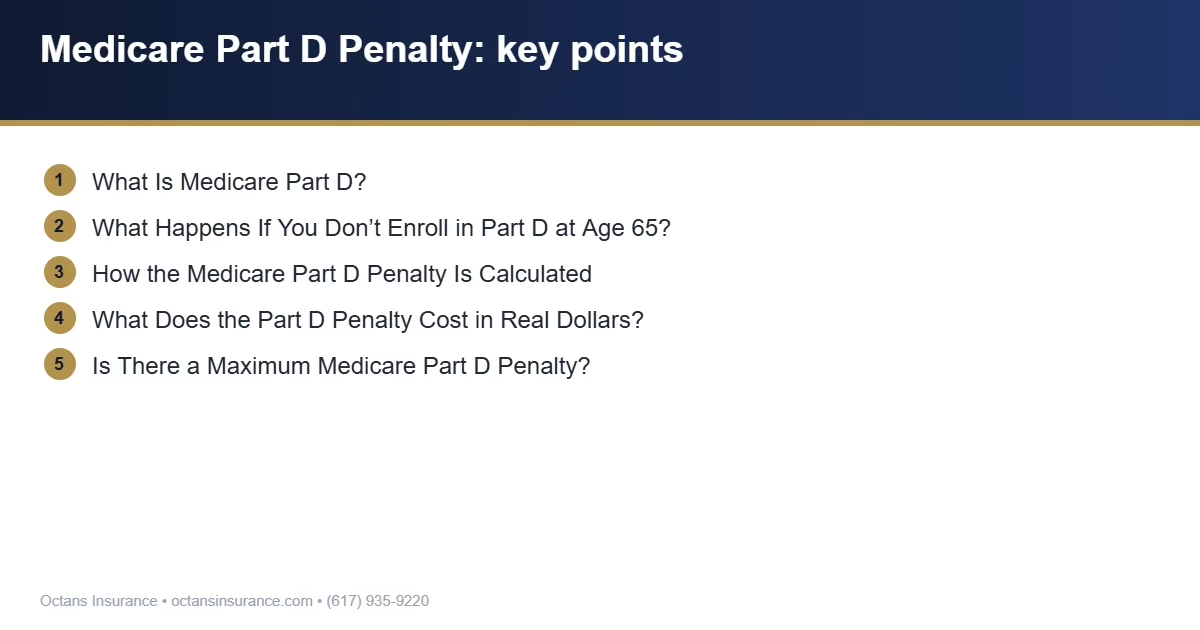
Table of Contents
An Octans Insurance Guide
Turning 65 comes with a flood of Medicare decisions—and Medicare Part D is one of the most misunderstood.
At Octans Insurance, we regularly speak with people who delayed Part D because they didn’t take prescriptions at the time. Unfortunately, many don’t realize that waiting can trigger a lifetime financial penalty.
In this guide, we explain exactly how the Medicare Part D penalty works, how much it costs in real dollars, and how to avoid paying more than you should.

What Is Medicare Part D?
Medicare Part D is optional prescription drug coverage offered through private insurance companies approved by Medicare.
While enrollment is optional, Medicare penalizes late enrollment unless you have qualifying drug coverage from another source.
What Happens If You Don’t Enroll in Part D at Age 65?
If you don’t enroll when first eligible and you don’t have creditable prescription drug coverage, Medicare applies a late-enrollment penalty.
The critical rule:
- Going 63 consecutive days or more without creditable coverage triggers the penalty
- The penalty is permanent once applied
- It is added to your Part D premium every month for life
How the Medicare Part D Penalty Is Calculated
Medicare uses a simple formula:
1% × the national base beneficiary premium × every full month delayed
Key points Octans Insurance wants you to know:
- The percentage grows the longer you wait
- There is no maximum cap
- The dollar amount can increase each year
- You pay it for as long as you have Part D
What Does the Part D Penalty Cost in Real Dollars?
Using the 2026 national base beneficiary premium of $38.99 a month, here’s what delaying looks like. These totals hold the 2026 amount flat for illustration; the real figure is recalculated each year.
3 Years Late (36 Months)
- Penalty: 36%
- Monthly cost: ~$14.00
- Annual cost: ~$168
- 20-year cost: ~$3,360
4 Years Late (48 Months)
- Penalty: 48%
- Monthly cost: ~$18.70
- Annual cost: ~$224
- 20-year cost: ~$4,488
10 Years Late (120 Months)
This is where the mistake becomes costly.
- Penalty: 120%
- Monthly cost: ~$46.80
- Annual cost: ~$562
- 10-year cost on Part D: ~$5,616
- 20-year cost: ~$11,232
⚠️ This is only the penalty—not the prescription plan itself.
Is There a Maximum Medicare Part D Penalty?
No. There is no maximum penalty percentage.
Examples:
- 15 years late → ~180% → ~$70.20/month in 2026 dollars
- 20 years late → ~240% → ~$93.60/month in 2026 dollars
The penalty continues increasing the longer enrollment is delayed.
When Can You Delay Part D Without a Penalty?
You may safely delay Part D if you have creditable prescription drug coverage, such as:
- Employer or union plans
- Retiree health coverage
- VA prescription benefits
- TRICARE
- Federal Employee Health Benefits (FEHB)
Most plans provide an annual notice confirming whether coverage is creditable.
Why Octans Insurance Often Recommends Enrolling at 65
Even for healthy individuals with no current prescriptions, enrolling in a $0 or low-premium Part D plan can:
- Prevent lifetime penalties
- Preserve future flexibility
- Protect against sudden prescription needs
- Cost less than penalties later
This is often a strategic financial decision, not a medical one.
What is the Medicare Part D penalty in 2026 dollars?
The penalty is based on the national base beneficiary premium. For 2026, that figure is $38.99, per Medicare.gov and CMS. Medicare takes 1% of that amount for each full month you went without coverage, then rounds to the nearest $0.10.
Rounding works in normal steps. For example, $9.36 rounds to $9.40, and $14.04 rounds to $14.00. Your plan will tell you the exact amount after you join.
The table below applies that official formula to the 2026 base premium. The 14-month row matches Medicare.gov’s own example. The other rows are our arithmetic using the same formula.
| Full months without coverage | Penalty percentage | Added to monthly premium (2026) | Added per year (2026) |
|---|---|---|---|
| 12 | 12% | $4.70 | $56.40 |
| 14 | 14% | $5.50 | $66.00 |
| 24 | 24% | $9.40 | $112.80 |
| 36 | 36% | $14.00 | $168.00 |
| 60 | 60% | $23.40 | $280.80 |
| 120 | 120% | $46.80 | $561.60 |
The penalty is added on top of your plan’s own premium. It is not part of the plan price, and it is the same no matter which plan you pick.
Hypothetical example: Say a Medicare Part D penalty of 24% stays at the 2026 amount of $9.40 a month. Over 20 years, that adds up to $2,256 ($9.40 x 12 months x 20 years). In real life, the dollar amount is recalculated each year as the base premium changes, so the true total could be higher or lower.
How are the uncovered months counted?
Only certain months count toward the penalty. According to Medicare.gov, a month counts when all of these are true:
- Your Initial Enrollment Period has already ended.
- You were eligible for Medicare drug coverage but did not have it.
- You also had no other creditable prescription drug coverage.
- The gap lasted 63 days or more in a row.
Medicare counts only full, uncovered months. Months when you had creditable coverage, such as qualifying drug coverage from a current employer, are not counted.
Hypothetical example: Sam’s Initial Enrollment Period ends, and he has no drug coverage of any kind. Exactly 14 full months later, he joins a Part D plan. He went far longer than 63 days without coverage, so all 14 months count. His penalty is 14% of the base premium, or $5.50 a month in 2026.
Now say Sam had creditable coverage from his job for 10 of those months. Only the 4 months without any coverage would count, as long as that gap was 63 days or more.
Hypothetical timeline: Rosa turns 65 in March 2026. Her Initial Enrollment Period runs from December 2025 through June 2026. She has no drug coverage and doesn’t join a plan. Her uncovered months start in July 2026. If her Part D coverage starts in January 2028, she has 18 uncovered months (July 2026 through December 2027). Using the 2026 base premium, her penalty would be 18% x $38.99 = $7.02, rounded to $7.00 a month.
How do you prove you had creditable coverage?
Creditable coverage is drug coverage that is expected to pay, on average, at least as much as standard Part D. If you had it, you should not owe a penalty for those months. But you may need to prove it.
Here is what Medicare.gov says to do:
- Keep your yearly notice. Your current plan must tell you each year whether its drug coverage is creditable. Save each one. Don’t send it to Medicare.
- Answer the plan’s letter. When you join a Medicare drug plan, it may send a letter asking whether you had creditable coverage. Fill it out and return it by the deadline. If you don’t, the plan won’t know about your other coverage, and you may be charged a penalty.
- Know what doesn’t count. Medicare.gov says doctor samples, discount cards and drug discount websites are not drug coverage.
Common sources of creditable coverage include a current or former employer or union, TRICARE, the VA and the Indian Health Service. Ask your benefits office before you change or drop any coverage.
How does the Medicare Part D penalty work if you’re still working?
Many people turn 65 while they still have drug coverage through a job. If that coverage is creditable, you can wait to join a Medicare drug plan without a penalty. Medicare.gov says this works as long as you don’t go more than 63 days without creditable drug coverage.
A few steps can help you stay protected:
- Check each yearly notice. Your plan must tell you every year whether its drug coverage is creditable. Coverage can change, so read every notice, not just the first one.
- Plan ahead for retirement. Find out the exact date your job coverage ends. The 63-day clock starts when your creditable coverage stops.
- Watch for changes at work. If your employer changes plans, ask whether the new drug coverage is still creditable.
- Keep your records. Store your notices where you can find them. A Medicare plan may ask about this coverage years later.
Medical coverage and drug coverage follow different rules. Having job-based health coverage does not by itself mean your drug coverage is creditable. Your benefits office can confirm.
Can you appeal a Medicare Part D penalty?
Yes. If you think your Medicare Part D penalty is wrong, you can ask for a review. This is called a reconsideration.
Here is how the process works, per CMS:
- Your Part D plan sends you a written notice when it first charges the penalty. It includes a reconsideration notice and a request form.
- You, or someone acting for you, complete and sign the form.
- You send it to the Independent Review Entity (IRE), a reviewer under contract with Medicare, as the form instructs.
- The IRE generally issues a decision within 90 calendar days of getting your request.
CMS says a review is only available in the situations listed on the form. Read the form closely to see which situations apply to you. If you had creditable coverage during any of the counted months, gather your yearly notices before you file. Follow the deadline printed on your notice, and send the form to the address it gives.
It helps to have these ready before you start:
- The penalty notice from your plan, with its date
- Copies of any yearly creditable coverage notices
- The names of past employers, unions or plans that gave you drug coverage
- The start and end dates of that coverage
Keep copies of everything you send. Write down the date you mailed or faxed the form.
Does Extra Help remove the Part D penalty?
Yes. Medicare.gov says you won’t have to pay a Part D late enrollment penalty while you get Extra Help. Extra Help is a federal program that lowers drug plan costs for people with limited income and resources.
You qualify for Extra Help automatically if you have any of these:
- Full Medicaid coverage
- Help from your state paying Part B premiums through a Medicare Savings Program
- Supplemental Security Income (SSI)
If you qualify automatically and don’t have a drug plan, Medicare will enroll you in one. If you don’t qualify automatically, you can apply through Social Security. Note that Extra Help is not available in Puerto Rico, the U.S. Virgin Islands, Guam, the Northern Mariana Islands or American Samoa. You can also get help from your State Health Insurance Assistance Program.
Medicare Savings Programs have their own income limits. For 2026, the most generous program, QI, has a limit of $1,816 a month for one person and $2,455 for a couple, per Medicare.gov. Some states use looser rules, so it is worth applying even if you are close.
Does the penalty follow you if you switch plans?
Yes. Medicare.gov says the penalty is added to your premium for as long as you have Medicare drug coverage, even if you switch plans. Changing drug plans during Open Enrollment does not reset it.
The same is true if you get your drug coverage through a Medicare Advantage plan. Most of these plans include Part D, so the penalty is added to that plan’s premium instead.
The dollar amount can also change from year to year. That’s because it is tied to the national base beneficiary premium, which may go up each year. CMS has already set the 2027 base premium at $41.33, per its July 28, 2026 announcement.
Example using the official formula: A 24% penalty is $9.40 a month in 2026. In 2027, the same 24% becomes about $9.90 a month (0.24 x $41.33 = $9.92, rounded to the nearest $0.10). Your percentage stays the same. The dollar amount moves with the base premium.
Can the penalty ever stop? For most people, it does not. Medicare.gov describes late penalties as lasting as long as you have that coverage, which for most people means a lifetime penalty. The main exception is Extra Help. You don’t pay the Part D penalty while you get Extra Help, as explained above.
How does the Part D penalty compare with Part A and Part B penalties?
Each part of Medicare has its own late penalty, and the math is different for each one. Here is a side-by-side view based on Medicare.gov’s penalty page:
| Part | How the penalty grows | How long it lasts | Common ways to avoid it |
|---|---|---|---|
| Part A (only if you must buy it) | Premium may go up 10% | Twice the number of years you didn’t sign up | Qualify for a Special Enrollment Period |
| Part B | 10% for each full 12-month period without Part B | As long as you have Part B, for most people | Special Enrollment Period or a Medicare Savings Program |
| Part D | 1% of the base premium per month (12% a year) | As long as you have Medicare drug coverage | Creditable coverage or Extra Help |
The Part D penalty is often smaller in dollars than the Part B penalty. Medicare.gov’s 2026 example shows a 24-month Part B delay raising the premium to about $243.50 a month. But both can last for years.
Because the rules differ, it helps to check all three parts at once when you turn 65 or when job coverage ends. Write down when your Initial Enrollment Period ends, when any job coverage stops, and whether your drug coverage is creditable. Those three dates and facts decide most penalty questions.
Higher earners should also know that the Part D penalty is separate from the income-related amount (IRMAA). In 2026, IRMAA adds $14.50 to $91.00 a month to Part D premiums for incomes above $109,000 (single) or $218,000 (joint), per CMS. If you are still working, see our guide to working and Medicare.
The Bottom Line from Octans Insurance
Delaying Medicare Part D without creditable coverage can cost thousands of dollars over your lifetime—often unnecessarily.
At Octans Insurance, our role is to:
- Review your current coverage
- Confirm whether it’s creditable
- Help you avoid penalties
- Design the most cost-effective Medicare strategy
Need Help with Medicare Decisions?
Every situation is unique. A short review can help determine:
- Whether you should enroll now
- Whether you qualify for a Special Enrollment Period
- How to minimize or avoid penalties
Octans Insurance works with individuals, families, and retirees to simplify Medicare and protect long-term financial health.
Not affiliated or endorsed by Medicare or any government agency.
For more information – https://www.medicare.gov/health-drug-plans/part-d
Keep Reading: Related Guides
- What you can change during Medicare annual enrollment
- How and when to change Medicare plans
- Medicare deductibles explained
Medicare Part D Penalty: Frequently Asked Questions
How is the Medicare Part D penalty calculated?
The Medicare Part D penalty is 1% of the national base beneficiary premium ($38.99 in 2026) for each full month you went without creditable drug coverage. For example, 24 months without coverage adds about $9.40 per month, and the penalty usually lasts as long as you have Part D.
How can I avoid the Medicare Part D penalty?
Enroll in a Part D plan or Medicare Advantage plan with drug coverage when you are first eligible, or keep creditable drug coverage from an employer or union. A gap of 63 or more days without creditable coverage triggers the Medicare Part D penalty.
Medicare Part D Penalty: Next Steps With a Licensed Agent
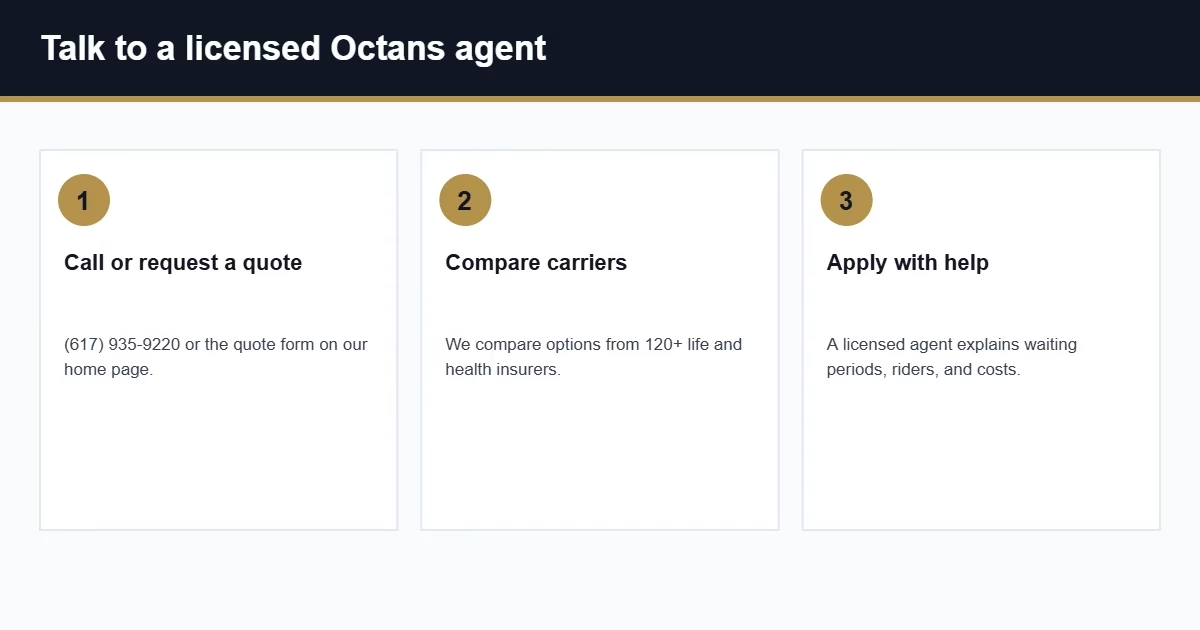
Questions about medicare part d penalty usually depend on your age, health, state, and budget. A licensed Octans agent can review your situation, compare options from more than 120 carriers, and explain the trade-offs before you decide. Call (617) 935-9220 or request a free quote.

Related guides
We do not offer every plan available in your area. Please contact Medicare.gov or 1-800-MEDICARE to get information on all of your options.
Sources: Medicare.gov; Centers for Medicare & Medicaid Services. This article is for general information and is not tax, legal, or medical advice.