
Medicare Coverage
Does Medicare Cover Hyperbaric Oxygen Therapy? Conditions and Costs
Does Medicare cover hyperbaric oxygen therapy? Part B pays for chamber treatment only for a fixed list of conditions, and serious diabetic foot wounds must first fail a month of standard care.
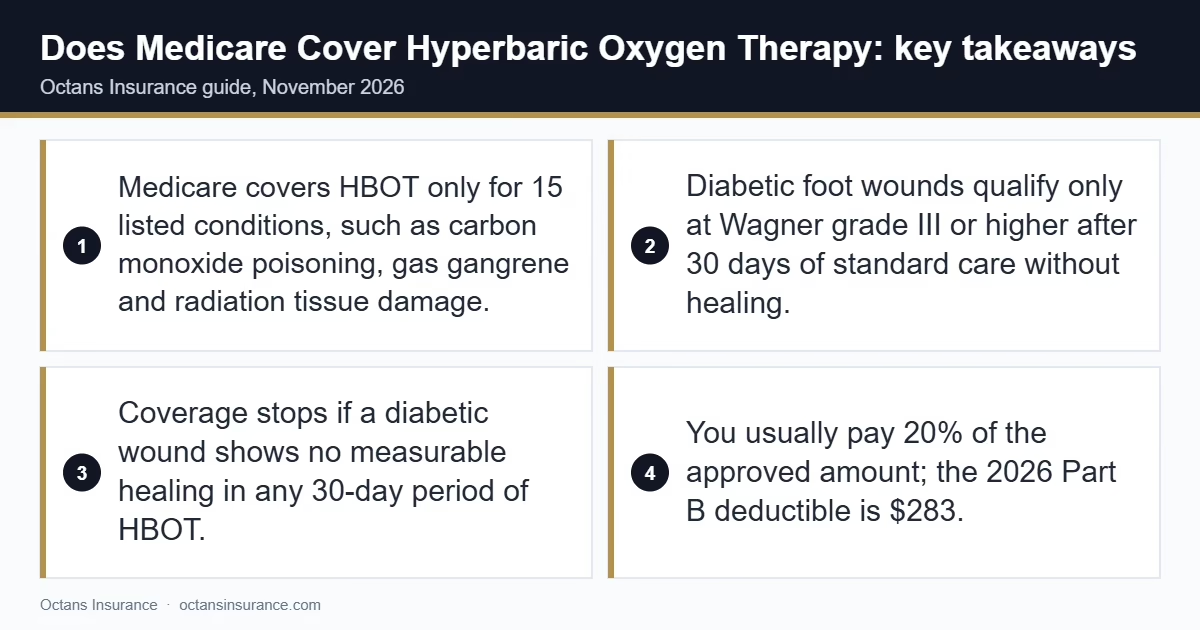
- Medicare covers HBOT only for 15 listed conditions, such as carbon monoxide poisoning, gas gangrene and radiation tissue damage.
- Diabetic foot wounds qualify only at Wagner grade III or higher after 30 days of standard care without healing.
- Coverage stops if a diabetic wound shows no measurable healing in any 30-day period of HBOT.
- You usually pay 20% of the approved amount; the 2026 Part B deductible is $283.
Table of Contents
Make sure your family is financially protected today!
Does Medicare cover hyperbaric oxygen therapy? Yes, but only for a set list of 15 conditions, such as carbon monoxide poisoning, decompression illness, radiation injury and certain serious diabetic foot wounds. The therapy must be given in a chamber. Medicare doesn’t pay for hyperbaric oxygen for any other condition. You usually pay 20% after the Part B deductible.
When does Medicare cover hyperbaric oxygen therapy?
Hyperbaric oxygen therapy (HBOT) exposes your whole body to oxygen under increased air pressure. Medicare.gov’s HBOT page says Part B may cover it if you get the therapy in a chamber, including a one-person unit, and you have one of these conditions:
- Acute carbon monoxide intoxication
- Decompression illness
- Gas embolism
- Gas gangrene
- Acute traumatic peripheral ischemia (low blood flow from an injury)
- Crush injuries and suturing of severed limbs
- Progressive necrotizing infections, such as necrotizing fasciitis
- Acute peripheral arterial insufficiency
- Preparation and preservation of compromised skin grafts
- Chronic refractory osteomyelitis (bone infection) that hasn’t responded to standard medical and surgical care
- Osteoradionecrosis (bone damage from radiation), along with standard treatment
- Soft tissue radionecrosis, along with standard treatment
- Cyanide poisoning
- Actinomycosis, only with standard therapy when antibiotics and surgery haven’t worked
- Diabetic wounds of the lower legs and feet that meet three criteria (next section)
These are the hyperbaric oxygen therapy Medicare criteria from national coverage determination 20.29. It was last reviewed in April 2017 and still applies as of November 2026. For several conditions, such as injury-related ischemia and crush injuries, the NCD treats HBOT as an add-on to standard care when loss of function, limb or life is threatened.
Skin graft coverage has a limit too. HBOT can help prepare or preserve a graft, but not as the main treatment for a wound.
If your diagnosis isn’t on this list, the answer to “does Medicare cover hyperbaric oxygen therapy?” is no, even if a doctor recommends it.
Does Medicare cover hyperbaric oxygen therapy for diabetic wounds?
Yes, in limited cases. Medicare hyperbaric oxygen therapy for wound care is covered only for diabetic wounds of the lower extremities when all three of these are true:
- You have type 1 or type 2 diabetes, and the leg or foot wound is due to diabetes.
- The wound is classified as Wagner grade III or higher.
- You’ve failed an adequate course of standard wound therapy.
These hyperbaric oxygen therapy Medicare criteria are strict. “Failed” has a specific meaning. The NCD says HBOT is covered only after there are “no measurable signs of healing for at least 30 days” of standard wound therapy. HBOT must be added to standard wound care, not used instead of it.
Standard wound care, per the NCD, includes:
- Checking blood flow in the leg and fixing vascular problems if possible
- Improving nutrition and blood sugar control
- Removing dead tissue (debridement)
- Keeping a clean, moist wound bed with the right dressings
- Taking pressure off the wound (off-loading)
- Treating any infection
Coverage needs regular check-ins. Your wound must be evaluated at least every 30 days during HBOT. If it shows no measurable healing in any 30-day period of treatment, Medicare stops covering more sessions.
For the rest of your diabetes benefits, including foot exams and therapeutic shoes, see our Medicare diabetes coverage guide.

Which conditions doesn’t Medicare cover HBOT for?
NCD 20.29 says all other uses are not covered and “no program payment may be made” for conditions not on the covered list. It also names 22 conditions specifically. Some of the ones people ask about most:
| Condition | Medicare HBOT coverage |
|---|---|
| Pressure ulcers (bedsores), stasis ulcers and other skin ulcers | Not covered |
| Chronic poor circulation in the legs (chronic peripheral vascular insufficiency) | Not covered |
| Thermal skin burns | Not covered |
| Heart attack and cardiogenic shock | Not covered |
| Alzheimer’s disease and other non-vascular chronic brain syndromes | Not covered |
| Multiple sclerosis | Not covered |
| Arthritic diseases | Not covered |
| Sickle cell anemia | Not covered |
| Pulmonary emphysema | Not covered |
| Acute cerebral edema and cerebral vascular insufficiency | Not covered |
| Diabetic foot wound, Wagner grade III or higher, after 30 days of failed standard care | Covered as an add-on to standard care |
Source: CMS NCD 20.29, Hyperbaric Oxygen Therapy (Rev. 203, effective April 3, 2017), as of November 2026.
The NCD also lists senility, smoke inhalation lung damage, organ transplantation, tetanus, liver necrosis and several kinds of infection as non-covered. Topical oxygen applied to a wound is a different treatment. The NCD leaves its coverage for chronic non-healing wounds to your regional Medicare contractor.
Does Medicare pay for hyperbaric oxygen therapy in full?
No. Does Medicare pay for hyperbaric oxygen therapy at 100%? Medicare.gov says you usually pay 20% of the Medicare-approved amount, and the Part B deductible may apply. That deductible is $283 in 2026, per the CMS 2026 fact sheet.
If your treatment is a series of sessions, your share repeats with each one. If you get HBOT in a hospital outpatient department, you usually pay the hospital a copayment for each service. In most cases, that copayment can’t be more than the Part A deductible, per Medicare.gov. Ask the center how it bills before you start.
What could a course of HBOT cost? A worked example
Hypothetical example: Walter, 71, has type 2 diabetes and a Wagner grade III foot wound. It showed no healing after 30 days of standard wound care. His doctor orders 20 HBOT sessions. Assume the Medicare-approved amount is $250 per session. That number is made up for this example. Walter hasn’t paid his 2026 Part B deductible yet.
- Total approved for 20 sessions: 20 × $250 = $5,000.
- Part B deductible: $283.
- Amount left: $5,000 − $283 = $4,717.
- His 20% coinsurance: 20% × $4,717 = $943.40.
- Walter’s total share: $283 + $943.40 = $1,226.40.
This is a simplified estimate using Medicare.gov’s 20% rule. Hospital-based centers bill differently, and doctor visits and wound care are extra. If Walter’s wound stops improving in a 30-day stretch, Medicare stops paying for more sessions.
Does Medicare cover hyperbaric oxygen therapy in Medicare Advantage?
Medicare Advantage plans “must cover all medically necessary services that Original Medicare covers,” the Medicare & You 2027 handbook says. So the same covered-conditions list applies. But:
- The plan may require approval (prior authorization) before treatment starts.
- You may need to use a wound center in the plan’s network.
- Your copays or coinsurance follow the plan’s rules, and the plan’s yearly out-of-pocket limit caps your costs for covered services.
With Original Medicare, a Medicare Supplement (Medigap) plan can help pay your 20% coinsurance, which adds up over many sessions. Our Medicare Advantage vs Medigap guide compares how each handles repeated outpatient care.
How to get hyperbaric oxygen therapy covered
Medicare hyperbaric oxygen therapy for wound care needs the most documentation, so most of these steps focus on it.
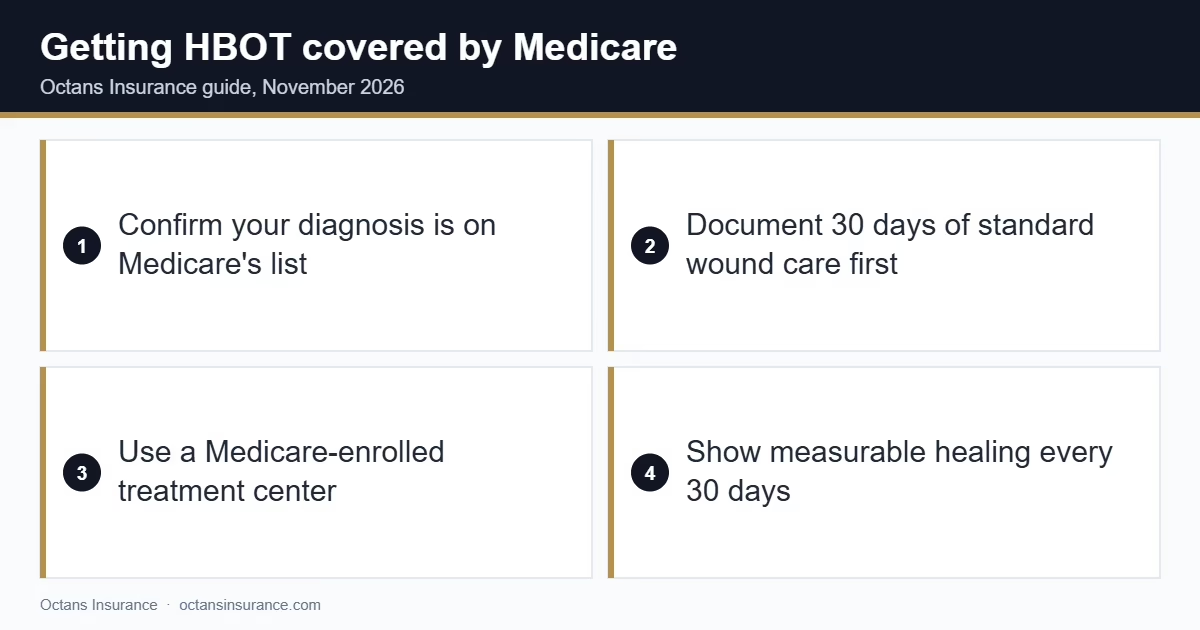
- Confirm your diagnosis is on the list. Ask your doctor which of the 15 covered conditions applies.
- For a diabetic wound, document standard care first. Make sure your records show at least 30 days of standard wound care with no measurable healing, and the Wagner grade.
- Choose a Medicare-enrolled center. Ask if it’s hospital-based and whether its doctors accept assignment.
- Get plan approval if needed. In Medicare Advantage, confirm prior authorization and network rules.
- Keep up with standard care during HBOT. Dressings, off-loading and blood sugar control still matter.
- Track your 30-day evaluations. Ask your doctor to document measurable healing at each one.
Questions to ask the wound care center
- Which covered condition will you list on my claims, and do my records meet the hyperbaric oxygen therapy Medicare criteria for it?
- For a diabetic wound, do my records show the Wagner grade and 30 days of failed standard care?
- Is this center part of a hospital? Will I owe a copayment for each session?
- How many sessions do you expect, and what will each cost me?
- Who reviews my wound every 30 days, and what happens if healing stalls?
- Do you need prior authorization from my Medicare Advantage plan?
Does Medicare cover hyperbaric oxygen therapy: frequently asked questions
Does Medicare cover hyperbaric oxygen therapy for radiation damage?
Yes, for two radiation injuries. Medicare covers HBOT for osteoradionecrosis, which is bone damage from radiation, and soft tissue radionecrosis. In both cases it’s covered as an add-on to conventional treatment, not on its own. Ask your doctor to document the diagnosis. Our Medicare cancer treatment guide explains other cancer-related benefits.
Does Medicare cover hyperbaric oxygen therapy for bedsores?
No. Medicare’s national coverage determination lists decubitus ulcers (bedsores), along with cutaneous and stasis ulcers, as conditions where no program payment may be made for HBOT. The only wound category on the covered list is diabetic wounds of the lower extremities that meet the Wagner grade and failed-care rules. Ask your doctor about other covered wound treatments.
How long will Medicare pay for HBOT for a diabetic wound?
There’s no fixed number of sessions in the national rules. Instead, your wound must be evaluated at least every 30 days during treatment. Medicare stops covering HBOT if the wound doesn’t show measurable signs of healing within any 30-day period. Ask your doctor to document healing at each evaluation so coverage can continue.
Is hyperbaric oxygen therapy the same as home oxygen?
No. HBOT is given in a pressurized chamber at a treatment center for specific conditions. Home oxygen equipment is durable medical equipment you use at home, and Medicare covers it under different rules. See our guide to whether Medicare covers oxygen for those rules.
Does Medicare cover HBOT for conditions not on the list?
No. National coverage determination 20.29 says all other uses are not covered and no program payment may be made for conditions other than those listed. If a clinic offers HBOT for an unlisted condition, expect to pay the full cost yourself. Ask for a written estimate before you agree to treatment.
Does Medicare cover hyperbaric oxygen therapy for burns?
No. NCD 20.29 lists thermal skin burns among the conditions where no program payment may be made for HBOT. Smoke inhalation lung damage is also on the non-covered list. If a burn center suggests HBOT, ask your doctor what other covered treatments fit, and get a written cost estimate before any session.

How a licensed Octans agent can help
Does Medicare pay for hyperbaric oxygen therapy the same way in every plan? The covered conditions are the same, but your costs aren’t. A course of HBOT can mean many sessions, each with its own cost. A licensed Octans agent can compare Medicare Supplement and Medicare Advantage options from the carriers we work with and explain how each handles repeated outpatient treatment. Call (617) 935-9220.
For free, unbiased counseling, contact your State Health Insurance Assistance Program (SHIP) at shiphelp.org, or call 1-800-MEDICARE (1-800-633-4227). TTY users can call 1-877-486-2048. For medical questions about your wound or condition, talk with your doctor.
Keep Reading: Related Guides
- Medicare diabetes coverage
- Does Medicare cover oxygen?
- Medicare cancer treatment coverage
- Does Medicare Cover Foot Care? Podiatry, Nails and Diabetic Shoes
We do not offer every plan available in your area. Please contact Medicare.gov or 1-800-MEDICARE to get information on all of your options.
This article is for general information and is not tax, legal, or medical advice.
About examples and tools: Hypothetical examples, sample rates, calculators and quizzes on this site are for general educational and illustrative purposes only. They are not quotes, offers of coverage, or guarantees of eligibility, approval, price or benefits, and they are not legal, tax, financial or medical advice. The insurance company decides eligibility and price; Medicare rules are set by CMS and the Social Security Administration. Octans Insurance is not connected with or endorsed by the U.S. government or the federal Medicare program.
Plan for the cost of repeated treatments
Start with a free, no-obligation quote review with a licensed Octans agent.
(617) 935-9220 | life@octansinsurance.com