
Medicare Coverage
Does Medicare Cover Lab Tests? Blood Work, Screenings and Costs
Does Medicare cover lab tests like blood work and urinalysis? Learn when tests cost $0, which screening blood tests are covered, how often Medicare pays and what an ABN means for you.
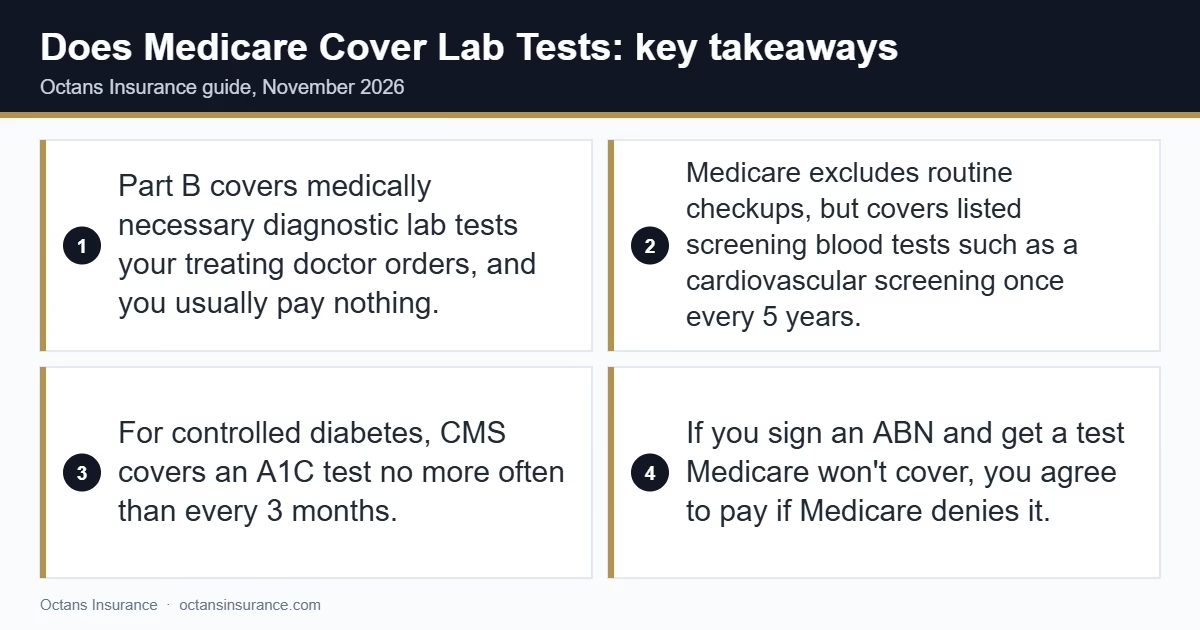
- Part B covers medically necessary diagnostic lab tests your treating doctor orders, and you usually pay nothing.
- Medicare excludes routine checkups, but covers listed screening blood tests such as a cardiovascular screening once every 5 years.
- For controlled diabetes, CMS covers an A1C test no more often than every 3 months.
- If you sign an ABN and get a test Medicare won’t cover, you agree to pay if Medicare denies it.
Table of Contents
Make sure your family is financially protected today!
Does Medicare cover lab tests? Yes. Part B covers medically necessary diagnostic lab tests, such as blood tests and urinalysis, when your provider orders them, and you usually pay nothing. Part B also covers some screening blood tests, which cost $0 if your provider accepts assignment. You may have to pay for tests Medicare doesn’t cover, such as blood work done only as part of a routine checkup.
Does Medicare cover lab tests your doctor orders?
Yes, when they’re medically necessary. Medicare.gov says diagnostic lab tests look for changes in your health and help your provider diagnose or rule out a suspected illness or condition. They may include certain blood tests, urinalysis and certain tests on tissue specimens.
Does Medicare pay for blood work your doctor orders? Usually in full. Medicare.gov says you usually pay nothing for Medicare-covered diagnostic lab tests. Medicare & You adds that you generally pay nothing when you get them from a laboratory, pharmacy, doctor or hospital that accepts assignment. That’s different from most Part B services, where you pay 20% of the approved amount.
One rule matters more than people expect. Under 42 CFR 410.32, a diagnostic lab test must be ordered by the doctor who is treating you for a specific medical problem and who uses the results to manage it. Tests not ordered that way aren’t considered reasonable and necessary, so Medicare won’t pay for blood work you order for yourself.
Does Medicare pay for yearly blood work?
Only in certain cases. Does Medicare pay for yearly blood work as part of a routine physical? No. Federal rules at 42 CFR 411.15 exclude routine physical checkups, meaning exams done for a reason other than treating or diagnosing a specific illness, symptom, complaint or injury.
That rule has exceptions written into it, including cardiovascular disease screening tests, diabetes screening tests and prostate cancer screening tests. Medicare also covers blood work to diagnose a new problem or to monitor a condition you already have, such as diabetes, high cholesterol or kidney disease, when your doctor orders it.
So the answer to “does Medicare cover blood work every year?” depends on why it’s ordered. Blood work tied to a diagnosis or a covered screening is usually covered, and you pay $0. A general panel “just to check” may not be. Your yearly wellness visit is a planning visit; ask your doctor which tests, if any, they’ll order and why.
Does Medicare cover lab tests for screening?
Yes, for a set list. Medicare covers several screening blood tests even when you have no symptoms. You pay nothing for these if your provider accepts assignment.
| Screening test | Who’s eligible | How often | Your cost |
|---|---|---|---|
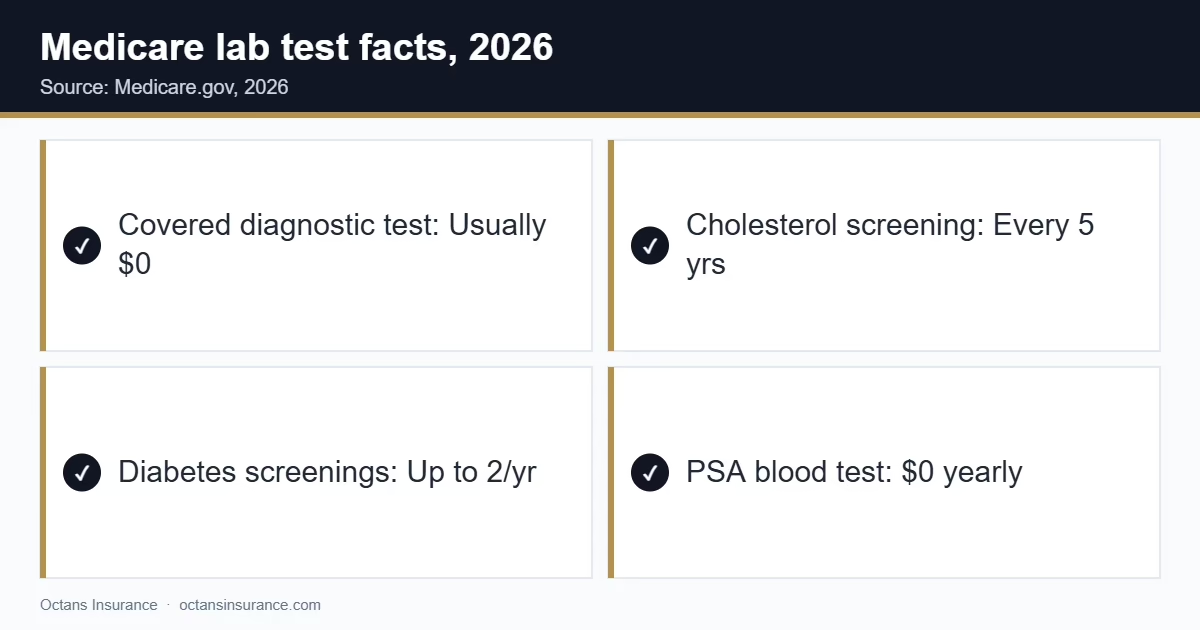
| Cardiovascular screening (cholesterol, lipid and triglyceride blood tests) | People with Part B | Once every 5 years | $0 if the provider accepts assignment |
| Diabetes screening (fasting or non-fasting glucose, A1C or other approved glucose tests) | People at risk for diabetes, based on listed risk factors | Up to 2 a year | $0 if the provider accepts assignment |
| Prostate cancer screening (PSA blood test) | Men over 50 | Once every 12 months | $0 for the PSA test |
| Hepatitis C screening | People at high risk, or born between 1945 and 1965, with a primary care order | Once, or once a year if at continued high risk | $0 if the provider accepts assignment |
| Blood-based biomarker test for colorectal cancer | Ages 45 to 85, at average risk, with no symptoms | Once every 3 years | $0 if the provider accepts assignment |
Source: Medicare.gov preventive and screening coverage pages. Checked November 6, 2026.
The diabetes screening has its own risk list. You qualify with one factor, such as high blood pressure, obesity, a history of abnormal cholesterol and triglyceride levels, or a history of high blood sugar. You also qualify with 2 or more of these: being 65 or older, being overweight, having a family history of diabetes, or having a history of gestational diabetes or delivering a baby weighing more than 9 pounds. For people who already have diabetes, our Medicare diabetes coverage guide explains supplies and monitoring.
Does Medicare cover lab tests as often as your doctor orders them?
Usually, as long as they’re medically necessary, but some tests have national limits. CMS sets national coverage rules for many common lab tests in its National Coverage Determinations Manual, including glycated hemoglobin (A1C), thyroid and lipid tests.
The A1C rule is a clear example. For a person whose diabetes is under control, CMS says testing more often than every 3 months isn’t considered reasonable and necessary. If your diabetes isn’t controlled, more than 4 tests a year may be needed, and your medical record must support the extra tests.
If your doctor orders a test more often than these rules allow, Medicare may deny it. That’s where the Advance Beneficiary Notice comes in.
When might you pay for a lab test?
Does Medicare cover lab tests in every case? No. You usually pay nothing for a covered test, but there are exceptions. You may pay when the test isn’t covered, when it’s done more often than Medicare allows, or when it’s part of a routine checkup.
If you have Original Medicare and your provider or lab thinks Medicare won’t pay, Medicare & You says it may give you a written notice called an Advance Beneficiary Notice of Non-coverage (ABN). The ABN lists the tests, an estimate of the cost and the reasons Medicare may not pay. Here’s what it means for you:
- You choose whether to get the tests listed on the notice.
- If you get them, you agree to pay if Medicare doesn’t.
- An ABN isn’t an official denial. You can still appeal once you get your Medicare Summary Notice.
- If your provider was required to give you the notice but didn’t, in most cases it must refund what you paid.
The visit where the doctor orders the test is billed separately. You pay 20% of the Medicare-approved amount for the visit after the Part B deductible, which is $283 in 2026, per the CMS 2026 fact sheet. Non-lab tests, such as X-rays, MRIs and EKGs, also cost 20% after the deductible.
Does Medicare pay for blood work in full?
For covered diagnostic tests, usually yes: your share is $0 and Medicare pays the lab from a national fee schedule. CMS’s Clinical Laboratory Fee Schedule page says it pays for most clinical diagnostic lab tests based on the weighted median of private payor rates, and it usually updates those rates every 3 years.
Hypothetical example: Pat, 70, has Original Medicare and type 2 diabetes that’s under control. In 2026, her doctor orders an A1C test every 3 months, 4 tests in all. She pays $0 for the covered tests. She also has 4 office visits, and the Medicare-approved amount is $130 each (an assumed figure for illustration), or $520 in total. She pays the $283 deductible, then 20% of the remaining $237, which is $47.40. Her total for the year is $330.40, all for visits, not tests.
Lab tests with Medigap or Medicare Advantage
Because covered lab tests usually cost $0 under Original Medicare, a Medigap policy rarely has anything to pay for the tests themselves. It helps with the visits around them. Plans A, B, C, D, F, G, M and N pay 100% of the Part B coinsurance, Plan K pays 50% and Plan L pays 75%. With Plan N, you may owe up to $20 for some office visits.
Medicare Advantage plans must cover all medically necessary services that Original Medicare covers, but they may require you to use labs in the plan’s network or get prior authorization for certain services, according to Medicare’s guide to these plans. Check which labs are in network before your blood draw.
How to get your lab tests covered
Does Medicare cover blood work automatically? Only when the coverage rules are met. These steps help.
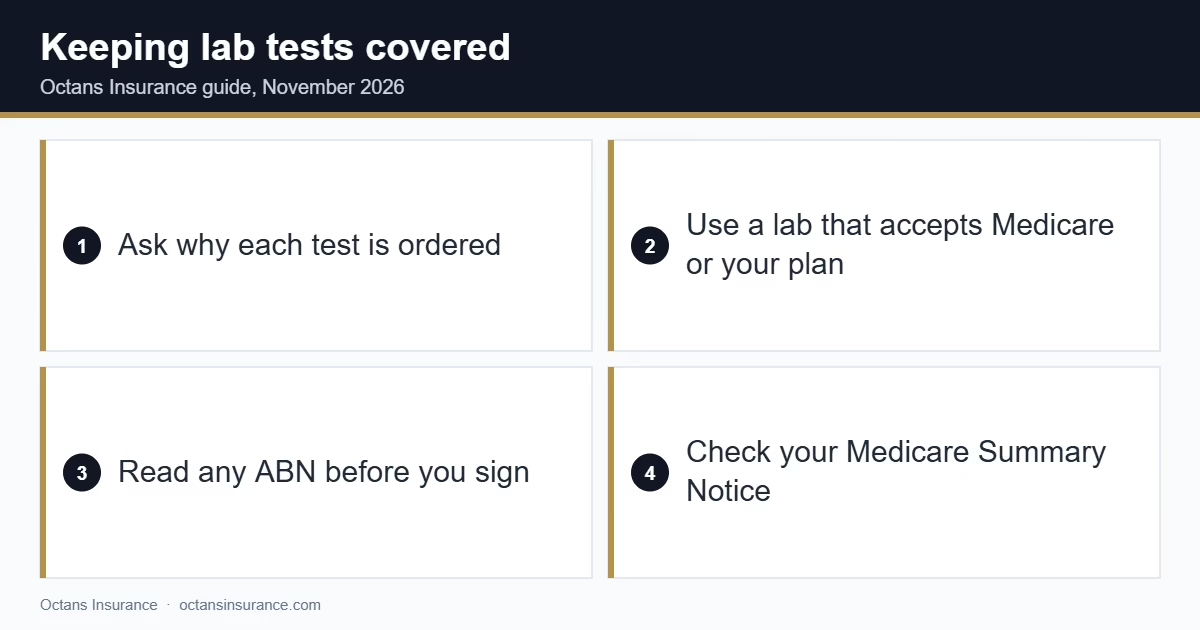
- Ask your doctor why each test is ordered: to diagnose a problem, to monitor a condition or as a covered screening.
- Use a lab that accepts Medicare assignment, or one in your plan’s network if you have Medicare Advantage.
- Bring the order from your treating doctor. Medicare won’t pay for a test you request on your own.
- Read any ABN before you sign it, and ask whether a covered alternative exists.
- Check your Medicare Summary Notice. Covered diagnostic tests should usually show $0 for you.
- Appeal any denial you think is wrong by the date on the notice.
Questions to ask your doctor about blood work:
- Is this test diagnostic, monitoring or a screening?
- Is it done more often than Medicare’s limits allow?
- Does the lab accept Medicare assignment?
- Will I be asked to sign an ABN for any test today?
Medicare lab tests: frequently asked questions
Does Medicare cover blood work at an independent lab?
Yes. Medicare covers blood work at an independent lab if the test is medically necessary and ordered by your treating doctor. You generally pay nothing for covered lab tests from a laboratory, pharmacy, doctor or hospital that accepts assignment. If you have Medicare Advantage, use a lab in your plan’s network. Medicare won’t pay for a test your treating doctor didn’t order.
Does Medicare pay for blood work once a year?
Medicare doesn’t pay for yearly blood work as part of a routine checkup, which Medicare excludes. It does cover blood work your doctor orders to diagnose or monitor a condition, plus listed screenings such as a cardiovascular blood test once every 5 years and diabetes screenings up to twice a year if you’re at risk. Covered tests usually cost you nothing.
Does Medicare pay for a PSA blood test?
Yes, for screening. Men over 50 can get a PSA blood test once every 12 months, and you pay nothing for the test itself. If the provider doesn’t accept assignment, you may owe a fee for the doctor’s services, but not for the test. A digital rectal exam, by contrast, costs 20% after the deductible.
Does Medicare cover a blood test for colon cancer?
Yes, in some cases. Medicare covers a blood-based biomarker screening test once every 3 years if you’re 45 to 85, have no symptoms and are at average risk. You pay nothing if the provider accepts assignment. If the result is positive, Medicare also covers a follow-up colonoscopy as a screening test.
What is an ABN for a lab test?
An Advance Beneficiary Notice of Non-coverage is a form a lab or provider may give you under Original Medicare when it thinks Medicare won’t pay. It lists the tests, the estimated cost and the reason. If you sign and get the tests, you agree to pay if Medicare doesn’t. It isn’t a denial, and you can still appeal.

How a licensed Octans agent can help
Does Medicare cover lab tests the same way in every plan? The coverage rules are the same, but lab networks and visit copays aren’t. A licensed Octans agent can show you how Medigap plans and the Medicare Advantage plans in your area handle office visits, lab networks and prior authorization, which matters if you have regular monitoring tests.
Octans is an independent agency and isn’t connected with Medicare or any government agency. For free, unbiased counseling, contact your State Health Insurance Assistance Program (SHIP). For questions about a lab claim or an ABN, call 1-800-MEDICARE (1-800-633-4227; TTY 1-877-486-2048). To talk with an Octans agent, call (617) 935-9220.
Keep Reading: Related Guides
- Medicare annual wellness visit
- Medicare diabetes coverage
- What Original Medicare covers
- Does Medicare Cover Colonoscopy? Screening Rules and Costs
- Medicare Part B
- Does Medicare Cover Urgent Care? Costs, Networks and Travel
- Does Medicare Cover MRI Scans?
We do not offer every plan available in your area. Please contact Medicare.gov or 1-800-MEDICARE to get information on all of your options.
This article is for general information and is not tax, legal, or medical advice.
About examples and tools: Hypothetical examples, sample rates, calculators and quizzes on this site are for general educational and illustrative purposes only. They are not quotes, offers of coverage, or guarantees of eligibility, approval, price or benefits, and they are not legal, tax, financial or medical advice. The insurance company decides eligibility and price; Medicare rules are set by CMS and the Social Security Administration. Octans Insurance is not connected with or endorsed by the U.S. government or the federal Medicare program.
Compare visit and lab costs across plans
Start with a free, no-obligation quote review with a licensed Octans agent.
(617) 935-9220 | life@octansinsurance.com