
Medicare costs
Medicare Savings Program: 2026 Limits, Levels, and How to Apply
A Medicare Savings Program is run by your state and pays Medicare premiums, and sometimes deductibles and coinsurance, for people with limited income and savings. Here are the four levels, the 2026 federal limits from CMS, and how to apply, renew, and check your status.
- Four levels (QMB, SLMB, QI, and QDWI) pay different Medicare costs, and your state picks the level when you apply.
- 2026 federal income limits for one person run from $1,350 a month (QMB) to $1,816 (QI), with a $9,950 resource limit.
- QMB, SLMB, and QI pay the $202.90 monthly Part B premium and automatically qualify you for Extra Help with drug costs.
- You apply through your state Medicaid agency at any time, and states review eligibility at least once every 12 months.
Table of Contents
Make sure your family is financially protected today!
A Medicare Savings Program (MSP) is a state-run program that pays some or all of your Medicare costs if your income and savings are limited. For 2026, a single person can have up to $1,816 a month in income and $9,950 in resources under the federal limits, and some states allow more. Depending on the level, your state pays your Part B premium of $202.90 a month, your Part A premium if you owe one, and in some cases your Medicare deductibles and coinsurance.
What is a Medicare Savings Program?
MSPs are mandatory Medicaid eligibility groups, according to MACPAC, the commission that advises Congress on Medicaid. Your state Medicaid agency runs them, decides who qualifies, and helps pay your Medicare premiums and, for some people, other Medicare costs.
An MSP isn’t the same as full Medicaid. It pays Medicare costs only. Some people qualify for both full Medicaid and an MSP, and others qualify for an MSP alone.
The four Medicare Savings Program levels
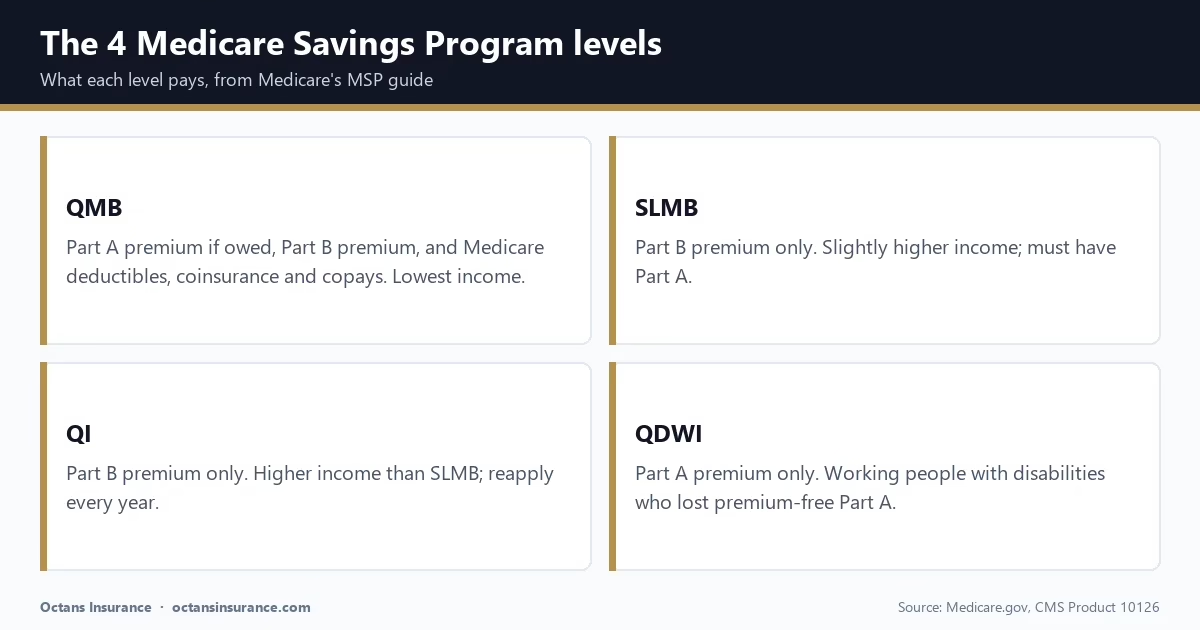
Federal law sets four levels. When you apply, your state decides which one fits your income, so you don’t have to pick.
| Level | What it pays | Who it’s for |
|---|---|---|
| QMB (Qualified Medicare Beneficiary) | Part A premium if owed, Part B premium, and Medicare deductibles, coinsurance, and copayments | Lowest income |
| SLMB (Specified Low-Income Medicare Beneficiary) | Part B premium only | Slightly higher income; must have Part A |
| QI (Qualifying Individual) | Part B premium only | Higher income than SLMB; must reapply every year |
| QDWI (Qualified Disabled and Working Individuals) | Part A premium only | Working people with disabilities who lost premium-free Part A |
Source: Medicare.gov, Medicare Savings Programs.
2026 Medicare Savings Program income and resource limits
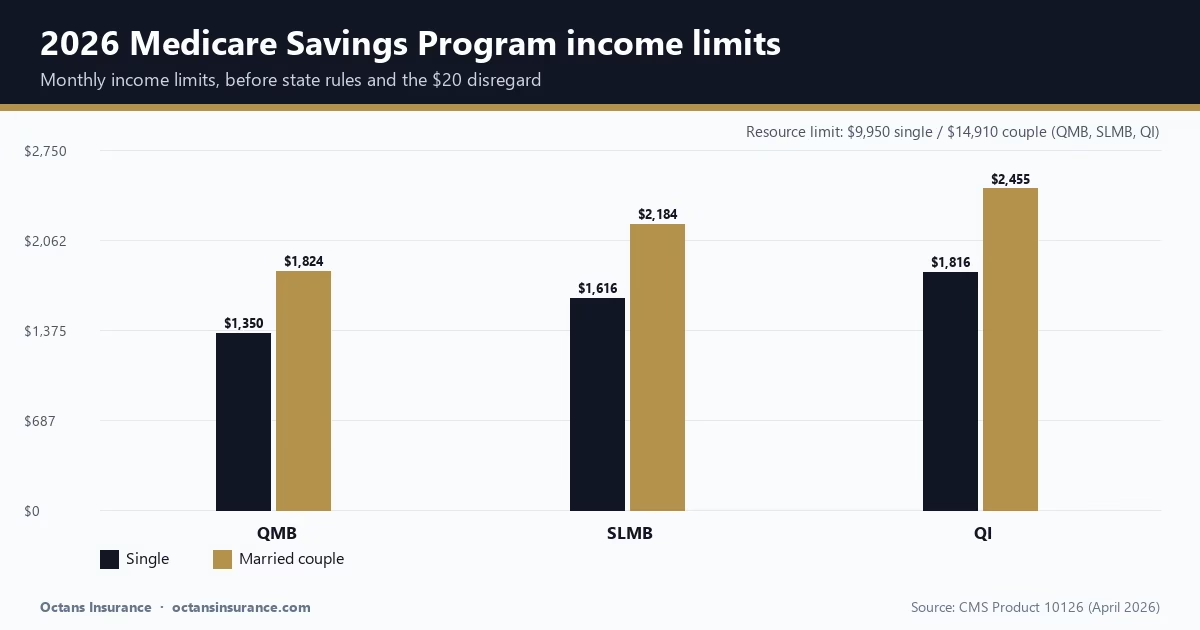
As of October 2026, these are the 2026 federal monthly limits from CMS publication 10126 (April 2026). Limits are slightly higher in Alaska and Hawaii. If you have income from working, you may qualify with income above these amounts.
| Level | Income, single | Income, married couple | Resources, single | Resources, married couple |
|---|---|---|---|---|
| QMB | $1,350 | $1,824 | $9,950 | $14,910 |
| SLMB | $1,616 | $2,184 | $9,950 | $14,910 |
| QI | $1,816 | $2,455 | $9,950 | $14,910 |
| QDWI | $5,405 | $7,299 | $4,000 | $6,000 |
Many states publish their own charts. Texas and Florida, for example, list limits $20 lower and subtract a $20 income disregard first, while Michigan builds the $20 into its chart. Either way, the result is the same. Some states set higher limits or don’t count resources at all. See our state guides for Texas, Florida, Michigan, and Massachusetts.
What counts as resources, and the drug-cost link
Countable resources include checking and savings accounts, stocks, and bonds. Medicare says not to count your home, one car, a burial plot, up to $1,500 set aside for burial, or household and personal items.
QMB, SLMB, and QI also make you automatically eligible for the federal drug-cost subsidy, which lowers Part D costs, because an MSP doesn’t pay for prescriptions itself. See our Extra Help guide and Part D guide.
QMB billing protections
Federal law bars Medicare providers and suppliers, including pharmacies, from billing people in the QMB program for Medicare deductibles, coinsurance, and copayments, according to CMS. Medicare.gov adds that you may still get a bill for a small Medicaid copayment, if one applies.
Show your Medicare card and your Medicaid or QMB card at every visit. If you’re billed for Medicare-covered care, tell the provider you’re in QMB, or call 1-800-MEDICARE (1-800-633-4227).
Hypothetical example: what an MSP could pay
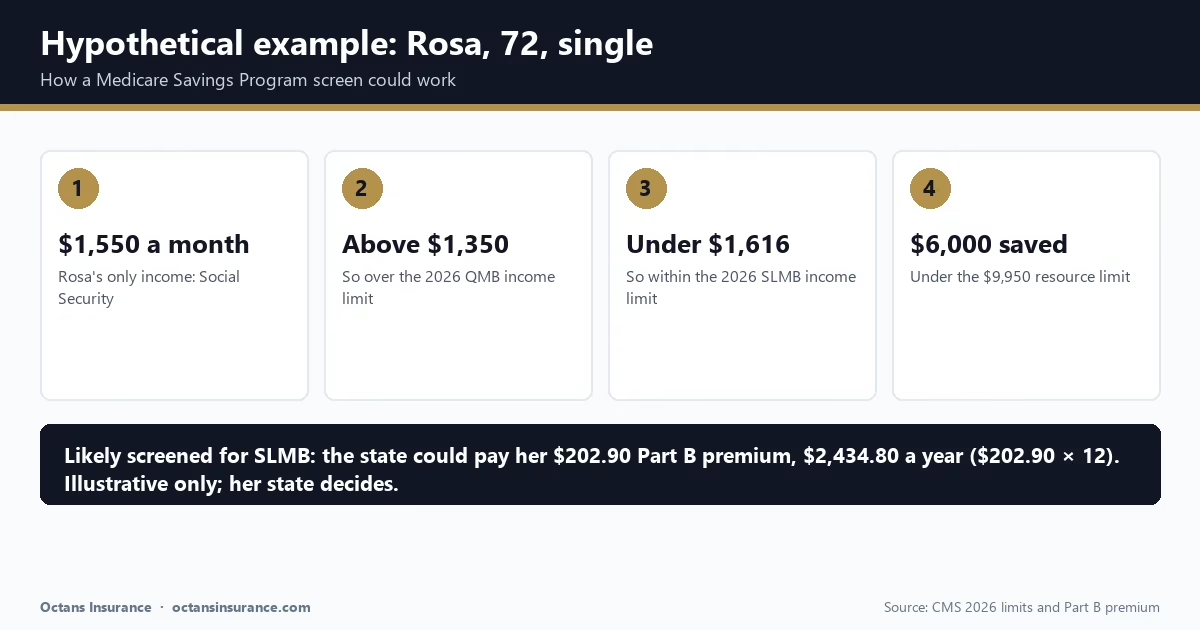
Hypothetical example. Rosa is 72, single, and lives alone. Her only income is a $1,550 monthly Social Security benefit, and she has $6,000 in savings. Her income is above the 2026 QMB limit ($1,350) but under the SLMB limit ($1,616), and her savings are under the $9,950 resource limit. She’d likely be screened for SLMB.
| Step | Amount |
|---|---|
| 2026 standard Part B premium (CMS) | $202.90 a month |
| Months in a year | 12 |
| Premium the state would pay in a full year ($202.90 × 12) | $2,434.80 |
Rosa would still pay her own deductibles and coinsurance, since SLMB doesn’t cover them. This example is illustrative only; her state makes the final decision and may count income differently.
How to apply for a Medicare Savings Program
You apply through your state Medicaid agency, not Medicare; 1-800-MEDICARE can give you its number. Medicare says the only way to know whether you qualify is to apply, even if your income or savings are above the federal limits. Free help is available from your State Health Insurance Assistance Program (SHIP), such as SHINE in Massachusetts.
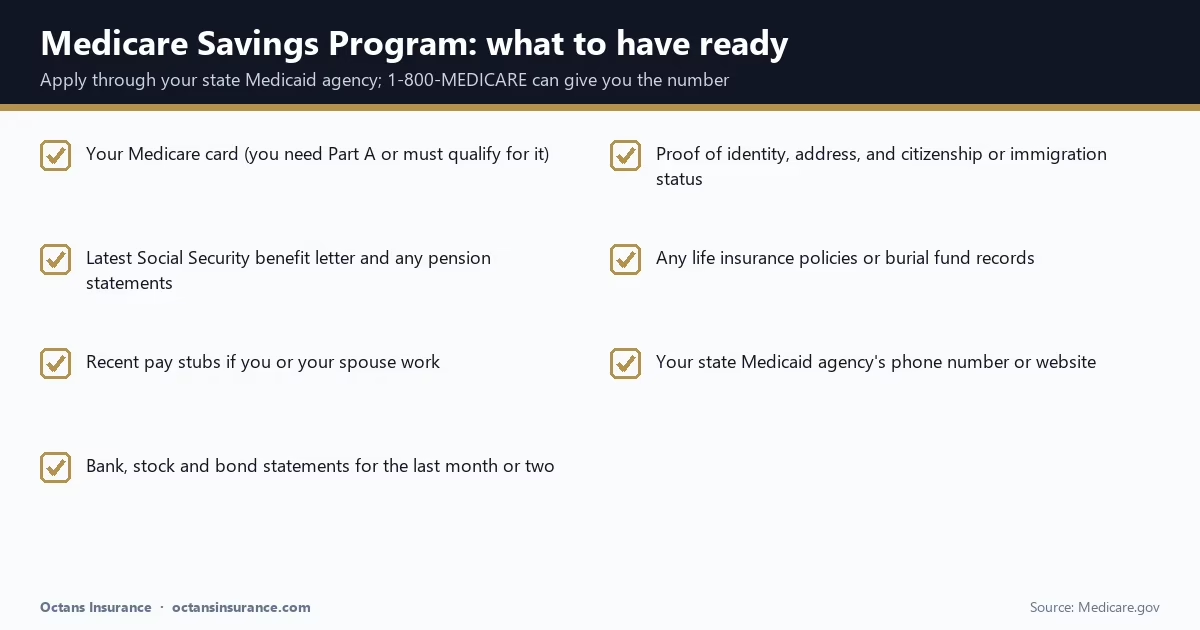
Checklist before you apply:
- Your red, white, and blue Medicare card (you need Part A or must qualify for it)
- Your latest Social Security benefit letter and any pension statements
- Recent pay stubs if you or your spouse work
- Bank, stock, and bond statements for the last month or two
- Proof of identity, address, and citizenship or immigration status
- Any life insurance policies or burial fund records
- Your state Medicaid agency’s phone number or website
Frequently asked questions
What is the Medicare Savings Program and how does it work?
It’s a group of four state-run programs (QMB, SLMB, QI, and QDWI) that help people with limited income and savings pay Medicare costs. Depending on the level, your state pays your Part B premium ($202.90 a month in 2026, per CMS), your Part A premium if you owe one, and, for QMB, Medicare deductibles and coinsurance. You apply through your state Medicaid office. See Medicare.gov.
How and when do I apply for an MSP?
Apply through your state Medicaid agency, which processes MSP applications. Depending on your state, you can apply online, by mail, by phone, or in person; 1-800-MEDICARE (1-800-633-4227) can give you its contact. You can apply at any time, because federal rules require states to let you apply for Medicaid without delay. Applying for Extra Help through Social Security also sends your information to your state.
How do I renew my MSP?
Your state must review your eligibility at least once every 12 months, and it must renew you using information it already has when it has enough to do so. If it needs more, it will contact you, often with a renewal form; return it by the deadline, online if your state’s portal allows it, or by mail. QI enrollees must reapply every year.
How do I check my MSP application status?
Contact your state Medicaid agency, because your state, not Medicare, decides MSP applications. If your state offers an online benefits account, you may be able to check there; otherwise, call the number on your application notice or your local Medicaid office. The state sends a written notice when it approves or denies you.
How do I cancel an MSP?
Ask your state Medicaid agency to close your MSP case, in writing if possible, and keep a copy. Know the trade-off first: you’ll pay your own Part B premium again ($202.90 a month in 2026) and may lose automatic drug-cost help. If your income rises or you move, report it promptly. MSPs are state programs, so after a move you apply in your new state.
Who qualifies for an MSP?
You may qualify if you have Medicare Part A, or qualify for it, and limited income and resources. For 2026, the federal limits for the highest level, QI, are $1,816 a month in income for one person ($2,455 for a couple) and $9,950 in resources ($14,910 for a couple), per Medicare.gov. Some states have higher limits or don’t count certain income or resources, so check with your state Medicaid agency.
What is the income limit for an MSP?
For 2026, federal monthly income limits are $1,350 for one person and $1,824 for a married couple for QMB; $1,616 and $2,184 for SLMB; and $1,816 and $2,455 for QI, per Medicare.gov. Limits are slightly higher in Alaska and Hawaii, and some states set higher limits. Resources generally can’t be more than $9,950 for one person or $14,910 for a couple.
What counts as income for an MSP?
Most income counts, including Social Security, pensions, wages, annuities, and interest. Federal law uses SSI income rules for these programs, which ignore the first $20 a month of most income and, for wages, the first $65 plus half of the rest. Under SSI rules, an income tax refund isn’t income. Some states don’t count certain types or amounts of income, so ask your state Medicaid agency.
Which MSP pays the Part B premium?
Three of the four levels pay it: QMB, SLMB, and QI. In 2026 the standard premium is $202.90 a month, per CMS, or $2,434.80 a year. QMB also pays the Part A premium if owed, plus Medicare deductibles, coinsurance, and copayments. The fourth level, QDWI, pays only the Part A premium for certain working people with disabilities.
What is QMB, and what does it cover?
QMB (Qualified Medicare Beneficiary) is the most generous of the four MSP levels, not a separate program. It pays your Part A premium if you owe one, your Part B premium, and Medicare deductibles, coinsurance, and copayments. Medicare providers may not bill you for Medicare-covered services, though a small Medicaid copay may apply, per CMS. The 2026 federal income limit is $1,350 a month for one person.
What are the four MSPs?
They are QMB, which pays Part A and B premiums plus deductibles, coinsurance, and copays; SLMB, which pays the Part B premium; QI, which pays Part B for people with somewhat higher income; and QDWI, which pays the Part A premium for certain working people with disabilities. You don’t choose a level; your state decides based on your income and resources, per Medicare.gov.
Does an MSP cover dental?
No. MSPs pay Medicare premiums and, with QMB, Medicare cost sharing, so they help only with care Medicare covers, and Original Medicare doesn’t cover routine dental care like cleanings, fillings, or dentures. If you also qualify for full Medicaid, your state may include some dental benefits. Some Medicare Advantage plans include dental too. See our dental, vision, and hearing guide.
Does an MSP help pay for prescriptions?
Not directly. MSPs pay Medicare premiums and, with QMB, Part A and B cost sharing, not Part D drug costs. But QMB, SLMB, and QI enrollees automatically qualify for Extra Help, which lowers Part D premiums, deductibles, and copays. For 2027, Medicare.gov lists copays under that program of up to $5.80 for a generic and $14.40 for a brand-name drug.
Will MSPs be cut?
As of October 2026, MSPs remain in federal law, and Congress made QI permanent in 2015. The 2025 budget law (Public Law 119-21) didn’t repeal MSPs. It paused parts of a 2023 CMS rule meant to expand eligibility and simplify MSP enrollment until September 30, 2034. Automatic QMB enrollment for most SSI recipients stays in effect, per CMS.
Is an MSP the same as Medicaid?
Partly. MSPs are run by state Medicaid agencies and are legally Medicaid eligibility groups, but they aren’t full Medicaid. An MSP pays Medicare premiums and, with QMB, Medicare cost sharing; it doesn’t add services such as long-term care or dental. Some people qualify for both full Medicaid and an MSP, but an MSP alone doesn’t give you full Medicaid benefits, per MACPAC.
Is an MSP the same as Extra Help?
No, but they’re linked. An MSP is run by your state Medicaid agency and pays Medicare premiums and, for QMB, cost sharing. The drug-cost subsidy is a federal Medicare program, handled by Social Security, that lowers Part D costs. QMB, SLMB, and QI enrollees qualify for it automatically. Its 2026 limits are higher: $23,940 a year in income and $18,090 in resources for one person, per Medicare.gov.
Is the MSP legitimate?
Yes. MSPs are government programs created by federal law, run by state Medicaid agencies, and described on Medicare.gov. Applying is free and goes through your state. Be wary of anyone who charges a fee, promises approval, or calls uninvited asking for your Medicare number. To report suspected fraud, call 1-800-MEDICARE (1-800-633-4227) or your state’s Senior Medicare Patrol.
When did MSPs start?
The first, QMB, began as a state option in 1986 and became mandatory under the Medicare Catastrophic Coverage Act of 1988. Congress added QDWI in 1989, SLMB in 1990, and QI in the Balanced Budget Act of 1997. Resource limits were raised and tied to inflation in 2008, and QI became permanent in 2015, according to MACPAC.
Who pays for MSPs?
Federal and state governments share the cost. QMB, SLMB, and QDWI are paid through Medicaid: the federal government covers a share set by each state’s Medicaid matching rate, and the state pays the rest. QI is paid 100% by the federal government up to a set yearly allotment for each state. Enrollees pay nothing to join.
How Octans can help
Octans Insurance is an independent, licensed agency, not a government agency, and your state, not Octans, decides MSP eligibility. We can help you see how an MSP, Extra Help, and your Medicare coverage fit together and point you to your state agency. Call a licensed Octans agent at (617) 935-9220, or browse our Medicare guides.
We do not offer every plan available in your area. Please contact Medicare.gov or 1-800-MEDICARE to get information on all of your options.
This article is for general information and is not tax, legal, or medical advice.
About examples and tools: Hypothetical examples, sample rates, calculators and quizzes on this site are for general educational and illustrative purposes only. They are not quotes, offers of coverage, or guarantees of eligibility, approval, price or benefits, and they are not legal, tax, financial or medical advice. The insurance company decides eligibility and price; Medicare rules are set by CMS and the Social Security Administration. Octans Insurance is not connected with or endorsed by the U.S. government or the federal Medicare program.
Need Help With Medicare Costs?
Start with a free, no-obligation quote review with a licensed Octans agent.
(617) 935-9220 | life@octansinsurance.com