
Medicare Basics
Medicare Tax in 2026: Rates, the 0.9% Surtax and Who Pays
Medicare tax takes 1.45% of every paycheck, with no cap, and mainly funds Part A; here is how the rate, the extra 0.9% and the self-employed version work in 2026.
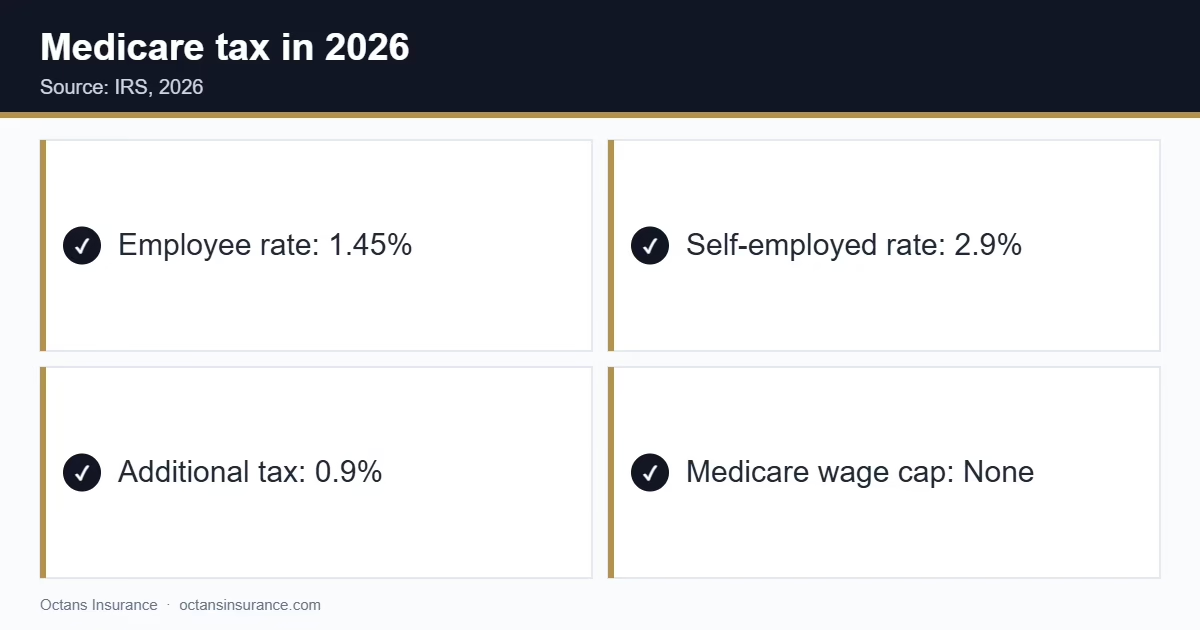
- Medicare tax is 1.45% from you and 1.45% from your employer, or 2.9% if you’re self-employed.
- There’s no wage cap for Medicare tax; Social Security tax stops at $184,500 of 2026 earnings and $192,300 in 2027.
- A 0.9% Additional Medicare Tax applies above $200,000 single or $250,000 joint, with no employer match.
- Wages are generally subject to Medicare tax regardless of age, so working past 65 means you keep paying.
Table of Contents
Make sure your family is financially protected today!
The Medicare tax is a payroll tax of 1.45% of your wages, matched by another 1.45% from your employer, for 2.9% in total. If you’re self-employed, you pay the full 2.9% yourself. Unlike Social Security tax, it has no wage cap. Higher earners also pay a 0.9% Additional Medicare Tax on wages above $200,000 for single filers or $250,000 for joint filers.
The money mainly pays for Medicare Part A, the hospital insurance part of Medicare. This guide covers the 2026 rates, how the extra 0.9% works, what self-employed people owe, and why the tax keeps coming out of your paycheck after 65. It’s general information, not tax advice; a tax professional can apply it to your return.
What is the Medicare tax rate in 2026?
The Medicare tax rate is 1.45% for you and 1.45% for your employer, or 2.9% total, according to IRS Topic 751. It applies to every dollar of wages. The IRS says plainly that there’s no wage base limit for Medicare tax; only Social Security tax has one.
The rate itself isn’t new. Social Security’s FICA and SECA tax-rate table lists the same 1.45% employee and employer rate for “1990 and later.” What does change is who owes the extra 0.9%, which depends on income and filing status.
| Payroll tax | You pay | Employer pays | Self-employed | 2026 wage cap |
|---|---|---|---|---|
| Social Security | 6.2% | 6.2% | 12.4% | $184,500 |
| Medicare | 1.45% | 1.45% | 2.9% | None |
| Additional Medicare Tax | 0.9% above your threshold | No match | 0.9% above your threshold | None |
Sources: IRS Topic 751; IRS self-employment tax page; IRS questions and answers on the 0.9% tax. Rates and wage cap as of November 2026.

Medicare and Social Security tax rate: how FICA adds up
Medicare and Social Security taxes are collected together as FICA taxes. The combined Medicare and Social Security tax rate is 7.65% from you (6.2% + 1.45%) and another 7.65% from your employer. That’s 15.3% in total, the same rate a self-employed person pays.
The big difference is the cap. Social Security tax stops once your 2026 earnings pass $184,500. Medicare tax never stops. Social Security’s wage base page notes there has been no limit on Medicare-taxable earnings after 1993.
For earnings in 2027, the Social Security cap is $192,300, the same page says. Medicare still has no cap in 2027, so pay above the Social Security limit is taxed only for Medicare.
How does the 0.9% Additional Medicare Tax work?
The Additional Medicare Tax adds 0.9% to wages, railroad retirement compensation and self-employment income above a threshold set by your filing status. The thresholds, from the IRS questions and answers, are:
- Married filing jointly: $250,000
- Married filing separately: $125,000
- Single, head of household or qualifying widow(er): $200,000
Your employer must withhold the extra 0.9% once it pays you more than $200,000 in a calendar year, no matter your filing status. There’s no employer match. You figure the final amount on Form 8959 with your tax return.
That withholding rule can leave a gap. If you and your spouse each earn under $200,000 but together earn over $250,000, neither employer withholds the 0.9%, yet you owe it. IRS Topic 560 says you can ask your employer to withhold more income tax on Form W-4 or make estimated tax payments.
Hypothetical example: Lee and Sam are married and file jointly. In 2026, Lee earns $180,000 and Sam earns $120,000, each from one employer, for $300,000 combined.
- Regular Medicare tax withheld: Lee pays 1.45% × $180,000 = $2,610. Sam pays 1.45% × $120,000 = $1,740. Together: $4,350.
- Their employers match it, paying another $4,350.
- No 0.9% is withheld, because neither paycheck passes $200,000.
- But their joint wages are $50,000 over the $250,000 threshold: 0.9% × $50,000 = $450, owed on Form 8959.
- Their total Medicare tax as employees: $4,350 + $450 = $4,800.
Medicare tax for the self-employed
If you work for yourself, you pay both halves. The IRS self-employment tax page puts the rate at 15.3%: 12.4% for Social Security and 2.9% for Medicare. The 2.9% Medicare part applies to all of your net earnings, with no cap.
A few rules shape the bill:
- You owe self-employment tax when your net earnings from self-employment are $400 or more.
- Generally, the amount subject to the tax is 92.35% of your net earnings, per IRS Topic 554.
- You can deduct the employer-equivalent portion, one-half of the tax, when figuring your adjusted gross income.
- The extra 0.9% also applies to self-employment income over your threshold.
For example, with an $80,000 net profit, 92.35% of it, or $73,880, is subject to the tax. The Medicare part is 2.9% × $73,880 = $2,142.52. The Social Security part is 12.4% × $73,880 = $9,161.12, for $11,303.64 in total.
Is the 3.8% Net Investment Income Tax a Medicare tax?
Not the same one. The IRS says the Net Investment Income Tax is separate from the Additional Medicare Tax. It’s 3.8% on the lesser of your net investment income or the amount your modified adjusted gross income exceeds a threshold.
Net investment income includes, but isn’t limited to, interest, dividends and capital gains. It generally doesn’t include wages, unemployment compensation or Social Security benefits, so the two taxes mostly apply to different income. The IRS also says this tax doesn’t apply to wages or self-employment income.
The IRS thresholds are $250,000 for married filing jointly, $125,000 for married filing separately, $200,000 for single or head of household, and $250,000 for a qualifying widow(er) with a child. That last one differs from the 0.9% tax, which uses $200,000. You report this tax on Form 8960.
Do you still pay Medicare tax after 65?
Yes, if you’re still working. IRS Publication 15, the employer’s tax guide, says employee wages are generally subject to Social Security and Medicare taxes regardless of the employee’s age or whether they are receiving Social Security benefits.
So the tax keeps coming out of your paycheck even after you enroll in Medicare or start Social Security. If you’re weighing whether to keep job-based coverage or sign up for Part B, see working and Medicare and when to enroll in Medicare.
Working longer can still pay off on the Medicare side. Medicare.gov says most people pay no Part A premium because they or a spouse paid Medicare taxes long enough while working, generally at least 10 years. Medicare eligibility explains how that’s counted.
What does Medicare tax pay for?
Medicare tax flows into the Hospital Insurance (HI) trust fund, which pays for Part A benefits like inpatient hospital and skilled nursing facility care. Medicare.gov lists four sources for that fund:
- Payroll taxes paid by most employees, employers and people who are self-employed
- Income taxes paid on Social Security benefits
- Interest earned on the trust fund’s investments
- Part A premiums from people who aren’t eligible for premium-free Part A
Payroll taxes are the biggest piece. The 2026 Trustees Report summary says payroll taxes made up 87% of HI income in 2025. It projects the HI fund’s reserves will run out in the second quarter of 2033. At that point, continuing income would cover 89% of scheduled HI benefits, a share the report expects to fall to 85% by 2050.
Part B and Part D work differently. They’re paid from a separate trust fund that relies on money authorized by Congress and on enrollee premiums, which is why you pay a Part B premium even after a career of Medicare taxes. In 2026, the standard Part B premium is $202.90 a month.

How to check your Medicare tax and avoid surprises
- Read your pay stub. The Medicare line should equal 1.45% of the wages subject to Medicare tax for that period.
- Watch the $200,000 mark. Once one employer pays you more than $200,000 in a year, the 0.9% should start.
- Add up household wages. If you file jointly and your combined wages top $250,000, estimate the 0.9% you’ll owe on the excess.
- Close any gap early. Ask for extra withholding on Form W-4 or make estimated tax payments.
- File the right forms. Use Form 8959 for the 0.9% tax, Schedule SE if your self-employment earnings are $400 or more, and Form 8960 for the Net Investment Income Tax.
Questions to ask a tax professional:
- Will our joint wages or self-employment income cross the 0.9% threshold this year?
- How much extra withholding or estimated tax covers it?
- Does any of my investment income fall under the 3.8% tax?
- How does the self-employment tax deduction change my adjusted gross income?
That last answer matters for Medicare premiums too. Your income can trigger higher Part B and Part D premiums, called IRMAA, which our Medicare IRMAA guide explains.
Medicare tax: frequently asked questions
Is there a Medicare tax limit in 2026?
No. The IRS says there’s no wage base limit for Medicare tax, so the 1.45% applies to all of your wages, and the 2.9% self-employment Medicare part applies to all of your net earnings. Only Social Security tax has a cap, which is $184,500 for 2026 earnings. Wages above $200,000 can also trigger the extra 0.9% tax.
What is the Medicare tax rate for 2027?
Social Security’s tax-rate table lists 1.45% each for employees and employers for “1990 and later,” with no separate 2027 rate. What changes in 2027 is the Social Security wage base, which rises to $192,300. Medicare tax still has no cap. Check IRS.gov early in 2027 for any updates.
Does my employer pay the 0.9% Additional Medicare Tax?
No. The IRS says there’s no employer match for this extra tax. Your employer only withholds it from your pay once your wages from that employer pass $200,000 in a calendar year. Your real threshold depends on your filing status, and you settle the final amount on Form 8959.
Is the Medicare tax the same as my Medicare premium?
No. The Medicare tax comes out of your wages while you work and mainly funds Part A. Your Part B premium is a separate monthly charge, $202.90 standard in 2026, and higher earners pay more through IRMAA. Most people pay no Part A premium because they or a spouse paid Medicare taxes long enough, generally at least 10 years.
Does income tax on Social Security benefits help fund Medicare?
Yes, in part. Medicare.gov lists income taxes paid on Social Security benefits as one of the four funding sources for the Hospital Insurance trust fund, along with payroll taxes, trust fund interest and Part A premiums. Whether any of your benefits are taxed is an income tax question for a tax professional or IRS.gov.
Do I stop paying Medicare tax once I have 40 quarters?
No. Earning enough work credits for premium-free Part A doesn’t end the tax. IRS Publication 15 says wages are generally subject to Medicare tax regardless of your age or whether you receive Social Security. CMS says about 99% of people with Medicare don’t pay a Part A premium because they have at least 40 quarters of covered work.

How a licensed Octans agent can help
Octans agents don’t give tax advice, and payroll tax is between you, your employer and the IRS. Where a licensed Octans agent can help is the coverage side: comparing Medicare Supplement, Medicare Advantage and Part D options from many carriers once you’re ready to use the benefits your taxes helped pay for, and timing that switch around job-based coverage.
For free, personalized Medicare counseling, contact your State Health Insurance Assistance Program (SHIP), which the Medicare & You 2027 handbook says isn’t connected to any insurance company. You can also call 1-800-MEDICARE (1-800-633-4227). For tax questions, talk with a tax professional or the IRS. To reach Octans, call (617) 935-9220.
Keep Reading: Related Guides
- Working and Medicare after 65
- Medicare eligibility and premium-free Part A
- Medicare IRMAA brackets
- Medicare Part A
- Medicare Cost in 2026
- Medicare Part B
- IRMAA Appeal Form (SSA-44)
We do not offer every plan available in your area. Please contact Medicare.gov or 1-800-MEDICARE to get information on all of your options.
This article is for general information and is not tax, legal, or medical advice.
About examples and tools: Hypothetical examples, sample rates, calculators and quizzes on this site are for general educational and illustrative purposes only. They are not quotes, offers of coverage, or guarantees of eligibility, approval, price or benefits, and they are not legal, tax, financial or medical advice. The insurance company decides eligibility and price; Medicare rules are set by CMS and the Social Security Administration. Octans Insurance is not connected with or endorsed by the U.S. government or the federal Medicare program.
Get Medicare coverage that fits your work plans
Start with a free, no-obligation quote review with a licensed Octans agent.
(617) 935-9220 | life@octansinsurance.com