
Medicare Supplement
Medigap Open Enrollment Period: Your 6-Month Window, Explained
The Medigap open enrollment period is your one-time federal window to buy any Medigap policy sold in your state without medical underwriting. See when it starts, what it protects, guaranteed issue rights and state rules.
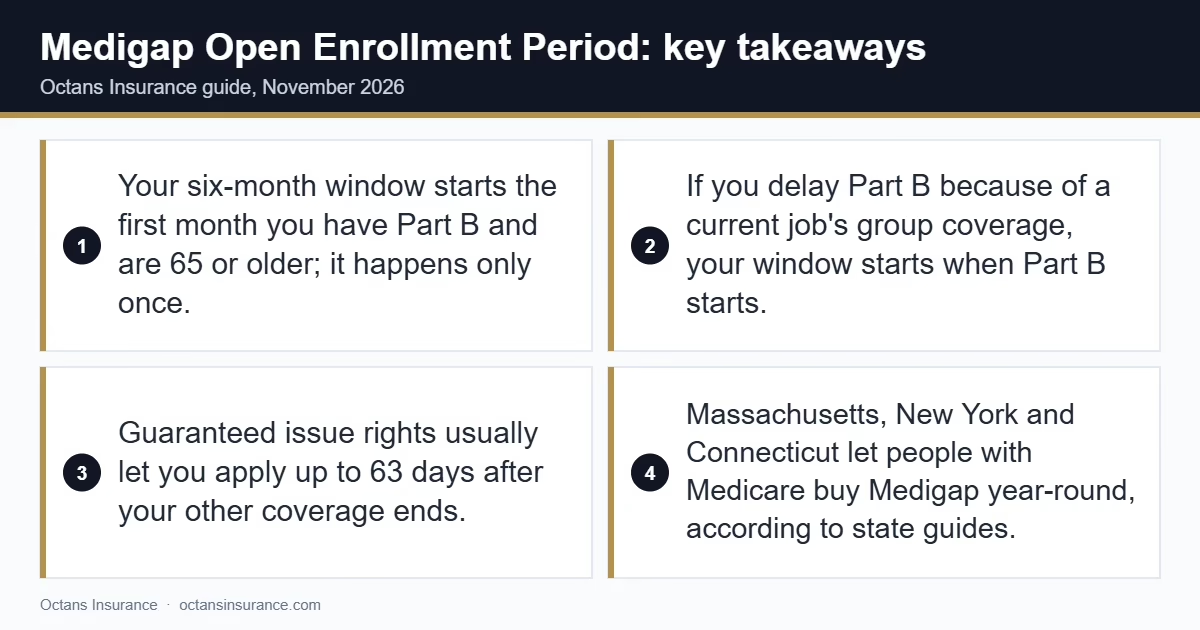
- Your six-month window starts the first month you have Part B and are 65 or older; it happens only once.
- If you delay Part B because of a current job’s group coverage, your window starts when Part B starts.
- Guaranteed issue rights usually let you apply up to 63 days after your other coverage ends.
- Massachusetts, New York and Connecticut let people with Medicare buy Medigap year-round, according to state guides.
Table of Contents
Make sure your family is financially protected today!
The Medigap open enrollment period is a one-time, six-month window that starts the first month you have Medicare Part B and are 65 or older. During it, an insurance company can’t turn you down for any Medigap policy it sells or charge you more because of your health. Once it ends, companies in most states can use medical underwriting.
How does the Medigap open enrollment period work?
Medicare’s 2026 guide, Choosing a Medigap Policy, points to this window as the time to buy a Medigap (Medicare Supplement Insurance) policy. It happens once, doesn’t repeat every year, and can’t be changed or repeated.
During your Medigap open enrollment period, you can:
- Buy any Medigap policy sold in your state, from any company licensed to sell one there.
- Apply without medical underwriting. A company can’t refuse to sell you any policy it offers or deny you because of pre-existing health problems.
- Pay the same price as people without health problems. A company can’t charge you more for your health.
- Have coverage start right away. A company can’t make you wait, except for costs tied to a pre-existing condition.
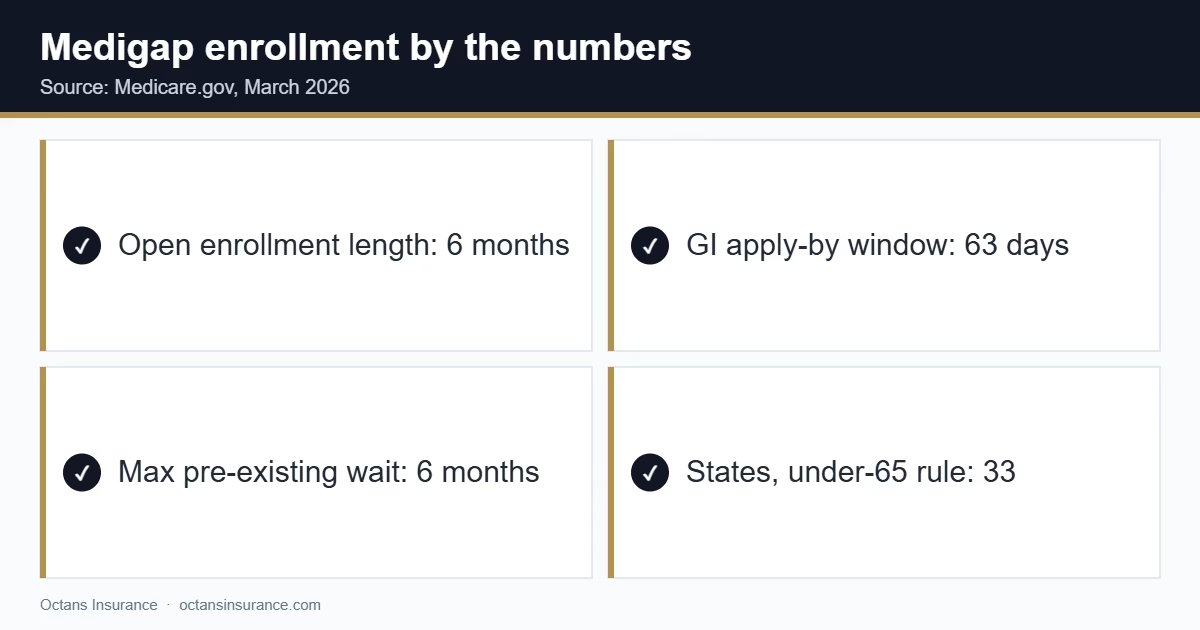
There’s one limit. A company can make you wait up to 6 months before it covers costs for a pre-existing condition, if that condition was treated or diagnosed in the 6 months before your policy starts. If you had at least 6 months of continuous creditable coverage, such as a job-based health plan, with no break longer than 63 days, the company can’t make you wait.
When does your Medicare supplement open enrollment period start?
Your Medicare supplement open enrollment period is tied to your Part B start date, not your birthday alone. Here is how it plays out in common situations:
| Your situation | When your six-month window starts |
|---|---|
| You’re 65 or older when your Part B starts | The first month you have Part B and are 65 or older |
| You’re past 65 and delayed Part B because you or your spouse is still working, with group coverage | When your Part B starts, after the job-based coverage ends |
| You had Medicare before 65 because of a disability or ESRD | A new window opens when you turn 65 |
| You live in Massachusetts, New York or Connecticut | State guides say you can buy Medigap year-round (see below) |
Source: Medicare, Choosing a Medigap Policy (March 2026); state agency guides cited below, as of November 2026.
For example, if your Part B starts May 1, your window runs through October 31.
Medigap open enrollment period after age 65
If you keep working past 65 with group health coverage from your own or your spouse’s current job, you may want to wait to sign up for Part B. Job-based coverage often works much like Part B, and if you took Part B early, your Medigap open enrollment period could run out before a Medigap policy would be useful. When the job coverage ends, you can sign up for Part B without a late penalty, and your window starts then.
Retiree coverage is different. Medicare pays first after you retire, and retiree coverage usually works much like a Medigap policy, so check how your plan pays before you buy both. Our guide on when to enroll in Medicare covers the Part B timing rules.
Hypothetical example: Luis turns 65 in May 2027 and keeps his job’s group health plan. He retires, that coverage ends March 31, 2028, and his Part B starts April 1, 2028. His Medigap open enrollment period after age 65 runs April 1 through September 30, 2028 (six months).
He applies in April, well within 63 days of losing his job coverage, and he’d had that coverage for years, so no pre-existing condition waiting period applies. If he’d had only 2 months of creditable coverage, a company could make him wait up to 4 more months (6 minus 2).
What happens after your open enrollment period ends?
Outside your Medicare supplement open enrollment period, Medicare’s guide warns that you may pay more for a policy, have fewer choices, and be turned down if you don’t meet a company’s medical underwriting rules.
Switching later works the same way. In most cases, federal law doesn’t give you a right to switch Medigap policies outside your open enrollment period or a guaranteed issue right. If a company does accept you, don’t cancel your old policy until the new one is in place. You get 30 days after the new policy arrives to decide whether to keep it, and you pay both premiums that month. Our Medicare supplement underwriting guide explains what companies ask.
How are guaranteed issue rights different from open enrollment?
Medicare supplement open enrollment vs guaranteed issue comes down to timing. Your open enrollment period happens once, at the start. Guaranteed issue rights are protections for set situations later, usually when other coverage ends. With a guaranteed issue right, a company must sell you a policy, must cover all your pre-existing conditions with no waiting period, and can’t charge more for your health. Medicare’s federal list:
| You have a right if… | You can buy | When to apply |
|---|---|---|
| Your Medicare Advantage plan leaves Medicare, stops serving your area or has a significant network change, or you move out of its area, and you return to Original Medicare | Plan A, B, C, D, F or G sold in your state | Up to 60 days before coverage ends (or by the date in your termination notice) and no later than 63 days after |
| Employer, union, retiree or COBRA coverage that pays after Medicare is ending | Plan A, B, C, D, F or G | No later than 63 days after the latest of: the end date, the notice date or a claim denial |
| You move out of your Medicare SELECT policy’s area | Plan A, B, C, D, F or G in your state or your new state | Up to 60 days before or 63 days after the policy ends |
| Trial right: you joined Medicare Advantage or PACE when first eligible at 65 and want to leave within the first year | Any Medigap policy sold in your state | Up to 60 days before or 63 days after coverage ends |
| Trial right: you dropped Medigap for Medicare Advantage or Medicare SELECT for the first time, less than a year ago | Your old policy if the same company still sells it; if not, Plan A, B, C, D, F or G | Up to 60 days before or 63 days after coverage ends |
| Your Medigap company goes bankrupt, or your policy ends through no fault of your own | Plan A, B, C, D, F or G | No later than 63 days after the policy ends |
| You left a plan or policy because the company broke the rules or misled you | Plan A, B, C, D, F or G | No later than 63 days after coverage ends |
Source: Medicare, Choosing a Medigap Policy, pages 17 and 18 (March 2026). Plans C and F only if you were eligible for Medicare before January 1, 2020. Trial rights may last an extra 12 months in some cases.
Keep copies of letters, notices and claim denials, plus the postmarked envelopes, as proof. If your plan isn’t renewing, our guide to a Medicare Advantage plan not renewing walks through the steps.
Which states give extra Medigap enrollment rights?
Federal rules are a floor. Some states go further, according to their official guides:
- Massachusetts: the state’s 2026 Consumer Guide to Medicare says Massachusetts offers continuous open enrollment, and Medigap plans there are community rated. See our Massachusetts Medigap guide.
- New York: the state’s 2026 HIICAP notebook says a person with Parts A and B may buy a Medigap policy at any time, and insurers may not consider health status, claims experience or age.
- Connecticut: the state’s 2026 guide to Medicare open enrollment says Medigap enrollment is available at any point in the year.
- Maryland: the Maryland Insurance Administration gives policyholders a yearly window that includes their birthday and the 30 days after it to switch, without underwriting, to a policy with equal or lesser benefits.
- Oklahoma: the Oklahoma Insurance Department describes a yearly 60-day period, starting on your birthday, to move without underwriting to a policy with equal or lesser benefits.
Our Medicare supplement birthday rule page covers other states with similar rules, and the birthday rule calculator finds your dates. Massachusetts, Minnesota and Wisconsin also use their own Medigap plan designs instead of the usual letters.
Can you use the Medigap open enrollment period under 65?
Under federal law, generally not. Federal law doesn’t require companies to sell Medigap to people under 65, so the rules vary by state. Medicare’s 2026 guide lists 33 states that, at printing, required companies to offer at least one kind of Medigap policy to people with Medicare under 65. Some extend the right to everyone under 65 with Medicare; others only to people with a disability or ESRD.
Of the 19 states Octans serves, 13 are on that list: Florida, Georgia, Maine, Maryland, Massachusetts, Michigan, Mississippi, Missouri, New Jersey, North Carolina, Pennsylvania, Tennessee and Texas. New Jersey residents can see our guide to Medicare supplements under 65 in New Jersey.
Either way, you get a full Medigap open enrollment period when you turn 65. If you had Medicare for more than 6 months before 65, you may not face a pre-existing condition waiting period.
How to make the most of your Medigap open enrollment period
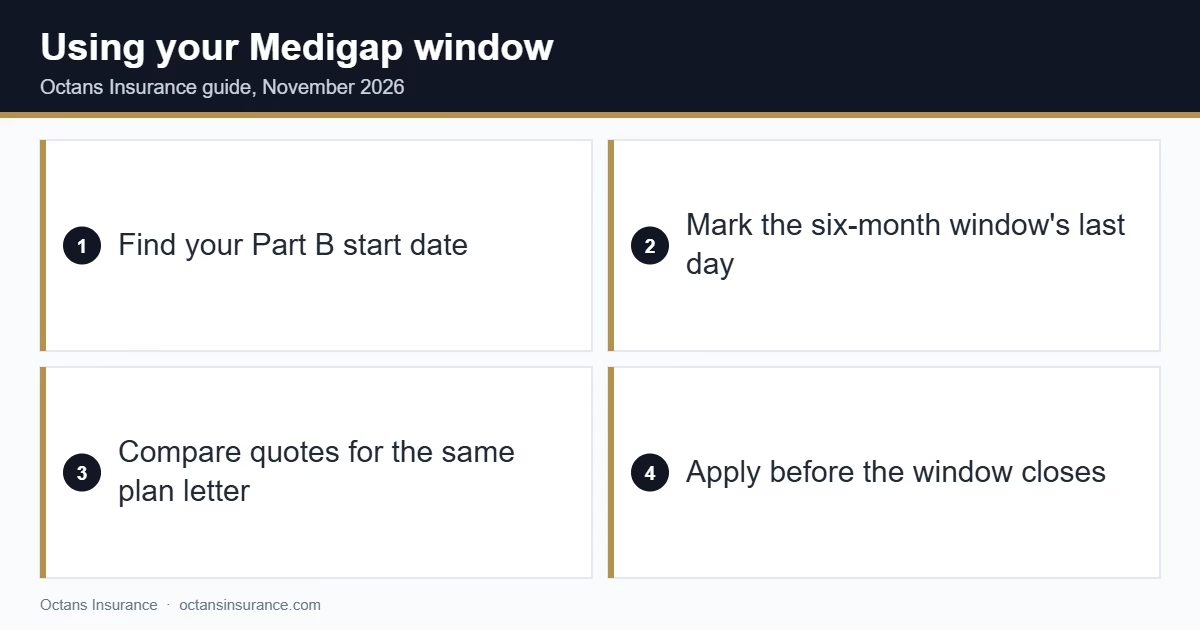
- Find your Part B start date. It sets your six-month window. Write down the last day.
- Pick a plan letter early. Compare benefits so you aren’t deciding in the final week.
- Get quotes for the same letter from several companies. Price is the only difference between policies with the same letter.
- Ask how each policy is priced: community, issue-age or attained-age rating.
- Apply well before the window closes, and ask for coverage to start when you need it.
- Keep proof of prior coverage, such as letters showing when a job-based plan ended.
Questions to ask yourself before the window closes:
- What month does my window end?
- Do I have 6 months of creditable coverage to avoid a pre-existing condition wait?
- Does my state add rights, like a birthday rule or year-round enrollment?
- Will I want Medigap now, or try Medicare Advantage and rely on a trial right?
- How has each company’s premium changed over the last three years?
Medigap open enrollment period frequently asked questions
How long is the Medigap open enrollment period?
Six months. It starts the first month you have Medicare Part B and are 65 or older, and it happens only once. It doesn’t repeat every year, and it can’t be changed or repeated. If your Part B starts on May 1, for example, your window runs through October 31 of that year.
Is Medigap open enrollment the same as Medicare open enrollment?
No. The fall Medicare Open Enrollment Period, October 15 to December 7, is for joining or switching Medicare Advantage and drug plans; for 2027 coverage it runs October 15 to December 7, 2026. Medigap open enrollment is your personal six-month window tied to your Part B start date. Medigap has no yearly federal enrollment season.
Can a company make me wait for pre-existing condition coverage?
During open enrollment, a company can wait up to 6 months to cover a condition treated or diagnosed in the 6 months before your policy starts. If you had at least 6 months of continuous creditable coverage, with no break over 63 days, it can’t make you wait. With a guaranteed issue right, there’s no waiting period.
What if I miss my Medigap open enrollment period?
You can still apply, but in most states a company can use medical underwriting, charge more or turn you down. Check whether you have a guaranteed issue right or a state right, such as a birthday rule or year-round enrollment. Medicare Advantage is another option you can choose during the fall enrollment period.
Does joining Medicare Advantage at 65 use up my window?
Your six-month clock keeps running, but federal law gives you a trial right. If you joined Medicare Advantage when you were first eligible at 65 and leave within the first year, you can buy any Medigap policy sold in your state. Apply up to 60 days before, or no later than 63 days after, that coverage ends.
Do I get a Medigap open enrollment period at 65 if I’m on Medicare for a disability?
Yes. If you already have Part B because of a disability or ESRD, you still get a Medigap open enrollment period when you turn 65. During it, companies can’t refuse to sell you any policy because of a disability or other health problem, or charge you more based on health than they charge other people who are 65.

How a licensed Octans agent can help with your window
A licensed Octans agent can work out your window’s start and end dates, compare Medigap quotes from several insurance companies in your state, and check whether you have a guaranteed issue right or a state rule such as a birthday rule. Call (617) 935-9220.
If you’re also weighing Medicare Advantage, we’ll explain the trade-offs, including how trial rights work, so the choice is yours.
For unbiased help, your State Health Insurance Assistance Program (SHIP) offers free counseling, and you can call 1-800-MEDICARE (1-800-633-4227) 24 hours a day, 7 days a week.
Keep Reading: Related Guides
- Medicare supplement underwriting
- Medicare supplement birthday rule
- If your Medicare Advantage plan isn’t renewing
- Medicare Plan G
- Medicare Supplement Plan F
- How to Sign Up for Medicare
- Medicare Advantage Open Enrollment Period
- Turning 65 Medicare Checklist
- Medigap Guaranteed Issue Rights
- Medicare and COBRA
We do not offer every plan available in your area. Please contact Medicare.gov or 1-800-MEDICARE to get information on all of your options.
This article is for general information and is not tax, legal, or medical advice.
About examples and tools: Hypothetical examples, sample rates, calculators and quizzes on this site are for general educational and illustrative purposes only. They are not quotes, offers of coverage, or guarantees of eligibility, approval, price or benefits, and they are not legal, tax, financial or medical advice. The insurance company decides eligibility and price; Medicare rules are set by CMS and the Social Security Administration. Octans Insurance is not connected with or endorsed by the U.S. government or the federal Medicare program.
Check your Medigap window with a licensed agent
Start with a free, no-obligation quote review with a licensed Octans agent.
(617) 935-9220 | life@octansinsurance.com