
Medicare Supplement
Medicare Supplement Plan F: Who Can Buy It, What It Covers, F vs G
Medicare Supplement Plan F is still open to people eligible for Medicare before 2020, and anyone who has it can keep it. Learn what it pays, how it compares with Plan G and why closed-block premiums can climb.
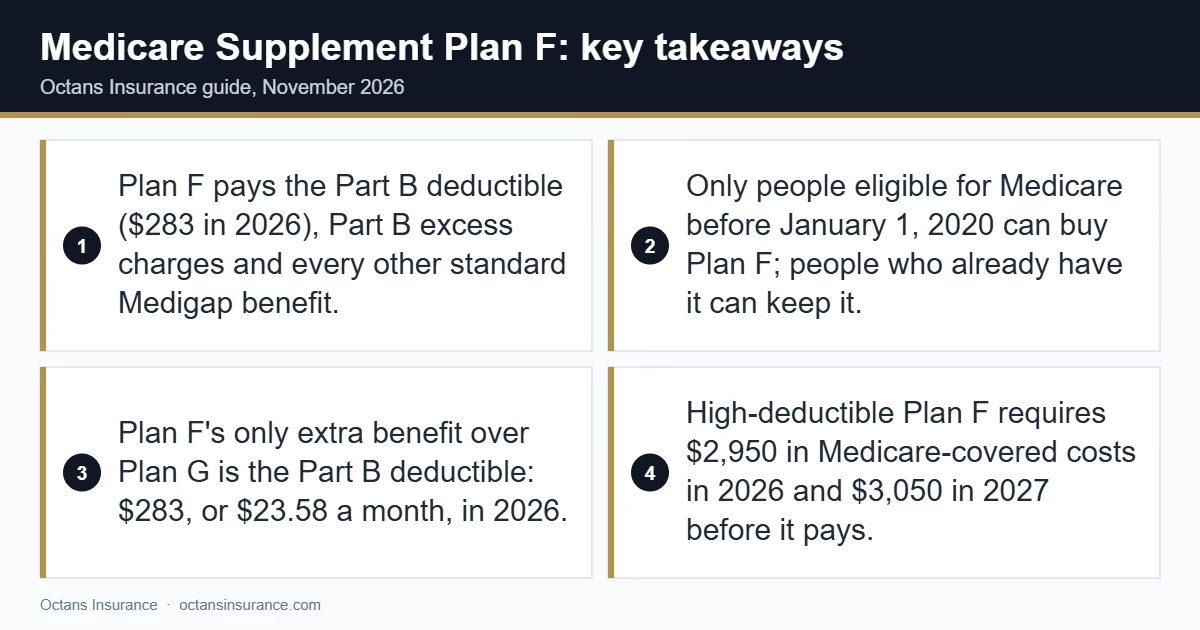
- Plan F pays the Part B deductible ($283 in 2026), Part B excess charges and every other standard Medigap benefit.
- Only people eligible for Medicare before January 1, 2020 can buy Plan F; people who already have it can keep it.
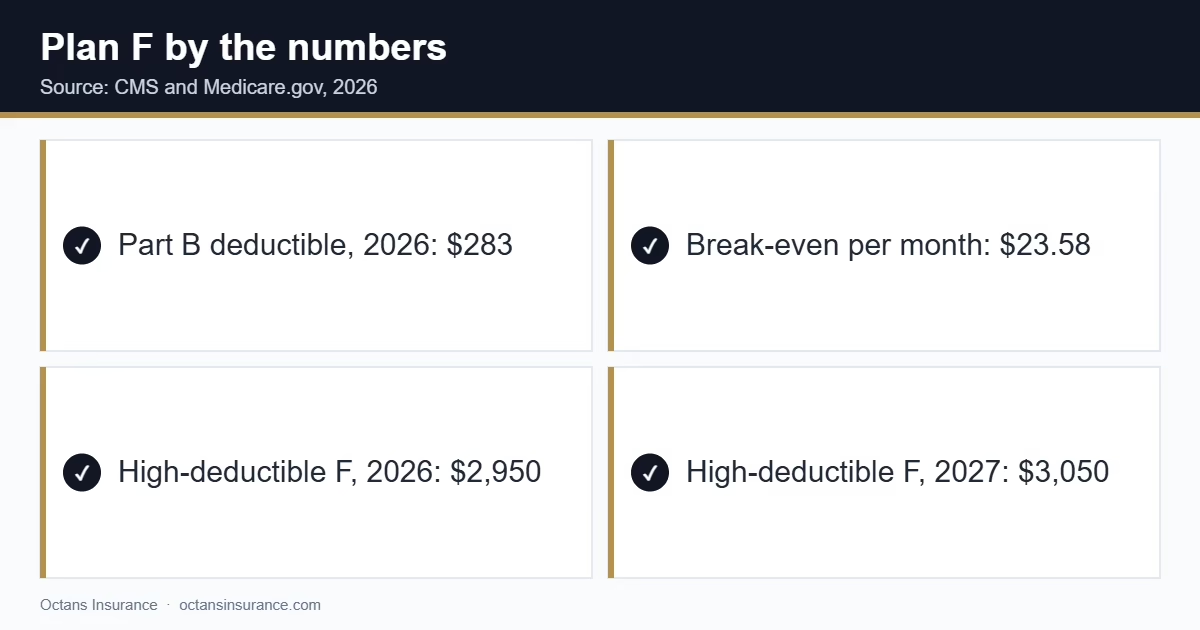
- Plan F’s only extra benefit over Plan G is the Part B deductible: $283, or $23.58 a month, in 2026.
- High-deductible Plan F requires $2,950 in Medicare-covered costs in 2026 and $3,050 in 2027 before it pays.
Table of Contents
Make sure your family is financially protected today!
Medicare Supplement Plan F is the Medigap plan that covers every benefit on Medicare’s standard chart, including the Part B deductible ($283 in 2026). You can buy it only if you were eligible for Medicare before January 1, 2020. If you already have Plan F, you can keep it as long as you pay the premium.
Who can still buy Medicare Supplement Plan F?
Medigap plans sold to people new to Medicare on or after January 1, 2020 aren’t allowed to cover the Part B deductible. Because of that rule, Medicare’s 2026 guide, Choosing a Medigap Policy, says Plans C and F are no longer available to people new to Medicare.
You’re new to Medicare, in CMS terms, if you turned 65 on or after January 1, 2020, or first became eligible because of age, disability or ESRD on or after that date. So Medicare Supplement Plan F is open to two groups:
- People who already have it. Medicare’s Medigap overview says that if you already have Plan C or F (or high-deductible F), or were covered by one before January 1, 2020, you can keep it.
- People eligible before 2020. If you were eligible for Medicare before January 1, 2020 but haven’t enrolled yet, you may be able to buy Plan F. Under CMS’s definition, that can include someone who first qualified through a disability before 2020.
Even if you’re eligible, a company doesn’t have to sell Plan F. Each insurer decides which plans it offers. People new to Medicare have the right to buy Plan D or G instead, which give the same benefits minus the Part B deductible.
What does Medicare Supplement Plan F cover?
Medicare Supplement Plan F is standardized, so every Plan F policy offers the same benefits no matter which company sells it. Price is the only difference. Here’s what it pays, using 2026 amounts:
| Original Medicare cost | What Plan F pays |
|---|---|
| Part A deductible ($1,736 per benefit period) | 100% |
| Part A hospital coinsurance, plus up to 365 extra hospital days | 100% |
| Skilled nursing facility coinsurance ($217 a day for days 21 to 100) | 100% |
| Part A hospice coinsurance or copayment | 100% |
| Part B deductible ($283) | 100% |
| Part B coinsurance (usually 20%) | 100% |
| Part B excess charges | 100% |
| First 3 pints of blood | 100% |
| Emergency care outside the U.S. | 80%, up to plan limits |
Sources: Medicare, Choosing a Medigap Policy (March 2026); CMS, 2026 Medicare Parts A and B Premiums and Deductibles (Nov. 14, 2025).
Like every Medigap plan, Plan F generally doesn’t cover long-term care, dental or vision care, hearing aids, glasses or private-duty nursing. Medigap plans sold after 2005 don’t include drug coverage, so you’d pair it with a separate Part D plan.
Massachusetts, Minnesota and Wisconsin use their own plan designs. In Massachusetts, the plan that covers the Part B deductible is Supplement 1, closed to anyone not eligible before 2020 (see our Massachusetts Medigap guide). Minnesota and Wisconsin offer Part B deductible coverage as an add-on, under the same pre-2020 limit.
How does high-deductible Plan F work?
High-deductible Plan F has the same benefits as standard Plan F, but you first pay Medicare-covered costs up to a yearly deductible: $2,950 in 2026 and $3,050 in 2027. Once you reach it, the plan covers all remaining Medicare cost sharing for the rest of the year. Emergency care outside the U.S. has its own $250 deductible each year.
CMS says the high-deductible version of Plan F is only available to people who were eligible for Medicare before January 1, 2020. People new to Medicare can choose high-deductible Plan G, where it’s sold.
Medicare Supplement Plan F vs G: what’s the difference?
Medicare Supplement Plan F vs G comes down to one benefit. Plan F pays the Part B deductible; Plan G doesn’t. Every other benefit on the standard chart is the same, including Part B excess charges. Medicare’s guide says Plans D and G “give the same benefits” as C and F, minus the Part B deductible.
So the most Plan F can save you over Plan G in 2026 is $283, the Part B deductible. That’s $23.58 a month ($283 ÷ 12). If a Plan G premium is more than $23.58 a month below your Plan F premium, Plan G costs less for the year, even if you pay the whole deductible. CMS announces 2027 amounts in the fall; check Medicare.gov.
Hypothetical example: Ann was eligible for Medicare in 2018 and has Plan F. In 2026 she has a 6-day hospital stay and $2,000 in Medicare-approved outpatient care from doctors who accept assignment.
- Original Medicare alone: $1,736 Part A deductible + $283 Part B deductible + 20% of the remaining $1,717 ($343.40) = $2,362.40.
- Plan F: $0 of those costs.
- Plan G: $283, the Part B deductible.
- High-deductible Plan F: $2,362.40, because it’s under the $2,950 deductible.
Whatever her care costs, Plan F’s edge over Plan G stays capped at $283 for 2026. Premiums decide the rest. Maine’s Bureau of Insurance warns that in some instances, Plan F’s yearly premium is higher than Plan G’s by more than that added benefit (see our Maine Medigap rates page).
Why can Plan F premiums rise in a closed block?
Since federal changes under MACRA took effect, the Oklahoma Insurance Department explains, Plans C and F are generally closed to new enrollees. The department calls these closed pools “closed blocks.”
The department explains that over time these closed pools demand higher and higher premiums. It adds that policyholders in them can’t move to more affordable plans without going through medical underwriting, so people whose health keeps them from switching may keep paying the higher premiums.
Other forces apply to every Medigap plan, not just Plan F. Medicare says premium amounts typically increase each year. If your policy is attained-age rated, your premium also rises as you get older. Issue-age and community-rated policies don’t rise because of age, but they can rise because of inflation and other factors.
None of this predicts your own premium. Medigap prices vary by company, plan and where you live, so ask your company for your policy’s rate history before you decide anything.
Should you keep Plan F or switch?
Whether to keep Medicare Supplement Plan F is your call, and the answer depends on your numbers and your health. Weigh these factors:
- The premium gap. Compare your yearly Plan F premium with Plan G quotes. If the gap is more than $283 (2026), Plan G costs less even in a year when you pay the whole Part B deductible.
- Your health and your state’s rules. In most states, a new company can use medical underwriting if you switch outside open enrollment or a guaranteed issue right. Some states help. Maryland’s yearly birthday window allows a switch to equal or lesser benefits without underwriting, and its chart lists Plan G as an equal-or-lesser choice for Plan F. Oklahoma’s birthday rule also allows a move from F to G.
- Pricing method. An attained-age policy keeps rising with age. Ask how each new policy is priced.
- Permanence. Once you cancel your Plan F policy, you can’t get that policy back, and people new to Medicare can’t buy Plan F.
Questions to ask before you decide:
- How much has my Plan F premium gone up in each of the last three years?
- Is my policy community, issue-age or attained-age rated?
- What would Plan G or high-deductible G cost from my company and from others?
- Does my state have a birthday or anniversary rule I can use? (Our Medicare supplement birthday rule page lists them.)
- Will the new company ask health questions, and is there a pre-existing condition wait?
How to compare Medicare Supplement Plan F with your options
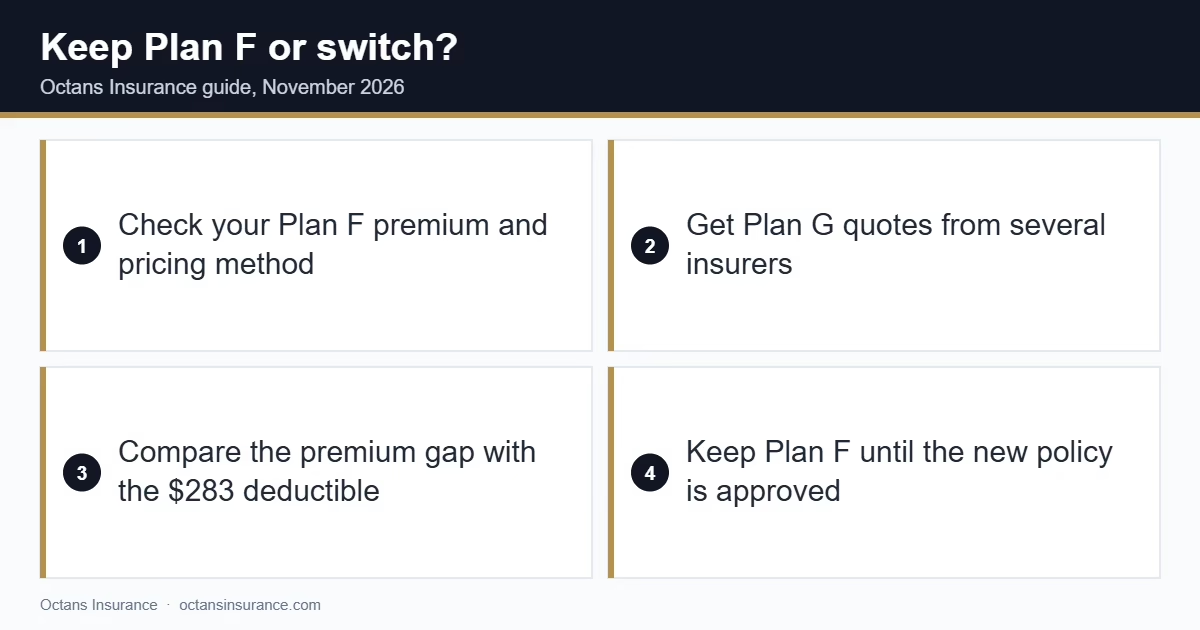
- Find your current premium and pricing method on your bill or policy.
- Get Plan G quotes from several companies, including your current one.
- Do the math: yearly premium savings minus $283, the 2026 Part B deductible.
- Check your switching rights: open enrollment, a guaranteed issue right, or a state birthday or anniversary rule. Our Medicare supplement underwriting guide explains the health questions.
- Apply before you cancel. Ask for the new policy to start when Plan F ends.
- Use your 30 days. You have 30 days after the new policy arrives to decide whether to keep it, and you pay both premiums the month you have both.
To compare every letter side by side, see our Medicare supplements guide, and for a common alternative to Plan G, our Plan G vs Plan N comparison.
Medicare Supplement Plan F frequently asked questions
Is Medicare Supplement Plan F still available?
Only to some people. Medigap plans sold to people new to Medicare on or after January 1, 2020 can’t cover the Part B deductible, so Plans C and F aren’t sold to them. If you were eligible for Medicare before 2020, you may still buy Plan F where a company offers it, and anyone who already has it can keep it.
What’s the difference between Plan F and Plan G?
One benefit. Plan F pays the Part B deductible, which is $283 in 2026; Plan G doesn’t. Every other standard benefit is the same, including Part B excess charges and 80% foreign travel emergency coverage up to plan limits. Plan G is open to people new to Medicare, while Plan F isn’t.
Can I switch from Plan F to Plan G without health questions?
Only in certain cases. Federal law gives no general right to switch outside your open enrollment period or a guaranteed issue right, so most companies can ask health questions. Some states help. Maryland’s yearly birthday window, for example, lets you move to equal or lesser benefits, including Plan G, without underwriting.
Does Plan F cover prescription drugs?
No. Medigap plans sold after 2005 don’t include drug coverage, so you’d need a separate Medicare drug plan (Part D). If you have an older Medigap policy with drug coverage and join a Part D plan, you must tell your Medigap company to remove the drug coverage, and you can’t add it back later.
Will my Plan F premium keep going up?
It may. Medicare says Medigap premium amounts typically increase each year, and attained-age policies also rise as you age. The Oklahoma Insurance Department notes that closed pools like Plans C and F can demand higher premiums over time. Your company can show you your own policy’s rate history, which tells you the most about your plan.
Is high-deductible Plan F still sold?
Only to people who were eligible for Medicare before January 1, 2020. Its deductible is $2,950 in 2026 and $3,050 in 2027. After you pay that much in Medicare-covered costs, the plan covers all remaining Medicare cost sharing for the rest of the year. Emergency care abroad has its own $250 yearly deductible.

How a licensed Octans agent can help with Plan F
A licensed Octans agent can review your current Plan F premium, gather Plan G and high-deductible G quotes from several insurance companies in your state, and check whether a state birthday or anniversary rule could let you switch without health questions. Call (617) 935-9220.
If keeping Plan F is the better fit for your numbers, we’ll show you that too. The decision stays yours.
For unbiased help, your State Health Insurance Assistance Program (SHIP) offers free counseling, and you can call 1-800-MEDICARE (1-800-633-4227) 24 hours a day, 7 days a week.
Keep Reading: Related Guides
- Medicare supplements explained
- Medicare supplement birthday rule
- Medicare supplement underwriting
- Medicare Plan G
- Medigap Open Enrollment Period
We do not offer every plan available in your area. Please contact Medicare.gov or 1-800-MEDICARE to get information on all of your options.
This article is for general information and is not tax, legal, or medical advice.
About examples and tools: Hypothetical examples, sample rates, calculators and quizzes on this site are for general educational and illustrative purposes only. They are not quotes, offers of coverage, or guarantees of eligibility, approval, price or benefits, and they are not legal, tax, financial or medical advice. The insurance company decides eligibility and price; Medicare rules are set by CMS and the Social Security Administration. Octans Insurance is not connected with or endorsed by the U.S. government or the federal Medicare program.
Compare your Plan F with Plan G quotes
Start with a free, no-obligation quote review with a licensed Octans agent.
(617) 935-9220 | life@octansinsurance.com