
Veterans Benefits
Veterans Burial Benefits: What VA Pays and Who Qualifies in 2026
Veterans burial benefits can cover a gravesite, headstone and flag at no cost to the family, plus cash allowances in many cases. Here is what VA pays in 2026, who qualifies and how to apply.
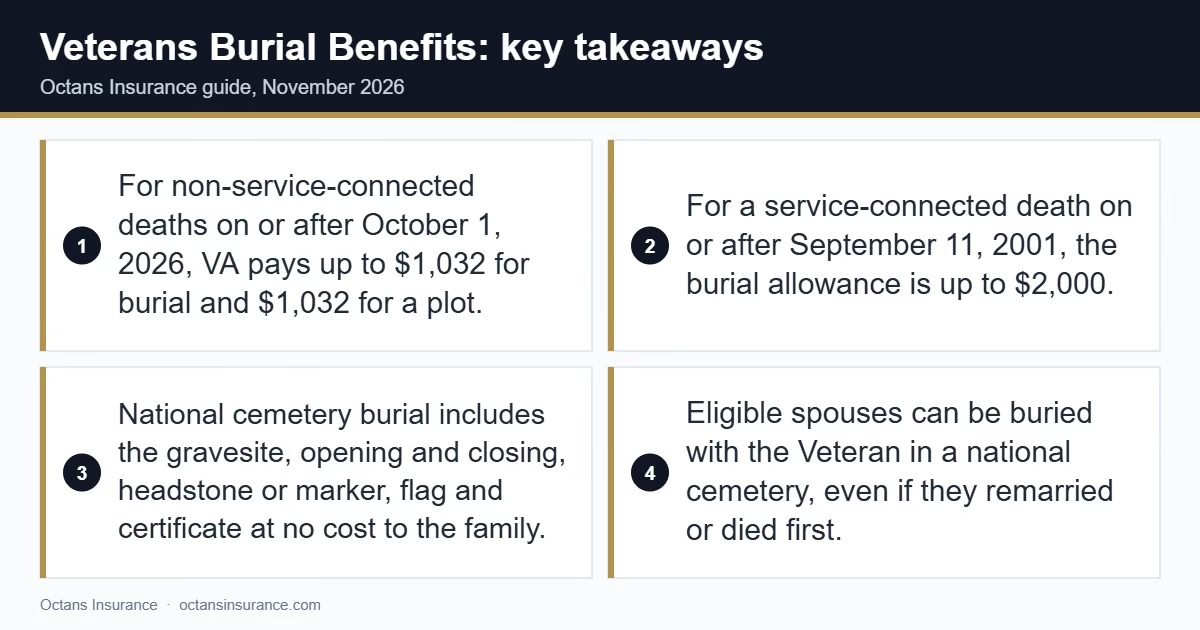
- For non-service-connected deaths on or after October 1, 2026, VA pays up to $1,032 for burial and $1,032 for a plot.
- For a service-connected death on or after September 11, 2001, the burial allowance is up to $2,000.
- National cemetery burial includes the gravesite, opening and closing, headstone or marker, flag and certificate at no cost to the family.
- Eligible spouses can be buried with the Veteran in a national cemetery, even if they remarried or died first.
Table of Contents
Make sure your family is financially protected today!
Veterans burial benefits include burial in a VA national cemetery at no cost to the family, a government headstone or marker, a burial flag and a Presidential Memorial Certificate. VA may also pay cash allowances: for a death on or after October 1, 2026, up to $1,032 toward burial plus $1,032 for a plot if the death wasn’t service connected, or up to $2,000 if it was.
What are veterans burial benefits?
VA burial benefits for veterans fall into two groups: money toward costs, and burial and memorial items. According to the Department of Veterans Affairs (VA) burial allowance page, the money can include:
- Burial allowance: help with some of the burial and funeral costs.
- Plot or interment allowance: help with some of the gravesite or interment costs.
- Transportation reimbursement: repayment for moving the Veteran’s remains to the final resting place, in certain cases, if you have a receipt in your name.
The burial and memorial items include a gravesite in a national cemetery, a headstone, marker or medallion, a burial flag and a Presidential Memorial Certificate. They don’t cover everything. VA says any item or service obtained from a funeral home or cremation office is at the family’s expense.
Who is eligible for VA burial benefits?
VA burial benefits eligibility starts with the Veteran’s discharge. VA’s national cemetery eligibility page says burial is open to:
- A Veteran who didn’t receive a dishonorable discharge.
- A service member who died on active duty, active duty for training or inactive duty for training.
- A National Guard or Reserve member who meets one of VA’s conditions, such as being entitled to retirement pay at the time of death.
- The spouse or surviving spouse of a Veteran, even if they remarried after the Veteran’s death.
- A Veteran’s minor child, and in some cases an unmarried adult dependent child.
The National Cemetery Administration describes burial as open to members of the armed forces who met a minimum active-duty service requirement and weren’t dishonorably discharged. Veterans convicted of certain serious crimes aren’t eligible.
The money part of veterans burial benefits has its own rules. The Veteran must not have received a dishonorable discharge, and one of these must be true:
- The death was service connected.
- The Veteran died while getting VA care, or while traveling to VA-authorized care at VA’s expense.
- The Veteran was receiving VA pension or compensation, or was eligible but received full military retirement or disability pay instead.
- A claim for VA compensation or pension was pending at death, and the Veteran would have been entitled to benefits.
The person applying must have paid the costs and not be repaid by another source, such as another government agency or the Veteran’s employer.
How much is the VA burial allowance in 2026?
The cash amounts in veterans burial benefits depend on the date of death and whether the death was service connected. VA considers a death service connected if it was due to an illness or injury caused, or made worse, by active-duty service.
| Situation | Most VA will pay |
|---|---|
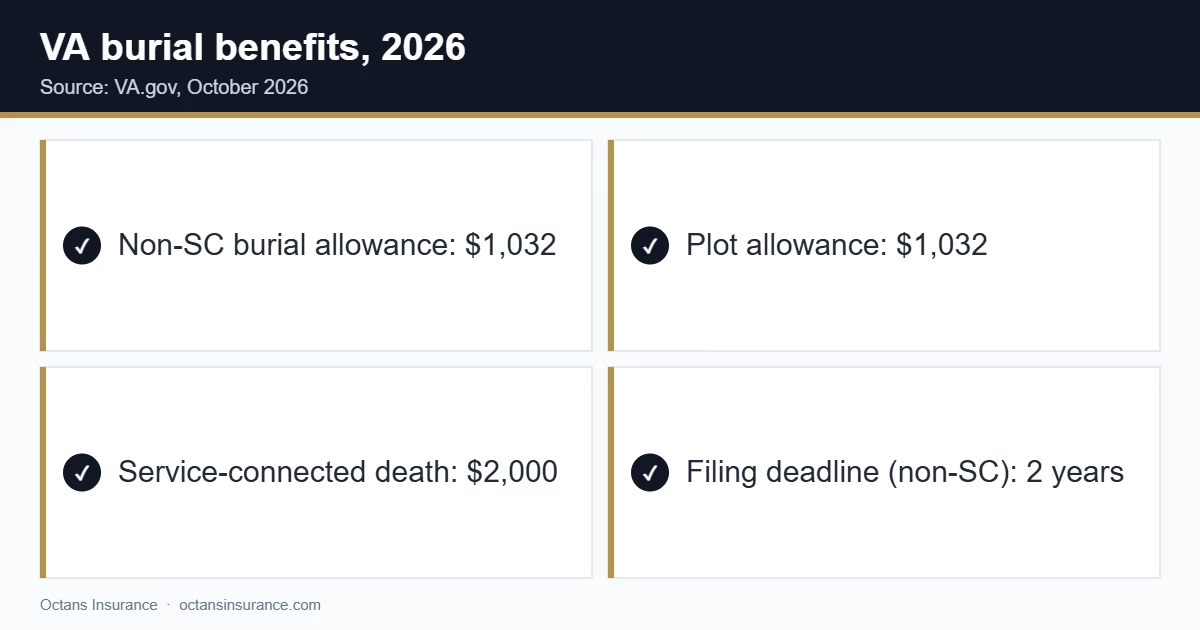
| Service-connected death on or after September 11, 2001 | Up to $2,000 burial allowance |
| Service-connected death before September 11, 2001 | Up to $1,500 burial allowance |
| Service-connected death, burial in a VA national cemetery | Some or all costs of moving the remains may be repaid |
| Non-service-connected death on or after October 1, 2026 | Up to $1,032 burial allowance and $1,032 for a plot |
Source: VA.gov, Veterans burial allowance and transportation benefits, tables for service-connected and non-service-connected deaths (last updated October 30, 2026). Amounts as of November 2026.
A few rules affect what you receive:
- Earlier deaths: VA’s table lists lower amounts for earlier dates of death, so check the row for the date the Veteran died.
- Transportation: for a non-service-connected death, VA may repay some or all moving costs if the Veteran was hospitalized or in a VA-contracted nursing home at the time of death, or died while traveling to VA-authorized care.
- Plot allowance: under federal rule 38 CFR 3.1707, it applies when an eligible Veteran is not buried in a national cemetery or another cemetery under U.S. jurisdiction.
- Surviving spouses: when VA learns of the death, it automatically pays eligible surviving spouses a set amount toward the plot, interment or transportation. No claim is needed if you’re listed as the spouse on the Veteran’s VA profile.
- Deadline: for a death that wasn’t service connected, file within 2 years after the burial. There’s no time limit if the death was service connected, if the Veteran died under VA care, or if you’re claiming the plot or interment allowance or transportation.
- Unclaimed remains: VA pays the person or organization responsible for the burial a burial allowance based on its non-service-connected rates.
Hypothetical example: A Veteran who was receiving VA disability compensation dies of an unrelated illness on October 20, 2026. The family pays $6,000 to a funeral home and $1,800 for a plot and interment in a private cemetery.
- Most VA would pay: $1,032 burial allowance + $1,032 plot allowance = $2,064.
- Family’s remaining cost: $6,000 + $1,800 = $7,800, and $7,800 − $2,064 = $5,736.
- With burial in a VA national cemetery instead, the gravesite, opening and closing, and headstone cost nothing, so the $1,800 cemetery bill goes away. The plot allowance no longer applies, so the family pays at most $6,000 − $1,032 = $4,968, before any transportation costs VA may repay.
The prices in this example are made up to show the math. Under federal rules (38 CFR 3.1705 and 3.1707), VA pays the maximum unless, when it learns of the death, it already has evidence that the costs were lower.
What does burial in a VA national cemetery include?
The National Cemetery Administration’s burial benefits page lists these at no cost to the family: a gravesite in any VA national cemetery with available space, opening and closing of the grave, perpetual care, a government headstone, marker or medallion, a Presidential Memorial Certificate and a burial flag.
Cremated remains are buried or inurned in national cemeteries in the same manner and with the same honors as casketed remains. What the family still pays for is anything bought from a funeral home or cremation office.
To arrange a burial, you or the funeral director call the National Cemetery Scheduling Office at 800-535-1117 (TTY 711), Monday through Friday, 8:00 a.m. to 7:30 p.m. ET. Have the Veteran’s DD214 or other discharge papers ready. Without them, VA may need several days to check eligibility. National cemeteries hold burials Monday through Friday.
For a Veteran or Reservist, also tell VA whether you’d like burial honors or memorial items, such as a burial flag, a Presidential Memorial Certificate or military honors beyond the playing of Taps and the folding and presentation of the flag. Details are on VA’s schedule a burial page.
Headstones, markers, flags and certificates
Veterans burial benefits also follow the Veteran to a private cemetery. VA provides these memorial items for an eligible Veteran there:
- Headstone or marker: VA provides a government headstone or marker for the unmarked grave of an eligible Veteran in any cemetery around the world. If the grave already has a private headstone, the Veteran must have died on or after November 1, 1990. Apply with VA Form 40-1330 online, by mail or by fax, per VA’s headstones and markers page. A private cemetery may charge setting or other fees.
- Medallion: a bronze medallion for a grave marked with a privately purchased headstone or marker. Apply with VA Form 40-1330M.
- Burial flag: a U.S. flag to drape a casket or place with an urn. Fill out VA Form 27-2008 and take it to a VA regional office or a U.S. post office, or ask the funeral director. VA can’t replace a flag that is lost, destroyed or stolen. See VA’s burial flags page for the service rules.
- Presidential Memorial Certificate: an engraved paper certificate signed by the current president. Next of kin, family members and close friends of a Veteran eligible for burial in a national cemetery can request one with VA Form 40-0247, and VA accepts multiple requests. See VA’s certificate page.
Veterans burial benefits for spouses and dependents
Veterans burial benefits for spouses and dependents are strongest in a national cemetery. There, an eligible spouse or dependent can be buried with the Veteran, and their name and dates of birth and death are inscribed on the Veteran’s headstone, at no cost to the family. Eligible spouses and dependents may be buried even if they die before the Veteran, and a surviving spouse stays eligible even after remarrying.
The rules are narrower elsewhere. A spouse or dependent child buried in a private cemetery isn’t eligible for a government headstone or marker. They may still be eligible for an inscription on the Veteran’s headstone or marker in that private cemetery.
How to apply for veterans burial benefits
Most families claim veterans burial benefits in the first weeks after a death, often with help from the funeral director:
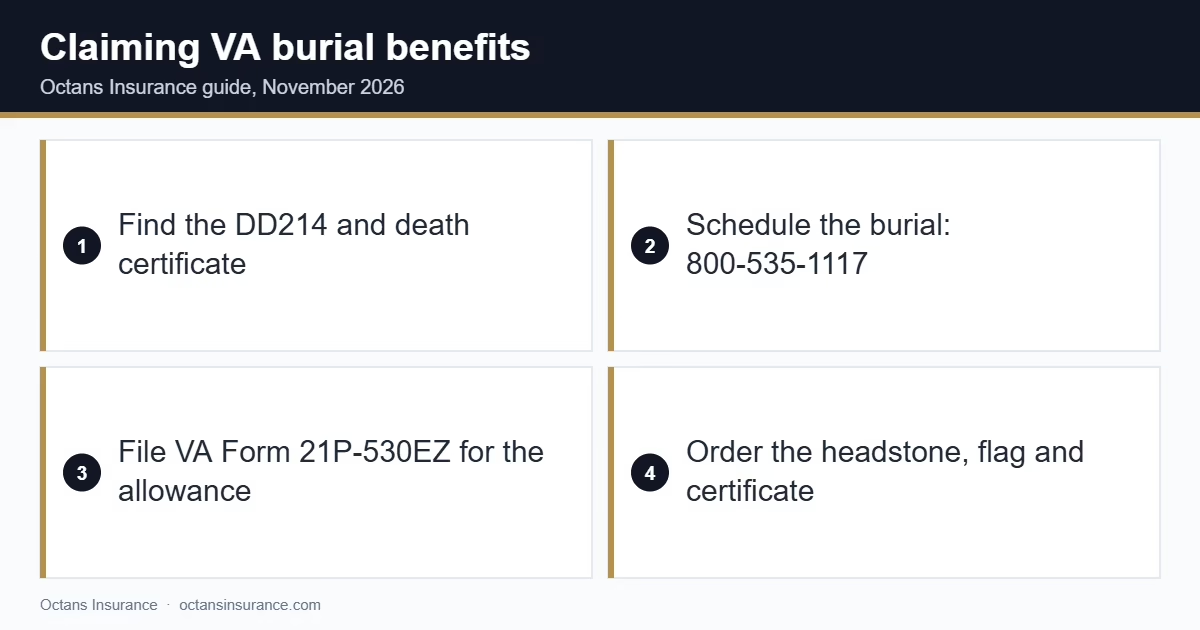
- Find the discharge papers. Locate the Veteran’s DD214 or other separation documents and the death certificate showing the cause of death.
- Schedule the burial. For a national cemetery, call 800-535-1117 or have the funeral director call. For a private cemetery, confirm any setting fees for a government headstone.
- Apply for the burial allowance. Use VA Form 21P-530EZ online, or mail it to the Department of Veterans Affairs, Pension Intake Center, PO Box 5365, Janesville, WI 53547-5365. Include an itemized receipt if you paid transportation costs.
- Order memorial items. Use VA Form 40-1330 for a headstone or marker, 40-1330M for a medallion, 27-2008 for a flag and 40-0247 for a certificate.
- Watch the deadline. File within 2 years after the burial if the death wasn’t service connected, unless an exception applies.
What should families do before a Veteran dies?
Planning ahead makes veterans burial benefits easier for your family to use. VA’s pre-need eligibility process lets Veterans, and family members connected to a Veteran, find out in advance whether they’re eligible for burial in a VA national cemetery, using VA Form 40-10007. A decision letter confirms eligibility, but it doesn’t identify a specific cemetery or gravesite, since these can’t be reserved in advance, and VA can’t guarantee burial in your preferred cemetery.
A short planning checklist:
- Keep the DD214 and any pre-need decision letter where family can find them.
- Write down whether the Veteran prefers a national, state or private cemetery, and burial or cremation.
- Make sure the spouse is listed correctly on the Veteran’s VA profile.
- List any life insurance, including VA or employer coverage, and who the beneficiaries are. Our guide on how to file a life insurance claim explains what they’ll need.
- Estimate the costs VA won’t cover, such as funeral home services.
Questions to ask the funeral home: Do you work with VA national cemeteries? Will you help file the veterans burial benefits forms, such as the burial allowance and flag forms? Which of your charges does VA not cover?
Veterans burial benefits frequently asked questions
How much does the VA pay toward a Veteran’s funeral?
Partly. VA burial benefits for veterans include cash allowances. For a death on or after October 1, 2026 that wasn’t service connected, VA may pay up to $1,032 toward burial costs and $1,032 for a plot. For a service-connected death on or after September 11, 2001, the burial allowance is up to $2,000. Burial in a VA national cemetery, with a headstone and flag, costs the family nothing, but funeral home services are the family’s expense.
Can a Veteran’s spouse be buried in a national cemetery?
Yes. Veterans burial benefits for spouses include burial with the Veteran in a VA national cemetery for an eligible spouse or surviving spouse, even if they remarried after the Veteran’s death or die before the Veteran. Their name and dates are inscribed on the Veteran’s headstone at no cost. A spouse buried in a private cemetery isn’t eligible for a government headstone or marker.
Does VA cover cremation?
Yes, veterans burial benefits apply to cremated remains. Cremated remains are buried or inurned in national cemeteries in the same manner and with the same honors as casketed remains. A burial flag can be placed with an urn. Cremation is bought from a funeral home or cremation office, so the family pays for it, though the burial allowance can help with costs.
Is there a deadline to apply for the VA burial allowance?
For a death that wasn’t service connected, you must file within 2 years after the burial. There’s no time limit if the death was service connected, if the Veteran died while under VA care, or if you’re claiming the plot or interment allowance or transportation. Apply with VA Form 21P-530EZ online or by mail.
Does a surviving spouse need to file a claim?
Usually not. If you’re listed as the spouse on the Veteran’s VA profile, VA automatically pays eligible surviving spouses a set amount toward the plot, interment or transportation when it learns of the death. Other family members, friends or a funeral home that paid the costs must apply with VA Form 21P-530EZ.

How a licensed Octans agent can help
Veterans burial benefits cover a lot, especially in a national cemetery, but funeral home costs usually fall on the family. A licensed Octans agent can walk you through ways to plan for that gap. Final expense insurance and burial insurance are options among others, such as savings, a prepaid funeral plan or existing coverage. Our guide to life insurance for veterans explains how VA coverage compares with private policies.
Octans compares coverage from more than 120 carriers in 19 states, and our funeral cost calculator can help you size a budget. If you’re sorting out costs now, see who pays for funeral costs. To talk with an agent, call (617) 935-9220.
Keep Reading: Related Guides
- Life insurance for veterans
- Final expense insurance
- Who pays for funeral costs
- Social Security Death Benefit
- What to Do When Someone Dies
- Funeral Cost
- Cost of a Headstone
Important: Octans Insurance agents are licensed in the states in which they operate. Coverage availability and rates may vary by state. Premium examples, when provided, are illustrative samples from published sources, not quotes. Final rates are determined by the insurance carrier based on underwriting and applicable policy criteria. Policy terms, exclusions, limitations, riders, and availability vary by carrier and state.
About examples and tools: Hypothetical examples, sample rates, calculators and quizzes on this site are for general educational and illustrative purposes only. They are not quotes, offers of coverage, or guarantees of eligibility, approval, price or benefits, and they are not legal, tax, financial or medical advice. The insurance company decides eligibility and price; Medicare rules are set by CMS and the Social Security Administration.
Plan for the funeral costs VA won’t cover
Start with a free, no-obligation quote review with a licensed Octans agent.
(617) 935-9220 | life@octansinsurance.com