
Term Life
What Happens When Term Life Insurance Ends? Your 4 Options
When term life insurance ends, your coverage simply stops unless you act. You can convert to permanent coverage without a medical exam, renew at much higher rates, buy a new policy, or let it lapse; you get no refund unless you bought return-of-premium term.
- Coverage stops at the end of the term unless you act.
- Conversion lets you switch to permanent coverage without a new exam.
- Renewing or buying new coverage later costs much more.
- Return-of-premium term refunds premiums but costs more upfront.
Table of Contents
What Happens When Term Life Insurance Ends?
When term life insurance ends, your coverage stops unless you take action. You do not get your premiums back unless you bought a return-of-premium policy. Most policies give you a few choices before or at the end of the term.
| Option | How it works | Best for |
|---|---|---|
| Convert to permanent coverage | Switch part or all of the policy to whole or universal life without a new medical exam | People whose health has changed |
| Renew the term | Keep coverage year by year at much higher, rising premiums | Short gaps, such as waiting for new coverage |
| Buy a new policy | Apply for new term or permanent coverage at your current age and health | Healthy people who still need coverage |
| Let it end | Stop paying; coverage ends | People whose debts are paid and family is secure |
How Does Converting Term Life Insurance Work?
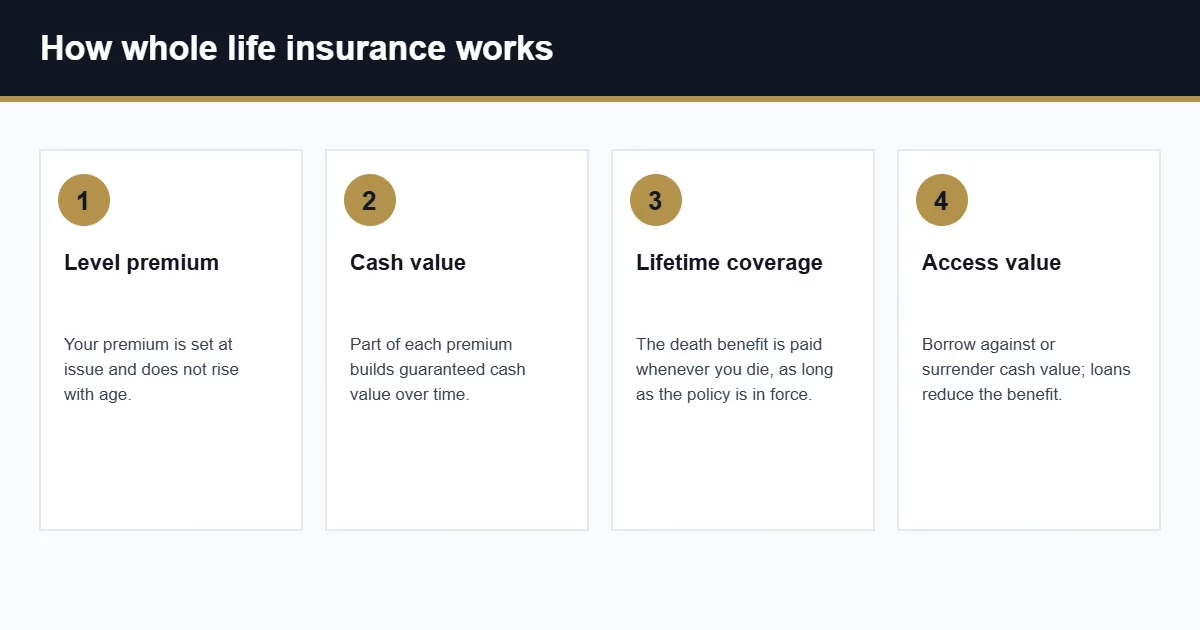
A conversion privilege lets you exchange your term policy for permanent coverage with no new health questions. Your new premium is based on your age at conversion, not your health. Check your policy for the conversion deadline; many carriers require you to convert before the term ends or before a set age, often 65 or 70.
What Does It Cost to Replace Term Coverage Later?
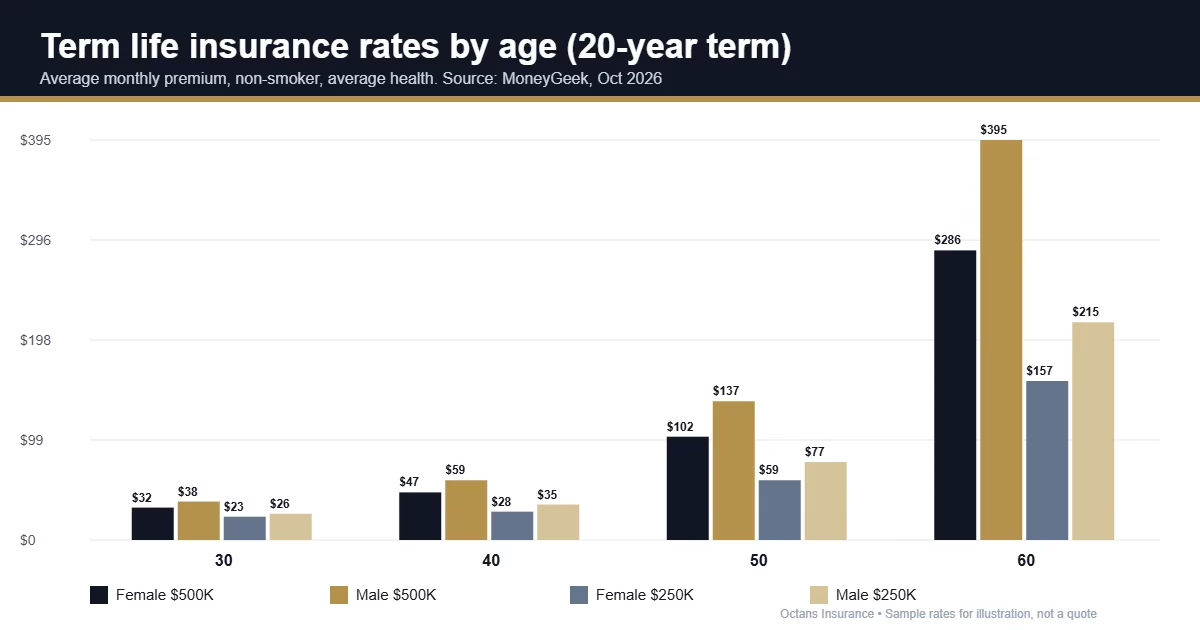
Waiting makes new coverage much more expensive. Published sample rates for a 20-year, $250,000 term policy show how the price climbs with age.
| Age when you buy | Female (monthly) | Male (monthly) |
|---|---|---|
| 40 | $28 | $35 |
| 50 | $59 | $77 |
| 60 | $157 | $215 |
Sample rates, not quotes: MoneyGeek, non-smoker in average health (Oct 11, 2026).
A man who bought at 40 for $35 a month would pay about $215 a month for the same new coverage at 60, if he still qualifies. That is why conversion matters when your health has changed.

What Is Return-of-Premium Term Life Insurance?
Return-of-premium (ROP) term refunds the premiums you paid if you outlive the term. It costs noticeably more than standard term, so compare the extra cost with what you could earn by investing the difference.
What Should You Do Before Your Term Ends?
- Find your policy and note the expiration and conversion deadlines.
- Decide whether you still need coverage and how much.
- Get quotes for new coverage while you are healthy.
- If your health has changed, ask your carrier for conversion options.
- Consider a smaller final expense policy for lifelong needs.
When should you start planning before your term ends?
Earlier than most people think. Thrivent suggests starting at least six months before the policy ends to avoid a gap in coverage. It also notes that some policies require you to convert a year or more before the term ends. If you wait until the final month, a key option may already be gone.
Planning early also gives you more choices. If you know what happens when term life insurance ends under your own contract, you can shop while you are still covered and still in your current health class.
Here is a simple timeline you can follow. Your policy’s dates come first, so check them against this plan.
| Time before term ends | What to do |
|---|---|
| 2 years | Find your policy. Note the end date, the conversion deadline and any renewal age limit. |
| 18 months | Decide if you still need coverage, and how much. List debts, dependents and final costs. |
| 12 months | Ask your insurer for a conversion quote. Get new-policy quotes from other carriers at the same time. |
| 6 months | Apply for any new policy. Underwriting can take time. |
| Final months | Keep the old policy until the new one is approved and in force. |
That last step matters. The NAIC warns not to drop an existing policy until you have studied the new one. If a new application is delayed or declined, your old coverage is your only protection until its end date.
Renew, convert or buy new: how do they compare?
Each path trades off cost, health checks and how long coverage lasts. This side-by-side summary draws on Thrivent and the NAIC.
| Option | Health check? | How the price works | How long it lasts |
|---|---|---|---|
| Renew the term | Usually no exam | Typically rises every year | Year to year, up to the maximum age in your policy |
| Convert to permanent | Usually no new exam | Based on your age at conversion; higher than term | For life, if premiums are paid |
| Buy a new policy | Yes, new underwriting | Based on current age and health | New term length, or for life |
| Let it end | None | No more premiums | Coverage stops |
Renewal is a short-term bridge. Thrivent notes some policies allow yearly renewal “often well into your 90s,” but premiums typically rise each year. The NAIC adds that you should ask whether the right to renew ends at a certain age.
Conversion is about access. It lets you keep coverage when your health would make a new policy hard to get. The trade-off is a higher premium for permanent coverage.
A new policy is usually the lowest-cost route if you are still healthy, because you are priced on current health, not on a guaranteed right.
What happens when term life insurance ends at 60 or 65?
Many 20- and 30-year policies end in your late 50s or 60s. Here are sample monthly prices for the most common next steps, from MoneyGeek term rates (Oct. 11, 2026), MoneyGeek whole life rates (Sept. 30, 2026) and Choice Mutual final expense rates (non-tobacco, valid Mar. 9, 2026), for healthy non-smokers. Samples, not a quote.
| Next step | Age 60 (F / M) | Age 65 (F / M) | Age 70 (F / M) |
|---|---|---|---|
| New $500,000, 20-year term | $286 / $395 | Not published | Not published |
| $100,000 whole life | $288 / $308 | $399 / $434 | $555 / $615 |
| $25,000 final expense whole life | $76 / $103 | $97 / $130 | $127 / $169 |
The table shows why many people step down in coverage when a term ends. Replacing a large policy at 60 can cost hundreds a month. A smaller final expense policy costs far less and never expires.
Here is a hypothetical example. A 60-year-old man’s $500,000 term is ending. His mortgage has $60,000 left, and his wife would need help with final costs. Instead of replacing all $500,000 at about $395 a month, he could buy a shorter, smaller term to cover the mortgage and a $25,000 final expense policy at about $103 a month. The right mix depends on actual quotes and his health.
Your conversion price will differ from these figures. It depends on your insurer’s permanent product and your age at conversion. Ask your carrier for an exact conversion quote, then compare it with new quotes.
Can you get a new policy without a medical exam?
Often, yes, though the limits shrink with age. Legal & General America’s underwriting guide lists no-exam term of up to $5 million for ages 20 to 60, but only up to $500,000 for ages 61 to 70. So turning 61 can change what you qualify for without an exam.
Skipping the exam does not have to cost much more if you are healthy. NerdWallet’s rate data (valid Oct. 1, 2026) shows a 50-year-old man in the best health class paying $810 a year with an exam and $814 without, for $500,000 of 20-year term.
Smaller no-exam policies are another route. Policygenius says simplified and guaranteed issue policies typically come with options between $25,000 and $40,000. These ask a few health questions, or none at all. See our no-exam life insurance guide for more.
What if your health has changed since you bought the policy?
This is when the end of a term can feel scary. If you have had cancer, heart disease or another serious condition, a new fully underwritten policy may be expensive or out of reach. You still have options:
- Convert before the deadline. Conversion usually needs no new medical exam, according to Thrivent. This is often the most valuable right in your policy if your health has declined.
- Apply for simplified issue coverage. These policies ask health questions but no exam. If you qualify, the full benefit is usually paid from day one.
- Consider guaranteed issue. There are no health questions. The trade-off is a waiting period: Choice Mutual says all guaranteed issue policies have a mandatory waiting period of two to three years. For the Mutual of Omaha product sold through Navy Mutual, a natural-cause death in the first two years pays 110% of premiums paid.
Guaranteed issue has age limits, too. Choice Mutual lists Mutual of Omaha’s issue ages as 45 to 85 (50 to 75 in New York), with benefits up to $25,000. Read more in our guaranteed issue life insurance and no waiting period guides.
Do you still need life insurance after the term ends?
Maybe not. Thrivent says going without coverage may suit people who are debt-free, have no dependents and have enough savings or retirement income to cover final expenses. Ask yourself:
- Is there still a mortgage or other debt your family would have to pay?
- Would a spouse lose income they depend on, such as a pension that shrinks at your death?
- Would your family struggle to pay for your funeral from savings?
- Do you want to leave money to children, grandchildren or a charity?
If you answered “no” to all four, letting the policy end may be reasonable. If you answered “yes” to even one, it is worth pricing out a smaller policy before you decide.
Funeral costs alone are worth planning for. The National Funeral Directors Association’s 2023 study put the national median at $8,300 for a funeral with viewing and burial, and $6,280 with cremation, as reported by Tribute Technology. Those figures exclude cemetery costs. If you do keep or buy coverage, your family generally won’t owe income tax on the payout: the IRS says death benefits paid to a beneficiary are generally not included in gross income, though interest paid on the proceeds is taxable.
Can you cancel term life before it ends?
Yes. According to Thrivent, you can cancel a term policy before the term ends, and there are usually no surrender charges or cancellation fees. You simply stop paying, or tell the insurer in writing.
What you will not get is money back. Thrivent notes that refunds are generally not given unless you cancel within the “free look” period right after you buy. Standard term has no cash value. The one exception is return-of-premium term, which is built to refund premiums if you outlive it.
Some people cancel early when their need ends ahead of schedule. Here is a hypothetical example. You bought a 30-year term at 35 to protect your family and your mortgage. At 58, the house is paid off, the kids are on their own, and your retirement savings are on track. Paying for seven more years of coverage you may not need could be money better spent elsewhere.
Before you cancel, though, check three things:
- Your conversion right. Once you cancel, it is gone. If there is any chance you will want permanent coverage later, convert first or keep the policy until you decide.
- Your health. If it has changed, the policy you already have may be worth more to you than any new one you could buy.
- Your spouse’s needs. A surviving spouse may still need help, for example if a pension shrinks at your death.
Knowing what happens when term life insurance ends, whether on schedule or early, helps you make this call on purpose instead of by default.
What happens to life insurance through work when you retire?
Group life through an employer is usually term coverage, and the end date is tied to your job. When you retire or leave, that coverage may stop. Ask HR well ahead of time:
- Does my coverage end on my last day, or later?
- Can I convert it to an individual policy, and by when?
- Can I keep it at group rates after I leave, and for how long?
- What would the premium be if I convert or keep it?
Work coverage has a tax side, too. The IRS excludes the first $50,000 of employer group-term life from income, and the cost of coverage above $50,000 is added to your taxable pay. Once you retire, that tax goes away, but so does the coverage unless you act.
If your personal term policy and your work coverage both end around retirement, you could lose most of your life insurance at once. Knowing what happens when term life insurance ends for each policy helps you avoid that gap. For help choosing, see term vs whole life insurance or our life insurance over 60 guide.
Term Life Ending FAQ
Do you get money back when term life insurance ends?
No, unless you bought a return-of-premium policy. Standard term life has no cash value.
Can I extend my term life insurance?
Many policies let you renew annually after the term, but premiums rise sharply each year. Converting or buying a new policy is often better.
What is the deadline to convert term life insurance?
It varies by policy. Many carriers require conversion before the term ends or before a certain age, often 65 or 70. Check your policy documents.
At what age does term life insurance end?
It ends when the term you chose is over, for example 20 years after you bought it. Many policies also set a maximum age for renewal or conversion, such as 70, 80 or 95. Check the expiry date and conversion period in your policy.
Related Coverage and Guides
Sources: MoneyGeek term life rates by age; NAIC consumer guide to life insurance.
Important: Octans Insurance agents are licensed in the states in which they operate. Coverage availability and rates may vary by state. Premium examples, when provided, are illustrative samples from published sources, not quotes. Final rates are determined by the insurance carrier based on underwriting and applicable policy criteria. Policy terms, exclusions, limitations, riders, and availability vary by carrier and state.
Ready to Compare Your Options?
Start with a free, no-obligation quote review with a licensed Octans agent.
(617) 935-9220 | life@octansinsurance.com