
Important Documents for Aging Parents: Caregiver Checklist
Important Documents for Aging Parents: The Short Answer
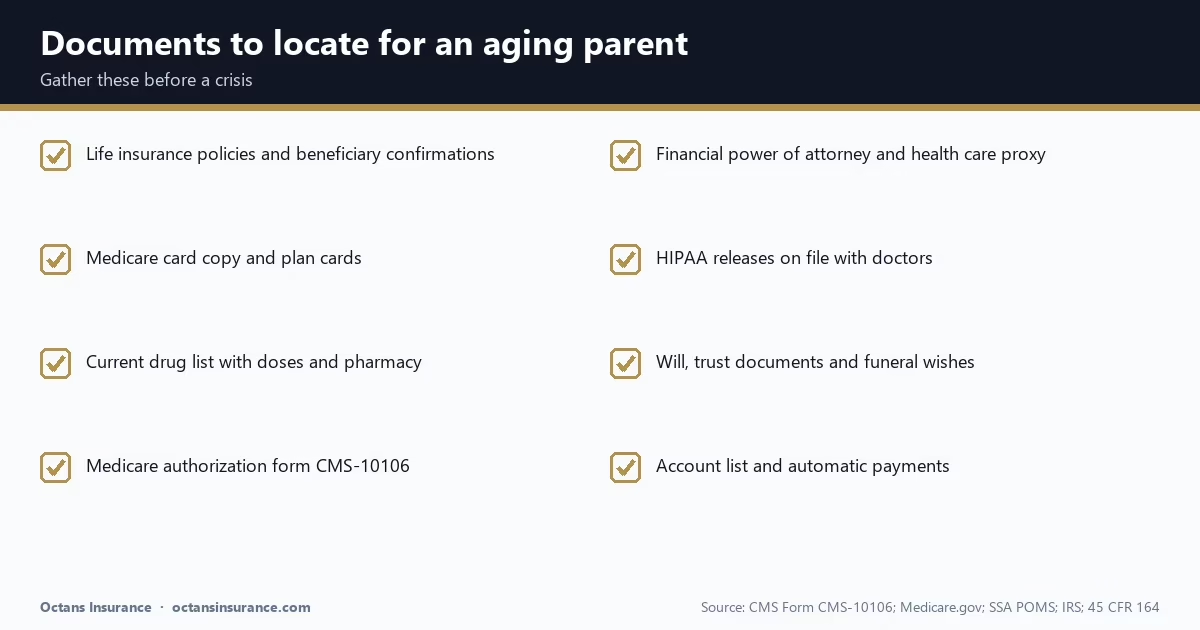
The important documents for aging parents include life insurance policies and beneficiary forms, Medicare and plan cards, a current drug list, a power of attorney and health care proxy, Medicare’s authorization form CMS-10106, a will and funeral wishes, and a list of accounts. Gather them while your parent can still sign permission forms.
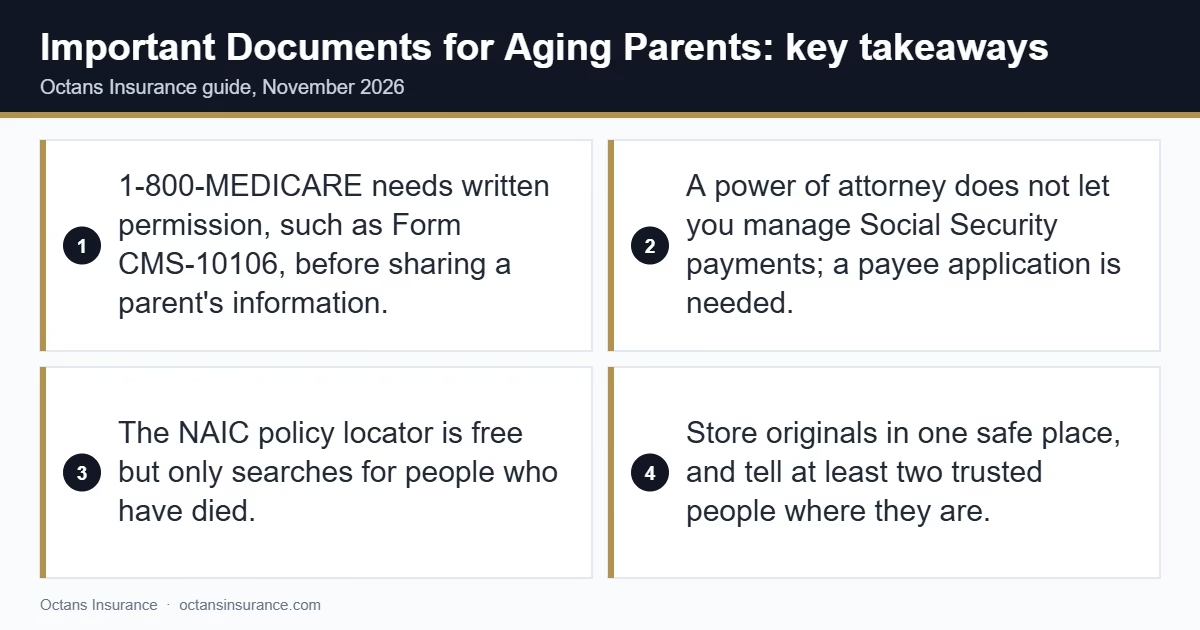
- 1-800-MEDICARE needs written permission, such as Form CMS-10106, before sharing a parent’s information.
- A power of attorney does not let you manage Social Security payments; a payee application is needed.
- The NAIC policy locator is free but only searches for people who have died.
- Store originals in one safe place, and tell at least two trusted people where they are.
Table of Contents
Make sure your family is financially protected today!
The important documents for aging parents fall into five groups: insurance policies and beneficiary forms, Medicare and plan cards, legal papers such as a power of attorney, a will and funeral wishes, and a list of accounts. Find them now, while your parent can sign permission forms, not during a crisis.
Why gather important documents for aging parents now
Many offices can’t talk to you about your parent without written permission. According to Medicare’s authorization form, CMS-10106, the law requires 1-800-MEDICARE to have permission in writing before it shares information with anyone other than the person with Medicare.
Social Security has its own rules. A power of attorney does not let you manage a parent’s benefit payments. Social Security’s operations manual (POMS GN 00502.139) says a power of attorney is not recognized by the Treasury Department for negotiating federal payments, so an agent must file a payee application. These steps are much easier while your parent can take part.
Life insurance policies and beneficiary forms
Life insurance papers are among the most important documents for aging parents to locate, because a claim starts with the policy number and the insurer’s name. Look for the policy itself, the latest annual statement, and the insurer’s name, phone number and policy number. Ask your parent who the beneficiaries are, and whether the insurer has confirmed them in writing. Don’t forget group life through a former employer, a union or a bank.
If you can’t find a policy after a parent dies, the NAIC Life Insurance Policy Locator is a free online tool. It only searches for people who have died, and you’ll need details from the death certificate. If no match is found, you won’t hear back. Our guide to finding a lost life insurance policy covers other places to look.
Medicare cards, plan cards and drug lists
Make a copy of your parent’s Medicare card and any plan cards. According to Medicare.gov, the Medicare Number is unique and is not the Social Security Number. If your parent has a Medicare Advantage plan, they show the plan’s card for care, but should still keep the Medicare card safe.
Medicare.gov says to share the Medicare Number only with providers, insurers or plans and their licensed agents, or trusted helpers such as a State Health Insurance Assistance Program. Medicare will never call uninvited and ask for personal information. A lost card can be replaced through a secure Medicare.gov account or by calling 1-800-MEDICARE.
Keep a current drug list too: each medicine, its dose, the prescriber and the pharmacy. You’ll need it for doctor visits and for comparing drug plans during open enrollment.
Power of attorney, health care proxy and HIPAA release
A financial power of attorney and a health care proxy are created under state law, so an elder law attorney is the right person to draft them. Find the originals and note where they are kept.
HIPAA already allows some sharing. Under 45 CFR 164.510(b), a provider may share information that is directly relevant to a family member’s role in care if the patient agrees or doesn’t object. If the patient is absent or incapacitated, the provider uses professional judgment. Under 45 CFR 164.502(g), a person with legal authority to make health decisions is treated as the patient’s personal representative.
For Medicare, use Form CMS-10106. Your parent can share any information or only limited types, such as claims or plan enrollment, and choose to share indefinitely or for set dates. It can be submitted through a secure Medicare.gov account or by mail. Your parent can cancel it at any time.
For Social Security, your parent can name people in advance as possible representative payees. According to POMS GN 00502.085, this can be done online, by phone, at an office or by mail on Form SSA-4547. For taxes, the IRS offers Form 8821 to let someone receive tax information, and Form 2848 to authorize a representative who is eligible to practice before the IRS.
Wills, trusts and funeral wishes
Ask where the original will is kept and who drafted it. If there is a trust, find the trust document and the name of the trustee. Write down any prepaid funeral contract, cemetery deed or burial insurance policy.
Ask, too, when your parent last reviewed the beneficiary forms on life insurance and retirement accounts. Those forms name who receives the money, so they should match current wishes after any marriage, divorce or death in the family. An elder law attorney can explain how they fit with a will in your state.
Funeral wishes belong on paper, too: burial or cremation, a service or none, and any religious needs. Our funeral cost calculator can help your family estimate what those wishes may cost.
Bank, retirement and bill-pay accounts
List each bank, retirement and investment account with the institution’s name and phone number. Never write full account numbers or passwords on a shared list. Note which bills are paid automatically, including insurance premiums. A premium that stops being paid can let a policy lapse.
Medicare premiums can be paid automatically, too. According to Medicare.gov’s forms page, Form SF-5510 starts, stops or changes Medicare Easy Pay. Knowing which account it draws from avoids surprises if that account changes.
How to store and share the documents safely
Keep originals in one safe place at home, such as a fire-resistant box, and tell at least two trusted people where it is. Keep copies with the person named as agent or executor. If you scan documents, store them in a password-protected account, not in email.
Decide who gets what. A sibling who handles bills may need the account list but not the medical records. For example, if two siblings share care, your parent can list both on Form CMS-10106. The form has room for 2 people or organizations on the front, and more can be added on the back.
Plan a yearly review of the important documents for aging parents, and add one after a move, a hospital stay or a death in the family. Update the drug list after every medication change, since an old list can mislead a doctor or an emergency room.
The full checklist: 20 important documents for aging parents
Use this caregiver checklist to work through the list. Check off each item and note where it is kept.
- Life insurance policies and latest statements
- Beneficiary confirmations from each insurer
- Group life coverage through an employer, union or bank
- Medicare card (copy)
- Medicare Advantage, Part D or Medigap plan cards
- Current drug list with doses, prescribers and pharmacy
- List of doctors and their phone numbers
- Medicare authorization form, CMS-10106
- Financial power of attorney
- Health care proxy and any living will
- HIPAA release forms on file with doctors
- Social Security advance designation or payee details
- IRS Form 8821 or 2848, if used
- Will and the attorney’s contact information
- Trust documents and trustee name
- Prepaid funeral contract, cemetery deed or burial policy
- Written funeral and burial wishes
- Bank, retirement and investment account list
- Automatic payments, including insurance premiums
- Recent tax returns
For more on coverage for a parent, see our life insurance for parents guide and how to file a life insurance claim.
Keep Reading: Related Guides
- Life Insurance for Parents Guide
- How to Find a Lost Life Insurance Policy
- How to File a Life Insurance Claim
- Funeral Cost Calculator
- Gift a Life Insurance Policy
- Primary vs Contingent Beneficiary
Important Documents for Aging Parents: Frequently Asked Questions
What documents should I have for my elderly parents?
Start with life insurance policies and beneficiary confirmations, Medicare and plan cards, a current drug list and a list of doctors. Add a financial power of attorney, a health care proxy, HIPAA releases and Medicare’s Form CMS-10106. Then locate the will, any trust, prepaid funeral contracts, written funeral wishes, a list of accounts and automatic payments, and recent tax returns. An elder law attorney can help with the legal papers.
How do I find out if my parent has life insurance?
While your parent is living, the simplest way is to ask, then look for policies, annual statements, premium payments on bank statements and group coverage through a former employer or union. After a death, the NAIC Life Insurance Policy Locator is a free tool that asks participating insurers to search. It only works for people who have died, and you won’t hear back if no match is found.
Can I talk to Medicare on my parent’s behalf?
Yes, with written permission. Your parent can fill out Form CMS-10106, the Authorization to Disclose Personal Health Information. It lets 1-800-MEDICARE share any information, or only limited types such as claims or plan enrollment, for as long as your parent chooses. It can be sent through a secure Medicare.gov account or by mail, and canceled at any time.
Why does a caregiver need a HIPAA authorization?
HIPAA lets a provider share information relevant to your role in care if your parent agrees or doesn’t object, but the provider decides how much. A signed release on file, or legal authority as a personal representative, makes it clearer what you may receive. Under 45 CFR 164.502(g), someone with legal authority to make health decisions is treated as the patient.
Where should important documents be kept?
Keep originals together in one safe place at home, such as a fire-resistant box, and make sure at least two trusted people know where it is. Give copies to the person named as agent or executor. If you scan documents, store them in a password-protected account rather than email, and never put full account numbers or passwords on a shared list.
This article is general information, not legal, tax, or medical advice. Premium examples are published samples, not quotes.
About examples and tools: Hypothetical examples, sample rates, calculators and quizzes on this site are for general educational and illustrative purposes only. They are not quotes, offers of coverage, or guarantees of eligibility, approval, price or benefits, and they are not legal, tax, financial or medical advice. The insurance company decides eligibility and price; Medicare rules are set by CMS and the Social Security Administration. Octans Insurance is not connected with or endorsed by the U.S. government or the federal Medicare program.