
Gift a Life Insurance Policy: How Ownership Works
Gift a Life Insurance Policy: The Short Answer
You can gift a life insurance policy by buying one you own on a grandchild, paying premiums on someone else’s policy, or transferring a policy you own. The owner controls the policy. Premiums you pay can count as gifts; the annual exclusion is $19,000 per recipient in 2026 and $20,000 in 2027. Ask a tax professional.
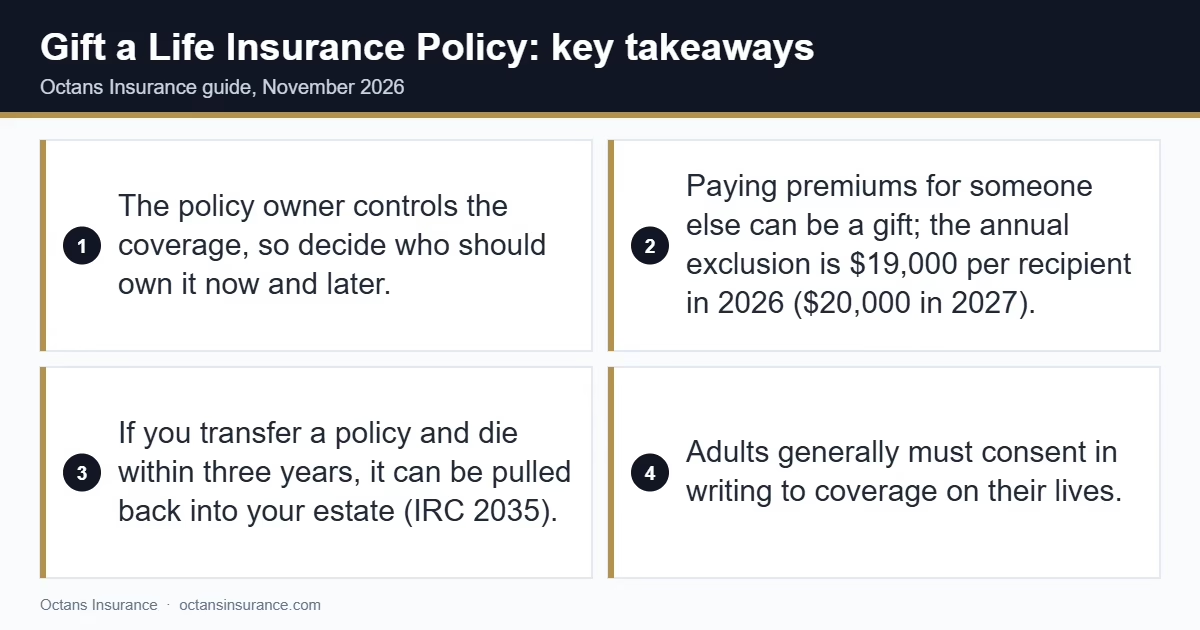
- The policy owner controls the coverage, so decide who should own it now and later.
- Paying premiums for someone else can be a gift; the annual exclusion is $19,000 per recipient in 2026 ($20,000 in 2027).
- If you transfer a policy and die within three years, it can be pulled back into your estate (IRC 2035).
- Adults generally must consent in writing to coverage on their lives.
Table of Contents
Make sure your family is financially protected today!
You can gift a life insurance policy in three main ways: buy a new policy that you own on a grandchild, pay premiums on someone else’s policy, or transfer ownership of a policy you already have. Ownership decides who controls the policy. Paying premiums or giving a policy away can also count as a gift for tax purposes.
Can you gift a life insurance policy?
Yes. But a policy isn’t like a sweater. Someone has to own it, someone is insured, and someone is named to receive the money. The owner controls the policy. The owner pays the premiums, can change the beneficiary and can cancel the coverage. The NAIC Life Insurance Buyer’s Guide notes that, as the policy owner, you can change beneficiaries at no cost.
So before you gift a life insurance policy, decide who should hold that control now, and who should hold it later. The answer shapes everything else in this guide.
Buying a new policy for a grandchild
A life insurance gift for grandchildren usually means a small juvenile policy. Our guide on whether child life insurance is worth it notes that some insurers let grandparents buy coverage. With some products, ownership passes to the child as an adult. If the policy offers a successor owner, name one in case you die before the hand-off.
Parents may still need to sign. In Massachusetts, M.G.L. c. 175, § 123 lets an insurer issue a policy on a child under 15 when a parent, guardian or other person with legal custody signs the application. Rules differ in other states, so talk with the parents first.
For example, our child life insurance guide shows a published sample rate of $3.70 a month for $5,000 of coverage on a child under 1 (a Delaware sample, March 2026). That’s $3.70 times 12, or $44.40 a year. It’s a sample, not a quote. See our life insurance for children guide for more options.
Paying premiums on someone else’s policy
Paying life insurance premiums for someone else is another way to gift a life insurance policy’s protection without owning it. The IRS gift tax FAQ defines a gift as any transfer to an individual, directly or indirectly, where full value isn’t received in return. Paying a premium on a policy your adult child owns can fit that definition.
The IRS lists the 2026 annual exclusion as $19,000 per recipient, or $38,000 when spouses split gifts. For example, our child life insurance guide shows a published sample rate of $59 a month for a 40-year-old man buying a $500,000, 20-year term policy. A year of that premium is $708. Add a $15,000 cash gift to the same person, and your 2026 total is $15,708, which is below $19,000. For 2027, the IRS announced on November 5, 2026 that the exclusion rises to $20,000 per recipient.
Keep one thing in mind. If your child owns the policy, they control it. They can change the beneficiary or stop paying, whoever funded it.
Gift a life insurance policy you already own: transferring ownership
To transfer ownership of life insurance you already own, ask the insurer for its change of ownership or assignment form. The new owner then controls the policy, including the beneficiary. You can’t take it back later unless the new owner agrees. Tax rules follow the transfer, so plan it carefully.
Some owners do this as part of estate planning, or to hand a policy to the adult child who will receive the benefit. Some give a policy to charity instead; see our guide on donating life insurance to charity.
A gift of a policy has a value. Under Treasury Regulation 25.2512-6, a newly bought policy is valued at its cost. For a policy already in force with more premiums due, the value may be approximated from its interpolated terminal reserve plus part of the last premium. According to the IRS, Form 712 is filed with Form 709 for insurance policy or premium amounts. Ask the insurer how to request one.
Timing matters too. Under 26 U.S.C. § 2035, the three-year rule, if you transfer an interest in a policy and die within three years, its value can be added back to your gross estate. That applies when the policy would have been included under section 2042 had you kept it. Section 2042 covers policies where you held any incidents of ownership at death.
Don’t sell a policy, even to family, without advice. IRS Publication 525 says death proceeds generally aren’t taxable unless the policy was turned over to the person receiving them for a price, or was acquired in a reportable policy sale.
Gift tax points to check with a professional
Most small premium gifts never come close to the limit. Still, check these points with a tax professional before you give:
| Situation | Point to check | Official source |
|---|---|---|
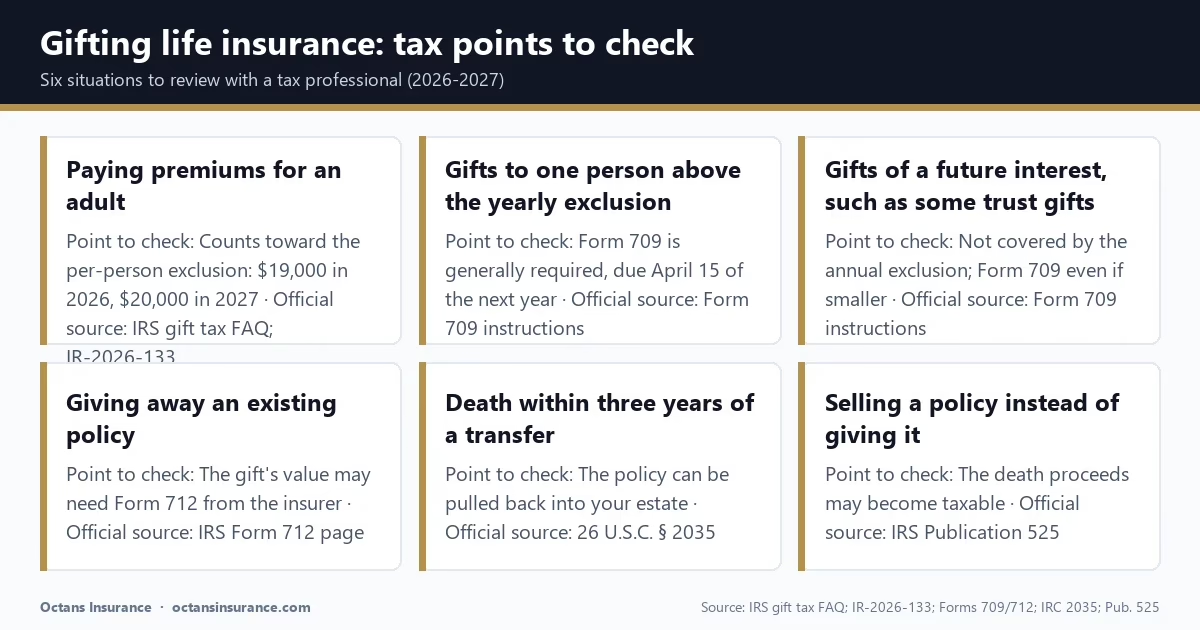
| Paying premiums for an adult | Counts toward the per-person exclusion: $19,000 in 2026, $20,000 in 2027 | IRS gift tax FAQ; IRS news release IR-2026-133 |
| Gifts to one person above the yearly exclusion | Form 709 is generally required, due April 15 of the next year | Form 709 instructions |
| Gifts of a future interest, such as some trust gifts | Not covered by the annual exclusion; Form 709 even if smaller | Form 709 instructions |
| Giving away an existing policy | The gift’s value may need Form 712 from the insurer | IRS Form 712 page |
| Death within three years of a transfer | The policy can be pulled back into your estate | 26 U.S.C. § 2035 |
| Selling a policy instead of giving it | The death proceeds may become taxable | IRS Publication 525 |
The Form 709 instructions explain the filing and future interest rules. The IRS FAQ adds that the donor is generally the one responsible for paying any gift tax. Read more in our guide to whether life insurance is taxable, and ask a tax professional about your own situation.
Consent and insurable interest rules
You can’t buy a policy on just anyone. New York’s Insurance Law § 3205 is a clear example. It says close relatives have an insurable interest based on love and affection. Others need a lawful and substantial economic interest in the insured’s continued life, health or bodily safety. It also says the insured generally must apply for, or consent in writing to, the policy. Exceptions include spouses and minors under 14 years and six months.
Massachusetts § 123 also requires a written application signed or agreed to in writing by the person insured, with the exceptions for children noted above. For adults, that means no surprise policies. If you want coverage on a parent, our guide on life insurance on your parents explains the consent steps.
Gift alternatives to compare
Should you gift a life insurance policy or something else? It depends on what you want the gift to do. A small juvenile policy can lock in coverage early, but the payout is modest and someone has to keep paying. Paying an adult child’s premiums keeps family coverage in place, yet they keep control. Giving your own policy can help with estate planning, but it is permanent and has tax effects.
Our child life insurance guide notes that parents may already have a child rider or may prefer a 529 plan. A cash gift or savings account is simpler. Talk with the family first, and ask a tax professional before any large transfer.
Keep Reading: Related Guides
- Is child life insurance worth it?
- Life insurance for children
- Is life insurance taxable?
- Life insurance on your parents
- Donating life insurance to charity
- Primary vs Contingent Beneficiary
- How to Change Life Insurance Beneficiary
Gift a Life Insurance Policy: Frequently Asked Questions
Can I buy a life insurance policy as a gift?
Yes, in several ways. You can buy and own a new policy on a grandchild, pay premiums on a policy someone else owns, or transfer a policy you own. You can’t buy coverage on an adult without consent. New York’s Insurance Law § 3205, for example, generally requires the insured to apply or consent in writing. Decide who should own the policy before you buy.
Can grandparents own a life insurance policy on a grandchild?
Often, yes. Some insurers let grandparents buy juvenile policies, and some products pass ownership to the child as an adult. State rules may require a parent’s signature. In Massachusetts, M.G.L. c. 175, § 123 lets an insurer issue a policy on a child under 15 when a parent, guardian or person with legal custody signs the application. Name a successor owner if the policy offers one.
Is paying someone’s life insurance premium a gift?
It can be. The IRS gift tax FAQ defines a gift as any transfer to an individual, directly or indirectly, without full value in return. Paying a premium on a policy your adult child owns can fit. The IRS lists the 2026 annual exclusion as $19,000 per recipient and has announced $20,000 for 2027, so most premium gifts stay under it. Ask a tax professional about larger gifts.
How do I transfer ownership of a life insurance policy?
Ask your insurer for its change of ownership or assignment form, complete it and get written confirmation. The new owner then controls the policy. Under 26 U.S.C. § 2035, if you die within three years of transferring a policy, its value can be added back to your estate. A transfer can also require a gift tax return, so ask a tax professional first.
Can I take out life insurance on someone without their consent?
Generally not, for adults. New York’s Insurance Law § 3205 says the insured generally must apply for, or consent in writing to, the policy. Massachusetts requires an application signed or agreed to in writing by the person insured. Exceptions cover certain children, spouses in New York and group coverage. You also need an insurable interest in the person’s life.
This article is general information, not legal, tax, or medical advice. Premium examples are published samples, not quotes.
About examples and tools: Hypothetical examples, sample rates, calculators and quizzes on this site are for general educational and illustrative purposes only. They are not quotes, offers of coverage, or guarantees of eligibility, approval, price or benefits, and they are not legal, tax, financial or medical advice. The insurance company decides eligibility and price; Medicare rules are set by CMS and the Social Security Administration.