
Starting a New Medicare Plan: January 1 Checklist
Starting a New Medicare Plan: The Short Answer
Starting a new Medicare plan on January 1 goes more smoothly with a checklist. Watch for your new member ID card and show it at your first 2027 visit. Confirm your doctors and pharmacy are in network, plan refills and premium payments, and know that Medicare Advantage members can make one change from January 1 to March 31.
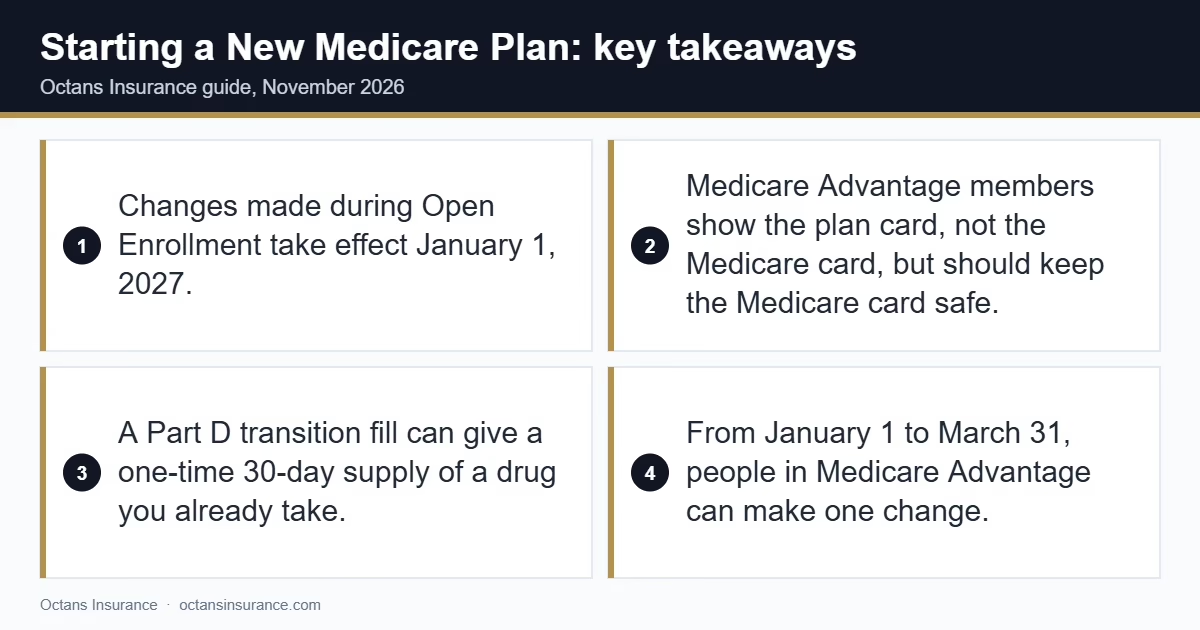
- Changes made during Open Enrollment take effect January 1, 2027.
- Medicare Advantage members show the plan card, not the Medicare card, but should keep the Medicare card safe.
- A Part D transition fill can give a one-time 30-day supply of a drug you already take.
- From January 1 to March 31, people in Medicare Advantage can make one change.
Table of Contents
Make sure your family is financially protected today!
Starting a new Medicare plan on January 1 goes more smoothly if you prepare with a short checklist. Watch for your new member ID card and show it at your first 2027 visit. Confirm your doctors and pharmacy are in the plan’s network. Plan your refills, set up premium payments, and know your options if the plan isn’t working.
Starting a new Medicare plan: what happens on January 1
If you switch plans during Medicare’s annual enrollment period, which runs through December 7, 2026, your new coverage starts on January 1, 2027. According to Medicare.gov’s Open Enrollment page, changes made from October 15 to December 7 take effect January 1 of the next year.
New plan year rules also start that day. Medicare.gov’s drug coverage costs page says no Medicare drug plan may have a deductible above $700 in 2027. The out-of-pocket threshold rises to $2,400. Our Medicare changes for 2027 guide covers the other updates.
Starting a new Medicare plan also means new rules for networks, drug lists and approvals. The checklist below helps you prepare in December and catch problems in the first week, not the first month.
Your new member ID card and welcome kit
Your new plan should send a letter confirming your enrollment and start date. According to Medicare.gov’s using your drug coverage page, a drug plan sends a letter within 2 weeks after it gets your completed application, and you should get a welcome package with your plan ID card within 5 weeks. If yours hasn’t arrived by then, call the plan’s member services number from your letter.
Don’t panic if you need a prescription first. The same page says you can prove coverage with the acknowledgement, confirmation or welcome letter from the plan. You can also show an enrollment confirmation number with the plan name and phone number. If you have none of these, your pharmacist may still be able to find your plan information.
Ask about an online account, too. Medicare.gov’s page on how to get Medicare services notes that plans may offer online accounts where you can view your plan card. A digital copy helps if the plastic card is late.
Which card to show at appointments and pharmacies
The right card depends on your coverage. Medicare.gov’s Medicare card page says Medicare Advantage members use the plan’s card to get services, not the Medicare card. People in Original Medicare carry their Medicare card, plus any drug plan or supplemental coverage card.
| Your 2027 coverage | At the doctor or hospital | At the pharmacy |
|---|---|---|
| Medicare Advantage with drug coverage | Plan card | Plan card |
| Original Medicare with Medigap and Part D | Medicare card and Medigap card | Part D plan card |
| Original Medicare with Part D only | Medicare card | Part D plan card |
Keep your red, white and blue Medicare card in a safe place. Medicare.gov says you may need it if you switch plans or go back to Original Medicare later. For prescriptions, the drug coverage page also suggests bringing a photo ID and your plan card, plus your Medicare card as proof that you have Medicare.
Check networks before your first visit. In a Medicare Advantage HMO, Medicare.gov’s HMO page says you generally must use the plan’s network, and in most cases you need a referral to see a specialist. Emergency care, out-of-area urgent care and temporary out-of-area dialysis are exceptions to the network rule.
Refills: transition supplies and prior authorizations
Your first prescription refill on a new plan is where surprises show up. A drug you’ve taken for years may not be on the new plan’s list, or may need prior authorization. Our guide to Medicare Part D explains drug lists and tiers. Medicare.gov’s drug plan rules page says that when your coverage begins, you may get a transition fill: a one-time, 30-day supply of a drug you’ve been taking that the plan doesn’t cover or that needs prior authorization or step therapy.
The federal rule, 42 CFR 423.120(b)(3), requires plans to offer this temporary supply within the first 90 days of coverage under a new plan. The plan must send you written notice within 3 business days after the fill.
For example, if your new Part D transition fill window starts January 1, 2027, the first 90 days run through March 31. That’s 31 days in January, 28 in February and 31 in March. Use that time. Ask your prescriber to request an exception or switch to a covered drug, as the plan rules page describes.
Medicare Advantage plans have a similar rule for ongoing care. Under 42 CFR 422.112(b)(8), a plan must give new enrollees at least a 90-day transition period for an active course of treatment. It must not disrupt or require reauthorization for that treatment during that time.
Setting up mail order and premium payments
If you take the same drugs every month, ask about longer fills. Medicare.gov suggests contacting your plan to see if you can get a 2- or 3-month supply for drugs you take regularly. Ask whether the plan offers mail order, and set it up early so the first shipment arrives on time.
Next, decide how to pay any premium. The drug coverage costs page says you can have your premium withheld from your Social Security payment. Contact your plan, not Social Security, to set this up. It may take up to 3 months to start. You’ll get a bill for any months not withheld and must pay the plan directly for them.
For example, if your plan premium were $40 a month and withholding began in March, you would pay January and February directly: 2 times $40, or $80. The $40 is only an illustration.
Keep paying your Part B premium, too. Medicare.gov’s costs page says you must keep paying it to stay in a Medicare Advantage plan or keep a Medigap policy. The 2026 standard amount is $202.90 a month, or more with higher income. CMS had not announced the 2027 Part B premium, deductible or income-related amounts (IRMAA) as of early November 2026. CMS released the 2026 amounts on November 14, 2025.
Closing out your old plan
Use this checklist as January 1 approaches and in your first week:
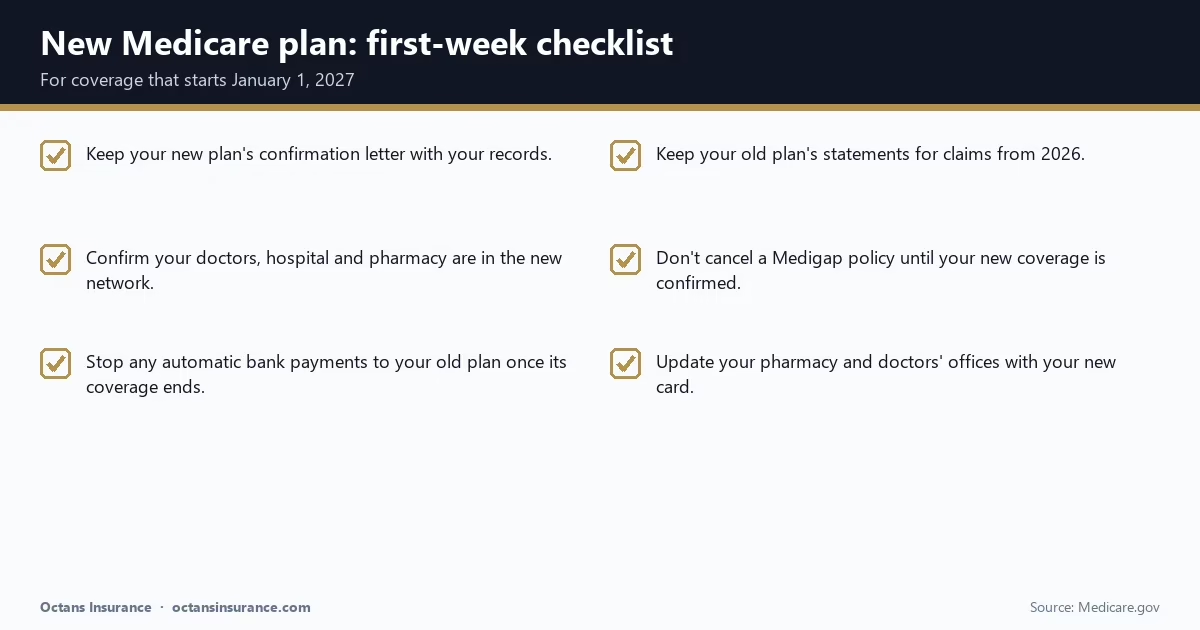
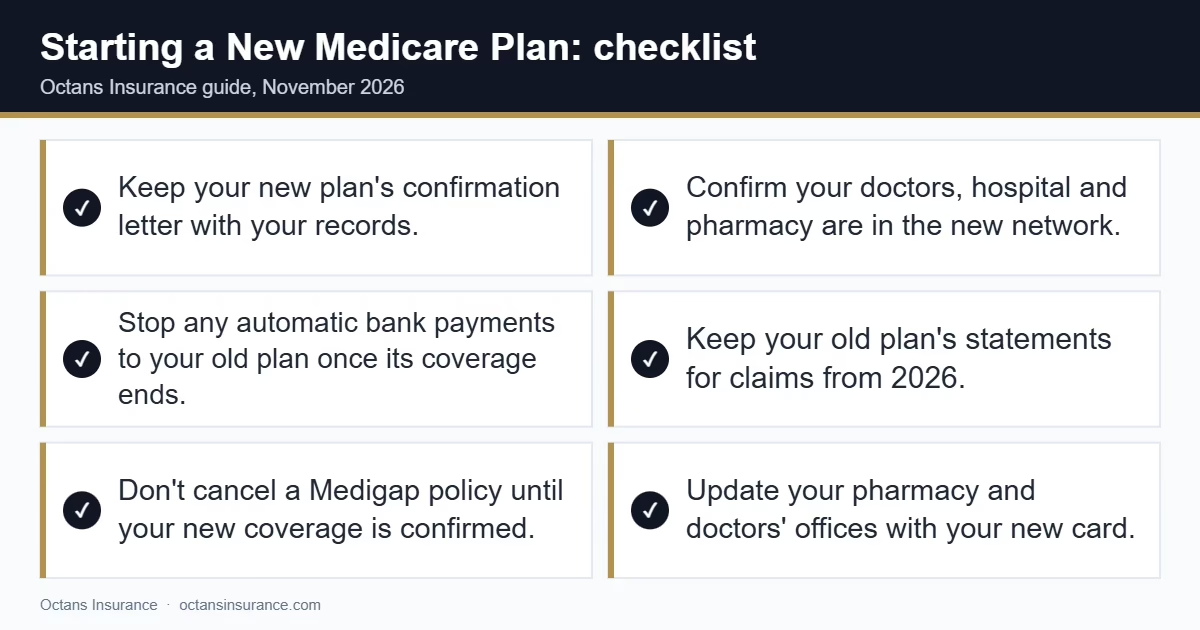
- Keep your new plan’s confirmation letter with your records.
- Confirm your doctors, hospital and pharmacy are in the new network.
- Stop any automatic bank payments to your old plan once its coverage ends.
- Keep your old plan’s statements for claims from 2026.
- Don’t cancel a Medigap policy until your new coverage is confirmed.
- Update your pharmacy and doctors’ offices with your new card.
For drug coverage, the Medicare.gov switching page says your old drug coverage ends when your new coverage begins, so you don’t need to cancel your old plan.
Medigap is different. According to Medicare.gov’s Medigap page, most Medigap policies don’t automatically cancel when you join a Medicare Advantage Plan. You must contact the insurer to cancel. Medicare.gov also warns that in most cases you won’t be able to get it back once you drop it.
Starting a new Medicare plan that isn’t working: options after January 1
A new Medicare Advantage plan doesn’t lock you in for the whole year. Medicare’s enrollment periods fact sheet describes the Medicare Advantage Open Enrollment Period. If you’re already in a Medicare Advantage Plan, it runs from January 1 to March 31.
During that window, you can switch to another Medicare Advantage Plan, or drop your plan and go back to Original Medicare and join a drug plan. You can make only one change. It takes effect the first day of the month after the plan gets your request. For example, if a new plan gets your request on February 10, your coverage starts March 1.
This window doesn’t let you switch from Original Medicare to Medicare Advantage, or change drug plans if you’re in Original Medicare. Before returning to Original Medicare, read our guide to Medicare Supplement underwriting. See how to change Medicare plans for the steps.
Keep Reading: Related Guides
- Medicare changes for 2027
- How to change Medicare plans
- What is Medicare Part D?
- Medicare Supplement underwriting
- Is Medicare Part D Going Away? 2027 Facts, Not Rumors
- Switch From Medicare Advantage to Medigap
Starting a New Medicare Plan: Frequently Asked Questions
When will I get my new Medicare plan card?
For a drug plan, Medicare.gov’s using your drug coverage page says you’ll get a letter within 2 weeks after the plan gets your completed application, and a welcome package with your plan ID card within 5 weeks. Keep the confirmation or welcome letter. If the card hasn’t arrived by then, call the member services number on that letter. Plans may also offer online accounts where you can view your card.
What if I need a prescription before my new card arrives?
You can still fill it. Medicare.gov’s using your drug coverage page says you can prove coverage with the acknowledgement, confirmation or welcome letter from your plan, or with an enrollment confirmation number plus the plan’s name and phone number. If you have none of these, your pharmacist may still be able to get your drug plan information.
What is a Part D transition fill?
It’s a temporary supply for a drug you already take. Medicare.gov’s drug plan rules page describes a one-time, 30-day supply of a drug your new plan doesn’t cover or that needs prior authorization or step therapy. Federal rules require plans to offer it within the first 90 days of coverage. Use that time to ask for an exception or switch to a covered drug.
Do I need to cancel my old Medicare plan?
Not for drug coverage. The Medicare.gov switching page says your old drug coverage ends when your new coverage begins, so you don’t need to cancel the old plan. Medigap is different. Medicare.gov says most Medigap policies don’t automatically cancel when you join a Medicare Advantage Plan, so contact the insurer, and confirm your new coverage before you drop it.
Can I change plans again after January 1?
If you’re in a Medicare Advantage Plan, yes, once. Medicare’s enrollment periods fact sheet says that from January 1 to March 31 you can switch to another Medicare Advantage Plan or return to Original Medicare and join a drug plan. The change starts the first of the month after the plan gets your request. This window doesn’t cover drug plan changes in Original Medicare.
We do not offer every plan available in your area. Please contact Medicare.gov or 1-800-MEDICARE to get information on all of your options.
This article is general information, not legal, tax, or medical advice. Premium examples are published samples, not quotes.
About examples and tools: Hypothetical examples, sample rates, calculators and quizzes on this site are for general educational and illustrative purposes only. They are not quotes, offers of coverage, or guarantees of eligibility, approval, price or benefits, and they are not legal, tax, financial or medical advice. The insurance company decides eligibility and price; Medicare rules are set by CMS and the Social Security Administration. Octans Insurance is not connected with or endorsed by the U.S. government or the federal Medicare program.