
Medicare Coverage
Medicare Observation Status: What It Costs and How to Appeal
Medicare observation status can change what you pay for a hospital stay and whether Part A covers skilled nursing care afterward. Learn how observation works, what the MOON notice means and when you can appeal.
- Observation makes you a hospital outpatient, even overnight; Part B pays, with a $283 deductible in 2026 and usually a copayment per service.
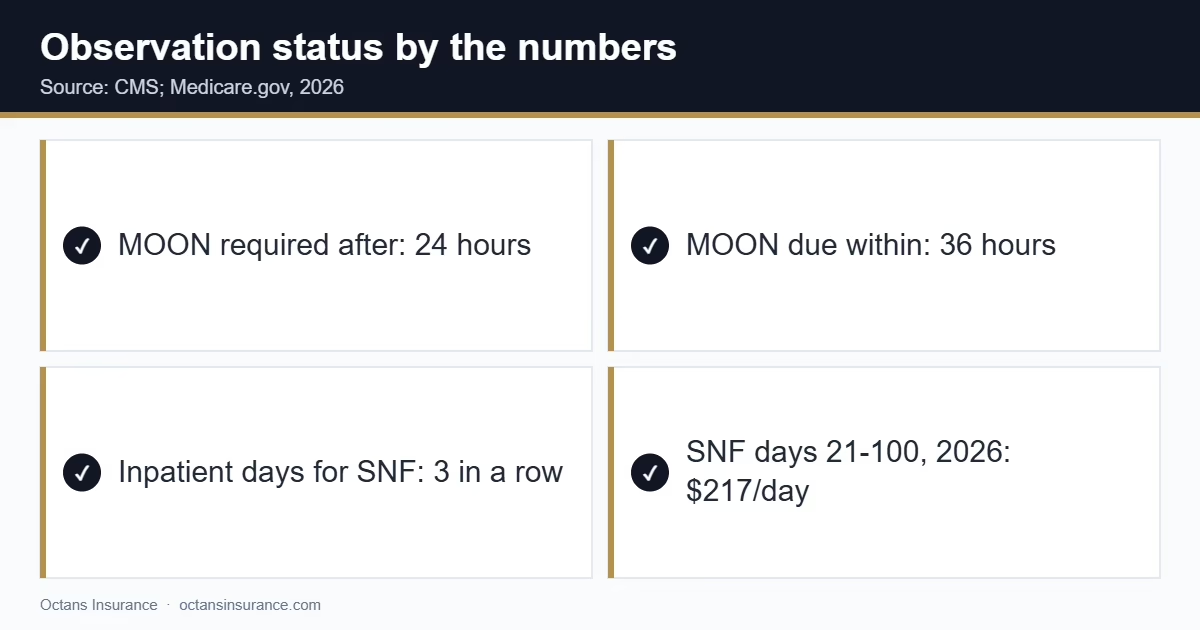
- Hospitals must give you a MOON after more than 24 hours of observation, no later than 36 hours after it starts.
- Observation days don’t count toward the 3 inpatient days in a row Part A needs before covering skilled nursing facility care.
- Since February 14, 2025, eligible Original Medicare patients moved from inpatient to observation can ask a BFCC-QIO for a fast appeal.
Table of Contents
Make sure your family is financially protected today!
Medicare observation status means the hospital is treating you as an outpatient, even if you stay overnight in a regular bed. Part B, not Part A, pays for the stay, so you usually owe the Part B deductible and a copayment for each hospital service. Observation days also don’t count toward the 3-day inpatient stay Medicare requires before it covers skilled nursing facility care.
What is Medicare observation status?
Observation services are hospital outpatient services you get while your doctor decides whether to admit you or send you home. Medicare.gov’s hospital status page says you can get them in the emergency department or another area of the hospital.
You become an inpatient only when the hospital formally admits you with a doctor’s order, and your last inpatient day is the day before you’re discharged. Medicare.gov says an admission is generally appropriate when you’re expected to need 2 or more midnights of medically necessary hospital care, but your doctor still has to order it.
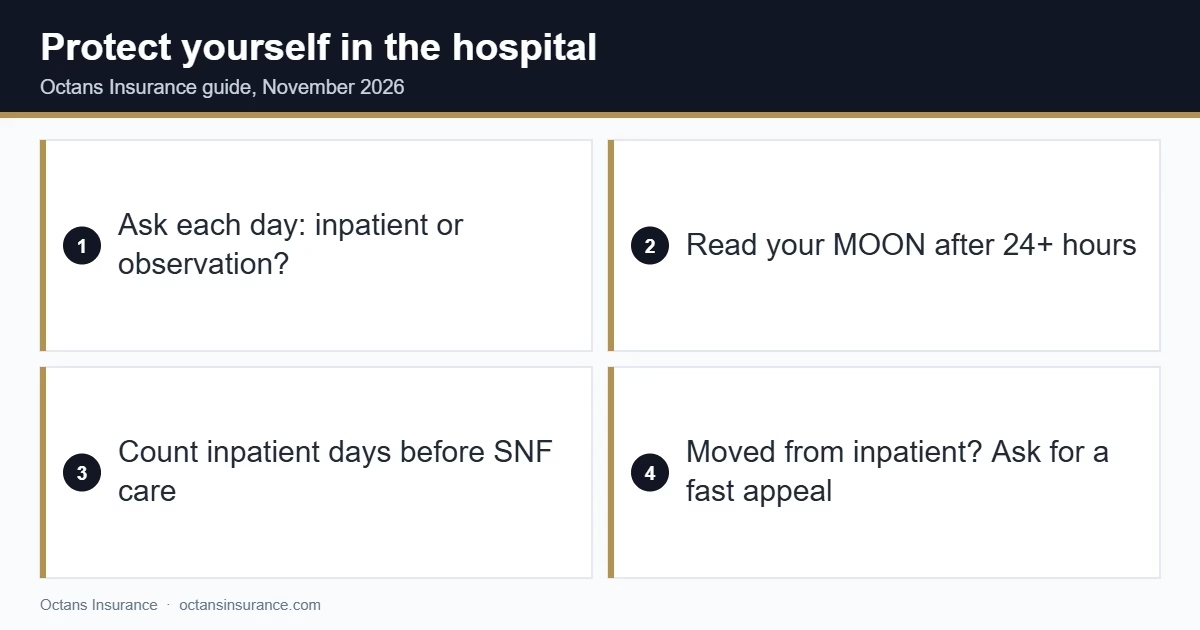
Your room won’t tell you your status, because even a night in a regular hospital bed can be an outpatient night. Medicare.gov says you or your caregiver should ask each day whether you’re an inpatient or an outpatient. The rules on Medicare and observation status below are for Original Medicare. With a Medicare Advantage plan, your costs and coverage may be different.

Observation status vs inpatient: what changes
Here’s how observation status vs inpatient status plays out in Original Medicare in 2026.
| What changes | Inpatient (formally admitted) | Outpatient getting observation services |
|---|---|---|
| Which part pays the hospital | Part A | Part B |
| Your share of the hospital bill | $1,736 Part A deductible per benefit period, then $0 a day for days 1 to 60 | $283 Part B deductible, then usually a copayment for each hospital service |
| Doctor services | Part B generally covers 80% of the Medicare-approved amount | You usually pay 20% of the Medicare-approved amount |
| Drugs you’d normally take on your own | Part A covers certain drugs as part of your inpatient treatment | Part B generally doesn’t cover them; Part D may, in certain cases |
| Counts toward the 3-day rule for skilled nursing care | Yes, from the day you’re admitted (not the day you leave) | No, even if you stay overnight |
| Notice you may get | Medicare Change of Status Notice (CMS-10868) if you’re moved to observation and eligible to appeal | Medicare Outpatient Observation Notice (CMS-10611) after more than 24 hours |
Sources: Medicare.gov coverage pages; CMS 2026 Parts A and B fact sheet; 42 CFR 489.20(y) and 405.1210. As of November 2026. Medicare Advantage plans set their own cost sharing, which can vary by plan and area.
How does Medicare observation status affect your costs?
Under Medicare observation status, your hospital care falls under Medicare Part B. Medicare.gov’s outpatient hospital services page says that after the Part B deductible ($283 in 2026), you pay 20% of the Medicare-approved amount, and other costs may apply:
- Hospital copayments. You usually pay the hospital a copayment for each service. In most cases, one service’s copayment can’t be more than the Part A deductible ($1,736 in 2026), but your total for all outpatient services can be. At a critical access hospital, your copayment may be higher and may exceed the Part A deductible.
- Pills you’d normally take yourself. Part B generally doesn’t cover these “self-administered drugs” in an outpatient setting, and many hospitals don’t let you bring drugs from home. If you have Medicare Part D, it may cover them in certain cases, but you’ll likely pay first and file a claim with your plan.
Observation isn’t always pricier for the hospital bill itself: Medicare says your Part B bill may be lower or higher than the Part A deductible. The bigger risk often comes later, if you need skilled nursing care. If observation ends in an admission, Part A covers the stay plus, for most hospitals, related outpatient services from the 3 days before admission.
What is the Medicare Outpatient Observation Notice (MOON)?
The Medicare Outpatient Observation Notice, or MOON, is a standard form (CMS-10611) that confirms your Medicare observation status: you’re an outpatient getting observation services, not an inpatient. Under federal rule 42 CFR 489.20(y), a hospital or critical access hospital must give it to you when you get observation services as an outpatient for more than 24 hours.
- Timing. You must get it no later than 36 hours after observation starts, or sooner if you’re transferred, discharged or admitted.
- Content. It explains why you’re an outpatient and how that affects your cost sharing and your eligibility for skilled nursing facility coverage later.
- Spoken explanation. Hospital staff must also explain it to you out loud.
- Medicare Advantage. CMS’s MOON page says hospitals must give the notice to Medicare Advantage plan members too.
A Medicare outpatient observation notice doesn’t by itself give you a right to appeal. Keep it with your discharge papers as a record of when observation started.
Medicare observation status and the 3-day rule
Part A covers skilled nursing facility (SNF) care only after a qualifying inpatient stay of at least 3 days in a row, counting the day you’re admitted but not the day you leave. Medicare.gov’s skilled nursing facility page says time under observation or in the emergency room before you’re admitted doesn’t count, even if you’re there overnight.
When you do qualify, you pay $0 a day for days 1 to 20 and $217 a day for days 21 to 100 in each benefit period in 2026. You don’t pay the $1,736 Part A deductible again if you already paid it for a hospital stay in the same benefit period. Our guide to nursing home coverage explains the rest of the SNF rules.
There are a few exceptions. You may not need 3 inpatient days if your doctor is part of an Accountable Care Organization approved for a “Skilled Nursing Facility 3-Day Rule Waiver.” Medicare Advantage plans may also waive the rule. If neither applies, ask about care in other settings, like home health care, or whether Medicaid or veterans’ benefits can help.
Hypothetical example: Clifford has Original Medicare. In 2026, he goes to the emergency room on a Sunday night and stays in observation through Monday. On Tuesday, his doctor writes an inpatient order. He leaves on Thursday and needs 24 days of skilled nursing care.
- Days that count: Tuesday and Wednesday. Sunday and Monday were observation, and Thursday is his discharge day. That’s 2 inpatient days, so 4 nights in the hospital don’t give him a qualifying stay.
- His hospital bill: the $1,736 Part A deductible, plus his Part B share of doctor bills, because most hospitals bill the observation days before admission with the inpatient stay.
- If he’d been admitted Sunday: 4 inpatient days would qualify. SNF days 1 to 20 would cost $0, and days 21 to 24 would cost 4 × $217 = $868, for a Part A total of $1,736 + $868 = $2,604.
- As it happened: Part A pays nothing for the 24 SNF days unless an exception applies, so he faces the facility’s charges on top of the $1,736.
Clifford was never moved from inpatient to observation, so the appeal below doesn’t apply to him.
Can you appeal Medicare observation status?
Usually not. CMS’s final rule fact sheet says a federal court ruled in March 2020 that people with Medicare aren’t entitled to appeal a hospital placing them in observation. But the court ordered new appeal rights for people formally admitted as inpatients whom the hospital later reclassified as outpatients getting observation services.
If you were hospitalized on or after February 14, 2025, you can ask for a fast appeal of a Medicare observation status change when all of these apply:
- A doctor or other qualified practitioner ordered your inpatient admission, and the hospital formally admitted you.
- The hospital later changed your status to outpatient getting observation services.
- You didn’t have Part B, or you stayed in the hospital 3 or more days in a row but were an inpatient for fewer than 3 days.
If you qualify, the hospital must give you a Medicare Change of Status Notice (CMS-10868) no later than 4 hours before you leave. With Part B, CMS says you must reach your 3rd hospital day before you get it. The notice explains the billing change, that Medicare won’t pay for a skilled nursing facility stay after you leave, and how to reach your Beneficiary and Family Centered Care Quality Improvement Organization (BFCC-QIO).
How to appeal a status change while you’re in the hospital
- Read your Medicare Change of Status Notice. If you think you should have gotten one, ask for it.
- Contact the BFCC-QIO before you leave, in writing or by phone. Medicare.gov’s fast appeal page says Commence or Acentra runs it, depending on your state.
- Stay reachable to share your views. Sending written evidence is optional.
- Ask the hospital for copies of what it sends the BFCC-QIO.
- Wait for the decision. The BFCC-QIO must decide within 1 calendar day after it gets the records it asked for; Medicare.gov says you’ll hear about 2 days after you file. While a timely fast appeal is pending, the hospital can’t bill you for the disputed services.
- If you’ve already left, you can still ask. The decision then comes within 2 calendar days after the records arrive, but the billing protection doesn’t apply.
- If you disagree with the decision, follow the written notice’s steps to ask for a reconsideration.
If the BFCC-QIO decides your status shouldn’t have changed, you pay the Part A inpatient deductible and may qualify for a covered SNF stay within 30 days of discharge if you meet the other rules. If it decides the change was right, you pay Part B costs, or the full outpatient cost without Part B, and you won’t qualify for a covered SNF stay after that visit.
A one-time process covers past stays from January 1, 2009, through February 13, 2025. Its 365-day filing window ended January 2, 2026. Medicare.gov says requests received after that date are denied unless you show good cause for filing late, and requests filed after May 15, 2026, face significant processing delays. CMS’s status-change appeals page explains the good-cause rule for late requests and has the form (CMS-10885).
Questions to ask about your hospital status
Ask these questions about Medicare and observation status each day. You can ask your doctor, the hospital, a hospital social worker or a patient advocate.
- Am I an inpatient today, or an outpatient getting observation services?
- What date does the hospital count as my first inpatient day, and how many will I have by discharge?
- If I’ve been in observation more than 24 hours, when will I get my MOON?
- Was my status ever changed from inpatient to observation? If so, where is my Medicare Change of Status Notice?
- Does my doctor belong to an Accountable Care Organization with a 3-day rule waiver?
- Which drugs am I getting that I’d normally take myself, and will the hospital bill me for them?
- If I’m in a Medicare Advantage plan, does it waive the 3-day rule, and what will this stay cost me?
Medicare observation status frequently asked questions
Does Medicare cover observation status?
Yes. Part B covers observation services as outpatient hospital care. After the $283 Part B deductible in 2026, you usually pay a copayment for each hospital service and 20% of the Medicare-approved amount for doctors’ services. But observation time doesn’t count toward the 3 inpatient days in a row that Part A needs before it covers skilled nursing facility care.
Is observation status different with Medicare Advantage?
In some ways. Hospitals must still give Medicare Advantage members the MOON when observation lasts more than 24 hours. But your plan sets your costs, may charge copayments, and may waive the 3-day inpatient rule for skilled nursing care. Medicare describes the new status-change appeals as an Original Medicare right, so ask your plan about its own appeal process.
What if I don’t sign the Medicare outpatient observation notice?
The hospital still has to give you the notice and explain it out loud. If you or your representative refuse to sign, the staff member who presented it signs instead, noting their name and title, the date and time, and that it was presented. Your signature only acknowledges that you received the notice. It doesn’t mean you agree with it.
Can I still appeal a past observation stay?
Only in limited cases. The one-time process for status changes during stays from January 1, 2009, through February 13, 2025, had a 365-day filing window that ended January 2, 2026. Medicare.gov says requests received after that date are denied unless you show good cause for filing late. For current stays, the fast appeal applies only if you were admitted as an inpatient and then moved to observation.
Who decides observation status vs inpatient status?
Your doctor orders an inpatient admission, and the hospital formally admits you. Medicare.gov calls it a complex medical decision based on your doctor’s judgment and your need for medically necessary hospital care. If the hospital later changes you from inpatient to outpatient, your doctor must agree, and the hospital must tell you in writing before you’re discharged.

How a licensed Octans agent can help
Octans Insurance is an independent agency, not Medicare or a government office. A licensed agent can’t change your hospital status or decide an appeal. But an agent can explain how your coverage handles Medicare observation status, outpatient hospital bills and skilled nursing care.
If you’re choosing coverage, an agent can compare how Medicare Supplement (Medigap) policies and Medicare Advantage plans in your area handle these costs, including whether a plan waives the 3-day rule. Call (617) 935-9220.
For unbiased counseling at no charge, contact your State Health Insurance Assistance Program (SHIP) at shiphelp.org. You can also call 1-800-MEDICARE (1-800-633-4227; TTY 1-877-486-2048), including with questions about the status-change appeal process.
Keep Reading: Related Guides
- Does Medicare cover nursing home care?
- Medicare Part A explained
- Does Medicare cover ER visits?
- Does Medicare Cover Knee Replacement?
We do not offer every plan available in your area. Please contact Medicare.gov or 1-800-MEDICARE to get information on all of your options.
This article is for general information and is not tax, legal, or medical advice.
About examples and tools: Hypothetical examples, sample rates, calculators and quizzes on this site are for general educational and illustrative purposes only. They are not quotes, offers of coverage, or guarantees of eligibility, approval, price or benefits, and they are not legal, tax, financial or medical advice. The insurance company decides eligibility and price; Medicare rules are set by CMS and the Social Security Administration. Octans Insurance is not connected with or endorsed by the U.S. government or the federal Medicare program.
Questions about hospital and nursing costs? Ask an agent
Start with a free, no-obligation quote review with a licensed Octans agent.
(617) 935-9220 | life@octansinsurance.com