
Creditable Prescription Drug Coverage: Notice Explained
Creditable Prescription Drug Coverage: The Short Answer
Creditable prescription drug coverage is drug coverage expected to pay, on average, at least as much as standard Medicare Part D. Employer, union and retiree plans must send a notice before October 15 each year saying whether yours qualifies. If it does, you can delay Part D without a penalty. Keep every notice as proof.
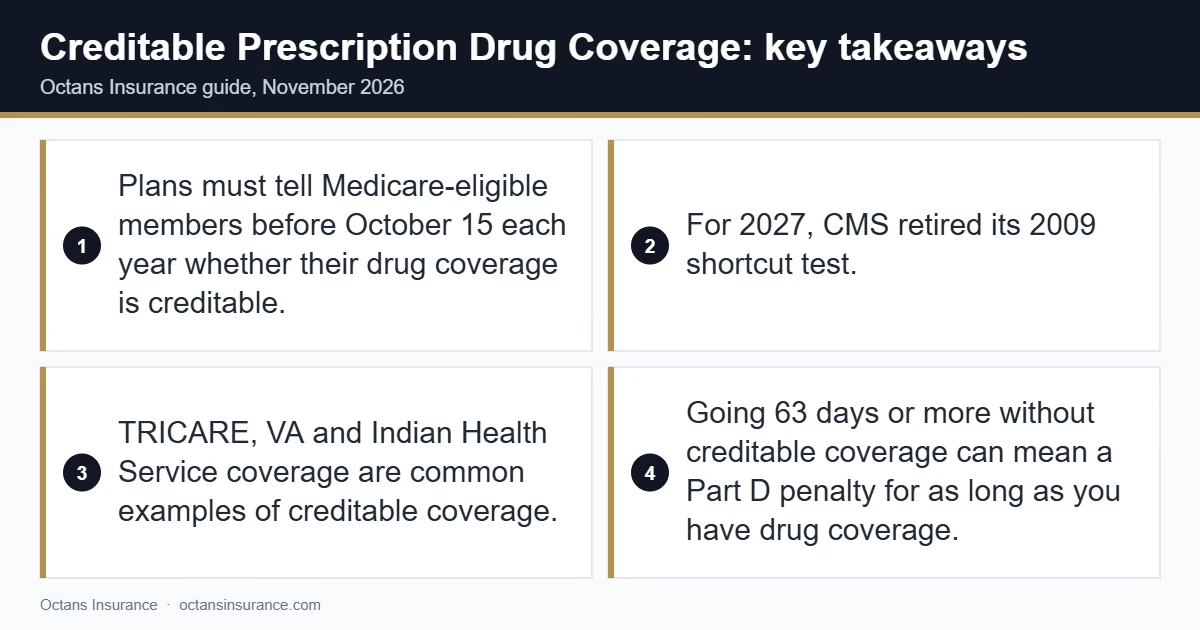
- Plans must tell Medicare-eligible members before October 15 each year whether their drug coverage is creditable.
- For 2027, CMS retired its 2009 shortcut test; the revised test requires plans to be designed to pay at least 73% of drug costs.
- TRICARE, VA and Indian Health Service coverage are common examples of creditable coverage.
- Going 63 days or more without creditable coverage can mean a Part D penalty for as long as you have drug coverage.
Table of Contents
Make sure your family is financially protected today!
Creditable prescription drug coverage is drug coverage expected to pay, on average, at least as much as standard Medicare Part D. Employer, union and retiree plans must tell you before October 15 each year whether yours qualifies. If it does, you can delay Part D without a penalty. If it doesn’t, Open Enrollment ends December 7.
What creditable prescription drug coverage means
According to Medicare.gov, creditable prescription drug coverage is drug coverage that’s expected to pay, on average, about as much as standard Medicare drug coverage. The federal rule at 42 CFR 423.56 sets the test: the coverage’s actuarial value must equal or exceed that of standard Part D coverage.
Why it matters: if you go 63 days or more in a row without Medicare drug coverage or other creditable coverage after your Initial Enrollment Period, you may owe a Part D late enrollment penalty if you join later. Creditable coverage is what lets many people who are still working, or who have retiree benefits, wait to join Part D.
The notice of creditable coverage your plan sends each fall
Plans that offer drug coverage must tell Medicare-eligible members whether that coverage is creditable. According to CMS, the written notice is due before October 15 each year. It goes to active workers, people on COBRA, Medicare-eligible people with disabilities, retirees and their covered dependents.
The federal rule also requires a notice before your Part D Initial Enrollment Period, before your coverage starts, whenever the plan’s creditable status changes, and whenever you ask for one. Plans report their status to CMS, too.
The notice is usually short. It says whether your plan’s drug coverage is creditable or not, and what that means for joining Part D. It may arrive with open enrollment materials, so look carefully. If you didn’t get one this fall, ask your benefits office. You have a right to request it.
Wondering “is my drug coverage creditable?” These steps answer it for most people:
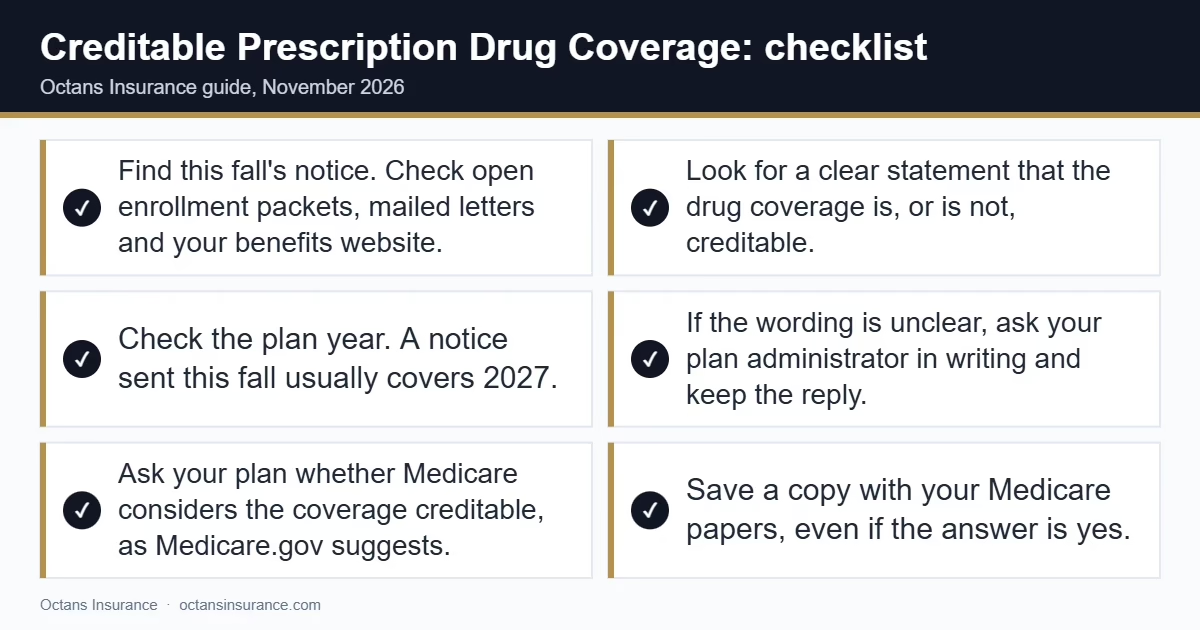
- Find this fall’s notice. Check open enrollment packets, mailed letters and your benefits website.
- Look for a clear statement that the drug coverage is, or is not, creditable.
- Check the plan year. A notice sent this fall usually covers 2027.
- If the wording is unclear, ask your plan administrator in writing and keep the reply.
- Ask your plan whether Medicare considers the coverage creditable, as Medicare.gov suggests.
- Save a copy with your Medicare papers, even if the answer is yes.
Why some plans stopped being creditable after Part D’s redesign
The Inflation Reduction Act made standard Part D more generous. According to the CMS Final CY 2026 Part D Redesign Program Instructions, the changes include a $35 cap on a month’s supply of each covered insulin, recommended adult vaccines without cost sharing, a yearly out-of-pocket cap ($2,100 for 2026) and the end of the coverage gap.
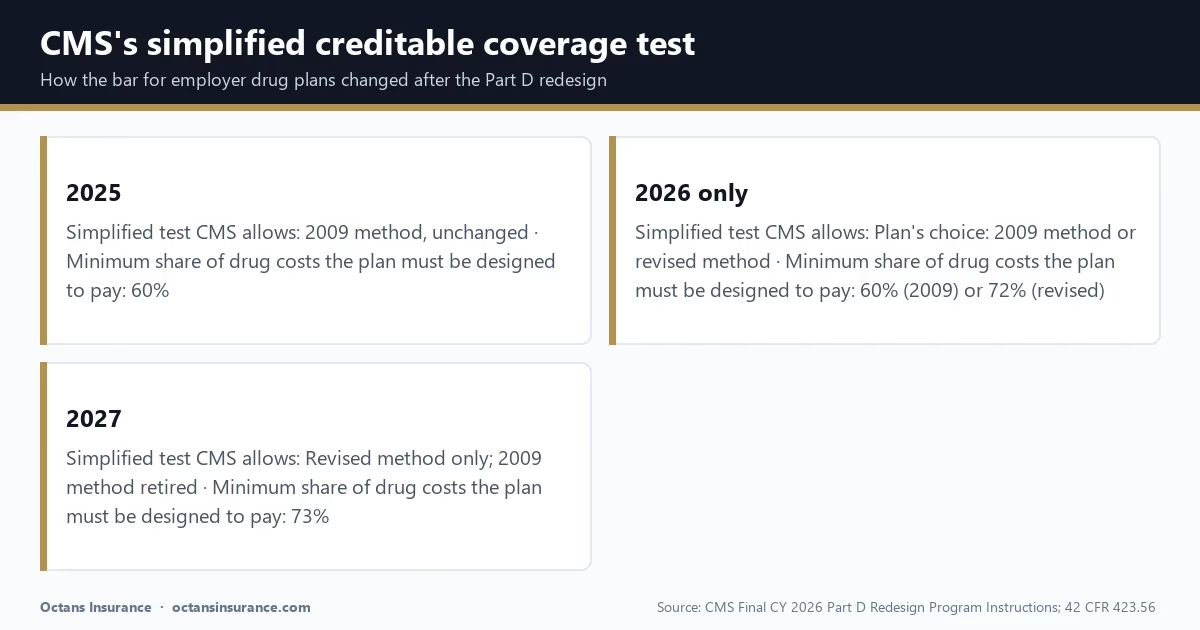
A richer Part D raises the bar for other plans. Since 2009, many employer plans used a CMS shortcut called the “simplified determination.” It counted coverage as creditable if, among other standards, it was designed to pay at least 60% of members’ drug costs. CMS said that test no longer measured up after the redesign.
| Plan year | Simplified test CMS allows | Minimum share of drug costs the plan must be designed to pay |
|---|---|---|
| 2025 | 2009 method, unchanged | 60% |
| 2026 only | Plan’s choice: 2009 method or revised method | 60% (2009) or 72% (revised) |
| 2027 | Revised method only; 2009 method retired | 73% |
CMS made the 2027 change final in a rule published April 6, 2026, and the federal rule at 42 CFR 423.56 now sets the simplified bar at 73% for 2027. Plans can still use full actuarial testing instead. CMS will set the percentage for later years in its guidance. The same rule took account-based plans, such as HRAs, health FSAs and HSAs, off the list of coverage that must send these notices.
The result: a plan that was creditable last year may not be for 2027. Read this fall’s notice, even if past ones said yes.
Coverage that usually counts: VA, TRICARE and others
Medicare.gov lists common sources of creditable coverage, including coverage from a current or former employer or union, TRICARE, Department of Veterans Affairs (VA) coverage and Indian Health Service coverage. The federal rule also lists Medicaid, the Federal Employees Health Benefits Program, state pharmacy assistance programs and PACE, among others. Each still has to meet the value test.
Some things are not drug coverage at all. Medicare.gov says doctor samples, discount cards, free clinics and drug discount websites don’t count. Veterans can learn more in our guide to Medicare for veterans.
If your coverage is not creditable: act before December 7
It depends on your situation, but time matters. Medicare Open Enrollment ends Monday, December 7. Joining a Medicare drug plan by then means coverage starts January 1, 2027.
You may also have a Special Enrollment Period. According to Medicare.gov, if you’re told your coverage is no longer creditable, your chance to join lasts 2 full months after the month you lose creditable coverage, or after you’re notified, whichever is later.
Before you drop anything, talk to your benefits administrator. Medicare.gov warns that dropping employer or union coverage can affect your spouse or dependents. Medicare.gov also notes your out-of-pocket drug costs could change. Weighing employer drug coverage and Medicare Part D comes down to your drugs, your total yearly costs and who else is on your plan. Compare both before deciding. Our guide to working and Medicare covers how the two fit together.
Keep your notice to prove coverage later
Store every notice of creditable coverage with your Medicare papers. Medicare.gov says to keep records showing you had creditable coverage.
Here’s when they matter. When you join a Medicare drug plan, the plan may send you a letter asking whether you had creditable drug coverage. If you get one, complete the form and return it by the deadline in the letter. If you don’t, the plan won’t know about your coverage, and you may be charged a penalty. Your saved notices make this step easy.
How creditable prescription drug coverage connects to the Part D penalty
The penalty is 1% of the national base beneficiary premium for each full month you went without creditable coverage. According to Medicare.gov, that premium is $38.99 for 2026. CMS’s July 28, 2026 announcement set it at $41.33 for 2027. The penalty is usually added to your premium for as long as you have Medicare drug coverage.
For example, 14 uncovered months means a 14% penalty. In 2026, 14% of $38.99 is $5.46, rounded to $5.50 a month. In 2027, 14% of $41.33 is $5.79, rounded to $5.80 a month. People who get Extra Help don’t pay the penalty. Because the penalty can last as long as you have Medicare drug coverage, a few minutes with this fall’s notice can be worth far more than the time it takes. See our Part D penalty guide for more examples.
Keep Reading: Related Guides
- Medicare Part D late enrollment penalty
- Working and Medicare
- Medicare for veterans
- Medicare Extra Help
- Annual Notice of Change
- How to Use Medicare Plan Finder
Creditable Prescription Drug Coverage: Frequently Asked Questions
What is creditable prescription drug coverage?
It’s drug coverage that’s expected to pay, on average, at least as much as standard Medicare Part D coverage. Under 42 CFR 423.56, its actuarial value must equal or exceed that of standard Part D. If you have creditable coverage, you can delay joining a Medicare drug plan without owing a late enrollment penalty later.
How do I know if my drug coverage is creditable?
Check the notice your employer, union or retiree plan must send before October 15 each year. It states whether the drug coverage is creditable. If you can’t find it, ask your benefits office or plan administrator, since you can request one at any time. Medicare.gov also suggests asking your plan directly whether Medicare considers your coverage creditable. Keep the answer in writing.
What happens if my employer coverage is not creditable?
If you go 63 days or more without creditable drug coverage after your Initial Enrollment Period, you may owe a Part D late penalty when you join later. You can join a Medicare drug plan during Open Enrollment, which ends December 7, or use a Special Enrollment Period that lasts 2 full months after you’re notified or lose creditable coverage, whichever is later. Talk to your benefits administrator before dropping coverage.
Do I need to keep my notice of creditable coverage?
Yes. Medicare.gov says to keep records showing you had creditable coverage. When you later join a Medicare drug plan, the plan may send you a letter asking whether you had creditable drug coverage, and you must return the form by the deadline in the letter. If you don’t, you may be charged a late enrollment penalty. Your saved notices help you answer accurately.
Does VA drug coverage count as creditable coverage?
Yes, VA coverage is one of the examples of creditable coverage listed on Medicare.gov, along with TRICARE and Indian Health Service coverage. That means veterans with VA drug benefits can generally delay Part D without a penalty while that coverage continues. Keep proof of your VA coverage with your Medicare papers, and compare costs and pharmacy access before deciding whether to add Part D.
We do not offer every plan available in your area. Please contact Medicare.gov or 1-800-MEDICARE to get information on all of your options.
This article is general information, not legal, tax, or medical advice. Premium examples are published samples, not quotes.
About examples and tools: Hypothetical examples, sample rates, calculators and quizzes on this site are for general educational and illustrative purposes only. They are not quotes, offers of coverage, or guarantees of eligibility, approval, price or benefits, and they are not legal, tax, financial or medical advice. The insurance company decides eligibility and price; Medicare rules are set by CMS and the Social Security Administration. Octans Insurance is not connected with or endorsed by the U.S. government or the federal Medicare program.