
Medicare Coverage
Does Medicare Cover Lift Chairs? What Part B Pays in 2026
Does Medicare cover lift chairs? Partly: Part B can share the cost of the lift mechanism when your doctor documents strict medical criteria, while the chair, upholstery and recliner features stay your expense.
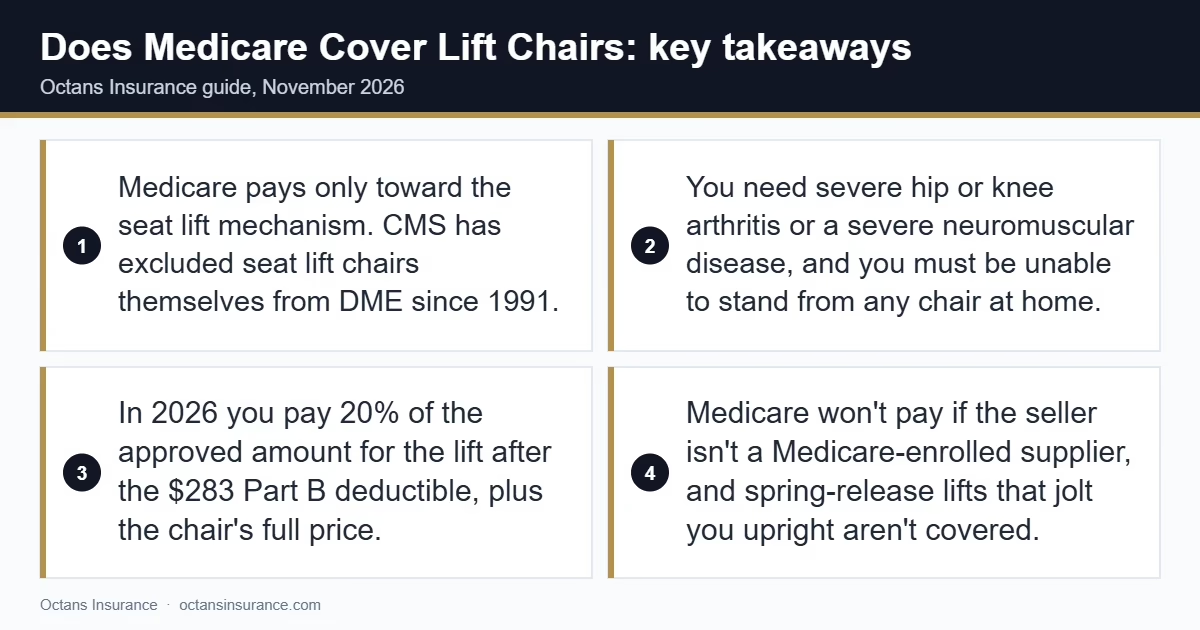
- Medicare pays only toward the seat lift mechanism. CMS has excluded seat lift chairs themselves from DME since 1991.
- You need severe hip or knee arthritis or a severe neuromuscular disease, and you must be unable to stand from any chair at home.
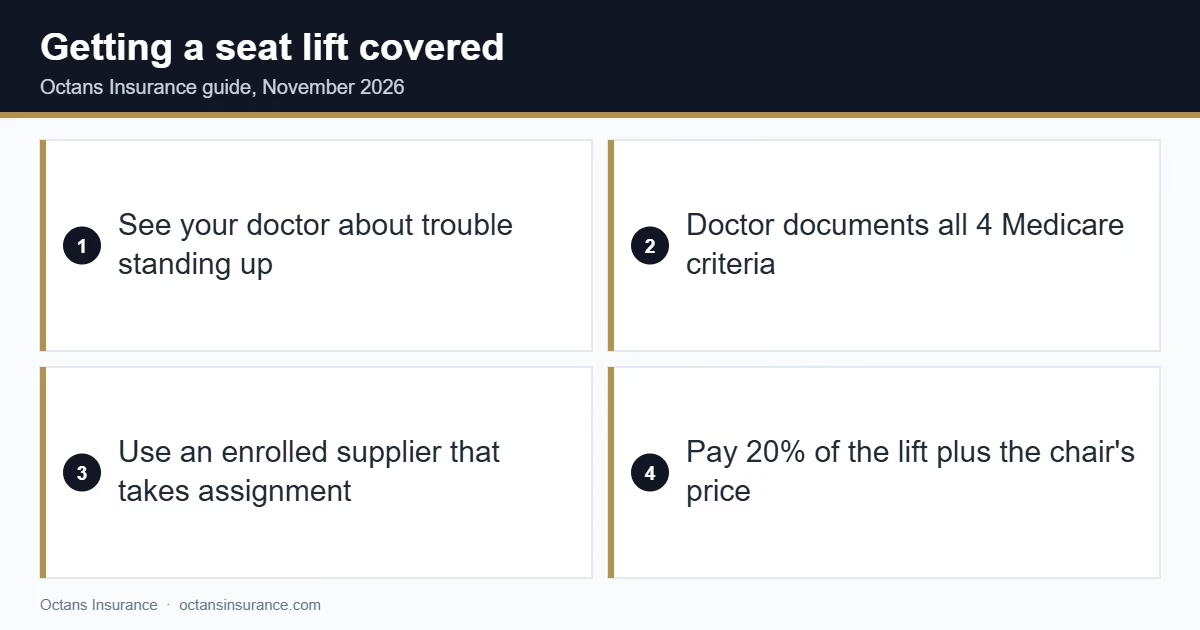
- In 2026 you pay 20% of the approved amount for the lift after the $283 Part B deductible, plus the chair’s full price.
- Medicare won’t pay if the seller isn’t a Medicare-enrolled supplier, and spring-release lifts that jolt you upright aren’t covered.
Table of Contents
Make sure your family is financially protected today!
Does Medicare cover lift chairs? Only in part. Medicare Part B can help pay for the seat lift mechanism, the part that raises you to standing, if you have severe arthritis of the hip or knee or a severe neuromuscular disease and meet other strict rules. Medicare doesn’t pay for the chair itself, so that part of the price is yours.
Does Medicare cover lift chairs or just the lift?
Just the lift. CMS’s Medicare Claims Processing Manual says that for items furnished after January 1, 1991, Medicare durable medical equipment (DME) “does not include seat lift chairs. Only the seat lift mechanism is defined under Medicare as DME.” If a supplier gives you a complete lift chair, Medicare pays “only for the lift mechanism portion of the chair.”
Medicare’s definition of DME explains the split. The equipment must hold up to repeated use, serve a medical purpose, be appropriate for use at home and generally not be useful to someone who isn’t sick or injured. The lift mechanism is the part Medicare classifies as DME. The chair is not.
Two more limits apply. Medicare’s national coverage rule for seat lifts caps payment for a unit with a recliner feature at what Medicare would pay for a seat lift without that feature. And Medicare’s equipment contractors treat any seat lift placed over or on top of a toilet as non-covered.
When the lift is built into the chair, the supplier bills Medicare for the mechanism, with one code for an electric lift and another for a manual one, and lists the chair as a separate item. That split is the real answer to “does Medicare cover lift chairs?”: the lift can be covered, the chair never is.
When does Medicare cover lift chairs?
Only when you meet every rule in Medicare’s seat lift mechanism coverage policy. You must meet all four:
- You have severe arthritis of the hip or knee, or a severe neuromuscular disease.
- The seat lift is part of your treating practitioner’s course of treatment and is prescribed to improve your condition or slow its decline.
- You are completely unable to stand up from a regular armchair or any chair in your home.
- Once you’re standing, you’re able to walk.
The national rule adds that the evidence must show your condition is severe enough that “the alternative would be chair or bed confinement.” Having a hard time getting up isn’t enough. The coverage policy also says your practitioner’s records must show that other treatments, such as medication and physical therapy, were tried and didn’t let you get from a chair to standing.
The lift itself has to qualify, too. Coverage is limited to lifts that “operate smoothly, can be controlled by the patient” and help you stand up and sit down without other help. Medicare excludes spring-release lifts that work with “a sudden, catapult-like motion” to push you upright.
Age doesn’t change these rules. So does Medicare pay for lift chairs for seniors who simply find standing slow or painful? Not unless all four criteria are met and your records back them up.

Medicare and lift chairs: what you pay in 2026
With Medicare and lift chairs, you face two separate costs: your share of the lift and the full price of the chair. If you qualify, Part B treats the lift mechanism like other DME. “Generally, you pay 20% of the Medicare-approved amount after you pay your Medicare Part B deductible for the year,” says Medicare’s booklet on medical equipment. The Part B deductible is $283 in 2026, according to CMS. Our guide to Medicare deductibles explains how that works.
The Medicare-approved amount is the lower of the supplier’s actual charge or the fee Medicare sets for the item. Ask the supplier for the approved amount on the lift mechanism before you order.
Medicare can pay for a seat lift as a rental or a purchase, the national rule says. CMS’s claims manual puts its seat lift instructions in section 130.2, the billing section for “inexpensive or other routinely purchased” equipment. For inexpensive or routinely bought items, Medicare’s equipment booklet says total rental payments are limited to the fee Medicare sets to buy the item.
| Part of the purchase | Original Medicare | What you pay in 2026 |
|---|---|---|
| Seat lift mechanism, when you meet all four criteria | Covered by Part B as DME | 20% of the Medicare-approved amount after the $283 deductible |
| The chair, including recliner features | Not covered | The full price |
| Seat lift placed over or on top of a toilet | Not covered | The full price |
| Spring-release lift with a catapult-like motion | Not covered | The full price |
| Any lift from a supplier not enrolled in Medicare | Medicare won’t pay the claim | The full price |
| Covered lift from an enrolled supplier that doesn’t accept assignment | Covered | You might pay more than 20% |
Sources: CMS Medicare Claims Processing Manual, chapter 20; National Coverage Determination 280.4; seat lift policy article A52518; Medicare’s DME booklet; CMS 2026 Part B figures. Checked November 6, 2026.
What a lift chair could cost you: an example
Hypothetical example: Doris, 78, has Original Medicare and severe arthritis in both knees. Medication and physical therapy haven’t helped. She can’t stand up from any chair in her home, but she can walk once she’s up. Her doctor documents this and orders a seat lift. She picks a power lift recliner with a $1,000 total price from a Medicare-enrolled supplier that accepts assignment.
Assume Medicare’s approved amount for the lift mechanism is $300. Both the $1,000 price and the $300 are illustrative figures, not real prices or Medicare fees. The other $700 of the price is the chair, which Medicare doesn’t cover.
- If Doris already met her 2026 Part B deductible: Medicare pays 80% of $300, or $240. Doris pays 20%, or $60, plus $700 for the chair. Her total is $760.
- If she hasn’t paid any of the $283 deductible: the first $283 of the $300 goes toward it. She pays 20% of the remaining $17, which is $3.40, and Medicare pays $13.60. Her total is $283 + $3.40 + $700 = $986.40.
So does Medicare pay for lift chairs like Doris’s? Only toward the lift. Doris pays the deductible only once a year, so in the second case she won’t owe it again for other Part B care in 2026. A Medigap plan that pays 100% of the Part B coinsurance would cover her $60 or $3.40 share. No Medigap plan would pay the $700 for the chair.
Does Medigap or Medicare Advantage pay for lift chairs?
Other coverage changes who pays the 20%, but the rules for Medicare and lift chairs stay the same. A Medigap plan can help with the lift, but not the chair. The official Medicare & You 2027 handbook says Medigap “helps cover your Medicare Part A and Part B out-of-pocket costs (like copayments, coinsurance, and deductibles) for covered Medicare services.” Most lettered plans pay 100% of the Part B coinsurance. Plan K pays 50% and Plan L pays 75%.
Only Plans C and F pay the Part B deductible, and you can’t buy either one if you became eligible for Medicare on or after January 1, 2020.
A Medicare Advantage plan “must cover the same medically necessary categories of DME items as Original Medicare,” the equipment booklet says. Your supplier choices and costs depend on the plan, though. Some plans offer extra benefits Original Medicare doesn’t cover, and these vary by plan and area. The plan’s Evidence of Coverage lists its cost-sharing for covered services and any supplemental benefits.
If your Medicare Advantage plan won’t cover a DME item you believe you need, you can appeal the denial and get an independent review, according to the booklet.
How to get Medicare to help pay for a lift chair
Does Medicare pay for lift chairs you’ve already bought? Not unless the purchase followed Medicare’s rules, including an order from your practitioner and an enrolled supplier. Take these steps in order.
- See your doctor or other treating practitioner. Describe exactly what happens when you try to stand up from chairs at home.
- Ask whether you meet all four seat lift criteria. If you do, your practitioner documents your need and sends the supplier a written order. Medicare’s policy says the supplier must have that order before it bills Medicare.
- Find a Medicare-enrolled supplier at Medicare.gov/medical-equipment-suppliers, and ask whether it accepts assignment.
- Get a written quote that shows the lift mechanism and the chair as separate items.
- Ask whether renting or buying the lift makes more sense for you, since Medicare can pay either way.
- If you’re in a Medicare Advantage plan, call the plan before you order to learn its supplier and approval rules.
- Keep the order, quote and receipts. If a claim is denied, our guide on how to appeal a denied health insurance claim walks through the next steps.
Questions to ask before you buy a lift chair
The first four questions come from Medicare’s equipment booklet.
- Are you a Medicare-enrolled supplier?
- Do you accept assignment?
- If you don’t accept assignment, will you consider assignment in my case?
- Will you bill Medicare for me?
- What is the Medicare-approved amount for the lift mechanism, and what do I owe for the chair?
- Is the lift electric or manual, and does it raise me smoothly rather than with a spring release?
- If I rent, who handles repairs? Medicare’s booklet says a rental supplier must keep the equipment in good working order at all times.
What if you don’t qualify for a covered seat lift?
If the answer to “does Medicare cover lift chairs?” is no in your case, you still have options. If your main problem is moving from a bed or wheelchair, ask about a patient lift. Medicare’s booklet lists “patient lifts to lift you from a bed or wheelchair” among covered DME. The national rules cover one when the medical staff at Medicare’s contractor decide your condition requires periodic movement to improve it or slow its decline.
Medicaid may help if you qualify for it. Home health services are a mandatory Medicaid benefit, according to Medicaid.gov, and federal rules say that benefit includes medical equipment and appliances. What your state covers varies, as the Medicaid question below explains.
If you pay on your own, keep in mind that Original Medicare won’t reimburse you later for a lift bought from a store that isn’t a Medicare-enrolled supplier.
Does Medicare cover lift chairs: frequently asked questions
Does Medicare pay for lift chairs for seniors?
Medicare doesn’t cover lift chairs based on age. It pays only toward the seat lift mechanism, and only if you meet all four of its rules, including severe hip or knee arthritis or a severe neuromuscular disease, being unable to stand up from any chair at home and being able to walk once standing. In 2026 you pay 20% of the approved amount for the mechanism after the $283 Part B deductible, plus the chair’s full cost.
Will Medicare pay for a lift chair if my doctor prescribes it?
A prescription alone isn’t enough. Your treating practitioner must document that you meet all four of Medicare’s seat lift criteria, including being completely unable to stand from any chair in your home. Even then, does Medicare pay for lift chairs in full? No. Medicare pays only toward the lift mechanism, and you pay for the chair, the upholstery and any recliner features.
Can I buy a lift chair at a furniture store and have Medicare pay?
Only toward the lift mechanism, only if you meet the seat lift criteria with your practitioner’s order, and only if the store is enrolled in Medicare as a supplier. Medicare’s DME booklet says that without a supplier number, Medicare won’t pay your claim, “even if your supplier is a large chain or department store that sells more than just DME.” Ask whether the store accepts assignment and get the lift and chair priced separately.
Does Medicare cover lift chairs that recline?
It can cover the lift mechanism in a reclining lift chair if you meet the criteria. But the national coverage rule limits payment for a unit with a recliner feature to the amount Medicare would pay for a seat lift without that feature. You pay for the recliner, the chair and your 20% share of the approved amount for the lift.
Does Medicaid pay for lift chairs?
It depends on your state. Medicaid’s home health benefit includes medical equipment, but each state sets its own lists and approval rules, and states must have a way to request items that aren’t on their preapproved list. Call your state Medicaid office to ask. You can get its phone number from 1-800-MEDICARE (1-800-633-4227).
What’s the difference between a seat lift and a patient lift?
A seat lift raises you from a seated position so you can stand and walk. A patient lift moves you from a bed or wheelchair. Medicare covers each under different rules: a seat lift needs the four seat lift criteria, and a patient lift needs a condition that requires periodic movement to improve or slow decline.

How a licensed Octans agent can help
If you’re asking “does Medicare pay for lift chairs?” while you also weigh your plan options, a licensed Octans agent can help with the second part. An agent can’t change Medicare’s seat lift rules, but can show you how your coverage choice affects what you pay for equipment like a lift mechanism. For example, an agent can set Medigap plans that cover your Part B coinsurance side by side with Medicare Advantage plans we offer in your area, including each plan’s equipment cost-sharing and supplier rules.
Call (617) 935-9220 to talk with an agent. You can also get free, personalized counseling from your State Health Insurance Assistance Program (SHIP), which isn’t connected to any insurance company, at shiphelp.org. Or call 1-800-MEDICARE (1-800-633-4227; TTY 1-877-486-2048) for information on Medicare coverage and plans in your area.
Keep Reading: Related Guides
- What Original Medicare covers
- Medicare Supplement (Medigap) plans explained
- Medicare Advantage (Part C) guide
- Medicare Durable Medical Equipment
- Does Medicare Cover Stair Lifts? No, but Here Is Where to Look
- Does Medicare Cover Medical Alert Systems? What to Know in 2026
- Medicare Part B
We do not offer every plan available in your area. Please contact Medicare.gov or 1-800-MEDICARE to get information on all of your options.
This article is for general information and is not tax, legal, or medical advice.
About examples and tools: Hypothetical examples, sample rates, calculators and quizzes on this site are for general educational and illustrative purposes only. They are not quotes, offers of coverage, or guarantees of eligibility, approval, price or benefits, and they are not legal, tax, financial or medical advice. The insurance company decides eligibility and price; Medicare rules are set by CMS and the Social Security Administration. Octans Insurance is not connected with or endorsed by the U.S. government or the federal Medicare program.
Compare how plans share your equipment costs
Start with a free, no-obligation quote review with a licensed Octans agent.
(617) 935-9220 | life@octansinsurance.com