
Medicare Coverage
Does Medicare Cover Stair Lifts? No, but Here Is Where to Look
Does Medicare cover stair lifts? Original Medicare and Medigap won’t, so the real question is which outside programs, plan extras or tax rules can soften the cost where you live.
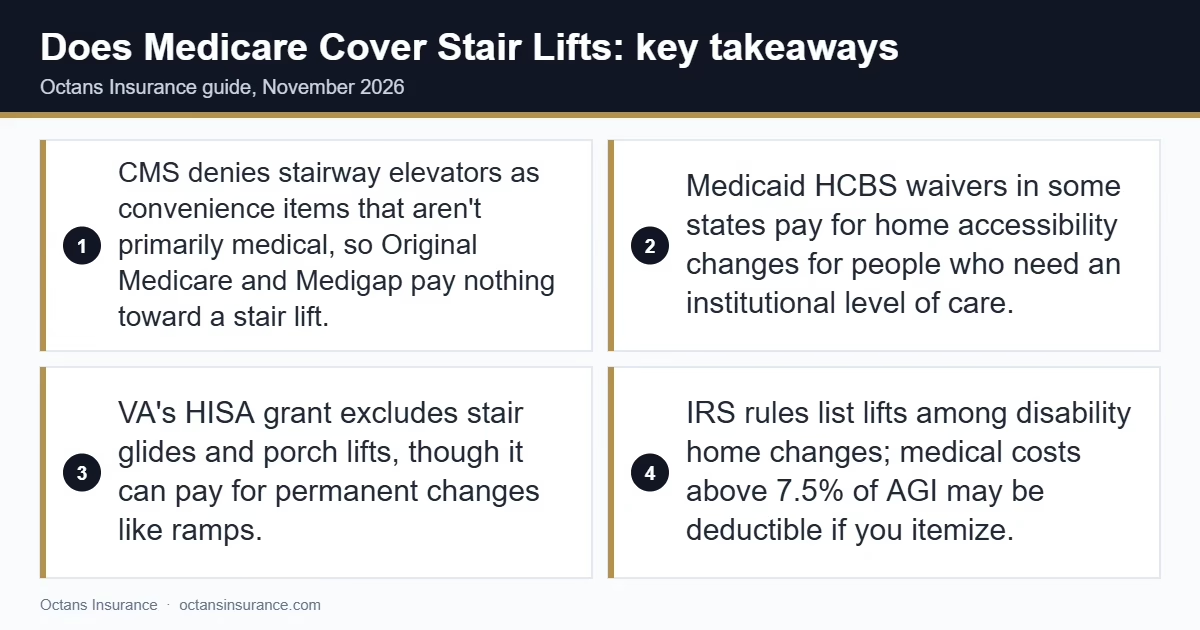
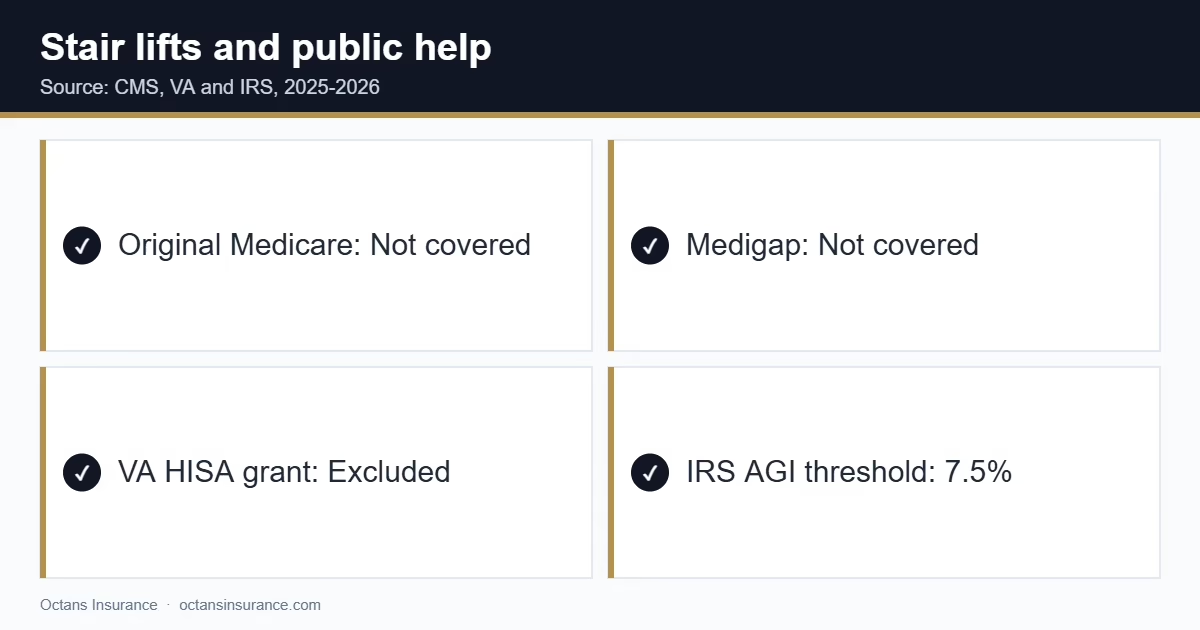
- CMS denies stairway elevators as convenience items that aren’t primarily medical, so Original Medicare and Medigap pay nothing toward a stair lift.
- Medicaid HCBS waivers in some states pay for home accessibility changes for people who need an institutional level of care.
- VA’s HISA grant excludes stair glides and porch lifts, though it can pay for permanent changes like ramps.
- IRS rules list lifts among disability home changes; medical costs above 7.5% of AGI may be deductible if you itemize.
Table of Contents
Make sure your family is financially protected today!
Does Medicare cover stair lifts? No. Original Medicare doesn’t pay for stair lifts, even with a doctor’s order, because CMS treats them as convenience items rather than medical equipment. Medigap won’t help either. Your options lie elsewhere: Medicare Advantage extra benefits that vary by plan and area, state Medicaid waivers, and IRS rules that may let you deduct part of the cost.
Does Medicare cover stair lifts if a doctor orders one?
No. Medicare’s national list of durable medical equipment decisions marks “Stairway Elevators” as denied and points to its entry for elevators: “Deny–convenience item; not primarily medical in nature.” A prescription doesn’t change that status.
CMS’s benefit manual explains the reasoning. Equipment that “basically serves comfort or convenience functions” is not medical equipment, and the manual names “elevators, stairway elevators, and posture chairs” as examples. It also calls safety grab bars “self-help devices” that are nonmedical in nature. The same national list denies bathtub lifts and raised toilet seats as convenience items.
So does Medicare pay for stair lifts through a Medigap plan? No. The official Medicare & You 2027 handbook says Medigap helps cover out-of-pocket costs “for covered Medicare services.” Because a stair lift isn’t a covered service, a Medigap plan has nothing to pay toward.
What Medicare may cover instead
If the answer to “does Medicare cover stair lifts?” leaves you stuck, look at related equipment. Some of it is covered under Part B when you meet Medicare’s rules. In 2026 you pay 20% of the Medicare-approved amount for covered equipment after the $283 Part B deductible, according to CMS and Medicare’s equipment booklet.
| Home item | Original Medicare | The rule |
|---|---|---|
| Stair lift (stairway elevator) or home elevator | Not covered | Convenience item, not primarily medical |
| Grab bars | Not covered | Self-help device, not primarily medical |
| Bathtub lift or raised toilet seat | Not covered | Convenience item |
| Commode chair | Covered in some cases | You’re confined to bed or a room, or your condition keeps you on a floor with no bathroom |
| Manual wheelchair or power mobility device | Covered in some cases | Medically necessary for use inside the home |
| Patient lift | Covered in some cases | Your condition requires periodic movement to improve or to slow decline |
| Seat lift mechanism (not the chair) | Covered in some cases | Severe hip or knee arthritis or neuromuscular disease, and you can’t stand from any chair at home |
Sources: CMS National Coverage Determinations 280.1 and 280.4; DME MAC seat lift policy L33801; Medicare’s DME booklet; CMS 2026 Part B figures. Checked November 6, 2026.
The commode rule matters for many stair problems. Medicare’s list says payment may also be made if “a patient’s medical condition confines him to a floor of the home and there is no bathroom located on that floor.” Ask your doctor whether that applies to you.
Does Medicare cover stair lifts through Medicare Advantage?
Possibly, but only as a plan’s own extra benefit. “Medicare Advantage Plans may cover some benefits Original Medicare doesn’t,” the handbook says, adding that “these benefits are generally limited.” Extra benefits vary by plan and area. A Medicare Advantage plan that offers one will describe it in its Evidence of Coverage.
CMS guidance opens two doors. First, its Medicare Managed Care Manual lets plans offer “specific non-Medicare-covered safety devices to prevent injuries in the bathroom.” Second, since 2020, plans can offer special supplemental benefits to members who meet a three-part definition of chronically ill. A 2019 CMS memo lists structural home modifications, such as “widening of hallways or doorways, permanent mobility ramps, easy use doorknobs and faucets.”
Stair lifts aren’t named in those CMS examples. So does Medicare pay for stair lifts through a private plan? Only if that plan chose to include such a benefit. You can change plans for 2027 during Open Enrollment, October 15 to December 7, 2026. Our guide to Medicare special needs plans covers plans built for certain chronic conditions.
Can Medicaid help pay for a stair lift?
Possibly, through home and community-based services (HCBS) waivers, depending on your state. These programs serve people who “prefer to get long-term care services and supports in their home or community,” according to Medicaid.gov. To qualify, you must need a level of care that would meet your state’s rules for care in an institutional setting. States choose the groups each waiver serves and the maximum number of people it covers.
CMS gives states a standard definition for “home accessibility adaptations.” It includes “the installation of ramps and grab-bars, widening of doorways, modification of bathroom facilities” and similar changes. It excludes improvements “of general utility” that aren’t of direct medical or remedial benefit. States can add to or narrow the list, so ask whether your state’s waiver includes stair lifts.
Does Medicare pay for stair lifts if you have both Medicare and Medicaid? Medicare still doesn’t, but your Medicaid program might, through a waiver. Medicaid programs vary from state to state. To find your state Medicaid office, you can call 1-800-MEDICARE (1-800-633-4227).
What help is there for veterans?
Does Medicare cover stair lifts for veterans? No, the Medicare rules are the same. VA’s Home Improvements and Structural Alterations (HISA) grant pays for medically necessary changes to a veteran’s primary home, such as roll-in showers and permanent ramps. But VA’s HISA page excludes “removable equipment or appliances such as portable ramps; porch lifts, and stair glides.” So HISA won’t buy the stair lift itself.
The HISA lifetime benefit is up to $6,800 for a service-connected disability, or for another disability if you have a service-connected rating of at least 50%. It’s up to $2,000 for other disabilities. To apply, you need a prescription written or approved by a VA physician, VA Form 10-0103, an itemized cost estimate and a color photo of the area. VA’s page was last updated February 12, 2025, and tells veterans to check available benefits with their local Prosthetic and Sensory Aids Service.
Veterans with certain service-connected disabilities may qualify for larger adapted housing grants. VA.gov lists maximums of $126,526 for a Specially Adapted Housing grant and $25,350 for a Special Home Adaptation grant for fiscal year 2026. VA may adjust these maximums each year, and as of November 2026 its page still showed the fiscal year 2026 amounts. Our page on Medicare for veterans explains how VA care and Medicare fit together.
Can you deduct a stair lift as a medical expense?
Possibly. Since the answer to “does Medicare cover stair lifts?” is no, your taxes may be one place to recover part of the cost. IRS Publication 502 (2025 edition, for 2025 returns) lets you count special equipment installed in a home, or home improvements, whose main purpose is medical care. If an improvement raises your home’s value, only the cost above that increase counts. But changes made to accommodate a disability “don’t usually increase the value of the home and the cost can be included in full.” The IRS list includes “porch lifts and other forms of lifts (but elevators generally add value to the house)” and “Modifying stairways.”
Two limits apply. “Only reasonable costs to accommodate a home to your disabled condition are considered medical care.” And you can deduct, on Schedule A, only the part of your medical expenses above 7.5% of your adjusted gross income (AGI). Upkeep costs can count too, as long as the main reason for them is medical care.
Hypothetical example: Leon, 72, has an AGI of $40,000 and itemizes deductions. Assume the IRS rules are unchanged for 2026. His threshold is 7.5% × $40,000 = $3,000. He paid the standard 2026 Part B premium of $202.90 a month, or $202.90 × 12 = $2,434.80, and the IRS says Part B premiums are a medical expense. He also paid $4,500 for a stair lift. That price is a made-up figure for the math, not a quote.
- Total medical expenses: $2,434.80 + $4,500 = $6,934.80.
- Amount above his threshold: $6,934.80 − $3,000 = $3,934.80.
- That $3,934.80 is what Leon could deduct on Schedule A, if the full stair lift cost qualifies.
Does Medicare pay for stair lifts in Leon’s case? No, so the deduction is how he may recover part of the cost. Ask a tax professional whether your costs qualify, how much a deduction would save you and whether itemizing makes sense for you.

How to pay for a stair lift: step by step
Here’s how to pay for a stair lift when Medicare won’t. Start with the programs that may need to approve the purchase first.
- Talk with your doctor about your safety on stairs, and ask whether a covered item, such as a commode chair or a seat lift, would meet your need.
- If you have Medicare Advantage, read your plan’s Evidence of Coverage or call the plan to ask about home safety or home modification benefits.
- Call your state Medicaid office to ask whether an HCBS waiver in your state covers home accessibility changes, and whether you meet the level-of-care rule.
- If you’re a veteran, contact your VA Prosthetic and Sensory Aids Service about HISA for permanent changes and about adapted housing grants.
- Get written, itemized quotes before you commit, and keep every receipt and your doctor’s notes for tax time.
- Ask a tax professional whether the cost counts as a medical expense for you.
Knowing how to pay for a stair lift before you sign matters, because some programs need approval first and your receipts back up any tax deduction.
Questions to ask before you buy a stair lift
Price is only part of how to pay for a stair lift. Ask these questions before you sign:
- Is the quote itemized, with the lift, rail and installation listed separately?
- What does the warranty cover, and for how long?
- Who services the lift, and what does a service call cost?
- Will the seller give me the cancellation forms the FTC requires for in-home sales?
- Does my Medicare Advantage plan, state waiver or VA program need to approve this purchase before I buy?
- Will my doctor document the medical reason in writing?
Buying from a salesperson in your home? The FTC’s Cooling-Off Rule generally covers home sales of $25 or more. “Your right to cancel for a full refund lasts until midnight of the third business day after the sale.” The seller must give you two copies of a cancellation form and a copy of your contract or receipt.
Does Medicare cover stair lifts: frequently asked questions
Does Medicare pay for stair lifts if my doctor says I need one?
No. Medicare’s national equipment list denies stairway elevators as convenience items that aren’t primarily medical, and a doctor’s order doesn’t change that. You would pay the full cost under Original Medicare. Other help may come from a Medicare Advantage extra benefit, a state Medicaid waiver or, in some cases, the medical expense deduction on your taxes.
Does Medigap cover stair lifts?
No. Medigap plans help pay out-of-pocket costs, like coinsurance and deductibles, for services Original Medicare covers. Because the answer to “does Medicare cover stair lifts?” is no, there’s no Medicare-approved amount for a Medigap plan to share. A Medigap plan can still help with your share of covered equipment, such as a commode chair, a wheelchair or a seat lift mechanism.
Does the VA pay for stair lifts?
VA’s HISA grant doesn’t. Its rules exclude removable equipment such as porch lifts and stair glides, though HISA can pay for permanent changes like ramps and roll-in showers. Veterans with certain service-connected disabilities may qualify for VA adapted housing grants. Contact your local VA Prosthetic and Sensory Aids Service to learn which benefits apply to you.
Is a stair lift tax deductible?
It may be. IRS Publication 502 (2025 edition) lists “porch lifts and other forms of lifts” among home changes for a disability that usually don’t raise a home’s value, so the cost can often be included in full as a medical expense. You can deduct only medical expenses above 7.5% of your AGI, and only if you itemize. Ask a tax professional.
Does Medicaid pay for stair lifts?
It depends on your state. Medicaid home and community-based services waivers can pay for home accessibility adaptations for people who need an institutional level of care but want to stay home. States decide which changes are included and how many people each waiver serves. Ask your state Medicaid office whether its waivers cover stair lifts.
Does Medicare cover a commode if I can’t get upstairs to a bathroom?
It can. Medicare’s equipment rules allow payment for a commode chair if you’re confined to bed or a room, or if your medical condition keeps you on a floor of your home that has no bathroom. With Original Medicare, you pay 20% of the approved amount after the $283 Part B deductible in 2026.

How a licensed Octans agent can help
If you’re asking “does Medicare cover stair lifts?” because you’re also reviewing your plan, a licensed Octans agent can help with that part. An agent can’t make Medicare pay for a stair lift, but can help you check which Medicare Advantage plans we offer in your area include home safety or home modification benefits, what those benefits limit, and how the plans compare with Original Medicare and a Medigap plan for the equipment Medicare does cover. Call (617) 935-9220.
For free, personalized counseling from a program that isn’t connected to any insurance company, contact your State Health Insurance Assistance Program (SHIP) at shiphelp.org. You can also call 1-800-MEDICARE (1-800-633-4227; TTY 1-877-486-2048) for information on plans in your area.
Keep Reading: Related Guides
- Medicare Advantage (Part C) guide
- Medicare for veterans
- Medicare Supplement (Medigap) plans explained
- Does Medicare Cover Lift Chairs? What Part B Pays in 2026
- Medicare Durable Medical Equipment
- Does Medicare Cover Medical Alert Systems? What to Know in 2026
- Medicare vs Medicaid
We do not offer every plan available in your area. Please contact Medicare.gov or 1-800-MEDICARE to get information on all of your options.
This article is for general information and is not tax, legal, or medical advice.
About examples and tools: Hypothetical examples, sample rates, calculators and quizzes on this site are for general educational and illustrative purposes only. They are not quotes, offers of coverage, or guarantees of eligibility, approval, price or benefits, and they are not legal, tax, financial or medical advice. The insurance company decides eligibility and price; Medicare rules are set by CMS and the Social Security Administration. Octans Insurance is not connected with or endorsed by the U.S. government or the federal Medicare program.
Check plans for home safety benefits
Start with a free, no-obligation quote review with a licensed Octans agent.
(617) 935-9220 | life@octansinsurance.com