
Life Insurance When You Are Young: The Short Answer
Life insurance when you are young usually costs less, because premiums are based largely on age and health, and on a level term policy the premium you start with stays the same for the level period. In MoneyGeek samples for $500,000 of 20-year term, a man pays $38 a month at 30 and $59 at 40, a difference of $5,040 over the term. Buying early also locks in the rate class you qualify for before your health or driving record changes.
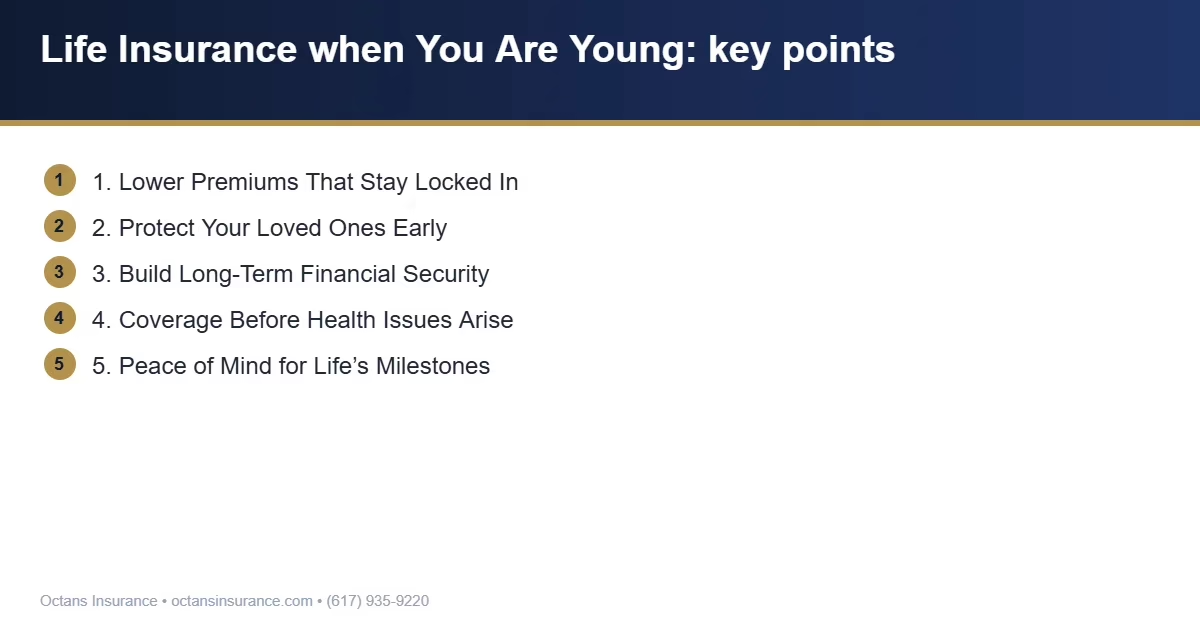
Table of Contents
Make sure your family is financially protected today!
Getting Life Insurance When You’re Young
When most people think about life insurance, they picture something to consider later in life—after buying a home, starting a family, or approaching retirement. But in reality, one of the best times to purchase life insurance is when you’re young. Securing coverage early offers advantages that last a lifetime, from lower costs to stronger financial protection for the future.
Here’s why making this decision now can be one of the smartest financial moves you’ll ever make:
1. Lower Premiums That Stay Locked In
Life insurance premiums are based on several factors, including age and health. The younger and healthier you are when you apply, the less you’ll pay for coverage. Even better, many policies allow you to lock in that lower rate for decades—or even for life.
For example, a healthy 25-year-old may pay a fraction of what a 40-year-old would for the same policy. That difference adds up to thousands of dollars saved over time. Buying young can reduce the risk of having to qualify for affordable coverage later in life, when health issues may arise.
2. Protect Your Loved Ones Early
You may not have children yet, or you may just be starting out on your own. But think about the people who depend on you now—your spouse, parents, or even co-signers on your student loans. Life insurance ensures that if the unexpected happens, they won’t be left with financial burdens.
Starting a policy early means you’re protecting those closest to you today, while also building a foundation for your future family tomorrow.
3. Build Long-Term Financial Security
If you choose permanent life insurance, such as whole life, you’re not just getting protection—you’re also building cash value. This is money that grows over time and can be accessed through loans or withdrawals later in life.
Buying young gives your policy more time to grow, which means you’ll have a stronger financial safety net when you need it—whether that’s helping with a down payment on a home, covering unexpected expenses, or supplementing retirement income.
4. Coverage Before Health Issues Arise
Unfortunately, no one can predict the future. Health issues can develop unexpectedly, and even minor conditions can make life insurance more expensive—or difficult to qualify for. By securing coverage while you’re young and healthy, you lock in protection that stays with you for the policy’s term, or for life with permanent coverage, as long as you pay premiums, even if your health changes.
5. Peace of Mind for Life’s Milestones
Buying life insurance early is about more than just saving money. It’s about creating peace of mind as you move through life’s milestones. Whether you’re getting married, starting a family, buying your first home, or building a career, you’ll know your financial foundation is secure.
Instead of waiting until those big life changes force you to think about protection, you’ll already be covered.
The Bottom Line
Life insurance isn’t just for older adults or parents with kids. It’s a powerful financial tool that works best when you start early. Lower premiums, coverage that stays in force as long as you pay, cash value growth with permanent policies, and long-term peace of mind are just some of the benefits you can secure by acting now.
If you’re young and considering your financial future, now is the perfect time to explore your life insurance options. The earlier you start, the stronger and more affordable your protection will be for years to come.
What does waiting cost? Life insurance when you are young vs. later
The easiest way to see the value of life insurance when you are young is to compare the same policy at different ages. The table below shows sample monthly rates for 20-year term coverage for nonsmokers in average health, published by MoneyGeek (updated October 11, 2026).
| Age at purchase | Female $250K | Female $500K | Male $250K | Male $500K |
|---|---|---|---|---|
| 30 | $23 | $32 | $26 | $38 |
| 40 | $28 | $47 | $35 | $59 |
| 50 | $59 | $102 | $77 | $137 |
| 60 | $157 | $286 | $215 | $395 |
Sample rates published by MoneyGeek as of October 11, 2026. Shown for illustration only. This is not a quote or an offer of coverage. Your actual premium depends on age, sex, health, tobacco use, state, carrier, and underwriting.
Hypothetical example: A man buys a $500,000, 20-year policy at 30 for $38 a month. His twin waits until 40 and pays $59. The gap is $21 a month, or $21 x 12 = $252 a year. Over a 20-year term, that is $252 x 20 = $5,040. For women, the same math gives ($47 – $32) x 12 x 20 = $3,600.
Waiting until 50 widens the gap fast. A man would pay $137 instead of $38, which is $99 more a month, or $99 x 12 x 20 = $23,760 over the term. One caution: these samples assume the same average health at each age. If your health changes while you wait, the real gap can be larger.
What does it mean to lock in your insurability?
When you apply, the insurer reviews your health and history and places you in a rate class. On a level term policy, the premium you start with is the premium you keep for the level period. Your price is set by who you are on the day you apply, not who you become later.
That matters because underwriting looks at more than medical records. Policygenius notes that most insurers check the last five years of your driving record, and some look back up to 10 years. Multiple violations can mean a lower rate class, a flat extra fee of $2 to $4 per $1,000 of coverage, or a denial.
Rate class can matter as much as age. NerdWallet publishes annual samples for a $500,000, 20-year policy (data valid October 1, 2026). A 30-year-old man pays $213 a year at Preferred Plus but $396 at Standard. That is $396 – $213 = $183 more a year, or $183 x 20 = $3,660 over the term, for the same age and the same coverage. These are samples, not a quote.
A speeding ticket, a new diagnosis, or a change in prescriptions after your policy is issued does not undo the class you already earned. Buying life insurance when you are young, while your record is clean, is the simplest way to lock in the best class you qualify for. You can see how rates climb at each age on our life insurance rates by age page.
Can you turn term into permanent coverage later?
Many term policies include a conversion option. It lets you switch some or all of your term coverage to a permanent policy without starting over. For a young buyer, this is a useful backup plan. You get low term rates now and keep the door open to lifelong coverage later.
According to MoneyGeek (updated September 1, 2026), conversion works like this:
- No new medical review. Converting within the conversion period requires no medical exam, health questions, or underwriting.
- Your original health class carries over. The rating you earned when you first applied is the one you keep.
- The new premium uses your age at conversion. Waiting longer to convert costs more.
- Partial conversion is possible. You can convert part of the death benefit and keep the rest as term.
- Deadlines are firm. Missing the conversion deadline ends the option for good.
Not every policy offers conversion, and the window differs by carrier. Before you buy, ask two questions. Is the policy convertible? And until what age or policy year? Write the deadline down. To compare the two policy styles, see term vs. whole life insurance.
Do student loans change whether you need coverage?
It depends on what kind of loans you have, and who signed for them.
Federal student loans are canceled when the borrower dies. The CFPB says relatives can notify the loan servicer and the loan will be canceled, and that the loans won’t transfer to another person. Federal rules at 34 CFR 685.212 require proof of death, such as a copy of the death certificate.
Private student loans work differently. The same CFPB page says private lenders are not legally required to cancel private student loans, and that the debt may pass to a spouse or cosigner. Some lenders have their own discharge rules, so read your loan terms.
What if your parents borrowed for you? Under 34 CFR 685.212, a Direct PLUS loan is also discharged if the student on whose behalf the parent borrowed dies. So a Parent PLUS loan taken out for your degree would not fall on your parents if something happened to you.
A 2021 U.S. Senate press release said federal law releases cosigners from private loans when the student dies only if the loans were made after November 20, 2018. Older loans depend on the contract.
The reverse risk exists too. In 2014, the CFPB reported that many private loan contracts let the lender demand the full balance when a cosigner dies, even if the borrower is paying on time.
Hypothetical example: You have $30,000 in private loans co-signed by a parent. You also have federal loans. If you died, the federal loans would be discharged, but your parent could owe the $30,000. A term policy with that parent as beneficiary covers that risk directly.
Is the life insurance from your first job enough?
Your first full-time job may offer group life insurance. In March 2026, 63% of civilian workers and 59% of private industry workers had access to employer life insurance, according to the Bureau of Labor Statistics. That means a large share of workers have no access at all.
When it is offered, group coverage is often a multiple of salary. Western & Southern says group coverage often ranges from one to five times your annual salary. It is a good start, but it is tied to the job.
Hypothetical example: You earn $48,000 and your employer gives you one times salary, or $48,000 of coverage. You also plan to buy a home with a partner in three years and expect a $300,000 mortgage. Group coverage would pay $48,000, or about 16% of that balance ($48,000 / $300,000 = 0.16). A personal policy could cover the rest.
If you leave, you usually have two options, per Western & Southern:
- Portability: keep group term coverage by paying the insurer directly. Initial costs are lower, but premiums typically rise with age. Basic employer-paid coverage may require proof of good health to port.
- Conversion: switch to an individual permanent policy with no medical exam or health questions, but at higher premiums.
Both options have a short window, often 31 to 60 days. Miss it and the rights are gone. If you change jobs, a personal term policy that stays with you no matter where you work fills the gap. Our employee benefits page explains how group plans fit in.
How much life insurance does a young single person need?
If no one depends on your income, you may need less than you think. Start with the costs someone else would be left to cover:
- Co-signed debt: private student loans, a car loan, or a lease a parent signed for.
- Final expenses: the national median cost of a funeral with viewing and burial was $8,300, and $6,280 for a funeral with cremation, per the NFDA 2023 study as reported by Tribute Technology.
- People you help: money you send to a parent or sibling.
- Future plans: a partner, a mortgage, or children in the next few years.
Hypothetical example: You owe $30,000 in co-signed private loans and help your mother with $300 a month. Add $8,300 for a funeral. Then add five years of help: $300 x 12 x 5 = $18,000. Your total is $30,000 + $8,300 + $18,000 = $56,300.
That need is modest. Still, the samples above show $250,000 of 20-year term at age 30 for $23 to $26 a month. Buying more than today’s need can make sense if you expect a partner, a home, or children before the term ends. Our how much life insurance do I need guide walks through the full math.
Do young adults overestimate the cost of life insurance?
Yes, by a wide margin. The 2025 Insurance Barometer Study from LIMRA and Life Happens found that healthy adults ages 18 to 30 overestimated the median cost of a $250,000, 20-year term policy by about 10 to 12 times, according to the June 25, 2025 release.
Cost is also a top reason people go without. The same release says 48% of Millennials and 39% of Gen Z adults named perceived cost as a reason for not owning life insurance, or not owning more.
Illustration: MoneyGeek’s sample for a 30-year-old man is $26 a month for $250,000. A guess 10 to 12 times too high would be $26 x 10 = $260 to $26 x 12 = $312 a month. Someone who believes the price is $300 may never ask for a quote. This uses MoneyGeek’s sample, not LIMRA’s own cost figure.
Checklist: buying life insurance when you are young
Use these steps to turn the ideas above into a plan. Most people can finish the first five in an evening with their loan statements, benefits paperwork, and a calculator in hand.
- List who would pay your debts or costs if you died, including any cosigners.
- Sort your student loans into federal and private. Check each private loan for death and cosigner release terms.
- Find out if your job offers group life, how much, and what happens when you leave.
- Add up your need: co-signed debt, final expenses, people you help, and near-term plans.
- Pick a term length that runs past your biggest obligations, such as a mortgage or raising children.
- Ask whether the policy is convertible, and note the conversion deadline.
- Apply while your health and driving record are clean, and answer every question honestly.
- Compare quotes from several carriers. A licensed agent can do this for you through our life insurance quotes page.
- Name a beneficiary, and review the policy after big life events.
Keep Reading: Related Guides
- Deaths not covered by life insurance
- Is life insurance taxable?
- How to find a lost life insurance policy

Life Insurance when You Are Young: Frequently Asked Questions
Why is life insurance cheaper when you are young?
Premiums are based largely on age and health, so buying life insurance when you are young locks in lower rates for the length of the term and protects your insurability if your health changes later.
How much does life insurance cost for someone in their 20s?
The samples on this page start at age 30: a healthy 30-year-old pays about $23 to $38 a month for $250,000 to $500,000 of 20-year term coverage. Because premiums rise with age, buyers in their 20s can often expect similar or lower rates; get a quote for your exact age.
Do I need life insurance in my 20s?
You may need life insurance in your 20s if someone depends on your income, you co-signed a loan, or you want to lock in coverage while you’re healthy. Rates rise with age: MoneyGeek’s published example for $500,000 of 20-year term is $38 a month for a 30-year-old man versus $59 at 40 (October 11, 2026). If no one relies on you, waiting may be fine. Term with a conversion option costs less than whole life; whole life adds lifelong coverage and cash value at a higher price.
Life Insurance when You Are Young: Next Steps With a Licensed Agent
Questions about life insurance when you are young usually depend on your age, health, state, and budget. A licensed Octans agent can review your situation, compare options from more than 120 carriers, and explain the trade-offs before you decide. Call (617) 935-9220 or request a free quote.


Related guides
Sources: NAIC Life Insurance Buyer’s Guide; NAIC Life Insurance Policy Locator. This article is for general information and is not tax, legal, or medical advice.
About examples and tools: Hypothetical examples, sample rates, calculators and quizzes on this site are for general educational and illustrative purposes only. They are not quotes, offers of coverage, or guarantees of eligibility, approval, price or benefits, and they are not legal, tax, financial or medical advice. The insurance company decides eligibility and price; Medicare rules are set by CMS and the Social Security Administration.