
Medicaid Basics
Medicaid Spend Down: How to Qualify When Income Is Over the Limit
A Medicaid spend down counts your medical bills against income above your state’s limit, and it also covers how savings get used before nursing home Medicaid. Here are the rules and the math.
- Medicaid.gov says 36 states and D.C. use spend-down programs, either medically needy programs or 209(b) rules.
- MassHealth’s deductible is excess monthly income times six, using a $522 monthly income standard for one person at home.
- Gifts made within 60 months before applying for nursing home Medicaid can trigger a penalty period under federal law.
- SSI rules don’t count burial spaces or up to $1,500 in burial funds each for you and your spouse.
Table of Contents
Make sure your family is financially protected today!
A Medicaid spend down lets you qualify for Medicaid even though your income is above your state’s limit. You count medical bills against the extra income, and once your bills reach that amount, Medicaid pays covered care for the rest of the period. The term also describes using savings on care and allowed costs, without gifting it away, until your assets fall to Medicaid’s limit.
What is a Medicaid spend down?
Medicaid is a joint federal and state program, so the rules vary by state. According to Medicaid.gov, states have the option to run a medically needy program for people with significant health needs whose income is too high for other Medicaid groups. These people can still qualify by “spending down” the income that’s above the state’s medically needy income standard.
You spend down by having medical and remedial care expenses that no insurance covers. Once those expenses exceed the gap between your income and the state’s medically needy income level, you can be eligible. Medicaid then pays for covered care beyond what you had to spend.
For people with Medicare, Medicare.gov explains it simply: some states let you spend down income above the Medicaid limit by paying non-covered medical expenses and cost sharing, like Medicare premiums and deductibles.
People also use “spend down” for assets. Most people who enter nursing homes start by paying out of pocket and may eventually spend down their savings until they meet Medicaid’s resource limit. Both meanings are covered below.

How does a Medicaid spend down work?
The math has two parts: your countable income and your state’s medically needy income level. The difference, over the state’s budget period, is the amount of medical bills you must have before Medicaid pays. Medicaid spend down rules on the budget period vary by state. Florida uses a monthly “share of cost.” Massachusetts, New Jersey and Pennsylvania use six-month periods.
The bills that count also vary. Florida’s Department of Children and Families lists examples that can count:
- unpaid medical bills not already used to meet a share of cost;
- medical bills you paid within the last three months;
- health insurance premiums and co-pays;
- medical services prescribed by a doctor;
- ambulance, bus or taxi rides to get medical care.
Florida doesn’t count premiums for policies that pay you cash for a hospital stay, or over-the-counter supplies such as bandages and cold remedies. Massachusetts applies bills in a set order. First come health insurance costs, such as Medicare premiums (six months credited up front), deductibles and coinsurance. Next come needed services MassHealth doesn’t cover, then services it does.
States also treat the bills you use differently. In Massachusetts, bills used to meet the deductible stay your responsibility. Florida’s brochure says the bill that meets your share of cost will be paid if the provider accepts Medicaid.
Timing is changing, too. Under a 2025 federal law (Pub. L. 119-21), for Medicaid applications made on or after January 1, 2027, coverage for most older and disabled applicants can reach back only to the second month before the month you apply, not the third.
What does a Medicaid spend down look like in real numbers?
Hypothetical example: Ruth, 72, lives at home in Massachusetts, has Medicare and has less than MassHealth’s $2,000 asset limit in countable savings. Her countable income is $1,622 a month, above the 2026 federal poverty level for one person ($15,960 a year, or $1,330 a month), so MassHealth’s rules let her qualify by meeting a deductible. MassHealth’s deductible income standard for one person living in the community is $522 a month, under 130 CMR 520.030.
- Excess income: $1,622 – $522 = $1,100 a month.
- Six-month deductible: $1,100 x 6 = $6,600.
- Medicare premiums count first: 6 x $202.90 (the 2026 standard Part B premium) = $1,217.40. Left to meet: $5,382.60.
- Part B deductible: $283 in 2026. Left to meet: $5,099.60.
- A hospital stay: the $1,736 Part A deductible. Left to meet: $3,363.60.
- Other unpaid medical bills: $3,500. Her deductible is met, and the $136.40 she didn’t need can count toward a future deductible period.
From there, MassHealth can pay her other covered care for the rest of the six-month period. The $6,600 in bills she used stays hers to pay. In a period with fewer medical bills, Ruth might not meet the deductible at all, which is why the rules matter so much for people with ongoing care.

Which states have a Medicaid spend down?
Not every state offers a Medicaid spend down. Medicaid.gov says 36 states and the District of Columbia use spend-down programs, either as medically needy programs or as “209(b)” states, which also must allow a spend down for older, blind and disabled people. Among the 19 states Octans serves, we confirmed these programs on official state pages:
| State | Program name | How the spend down is figured |
|---|---|---|
| Florida | Medically Needy (“Share of Cost”) | A monthly share of cost based on household size and income. Once allowable bills equal it, Medicaid covers the rest of that month. |
| Massachusetts | MassHealth deductible | Excess monthly income x 6, for a six-month period. The income standard is $522 a month for one person living in the community. |
| New Jersey | Medically Needy Program | A six-month spend-down liability. Groups include people 65 or older, blind or disabled. |
| North Carolina | Medicaid deductible (medically needy) | Excess monthly income x the months in the certification period. It’s met the day your bills equal the deductible. |
| Pennsylvania | Medically Needy Only (MNO) | Net income minus medical bills must be at or below the MNO limit for a 6-month period. DHS lists that limit as $2,550 of semi-annual net income, with a $2,400 resource limit for one person. |
Sources: Florida DCF, Medically Needy Program brochure (April 2024); MassHealth regulations 130 CMR 520.029-520.030 (rev. April 1, 2024); N.J.A.C. 10:70 (current through June 16, 2025); NC Medicaid manual MA-2360 (revised Dec. 8, 2025); 55 Pa. Code 181.14 and Pennsylvania DHS eligibility pages (2026). Not finding a state here doesn’t mean it lacks a program. Ask your state Medicaid office.
When you need to spend down assets for a nursing home
Medicare generally doesn’t cover long-term nursing home care, so many people pay privately first and later spend down assets to qualify for Medicaid. To qualify, your countable resources must fall to your state’s limit. For comparison, SSI’s resource standard is $2,000 for one person and $3,000 for a couple in 2026, according to CMS’s 2026 standards. MassHealth also uses $2,000 for one person. Pennsylvania uses $2,400, or $2,000 plus a $6,000 disregard, depending on income.
Federal spousal rules protect the husband or wife who stays at home. In 2026:
- the at-home spouse can keep resources between $32,532 and $162,660, depending on the state and the couple’s assets;
- the minimum monthly income allowance for the at-home spouse is $2,705 in most states (from July 1, 2026; higher in Alaska and Hawaii), with a maximum of $4,066.50;
- states set a home equity limit between $752,000 and $1,130,000.
Starting January 1, 2028, Pub. L. 119-21 caps the higher home equity option at $1,000,000 for homes that aren’t on land zoned for agricultural use. Many states also have higher Medicaid income limits for nursing home residents, Medicare.gov notes, so check your state’s rules before you assume you won’t qualify.
What can you spend money on?
Spending money on something of equal value is the core of an allowed spend down. Pennsylvania’s Department of Human Services measures a transfer by its “uncompensated value,” the difference between fair market value and what you received. When you pay a fair price for care or for things you need, nothing is given away.
Some purchases also turn countable cash into assets Medicaid doesn’t count. Under Social Security’s SSI resource rules, these don’t count:
- the home you live in;
- one vehicle used for transportation;
- household goods and personal effects;
- burial spaces for you or your immediate family;
- burial funds of $1,500 or less each for you and your spouse;
- life insurance with a combined face value of $1,500 or less.
State Medicaid rules for funerals differ. MassHealth treats certain funeral and burial arrangements, including irrevocable ones, as noncountable, and Pennsylvania lists “revocable and irrevocable burial reserves subject to specified limits.” See our guides to MassHealth life insurance and burial rules, Florida Medicaid burial rules and Pennsylvania Medicaid burial rules.
How does the 60-month look-back work?
Gifts are different from spending. Under 42 U.S.C. 1396p(c), if you or your spouse give away assets for less than fair market value within 60 months before you apply for nursing home Medicaid, you can face a penalty period with no Medicaid payment for nursing facility and certain home and community-based care.
The penalty math is set by law. The total uncompensated value of the transfers is divided by the average monthly cost of private-pay nursing home care in your state. States can’t round down part of a month. For example, a $30,000 gift divided by a made-up $12,000 monthly cost would mean 2.5 months without Medicaid payment. Your state publishes its own figure.
The law lists exceptions. Transfers to your spouse, to your blind or disabled child, or to a trust for a disabled person under 65 aren’t penalized. Neither is giving your home to your spouse, a child under 21, a blind or disabled child, a sibling with an equity interest who lived there at least a year, or a child who lived there two years and provided care that kept you at home.
Some purchases count as transfers, too. Buying an annuity is treated as a transfer unless it meets the law’s conditions, such as naming the state as remainder beneficiary. That’s why Medicaid spend down rules and gift rules should be read together.
How to start a Medicaid spend down
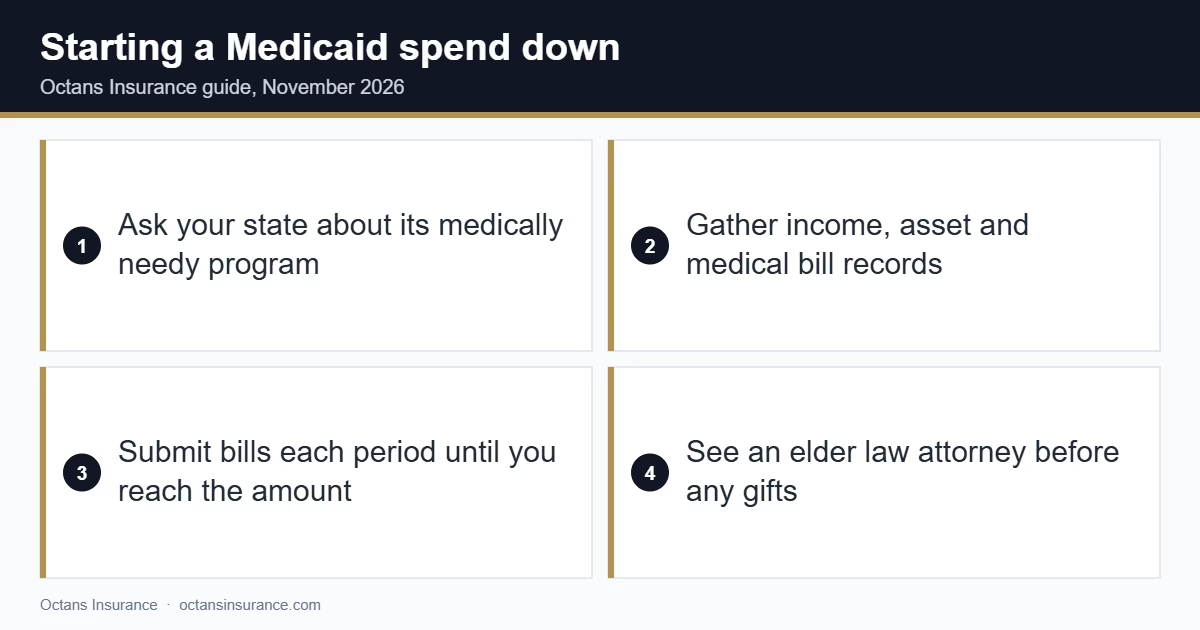
- Ask your state Medicaid office whether it has a medically needy program for people 65 and older, and get its income level for your household size.
- Gather proof of income and assets. For nursing home Medicaid, expect questions about transfers in the past 60 months.
- Add up your medical costs, including Medicare premiums, deductibles, unpaid bills and rides to care.
- Apply and send your bills the way your state asks, with your name and case number on each one.
- Track each period. Keep copies, report changes and start over when a new period begins.
- Talk to an elder law attorney before you give away money or change who owns your home.
Questions to ask your state Medicaid office:
- How long is the spend-down period, and what is my income level?
- Which bills count, and can older unpaid bills be used?
- Do my Medicare premiums count, and in what order are bills applied?
- What is the resource limit, and which burial arrangements are exempt?
- What is this year’s penalty divisor for transfers?
Medicaid spend down frequently asked questions
Do Medicare premiums count toward a Medicaid spend down?
Often, yes, in states that offer a spend down. Medicare.gov says some states let you spend down by paying non-covered medical expenses and cost sharing, like Medicare premiums and deductibles. Massachusetts applies Medicare premiums first, credited for six months at a time, and Florida counts health insurance premiums toward its share of cost. Ask how your state’s Medicaid spend down rules treat your Part B and Part D premiums.
Is a share of cost the same as a spend down?
Mostly, yes. They’re different names for the same idea in different states. Florida calls its medically needy amount a “share of cost,” similar to an insurance deductible. Massachusetts and North Carolina call it a deductible, and New Jersey calls it a spend-down liability. In each case, you must have enough medical bills before Medicaid pays.
Can I give money to my kids to qualify for Medicaid?
Giving money away within 60 months before applying for nursing home Medicaid can cause a penalty period, when Medicaid won’t pay for that care. Federal law lists exceptions, such as transfers to a spouse or to a blind or disabled child. Because the rules are strict and vary by state, talk to an elder law attorney before you give away assets.
Can I prepay my funeral to spend down assets?
Often, but follow your state’s rules. Under SSI rules, burial spaces don’t count, and burial funds of $1,500 or less each for you and your spouse don’t count. MassHealth treats certain irrevocable funeral arrangements as noncountable, and Pennsylvania allows burial reserves within set limits. Get the state’s rules in writing before you sign a contract.
What happens after I meet my spend down?
You’re eligible for Medicaid for the rest of that period. In Florida, that’s the rest of the month; in Massachusetts, it’s the rest of the six-month deductible period. In Massachusetts, the bills you used to meet the deductible are still yours to pay. When a period ends, the count starts again, so keep tracking your bills and report changes.

How a licensed Octans agent can help
Octans doesn’t decide Medicaid eligibility or run a Medicaid spend down; only your state Medicaid office can. A licensed Octans agent can explain how Medicaid works with your Medicare coverage, check whether a Medicare Savings Program might lower your costs, and walk you through Medicare vs Medicaid. Call (617) 935-9220.
If you’re planning for funeral costs before a Medicaid application, we can explain how options such as a small life insurance policy or a funeral arrangement are treated in your state’s rules. For nursing home planning and asset transfers, talk with an elder law attorney.
For unbiased help, your State Health Insurance Assistance Program (SHIP) offers free one-on-one Medicare counseling, and you can call 1-800-MEDICARE (1-800-633-4227) 24 hours a day, 7 days a week.
Keep Reading: Related Guides
- Medicare vs Medicaid
- Medicare Savings Programs
- MassHealth life insurance and burial rules
- Medicaid Estate Recovery
- Does Medicare Pay for Funeral Costs? What Families Can Use Instead
Important: Octans Insurance agents are licensed in the states in which they operate. Coverage availability and rates may vary by state. Premium examples, when provided, are illustrative samples from published sources, not quotes. Final rates are determined by the insurance carrier based on underwriting and applicable policy criteria. Policy terms, exclusions, limitations, riders, and availability vary by carrier and state.
About examples and tools: Hypothetical examples, sample rates, calculators and quizzes on this site are for general educational and illustrative purposes only. They are not quotes, offers of coverage, or guarantees of eligibility, approval, price or benefits, and they are not legal, tax, financial or medical advice. The insurance company decides eligibility and price; Medicare rules are set by CMS and the Social Security Administration. Octans Insurance is not connected with or endorsed by the U.S. government or the federal Medicare program.
Get help with Medicare when Medicaid is in the picture
Start with a free, no-obligation quote review with a licensed Octans agent.
(617) 935-9220 | life@octansinsurance.com