
Medicare Part B Excess Charges: Who Pays and When
Medicare Part B Excess Charges: The Short Answer
Medicare Part B excess charges are what a doctor who doesn’t accept assignment may bill above the Medicare-approved amount, capped at 15% in most cases. You pay them unless your Medigap plan covers them (Plans F and G do) or your state bans or limits them. Doctors who accept assignment can’t charge them.
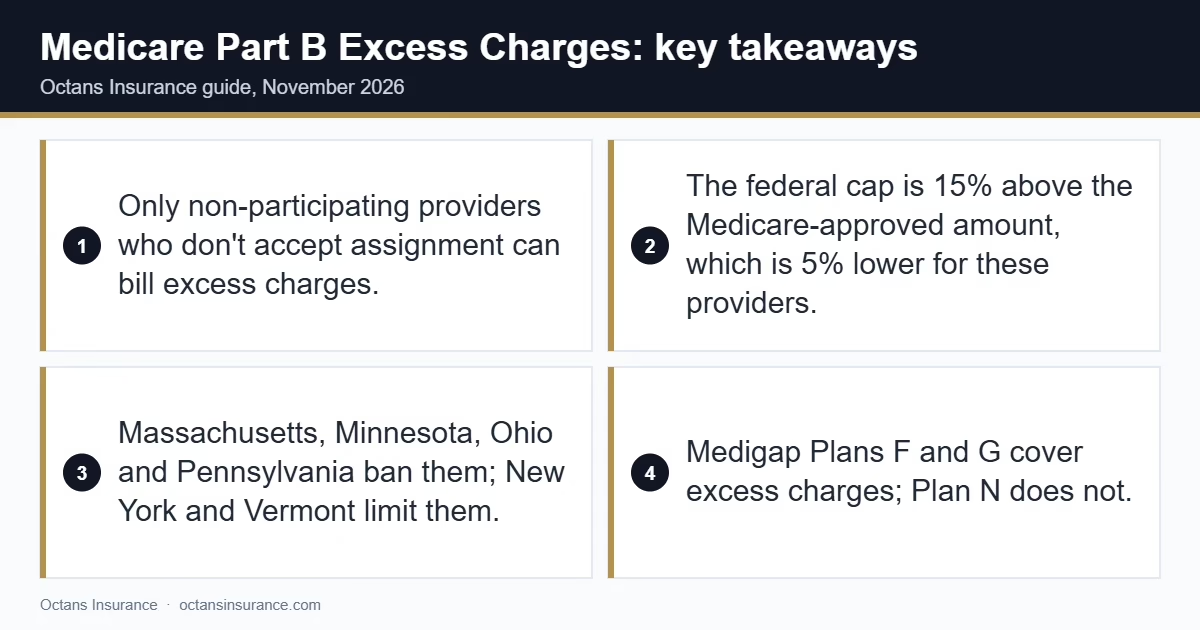
- Only non-participating providers who don’t accept assignment can bill excess charges.
- The federal cap is 15% above the Medicare-approved amount, which is 5% lower for these providers.
- Massachusetts, Minnesota, Ohio and Pennsylvania ban them; New York and Vermont limit them.
- Medigap Plans F and G cover excess charges; Plan N does not.
Table of Contents
Make sure your family is financially protected today!
Medicare Part B excess charges are the extra amount a doctor who doesn’t accept Medicare assignment can bill you, up to 15% above the Medicare-approved amount. You pay them unless your Medigap plan covers them (Plans F and G do) or your state bans or limits them. Doctors who accept assignment can’t charge them at all.
What Medicare Part B excess charges are
With Original Medicare, each Part B service has a Medicare-approved amount. Medicare usually pays 80% of it after your Part B deductible, and you pay the rest as coinsurance. An excess charge is anything a provider bills on top of the approved amount.
According to Medicare.gov, when a provider doesn’t accept assignment, the charge in many cases can’t be more than 15% above the Medicare-approved amount. Medicare calls that cap the limiting charge.
Medicare Part B excess charges are a feature of Original Medicare billing. That is why they matter most when you are choosing a Medigap plan to go with Original Medicare. Your Medicare Summary Notice shows the approved amount for each service, so you can compare it with what the provider billed. If the bill is higher, the difference is the excess charge.
The rules are the same across the country, but how often you meet Medicare Part B excess charges depends on your doctors and your state.
Accepting assignment vs non-participating providers
Providers fall into three groups. Knowing which one your doctor is in tells you whether an excess charge is even possible.
- Participating providers accept assignment on every claim. They take the Medicare-approved amount as payment in full. No excess charges.
- Non-participating providers can choose case by case. When they don’t accept assignment, they can bill up to the limiting charge. Medicare.gov says you might have to pay the full amount at the time of service.
- Opt-out providers don’t work with Medicare at all. Medicare.gov says Medicare won’t pay for their services except in emergencies, and opt-out status lasts at least two years.
Non-participating providers are also paid less. According to CMS, Medicare pays them 5% less than the fee schedule amount, and their limiting charge is 115% of that amount.
How the 15% limiting charge works, with an example
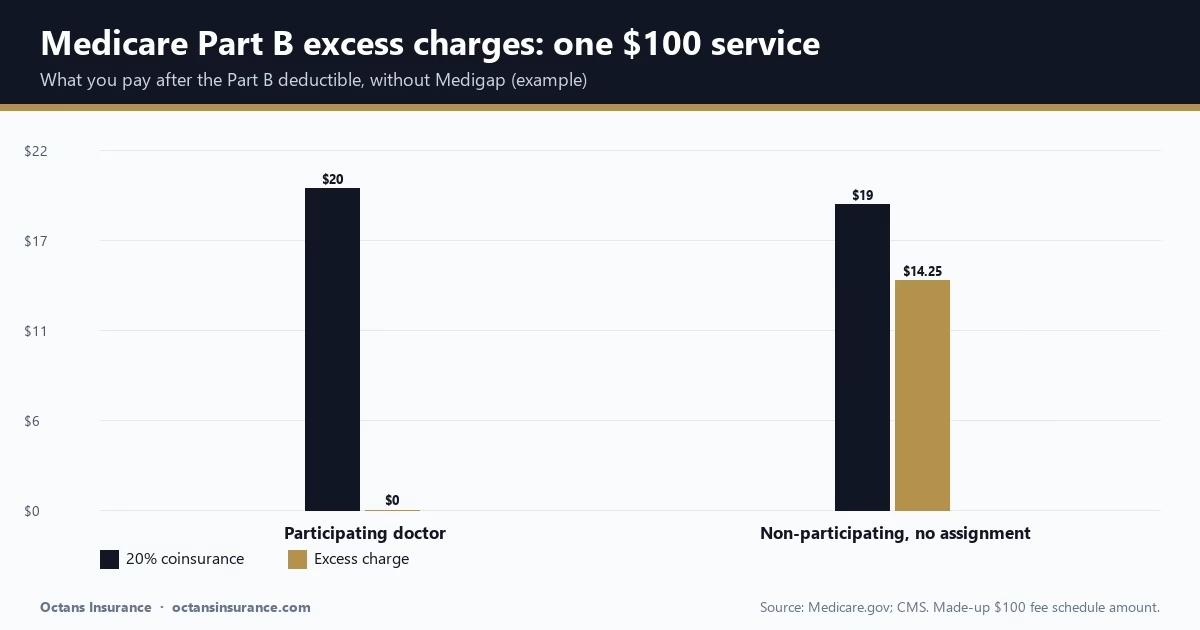
For example, say a service has a $100 fee schedule amount (a made-up number). Here is what happens at each type of doctor, assuming you have already met your Part B deductible:
| Step | Participating doctor | Non-participating doctor (no assignment) |
|---|---|---|
| Medicare-approved amount | $100.00 | $95.00 (5% less) |
| Most the doctor can bill | $100.00 | $109.25 (115% × $95) |
| Medicare pays 80% | $80.00 | $76.00 |
| Your 20% coinsurance | $20.00 | $19.00 |
| Medicare Part B excess charge | $0.00 | $14.25 |
| You pay without Medigap | $20.00 | $33.25 |
The math: $95 × 1.15 = $109.25. Medicare pays $95 × 80% = $76. Your coinsurance is $95 − $76 = $19. The excess charge is $109.25 − $95 = $14.25. So you owe $19 + $14.25 = $33.25 instead of $20.
On one visit, that gap is small. On a surgery or a long course of treatment, Medicare Part B excess charges grow with the bill, because the cap is a percentage.
States that ban or limit excess charges
Some states go further than the federal 15% cap. We list a state below only where we read the state law or an official state source:
| State | Rule | Source |
|---|---|---|
| Massachusetts | Doctors who treat Medicare patients must agree not to charge more than the Medicare amount | M.G.L. c. 112, § 2 |
| Minnesota | Providers can’t charge Minnesota residents more than the Medicare-approved amount (ambulance and medical supplies excluded) | Minn. Stat. § 62J.25 |
| Ohio | Health care practitioners can’t balance bill Medicare beneficiaries | Ohio Rev. Code § 4769.02 |
| Pennsylvania | Unlawful for practitioners to balance bill Medicare beneficiaries | Act 81 of 1990 |
| New York | Limit of 5% above the approved amount for most services; 15% for certain office and home visits | NY HIICAP Notebook 2026 |
| Vermont | Ban with exceptions, including office and home visits and some beneficiaries whose benefits are taxable | 33 V.S.A. ch. 65 |
Other states may have rules too. These are state laws, so ask your State Health Insurance Assistance Program how they apply to care you get in another state. New York’s HIICAP notebook also notes that the limiting charge rules don’t apply to medical equipment suppliers.
How to check whether your doctor accepts assignment
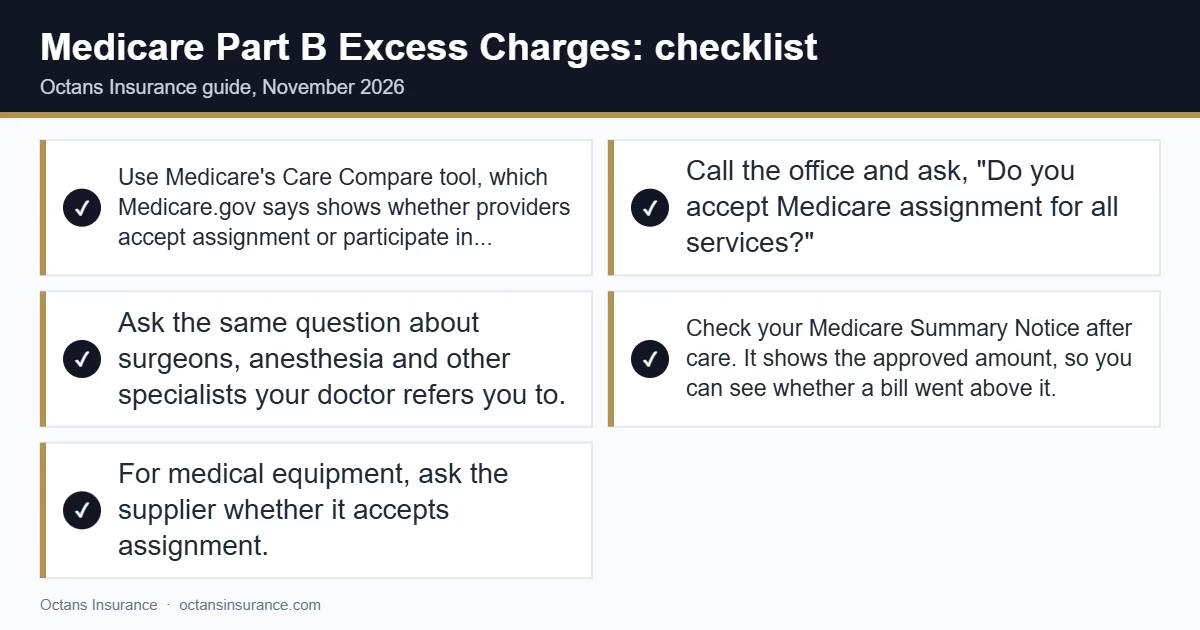
You can avoid most Medicare Part B excess charges with a two-minute check before your visit:
- Use Medicare’s Care Compare tool, which Medicare.gov says shows whether providers accept assignment or participate in Medicare.
- Call the office and ask, “Do you accept Medicare assignment for all services?”
- Ask the same question about surgeons, anesthesia and other specialists your doctor refers you to.
- Check your Medicare Summary Notice after care. It shows the approved amount, so you can see whether a bill went above it.
- For medical equipment, ask the supplier whether it accepts assignment.
CMS says it continues to have a high participation rate among physicians, and doctors can change their status each year from mid-November through December 31. So check again each January if you see a doctor who didn’t participate last year.
If you get a bill that seems to exceed the limiting charge, ask the office to explain it and compare it with your Medicare Summary Notice. In a state that bans or limits Medicare Part B excess charges, contact the state agency that enforces the law. Your SHIP can help you find it.
Which Medigap plans cover Medicare Part B excess charges
Only two Medigap plans cover them. According to the benefits chart in Medicare’s Choosing a Medigap Policy guide, Plans F and G cover 100% of them. Plans A, B, C, D, K, L, M and N don’t.
Plan F is not available to people new to Medicare on or after January 1, 2020. That leaves Plan G as the option for most new enrollees who want this coverage. Plan N pays the Part B coinsurance but has copays of up to $20 for some office visits and up to $50 for some emergency room visits, and it leaves excess charges to you. Our Plan G vs Plan N comparison walks through those trade-offs, and our guide to Medicare supplements covers every plan letter.

Should you worry about excess charges?
It depends on where you live and how you use care. Each charge is capped, but according to Medicare.gov, Original Medicare has no yearly out-of-pocket limit unless you have other coverage, so these charges can add up. Here is a balanced way to think about it:
- Less concern: You live in a state that bans them, your doctors all accept assignment, and you rarely see new specialists.
- More concern: You see many specialists, expect surgery, travel for care, or live where doctors who don’t take assignment are common.
- Middle ground: You choose a plan without excess charge coverage and check assignment before each new provider.
Should I worry about Medicare excess charges if I’m in Massachusetts? Less so, since state law bars doctors licensed there from charging them, and Massachusetts uses its own Medigap designs. See our Massachusetts Medigap guide. Everywhere else, the right answer depends on your doctors, your budget and how much uncertainty you’re comfortable with. For the basics of how Part B costs work, see our Original Medicare guide.
Keep Reading: Related Guides
- Medicare Plan G vs Plan N
- What are Medicare supplements?
- Massachusetts Medigap plans
- What is Original Medicare?
- Medigap Rate Increase? What to Do Before You Switch
- Do Veterans Need Medicare Part B? VA vs Medicare Costs
Medicare Part B Excess Charges: Frequently Asked Questions
How common are Medicare excess charges?
It depends on your doctors. Only providers who don’t accept assignment can bill them, and CMS says it continues to have a high participation rate among physicians. Participating providers accept the approved amount as payment in full. Check each doctor, surgeon and specialist before care, since one non-participating provider on a large bill can matter.
Which states do not allow Part B excess charges?
Based on the state laws we read, Massachusetts (M.G.L. c. 112, § 2), Minnesota (Minn. Stat. § 62J.25), Ohio (Ohio Rev. Code § 4769.02) and Pennsylvania (Act 81 of 1990) bar balance billing Medicare patients, with some exclusions such as ambulance and supplies in Minnesota. New York limits most charges to 5%, and Vermont bans them with exceptions. Other states may have rules; ask your SHIP.
Does Plan N cover Part B excess charges?
No. According to the benefits chart in Medicare’s Choosing a Medigap Policy guide, only Plans F and G cover Part B excess charges. Plan N pays the Part B coinsurance but has copays of up to $20 for some office visits and up to $50 for some ER visits. Plan F isn’t available to people new to Medicare on or after January 1, 2020.
Can a doctor charge more than Medicare allows?
Only in limited cases. According to Medicare.gov, a non-participating provider who doesn’t accept assignment can, in many cases, charge up to 15% above the Medicare-approved amount, called the limiting charge. Providers who accept assignment can’t. Opt-out providers don’t bill Medicare, and Medicare won’t pay them except in emergencies. Some states set tighter limits.
How do I find doctors who accept Medicare assignment?
Use Medicare’s Care Compare tool at Medicare.gov, which shows whether providers accept assignment or participate in Medicare. Then call the office and ask, “Do you accept Medicare assignment for all services?” Ask the same of any surgeon or specialist you’re referred to. CMS lets doctors change participation status each year from mid-November through December 31, so recheck in January.
We do not offer every plan available in your area. Please contact Medicare.gov or 1-800-MEDICARE to get information on all of your options.
This article is general information, not legal, tax, or medical advice. Premium examples are published samples, not quotes.
About examples and tools: Hypothetical examples, sample rates, calculators and quizzes on this site are for general educational and illustrative purposes only. They are not quotes, offers of coverage, or guarantees of eligibility, approval, price or benefits, and they are not legal, tax, financial or medical advice. The insurance company decides eligibility and price; Medicare rules are set by CMS and the Social Security Administration. Octans Insurance is not connected with or endorsed by the U.S. government or the federal Medicare program.